
Now those of you who may have been paying attention will note that “I Carry” was a popular video series over on Shooting Illustrated, and we’ve decided to bring it here to American Rifleman to keep it going. Watch our first “I Carry” segment above, featuring the Springfield Armory Hellcat Pro 9 mm in a PHLster holster.
Concealed carry is one of the fastest-growing segments of the firearm community, and one that folks are interested in, as it’s important and potentially life saving. What we’re going to cover are firearms, holsters and other gear you carry everyday for your consideration. We are always going to feature a firearm and a holster associated with that firearm, and then there’s going to be something else. It could be a red-dot sight, it could be a new type of ammunition, a flashlight, a pocket knife, pepper spray, first aid kit, you name it. You’re limited pretty much only to, well, how much stuff do you want to have hanging off your belt or in your pockets.
We’re going to start with my personal carry kit today, but going forward, we’ll showcase many different kits to give you ideas of what’s out there and what else to look for. In today’s kit, we have a Springfield Armory Hellcat Pro in 9 mm for the firearm. I’ve found this size of pistol to be about the best mix of capacity and shootability out there.
Capacity is 15+1 rounds, that’s a 15-round magazine and one in the chamber, which gives a grip size you can get all three fingers of your strong hand on for support when shooting. I’ve run this gun against larger guns in various drills and the time and accuracy difference really isn’t that significant. I can still pass a 5X5X5 drill and The Test, and score pretty well on the Bill Drill. The Hellcat Pro is easier to conceal than, let’s say, a full size Smith & Wesson M&P with a Tricon SRO. Not that there’s anything wrong with those, of course, but some people do have trouble concealing larger guns with larger optics.
On top of the Hellcat Pro, you’ll see the OSP (Optical Sight Pistol) optics cut, which is the standard RMSc footprint. Here we’ve got a Meprolight MPO Pro-S, which is the company’s enclosed-emitter red-dot sight. Also, you’ll see the Hellcat Pro has an accessory rail at the end of the dustcover. If you want to put a light or laser, you will need to look for smaller units, like the Streamlight TLR-7, for example, that will fit on the smaller rails. Of course if you do add something to that rail, you’ll need to find a holster that will accommodate both the firearm and the device. Personally, I prefer a handheld light to one attached to my everyday carry firearm. Running the setup that way keeps things cleaner and less complicated for the drawstroke.
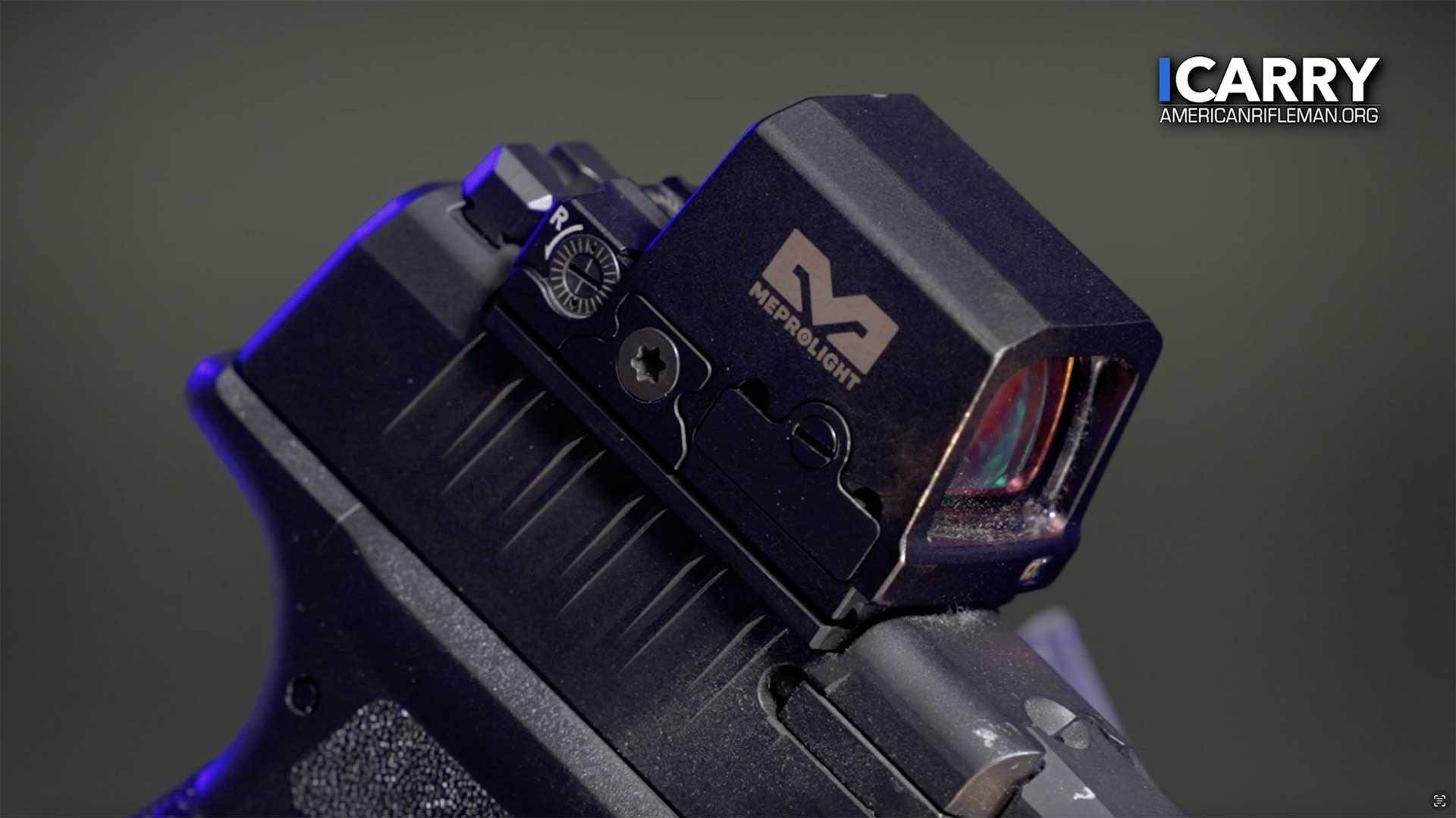
As for the powered optic, I’ve found as I get older, specifically as my eyes get older, the red dot really helps with sight acquisition. It reduces the number of things you need to worry about in the sighting plane from three to two, and that’s helpful. Specifically, instead of having to try to focus on the front sight, rear sight and the target, you just have to concern yourself with the dot and the target. I find it’s easier, and more accurate. Again, that’s my personal preference. I know some folks are concerned about batteries, their tendency to die at the most inconvenient time or even the electronics failing.
To that end, one of the things I like about the enclosed emitter is the large housing you can use as a rough sighting system should the worst happen. I’ve taken a number of courses to combat powered electronics failure, and of course we recommend training so that you know how to run your red dot and you know what to do if your red dot does in fact fail.
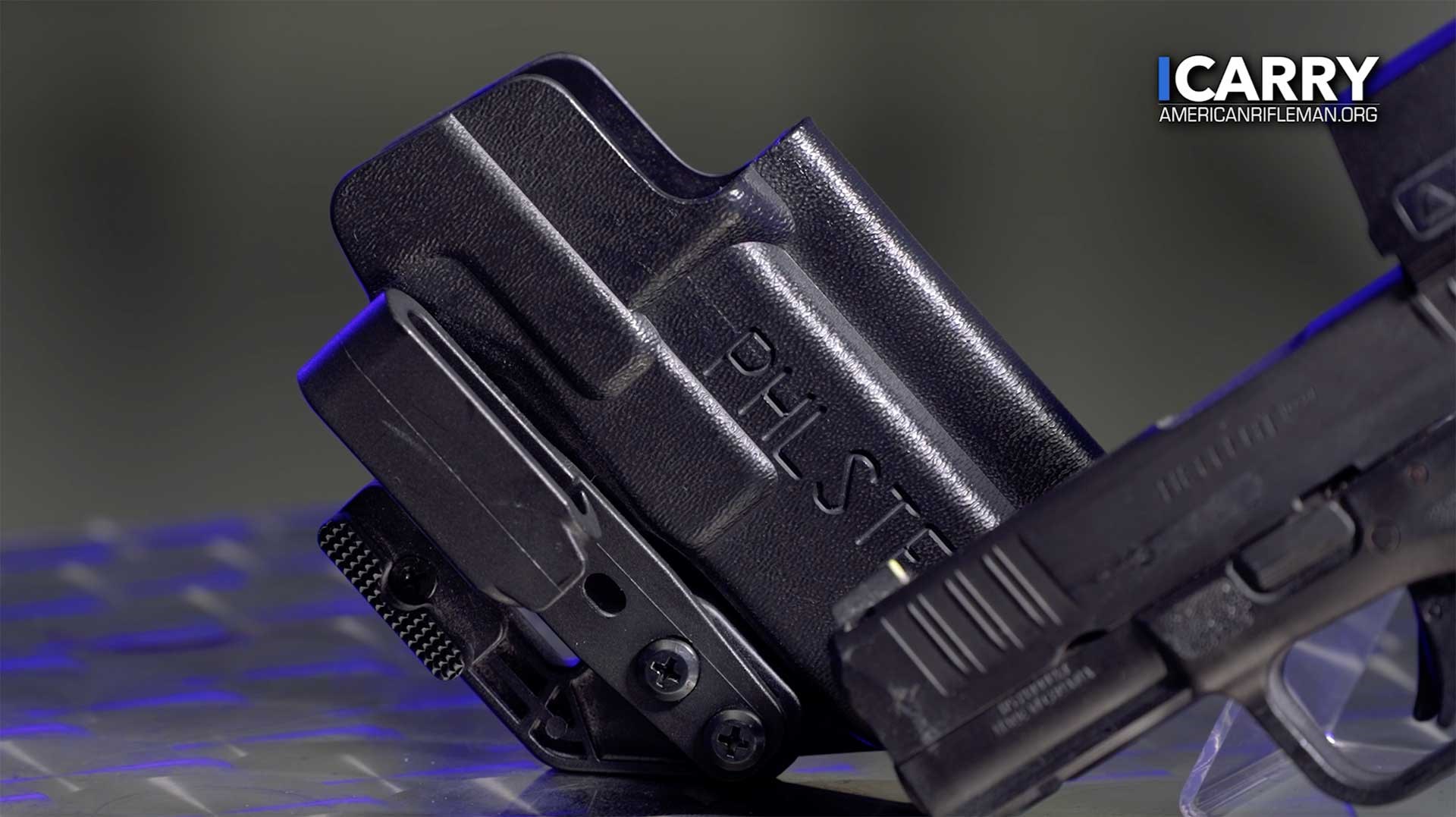
To wrap everything up, what do I carry this in? I’m a big fan of holsters from PHLster, and this particular holster is the Skeleton. This is an inside-the-waistband, appendix-carry holster, as I am a fan of appendix carry and find it to be the best mixture of concealment and accessibility possible. I know some folks are afraid of what the pistol might be pointed at in that position, but what I can tell you is that as long as you’re careful and practice carefully, you’ll be fine. This is one of the times where dry practice, practice without any live ammunition, can really help improve your familiarity with your gear and how to best use it.
In my opinion, the Skeleton is one of the best values out there. PHLster does great work and makes solid holsters. There’s plenty of configuration you can do, for example, it comes with a standard polymer belt clip you can swap for pull-the-dot loops, a DCC monoblock clip or whatever else you’d like. PHLster holsters are sturdy and just plain work. There’s not much else you can say, and they are quite affordable.
Read the full article here