

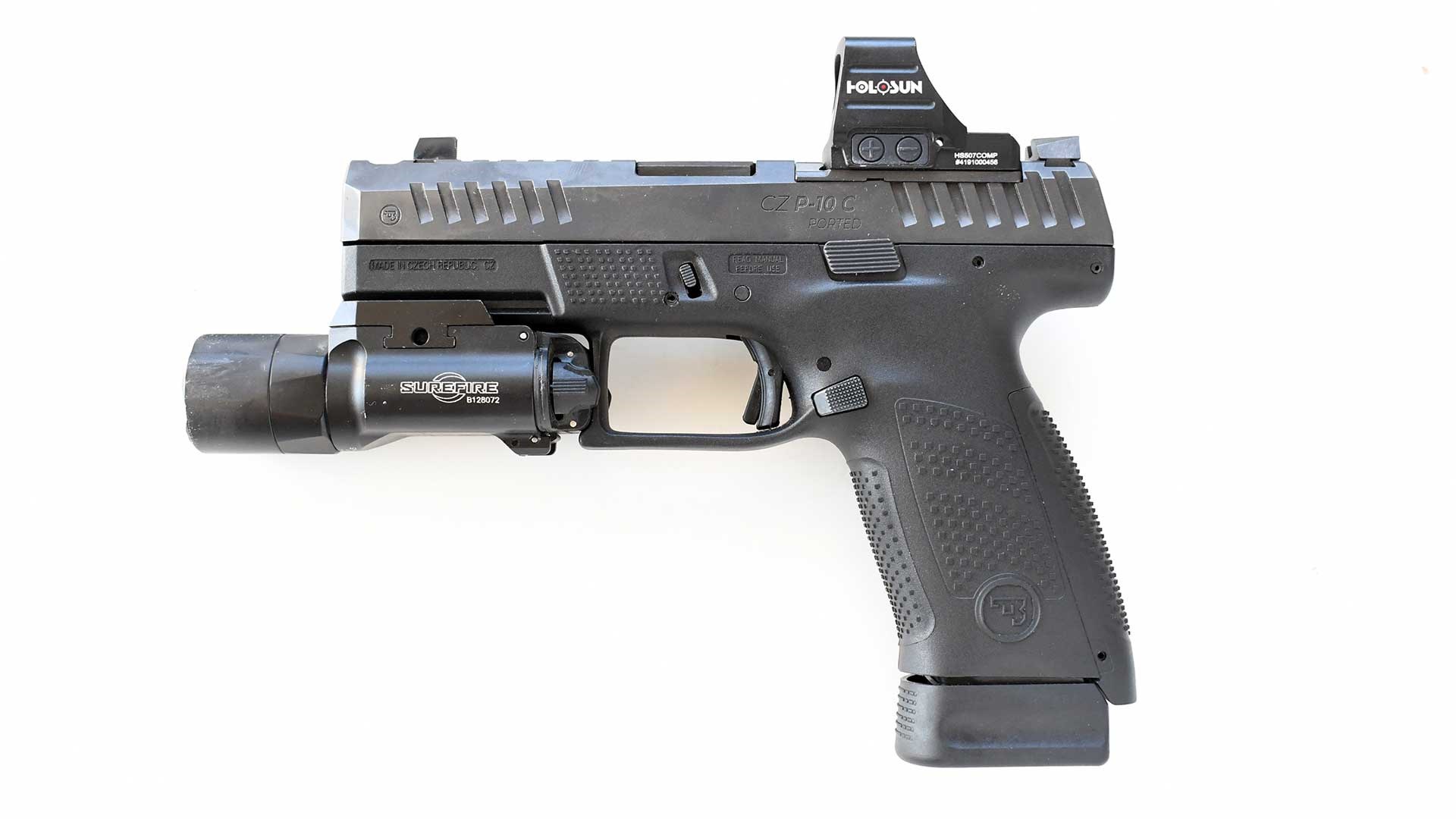
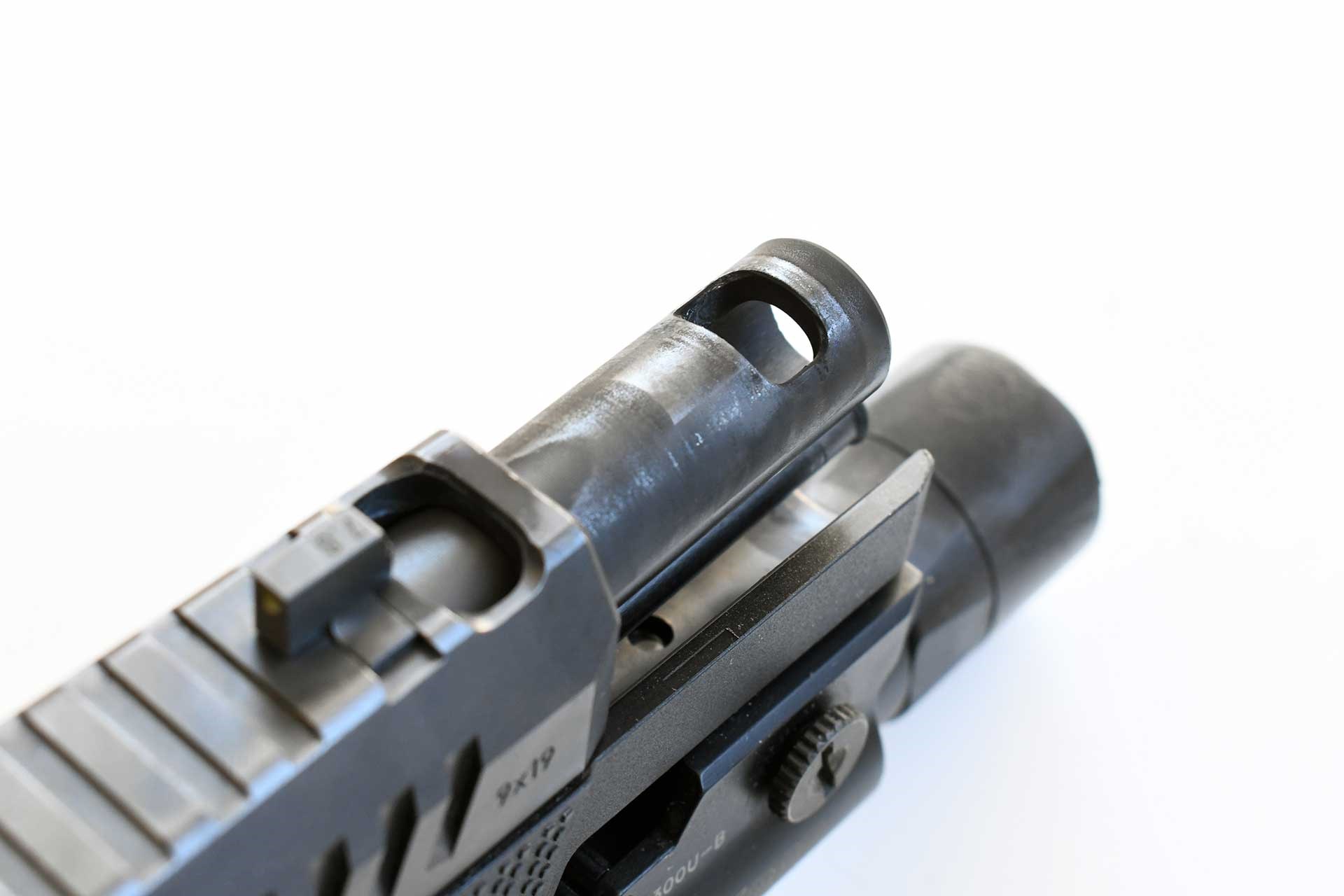
Summer 2025 signaled the launch of CZ’s P10C Ported, a CZ P10C variant that sports an integrated “Carry Comp” port ahead of the front sight and right behind the muzzle.
Although “Carry Comp” is terminology specific to Smith & Wesson, it best describes this particular style of a single, integrated pistol port. While the trend is taking off now, it was Smith & Wesson’s 3-inch-barreled Performance Center Model 19 that started it back in 2018. It wasn’t until the early 2020s that the “Carry Comp” style really took off. This came right behind the wider trend of adding external compensators to modern 9 mm pistols. If I were a betting man, I’d wager that this is all downstream of guns like the Roland Special that became popular more than a decade ago.
Since then, the U.S. handgun market has witnessed several different takes from the various manufacturers on the integral port trend.
Virtually all pistols that implement this style of single integral ports have barrels with counter-bored crowns. There’s approximately 5/8 to 3/4 inch of freebore underneath the port. Putting ports over the freebore reduces the chance of debris and jacket fragments impacting the shooter.
The P10 Origin Story
By this point, the CZ P10C needs no introduction. It is CZ’s flagship, a compact, striker-fired, polymer-frame, 9 mm pistol. Unlike CZ’s other polymer-frame designs, the P10 has no previous descendants and is a clean-sheet design.
Česká zbrojovka has always had a storied family tree. For example, it’s hard to deny the influence and standing of the classic CZ-75 design in the world of handguns. Naturally, the CZ-75 branches off into other models based on its hammer, lockwork and “inner” slide.
On the other hand, the CZ P10 instead represents one of the Czech company’s newest and most independent branches on its family tree. After CZ determined that its own portfolio was lacking a fully modern, duty-grade, polymer, striker-fired model that also conformed to modern NATO standards, it set out to design and develop the P10.
CZ carried this work out during the 2010s and brought them to market from 2017-2018. The end result is a modern, ambidextrous-friendly striker-fired pistol that works in concert with the standard Browning delayed blowback system. At this point in time, the P10 branch of the CZ family tree now has full-size models, compact models and even a slim, sub-compact, carry-friendly offering.
 The P10C Ported At A Glance
There’s not much difference between a standard optics-ready CZ P10C and the new P10C Ported, aside from the obvious port.
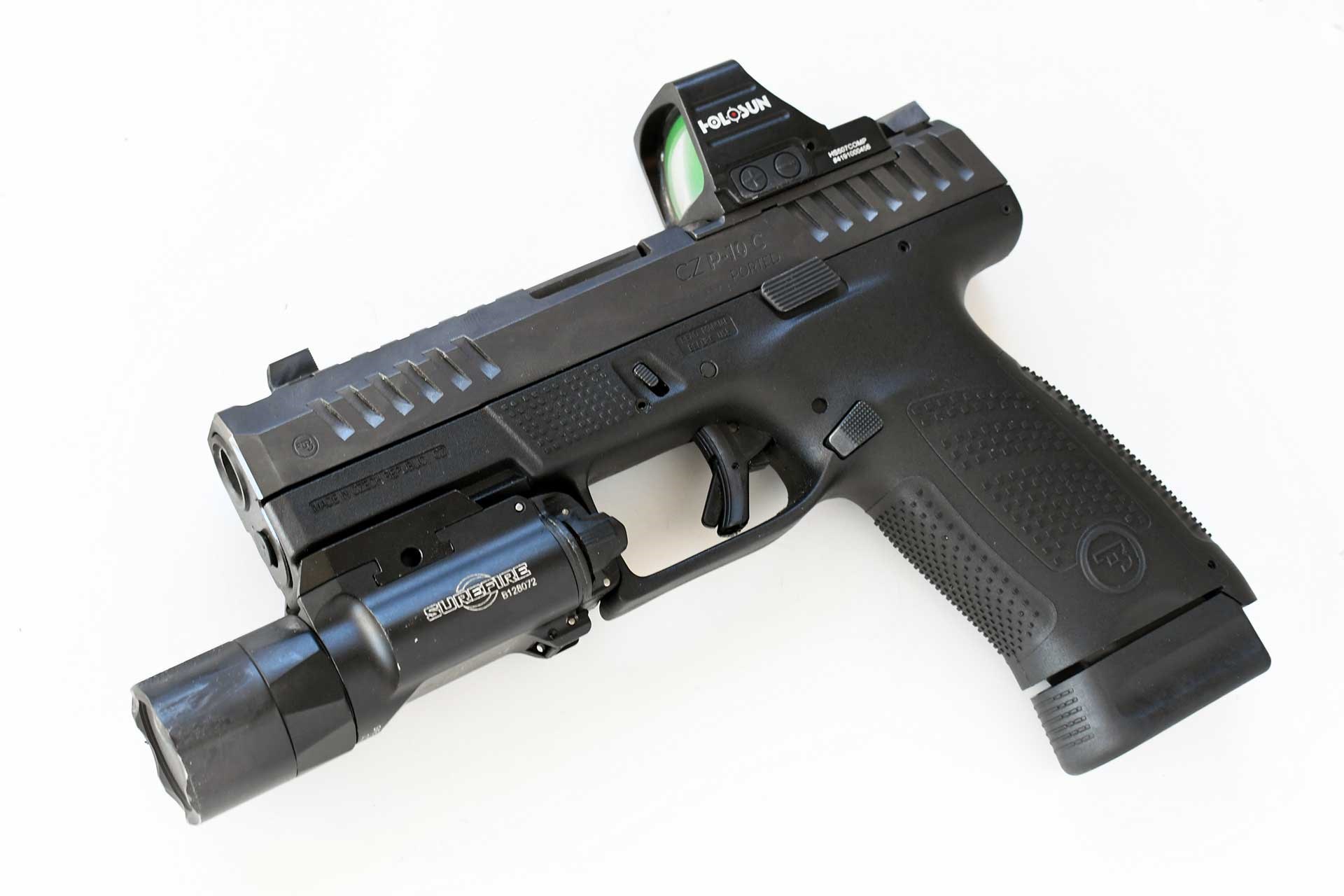
The P10C’s grip and frame keep modern lines. P10 frames include the practically mandatory railed dustcover for accessories. However, the grip is the P10 frame’s most remarkable feature. It’s not just because the grip accepts the requisite interchangeable backstraps, but it’s also because of the way it’s contoured.
The undercutting where the frontstrap meets the trigger guard is quite pronounced. In turn, it doesn’t cramp the fingers of the firing hand while forming a full firing grip. Among all the compact handgun makes and models that I’ve fielded as a writer, P10C grips continue to be some of the roomiest. The combination of the generous undercutting, the spacious frontstrap and a neutral grip angle mean that strenuous shooting sessions will not aberrate the knuckle of the firing hand’s middle finger. After putting the P10C Ported through Hunter Freeland’s strenuous two-day Performance Red-Dot class, I couldn’t help but notice the lack of a sore spot on my knuckle.
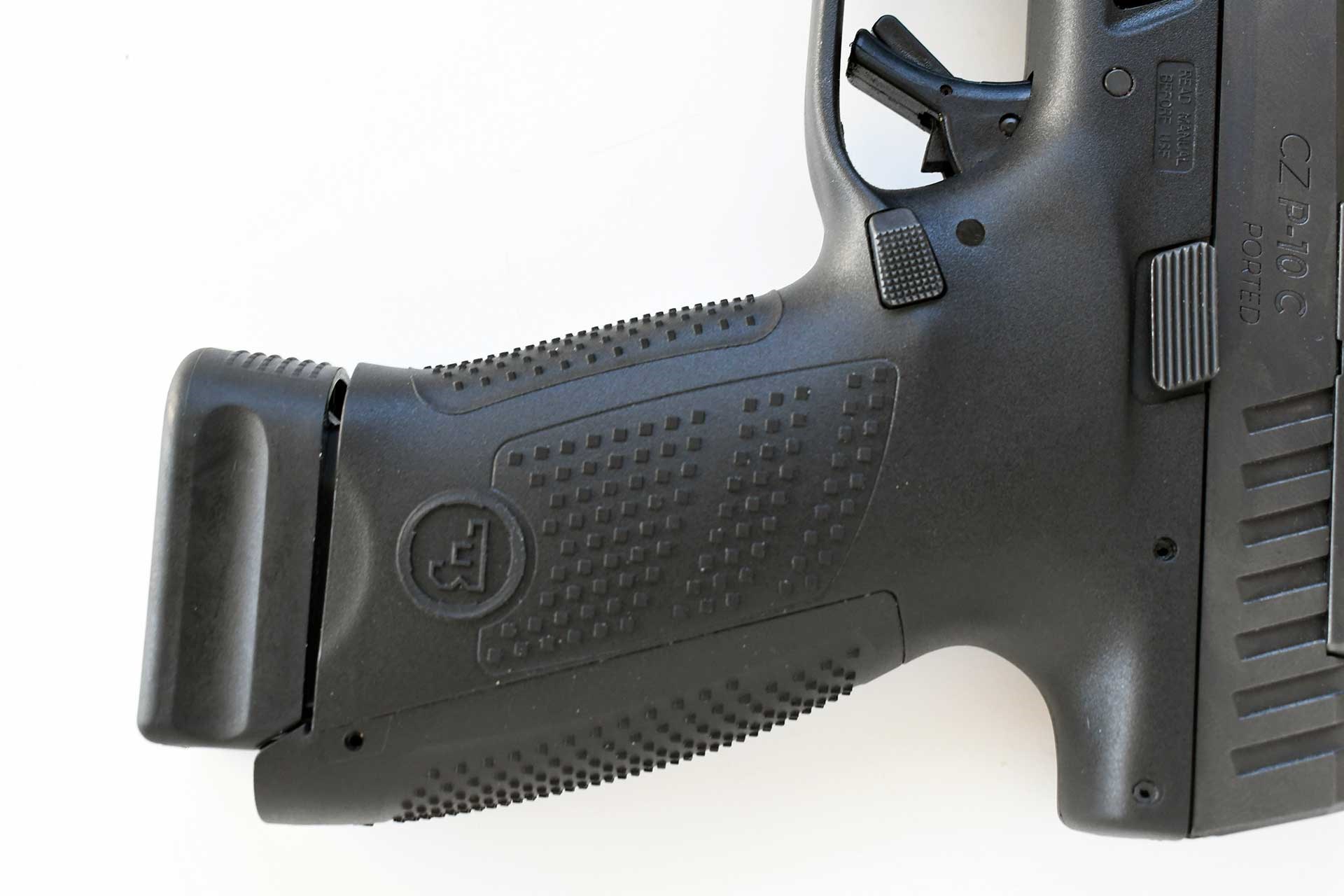 I also appreciate the radiusing at the top corner of the grip. Since it’s deep-set, it’s easy for the firing hand to firmly grasp the P10C, which leads to better control during shooting. The rest of the grip is sprinkled with studded squares. Those found over the backstrap or fronstrap are a little sharper compared to those that cover the sides of the grip. It’s my opinion that the studs on the sides would also benefit from being sharper and from covering more of the grip’s surface area.
The P10C Ported’s Slide & Barrel
The P10C Ported’s slide also retains the same shape and profile of the original P10C. Obviously, accommodating the port involves setting the front sight’s dovetail further back in order to clear space for the port. All things considered, the port is of a generous size.
Compared to the standard P10C or P10F optics-ready models, the P10C Ported uses a different style of iron sights. These look like an improvement over the pair that ships with the standard optics-ready models. Not to mention, the new rear sight’s face is serrated. Both the front and rear have off-white photoluminescent paint. CZ also had the foresight to include taller sights.
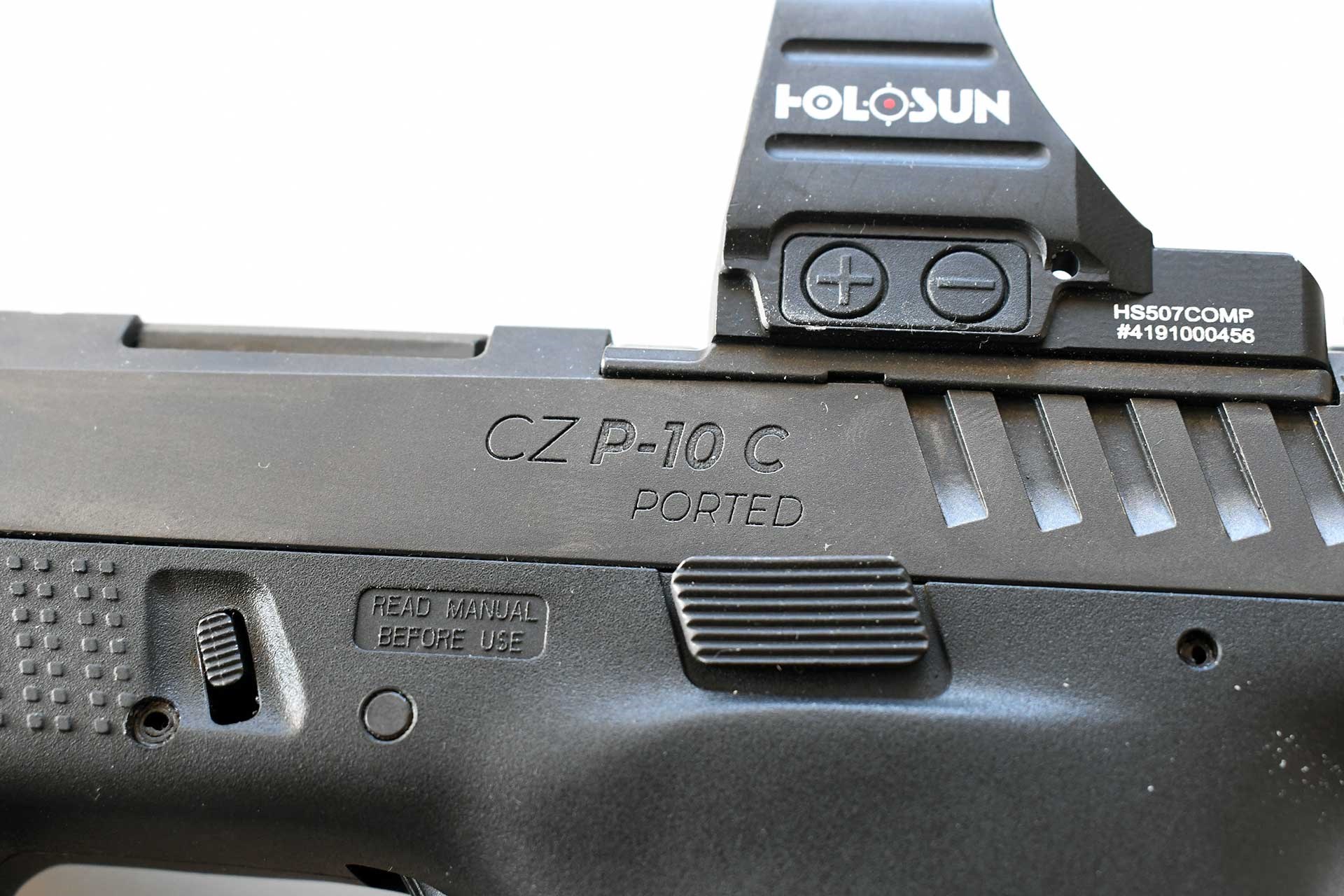
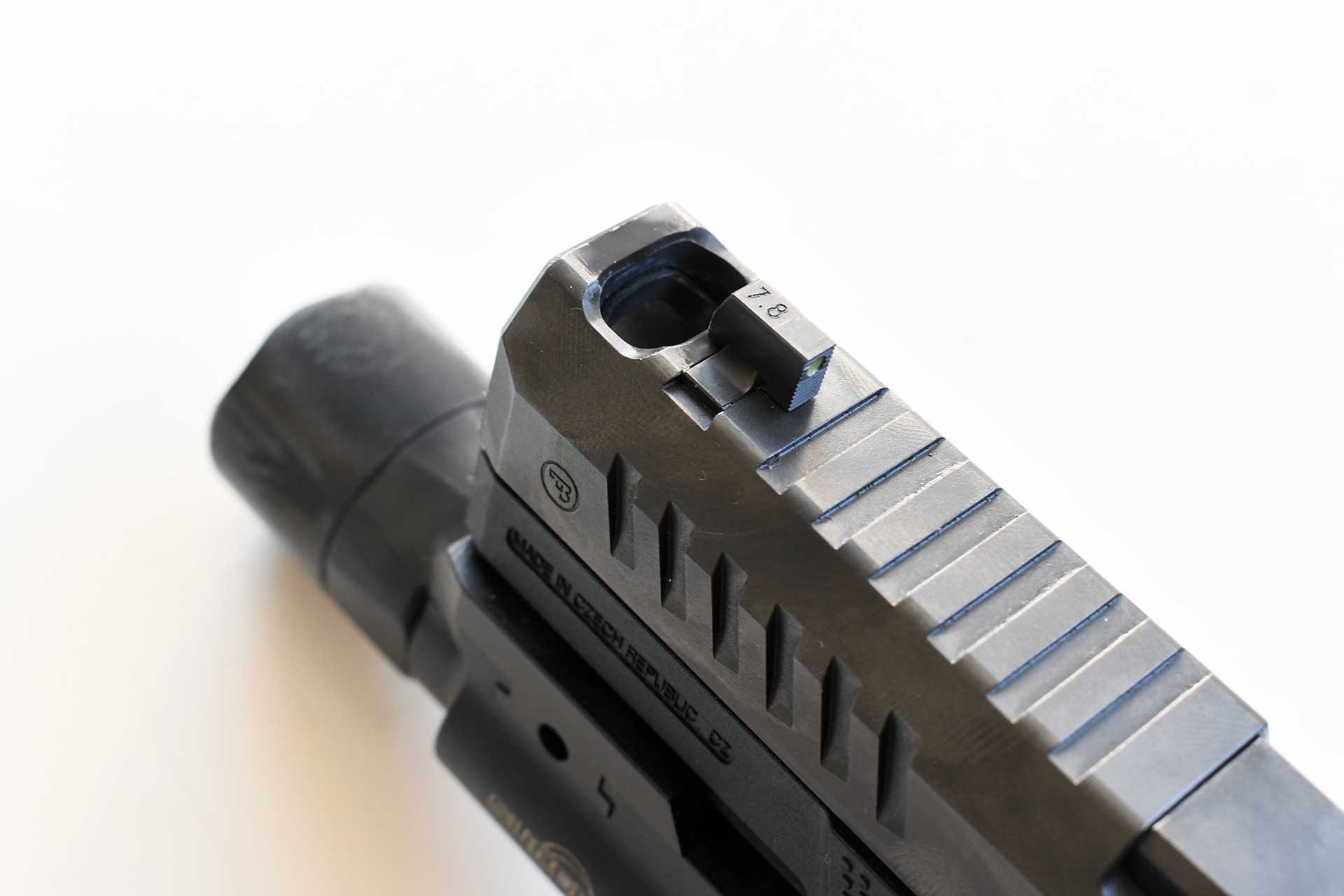 If mounting a reflex sight to the CZ P10C Ported’s optic-ready slide, its iron sights should be able to co-witness with most reflex sights that have a low-to-moderate deck-height. In my case, I mounted a Holosun HS507 Comp using a CZ OEM Trijicon RMR plate. I had no issue achieving co-witness.
CZ tweaked the P10C Ported slide serrations, too. Unlike the standard P10C slide, the P10C Ported’s serrations are not only deeper but more spread apart, which makes them easier to grab. The top portion of the slide also includes a row of serrations behind the front sight. The fonts, style and placement of slide markings is also different.
The P10C Ported’s barrel has a slightly wider external diameter compared to the original, but not by much. While it is slightly larger and has more mass than the original, I don’t think it rates being called a true bull-barrel. The extra width nonetheless accommodates the freebore space in front of the counterbored crown. Extra mass is always welcome, too.
The P10 Trigger On a Nuanced Level
The trigger found on the P10C Ported is the standard P10 trigger. There’s no point in re-writing the same thing again, so this is how I described it in my original CZ P10C Shooting Illustrated review:
Through the lens of contemporary polymer striker guns, CZ P-10 triggers are quite conventional with their requisite bladed safety being the chief means of preventing the trigger from inadvertently moving to the rear. The trigger’s face is almost flat and it sits inside the trigger guard at such an angle where it effectively functions like a flat trigger. Perhaps the only thing that deviates from the norm of typical striker-fired triggers and the P-10’s trigger are the CZ-75 style dual trigger bars that serve as linkage connecting the face of the trigger to the sear and striker surfaces.
The P10C Ported is the third member of the P10 family I’ve written about on behalf of NRA Media. I used the above excerpt to describe the P10F O-R’s trigger too. P10 triggers have a very clearly defined wall and a crisp but relatively heavy break. They’re not match triggers by any means, but they’re extremely consistent and predictable.
After spending two intensive days training with Hunter Freeland, I walked away from his class with very intimate knowledge of the P10 trigger. Due to their consistency, these triggers are very easy to prep and manage. There’s no spongy, ambiguous or rolling break either. For higher-level shooting, it’s easy to pick up on its rhythm. Three P10 reviews later, and I stand by this being a very reasonable trigger for a fairly affordable family of mass-produced, duty-grade handguns. This gun’s trigger breaks at 4 pounds, 12 ounces.
Ripping Rounds In Class
I’ve made a few references to Hunter Freeland’s two-day Performance RDS class. Review-wise, shooting guns proactively in shooting classes or competitions always makes for a better experience. In my usual manner, I showed up with this new-to-me and unfired pistol to break it in that weekend. As a technical or “pure” shooting class involving a fairly high round count and tons of repetitions, Performance RDS served as the perfect backdrop to shake out the CZ P10C Ported. Since we students spent two days of hard training, it afforded me to really get to know the CZ P10C Ported quite well. We shot several strings of fire strenuously to the point where our guns were hot to the touch.
Other than a portion of class where I shot the Glock 19 I actually carry, I shot this P10C Ported 80 percent of the time. After class and after grouping the pistol, its round count lies somewhere north of 700 rounds. Though the majority of the ammunition I fired through the P10C Ported were “warmer” 115-grain FMJ range loads, I had no issues with cycling or ejection. This was also true of the cartridges I used for my accuracy report.
I exclusively shoot from concealment (AIWB); it’s how I train and carry. The P10C Ported’s neutral grip angle gave me no issues on the draw. For a gun I had never touched until that weekend, it didn’t take long before I was drawing and shooting like I had owned it for a few years.
The Verdict
Nothing about the P10C Ported got in my way during shooting. In between shots, its slide delivered the red-dot back on target seamlessly. The ergonomics of its grip allowed me to maintain positive control of the gun. It was something that paid off especially during aggressive strings of fire. It’s really hard to articulate into words, but this pistol’s attributes set me up to feel like I had been shooting with it my entire life–and not like it was merely the next review gun that I had picked up on a few days prior to class. The P10C Ported’s recoil spring assembly plays fairly well with standard-pressure 9 mm loads with regards to how the slide reciprocates. It didn’t jerk the slide forward and down.
 I don’t have much to nitpick about the CZ P10C Ported. I wish its low-profile ambidextrous slide-stops were slightly more sensitive and less stiff, but even this is a minor quip. During reloads, I found myself using both strong-hand index finger and thumb to actuate the slide-stop. It’s the exact same move I do with S&W M&P 2.0s anyway. The top of the barrel hood has a notch that helps redirect gasses during shooting. It did a wonderful job at keeping gas, soot, oil and debris away from the lens of my reflex sight during two hard days of shooting.
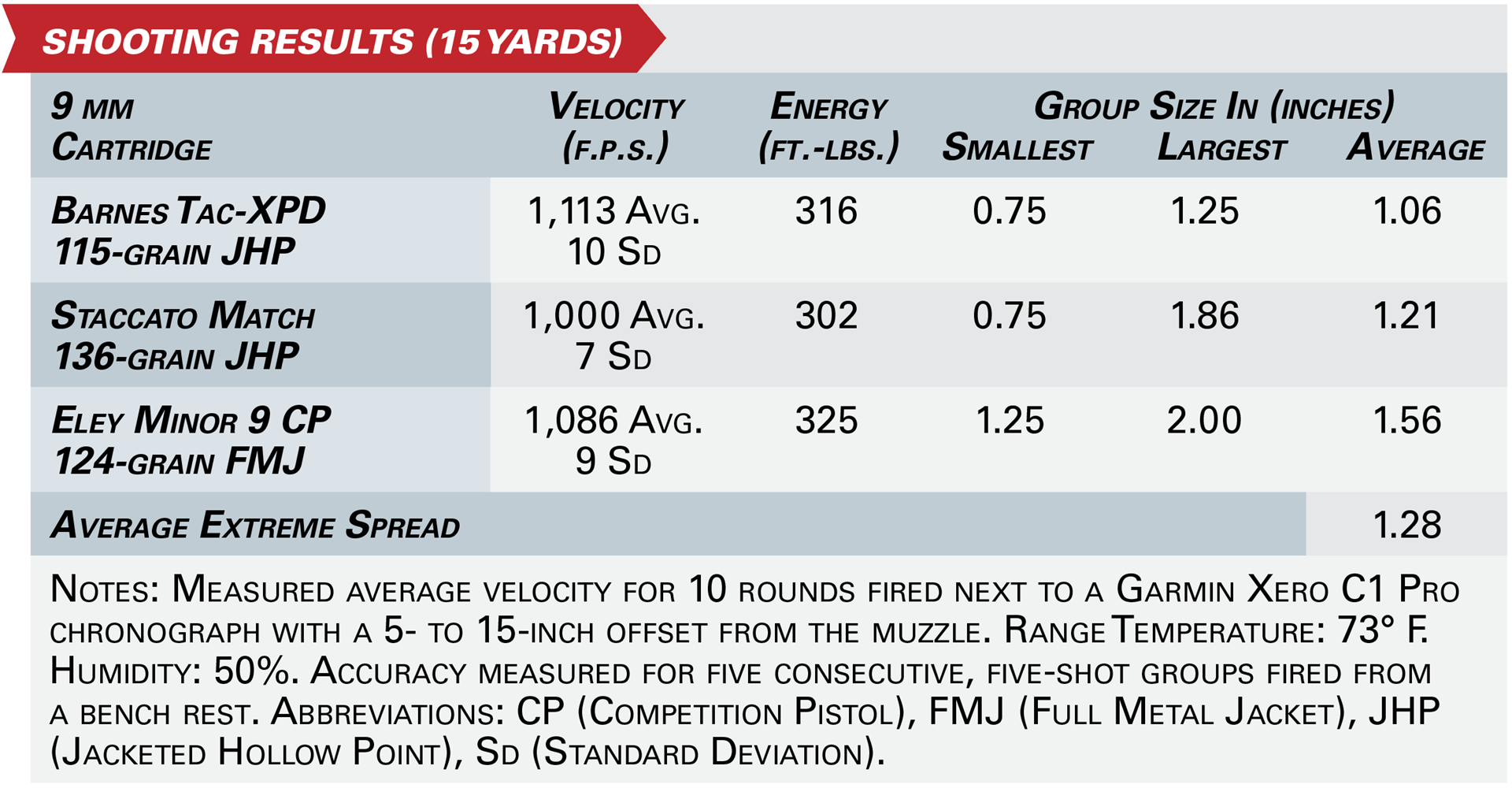
Outside of class, I grouped the P10C Ported with three different types of 9 mm cartridges: Barnes 115-grain Tac-XPD JHP, Eley 124-grain Minor 9 Competition FMJ and Staccato’s fairly new 136-grain Match JHP round. The overall accuracy is nothing to complain about, and had it been a mechanical rest instead of my hands and a shooting bag, I’m sure the groups would have shrunk even more.
Does Integrated Porting Work?
The whole point of the CZ P10C Ported is that it offers the shooter an integrated port. At the time of this writing, the difference in MSRP pricing between the standard P10C Optics-Ready and the P10C Ported is $50. Do I think the $50 upcharge is worth it? I think it could be for most shooters. Besides the fact that this SKU includes slightly nicer iron sights, this model also includes an optics-ready slide with better serrations. As for port functionality itself, I didn’t perceive the gun’s blast to be louder, more concussive or distracting due to the presence of its port.
Ports and compensators are currently very “in.” But it’s still important to keep in mind that these small integral single ports, or even the external compensators like those from Parker Mountain, KKM, Radian, et cetera, work in a nuanced manner. Yes, they do help keep the muzzle flat. Yes, they help the shooter on the margins. However, these ports and comps will not turn the typical polymer pistol into a race gun. To get the most out of a ported pistol like the CZ P10C Ported, the shooter still needs to do their part.
CZ P10C Ported Specifications
Manufacturer: CZ
Action Type: Browning delayed blowback, semi-automatic
Caliber: 9 mm
Capacity: 15+1 rounds
Frame: Fiber-reinforced polymer
Slide: Carbon steel
Barrel Length: 4 inches
Trigger Pull Weight: 4 pounds, 12 ounces
Sights: Tall luminescent, three-dot iron sights, factory cut for optic
Length: 7.3 inches
Width: 1.26 inches
Height: 5.2 inches
Weight: 26.8 ounces
Accessories: Two magazines, backstrap inserts, cable lock, cleaning rod/brush, instruction manual
MSRP: $549
Read the full article here