

The .380 ACP cartridge has historically been somewhat of a footnote in the U.S.; it’s too large to fit in tiny guns like the Colt Vest Pocket or Baby Browning, but for a long time was considered underpowered (as was the 9 mm for many years, until its adoption by the U.S. military in the 1980s). As ammunition design matured, and concealed carry blossomed across the country thanks to the efforts of the NRA, these cartridges became more significant, and the .380 ACP found its place in small firearms designed for this purpose. For example, we have the KelTec P3AT, the smallest, lightest pistol in which the 9 mm Kurz has been chambered. That pretty much revolutionized concealed carry, since you could now have seven rounds of (an admittedly on the low end of acceptable power) defensive ammo in a handgun you could easily conceal in a pocket.
The .380 ACP has wandered in and out of the firearm collective consciousness pretty much since its introduction in 1908. Colt offered its Pocket Hammerless model in .380 ACP. Versions of the Russian Makarov pistol, which borrows heavily from the Walther PP, were offered in .380 ACP in addition to the eponymous 9 mm Makarov. Beretta’s Cheetah has been chambered in it as well as the smaller .32 ACP. Perhaps the best-known variant would be the Ruger LCP, which took the .380 ACP and chambered it in a tiny, super-easy-to-carry pistol.
And now, Springfield Armory is offering its immensely popular Hellcat double-stack pistol in .380 ACP. Wait. Hasn’t the Hellcat been available in 9 mm since its inception in 2019? Yes, yes it has—so you might ask why we should care about a less powerful version. Well, there are a number of reasons. First and foremost, small pistols in more powerful chamberings are, quite frankly, difficult to shoot well. Medium-or-larger hands aren’t given a lot to hold onto when managing the 9 mm’s significant recoil, and they often feature stout recoil springs that make it difficult for people with reduced hand strength to cycle.
Up front, a luminescent yellow ring surrounds a tritium dot to draw the eye in any light, while Springfield’s Tactical Rack U-Dot rear sight provides leverage for charging the pistol as well as a generous notch for sighting. Texture surrounds the grip, fostering steady purchase. Disassembly requires a lever be rotated to remove the slide from the frame, then all major components are accessible for cleaning.
In fact, those concerns are such a thing that numerous manufacturers have already done what Springfield did: Ruger offers the Security 380, Smith & Wesson has the Shield EZ in .380 and SIG Sauer offers the P365-380. All of these are less powerful versions of existing pistols exactly for this market. And, clearly, there is demand for this class of handguns; not only are there the aforementioned guns, but importers bring in models from around the world, whether clones of existing designs or unique offerings.
Think the 9 mm version is better? Feel free to avail yourself of the practically identical version in 9 mm, then. Springfield’s .380 ACP version differs only a tiny fraction from the 9 mm one; minute differences in slide geometry owing to miniscule differences in ejection-port size are the only changes made to the .380 version. Holsters that index on the trigger guard will work for either pistol, but holsters designed around the ejection port might have problems. I own a Hellcat in 9 mm and have quite a few different holsters (in both Kydex and leather) for it, so I tried nearly a dozen from numerous name-brand makers and all fit just fine.
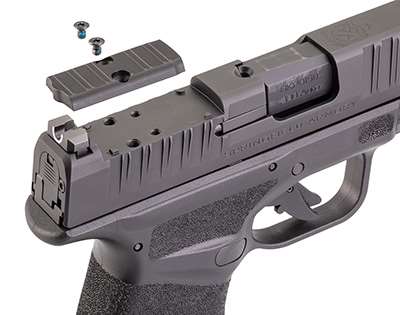
An optics cut for the Shield Sights RMSc footprint is revealed under a metal cover plate held in place by two screws. Adding a powered optic is simple and in many cases allows co-witnessing with the stock sights.
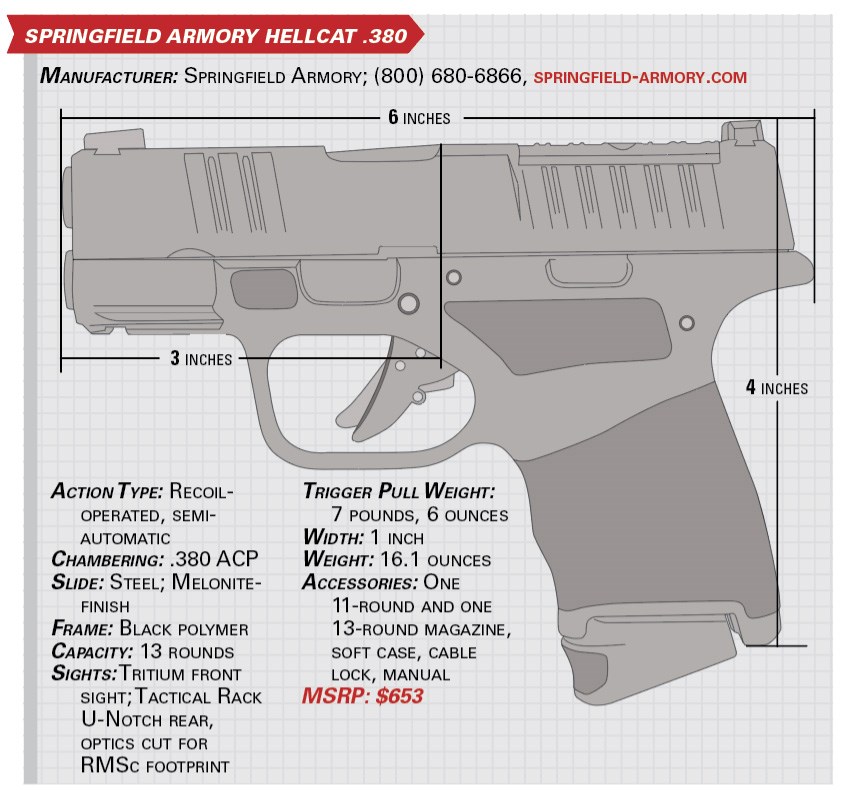
Size-wise, the 9 mm- and .380 ACP-chambered Hellcats are identical. Capacity is the same: 11 rounds in the flush-fit magazine and 13 rounds in the extended mag. Both pistols have an optics cut in the slide for the Shield RMSc footprint. I’d argue that, absent the chambering engraved on the barrel, it would be quite difficult to tell the difference between the two handguns at a glance.
Until you shoot them, that is.
When you’re used to the snappiness of 9 mm in a subcompact handgun, the difference when shooting a .380 ACP is noticeable. Happily so. Shooting the Hellcat in .380 ACP is a completely different animal than the 9 mm version—it’s very light, much like shooting .38 Spl. out of a 6-inch barrel, medium-frame revolver compared with .357 Mag. in such a pistol. It is downright enjoyable, almost on a par with shooting .22 LR out of a compact semi-auto.
Felt recoil is a fairly subjective metric for a handgun; I own a 12-ounce .357 Mag. J-frame revolver that I refer to as the “Snubby from Hell.” I’ve let a number of folks shoot it over the years, and more than a few have handed it back to me after firing exactly two rounds. Why two? They have to shoot that second round, because they are certain the violent impulse they experienced on the first shot was an anomaly; perhaps it was a round that had an overcharge of powder. When realizing that, no, .357 Mag. out of a 12-ounce handgun is just that bad, they don’t want to shoot it anymore.
Now, of course, 9 mm out of an 18-ish ounce semi-automatic is nowhere near as violent, but it can be snappy. To the recoil-averse, that might be enough that they don’t practice with it much, if at all; never mind taking it to a high-round-count class (or even a class with a moderate round count). So, the Hellcat in .380 ACP might mean the difference between a gun you carry a lot and never shoot and a gun you carry a lot and shoot a decent amount.
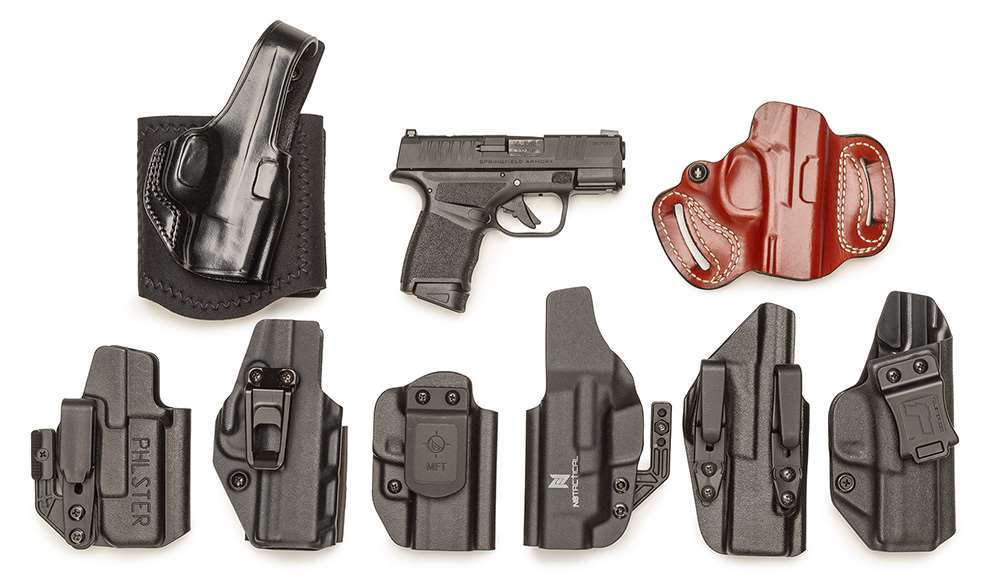
Since the Hellcat .380 shares most dimensions with the 9 mm variant, most holsters on the market for the 9 mm will work with the .380 ACP version. Holsters that index off the ejection port will need to be ordered specifically for the .380.
Yes, the 9 mm does generate more muzzle energy; no one’s debating that. Hornady, for example, offers its Critical Defense round for both 9 mm and .380 ACP: a 115-grain FTX projectile with 329 ft.-lbs. for 9 mm and a 90-grain FTX bullet with 200 ft.-lbs. for the .380 ACP. That’s 39 percent less powerful, but it’s still effective enough for most defensive scenarios. The same advances in defensive-handgun technology that have made the 9 mm better for defense have trickled down to the less powerful calibers, too. In addition to Hornady’s Critical Defense, there are also Speer Gold Dot, Federal’s Punch and Hydra-Shok Deep, and Winchester’s Defender and SilverTip available, to name just a few.
Because I am the curious sort, and because I happen to own a 9 mm Hellcat, I took it to the range when I tested the .380 ACP variant. There is a marked difference between the two; while the 9 mm is absolutely manageable, it’s manageable for me. My 5-foot nothing, 98-pound mother, on the other hand, probably isn’t going to want to shoot it much, if at all. In fact, because of her limited hand strength, she bought a .32 H&R Mag. revolver and stokes it with .32 S&W ammunition. It’s not a lot, but she practices with it. I wish the Hellcat .380 had been available when she was looking.
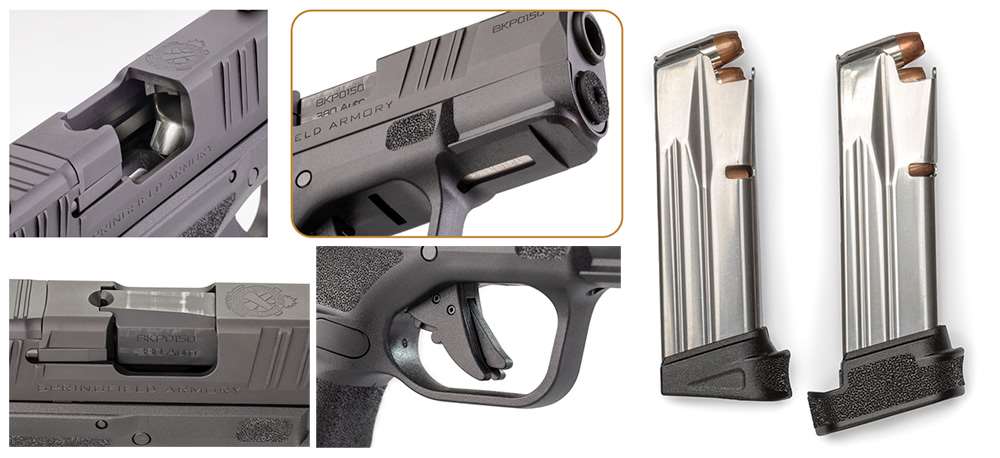
A generous ejection port and contoured feed ramp ensure proper loading and ejection. Should accessories like a weaponlight or laser be desired, a single-slot rail on the dustcover allows for purpose-built additions. Magazines are specifically designed for the .380 ACP round rather than using a 9 mm magazine with a spacer. Serving as a loaded-chamber indicator, a circular witness hole confirms the presence of a round in the chamber. The trigger has a bladed-safety design to guard against inadvertent firing if dropped.
I’m not joking or exaggerating when I say that the Hellcat .380 is an easy pistol to shoot compared with its more powerful sibling. Since I’ve shot both on video, I’ve gone through and watched the recoil impulse—there is a definite difference between the two, and the .380 is far more pleasant. It used to be such that the price difference between the two rounds meant something; I recall when you could get 100 rounds of 9 mm for about $12, and 50 rounds of .380 ACP was nearly double that. Today, of course, things are radically different: Federal’s American Eagle 95-grain FMJ .380 ACP is $24 for a box of 50 rounds, while its 124-grain FMJ 9 mm is $20 for 50 rounds.
To really demonstrate just how much more controllable the .380 ACP version is, I ran both the 9 mm and .380 ACP Hellcats through a series of drills. I’m a fan of drills that test basic performance like the 5x5x5 drill, the Bill Drill and The Test, so I ran each of them with both pistols. Each drill has both a timed component and an accuracy component, with the 5x5x5 and Bill Drill being pass/fail (you keep rounds in the specified area or you don’t) and The Test having an actual score (the rings on an NRA B-8 target). All drills were run in triplicate to ensure a single great (or terrible) run didn’t skew things. Results are presented in the accompanying table, but suffice to say, I was markedly faster with the .380 ACP Hellcat and slightly more accurate.
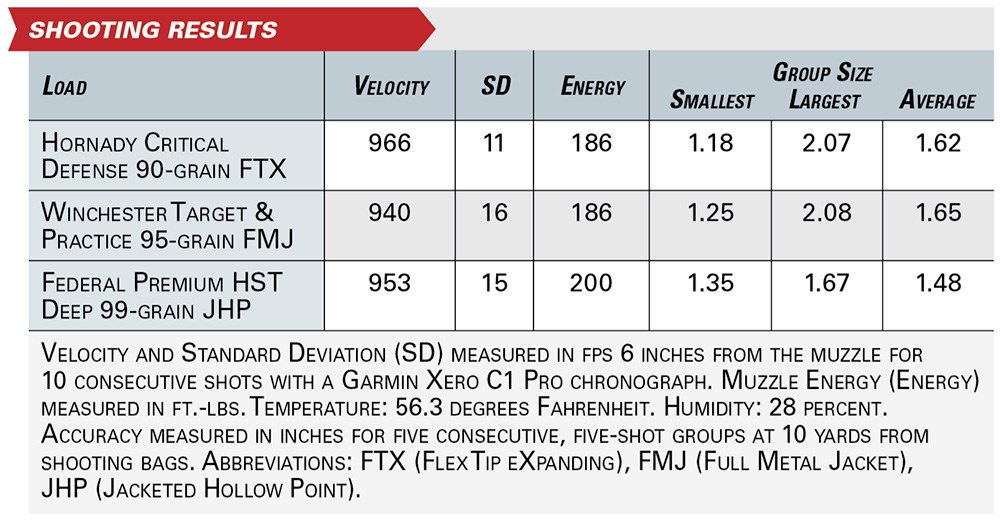
Across the board, accuracy was pretty much the same—however, I had to work harder and take more time to get the same results from the Hellcat in 9 mm. The Test, shot at 10 yards, showed the most dramatic difference in time, with more than 1.5 seconds between the 9 mm Hellcat and the .380 ACP version, with a three-point difference (out of 100) in score. Is that enough of an improvement to warrant choosing the less powerful round? For me, not so much. For someone who hates the recoil of 9 mm and never practices because of it? It might make all the difference in the world.
If it seems like I haven’t said too much about the actual Hellcat .380, there’s a reason—it is so close to the 9 mm pistol that there’s not much else to mention. It is 1.8 ounces lighter than the 9 mm version, although I dare say you won’t be able to tell the difference. Pricewise, it’s identical to the 9 mm as well, although there is only one model of .380 ACP, and it has night sights and the optics cut. There’s a 9 mm pistol with standard white-dot sights and no optics cut for $54 less.
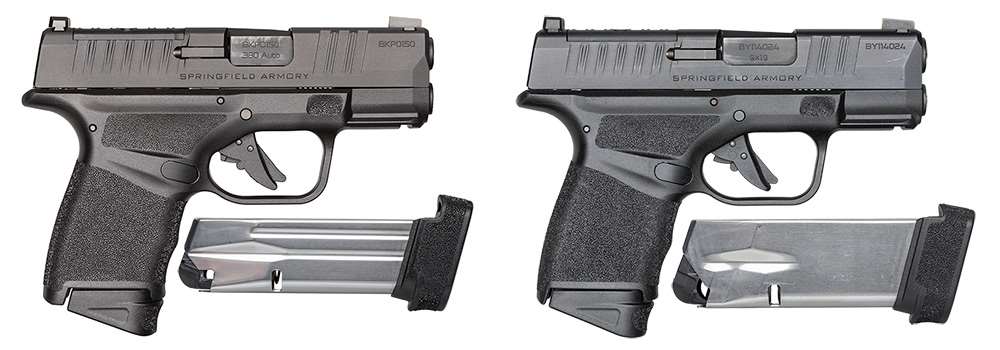
Dimensionally, other than slight differences in the ejection-port length, the .380 ACP Hellcat is indistinguishable from the 9 mm variant. Obviously, the magazines are different as well.
So, then, what does it come down to? For those who have been thinking about a small, lightweight pistol with optic capability and a double-stack magazine, but really don’t want to shoot 9 mm, it’s definitely worth investigation. Ergonomics and relia-bility are identical between the 9 mm Hellcat and the .380 ACP (I fired slightly more than 300 rounds in testing of the .380 ACP Hellcat with zero malfunctions of any kind). The Hellcat in .380 ACP is easier to rack, so folks with limited hand strength might find it easier to manipulate; the lighter-shooting .380 ACP makes it a joy on the range. Handguns in this size class require considerable practice to master, and being able to do that without beating yourself up is a definite bonus. While the 9 mm might offer more power, projectile design keeps improving every day—and the Hellcat .380 performed without incident over a range of ammunition types.
The Hellcat .380 is another option for the concealed-carry practitioner. More options are always a good thing; when they’re well made and easy to shoot, it’s even better. Springfield’s Hellcat .380 might be the surprise new hit on the market.
Read the full article here