

You can’t overlook Wisconsin’s No. 1 ranking when scrolling through the Boone and Crockett Club’s 17,465 record-book entries for white-tailed deer in the Lower 48.
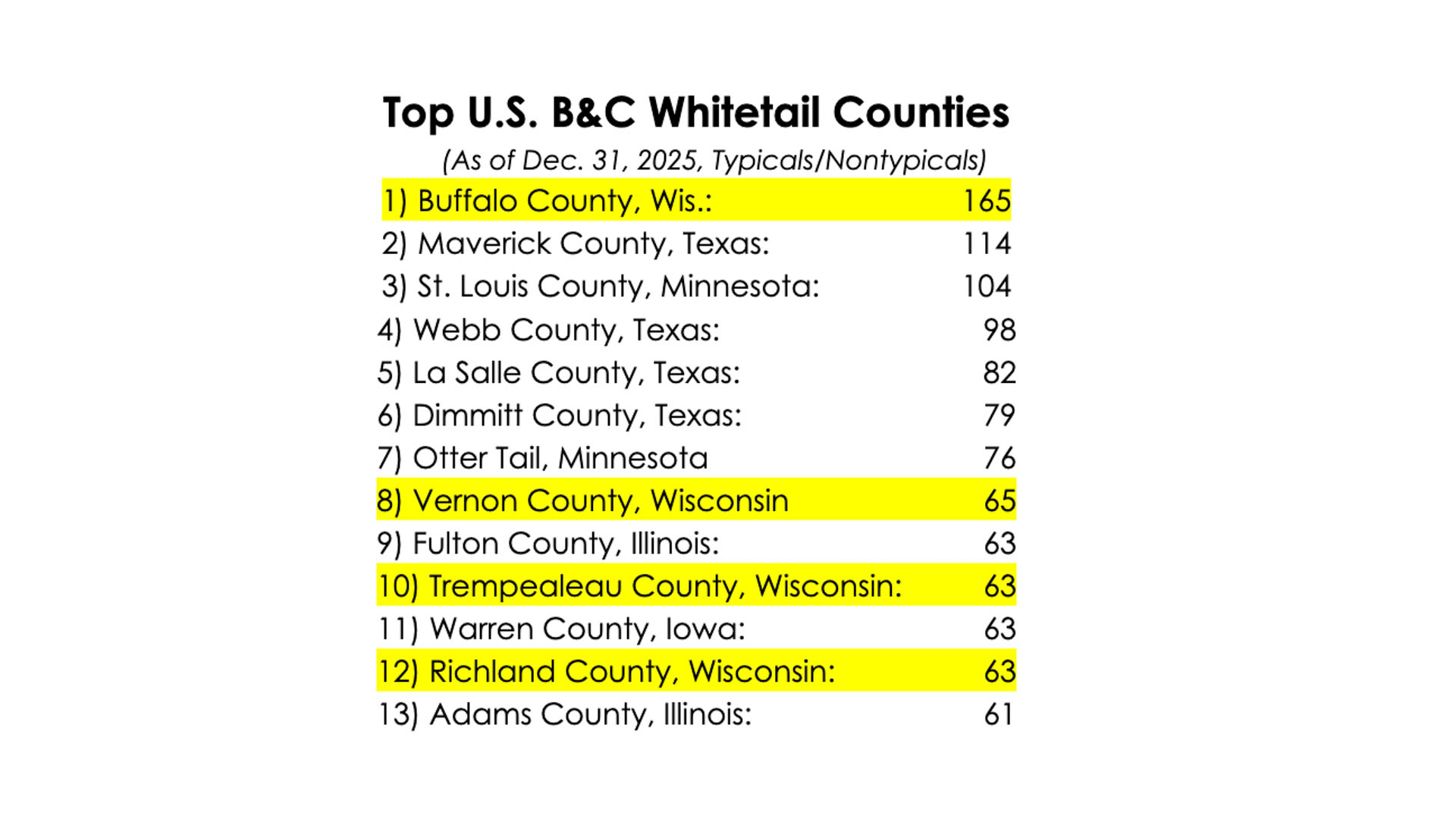
According to B&C’s “Big Game Records Live” online listings, hunters have entered 2,132 Wisconsin bucks (typicals and nontypicals combined) in “the book” since its origins in 1888. That’s 12% of all B&C whitetails for the Lower 48. Wisconsin also produced the legendary “Jordan Buck,” the No. 2 typical B&C whitetail killed in 1914 by Jim Jordan with a .25-20 Winchester in Burnett County.
Four Wisconsin counties rank among the nation’s top 12 counties. Buffalo County is No. 1 with 165 entries; followed by Vernon County, No. 8 with 65; and Richland and Trempealeau, tied for No. 9 through No. 12 with Illinois’ Fulton County and Iowa’s Warren County, with 63.
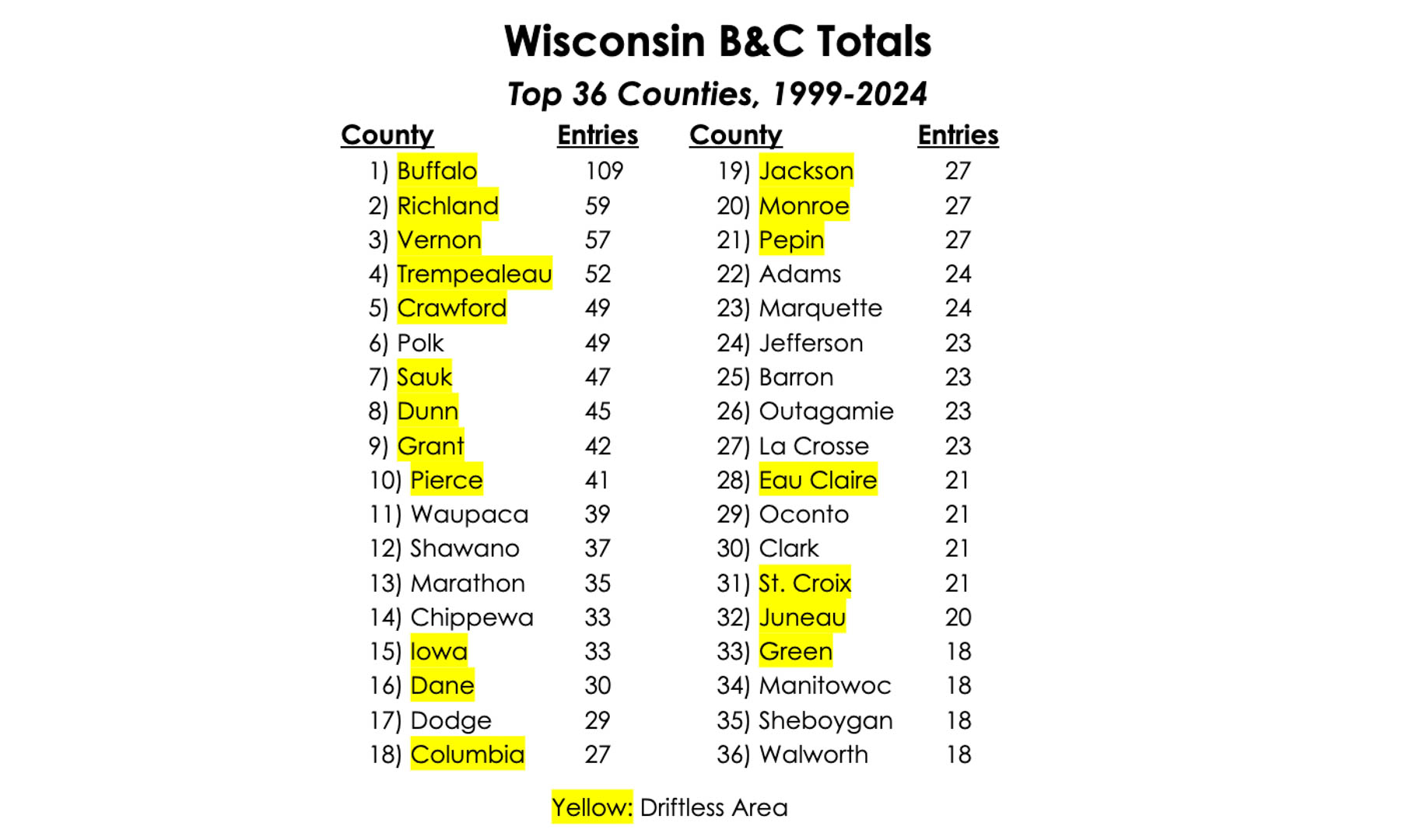
Wisconsin built much of its B&C dominance recently. From 1999 through 2024, Wisconsin entered 1,537 (72%) of its B&C bucks, which includes 1,105 typicals and 432 nontypicals. That’s 13% of 11,465 B&C whitetails entered from the Lower 48 those years.
Likewise, those top four Wisconsin counties built 78% of their B&C rankings from 1999 to 2024. They also share the same neighborhood in southwestern Wisconsin. The Mississippi River sets the western edges of Buffalo, Trempealeau, and Vernon counties. Just to the southeast, the Wisconsin River forms Richland County’s southern border. If you were a crow and flew from northwestern Buffalo County to the southeastern corner of Richland County, you’d fly 135 miles with one of those four counties beneath your wings for all but 28 miles. And if you hiked that route in summer, you’d seldom leave the shade of oak-dominated woodlands and brushy edges bordering fertile valleys, hillside fields, and stream-fed wetlands.
The Driftless Area
These deer-rich counties help anchor Wisconsin’s portion of the “Driftless Area,” 24,000 square miles of Midwestern magnificence that also include southeastern Minnesota, northeastern Iowa and northwestern Illinois. This region earned its name from the Laurentide Ice Sheet that bypassed it during the most recent glacial period—the Wisconsin glaciation—15,000 years ago. That great ice sheet never leveled southwestern Wisconsin’s steep hillsides and limestone ridges, nor plowed its dark loess soils and ancient lake bottoms.
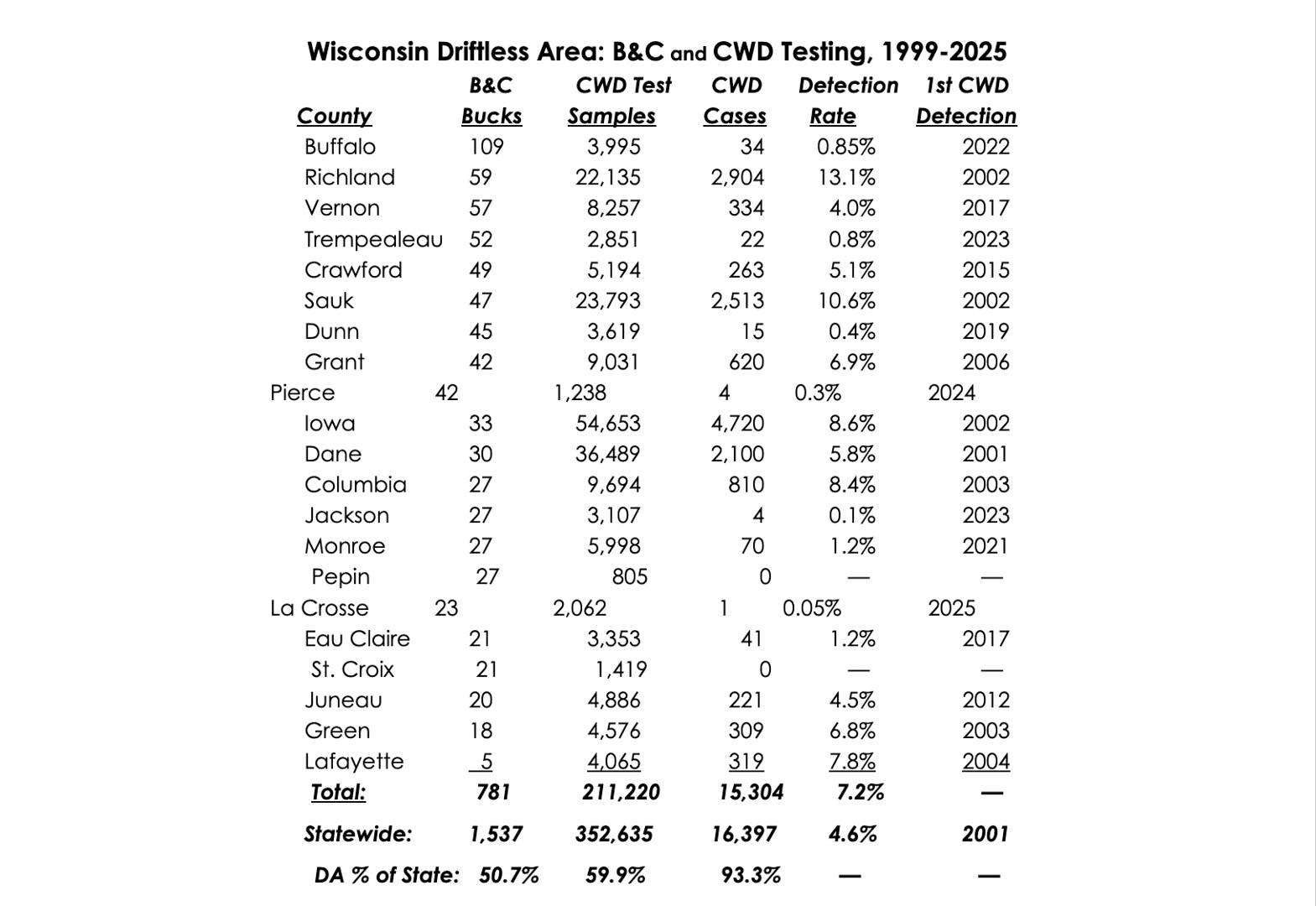
The Driftless Area remains lightly developed by today’s standards, and covers all or part of 21 Wisconsin counties. That means 31% of Wisconsin geography produced 780 of the state’s 1,537 (50.7%) B&C bucks for 1999-2024. In fact, the Driftless Area contains nine of Wisconsin’s top 10 B&C counties for 1999-2024 and 16 of its top 21 (76%). The top 10’s only outlier — Polk County, No. 6 with 49 B&C entries — is just 20 miles north of the region.
Driftless Area Dominates in CWD
Unfortunately, the Driftless Area’s many traits that benefit deer — undeveloped landscapes, nutrient-rich soils, abundant croplands, and lengthy river corridors — also helped spread and intensify Wisconsin’s worst outbreaks of chronic wasting disease in the past 25 years. This always-fatal disease kills its victims within 18 to 24 months of contraction. As each case worsens, victims grow increasingly vulnerable to hunting, predation, road-kills, and illnesses like pneumonia.
Wisconsin found its first three CWD cases in 2001 in Dane County on the Driftless Area’s southeastern corner. Those were also the first CWD cases east of the Mississippi River, triggering massive statewide testing (40,147 samples) in 2002. Those tests found 205 more cases, mostly in Dane, 94, and neighboring Iowa County, 107. Next-door Sauk County had two cases, and Richland and Walworth counties found one each. Only Walworth is outside the Driftless Area.
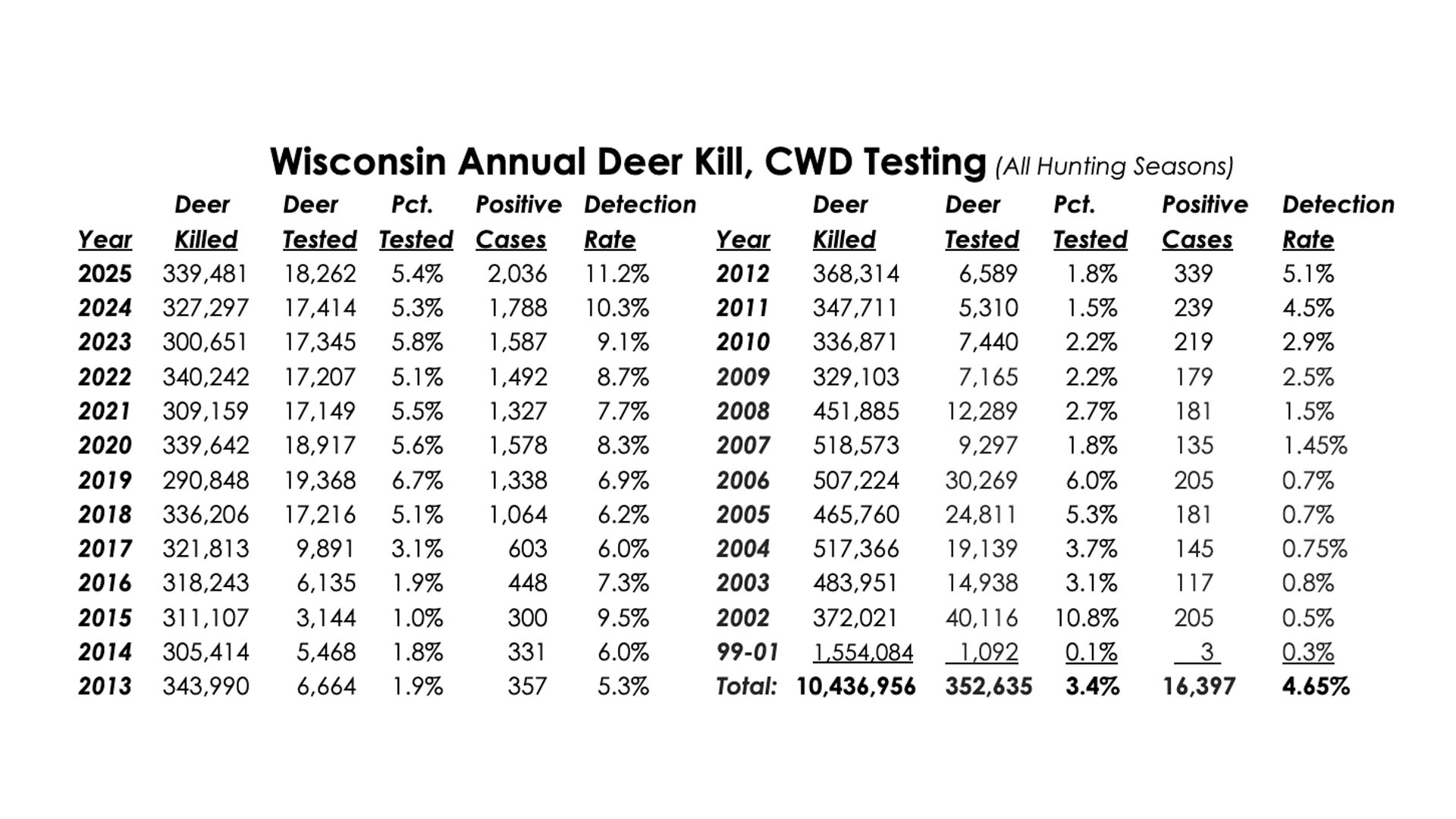
The Wisconsin Department of Natural Resources has since identified nearly 16,200 more CWD cases in wild deer, including at least one case in 51 (71%) of the state’s 72 counties. Most cases came from hunter-volunteered samples, even though Wisconsin hasn’t mandated CWD testing since 2012. A 2019 DNR survey found 70% of hunters have never submitted a deer for testing. And only 5.5% of successful hunters submitted deer for testing the past eight years. DNR data also show only 3.4% (352,635) of the 10.44 million Wisconsin deer registered by hunters since 1999 were tested.
The Driftless Area has produced 15,613 (95%) of Wisconsin’s 16,397 CWD cases. During 2025, the region’s 1,820 CWD cases accounted for 89.4% of Wisconsin’s record-setting 2,036 cases. That nearly doubled the 1,064 cases documented only seven years earlier with similar sampling efforts: 17,216 tests in 2018 and 18,262 in 2025.
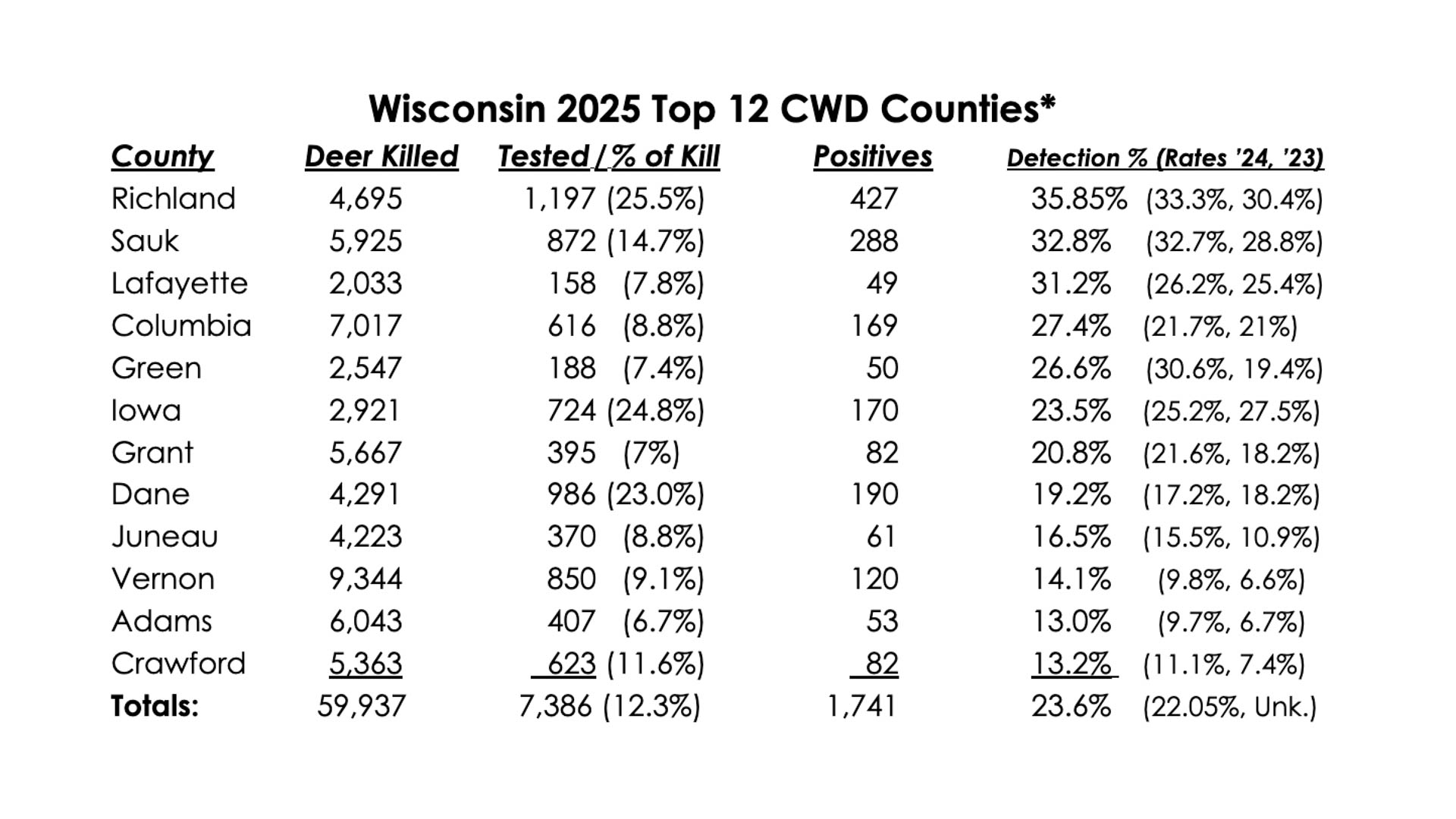
Further, Wisconsin’s top 12 CWD counties are all in the Driftless Area, and three other Driftless counties make the top 20 CWD list. Iowa County leads with 4,720 cases, followed by Richland, 2,904; Sauk, 2,513; and Dane, 2,100. Only two Driftless counties — Pepin and St. Croix — haven’t detected CWD, while La Crosse County found its first case in 2025.
However, hunters in Driftless Area counties also test deer at higher rates than hunters elsewhere, mainly for food-safety reasons. But more tests don’t guarantee more CWD cases. Jefferson County, just east of the Driftless Area, found its first case in 2005, and has since identified 69 CWD deer from 8,476 (0.8%) tests. Meanwhile, Vernon County (Driftless Area) has found nearly 5 times as many cases (334) with 219 fewer tests (8,257), and didn’t find its first case until 2017, 12 years after Jefferson County’s first.
Aggressive-Passive Management
Wisconsin has taken contradictory approaches to CWD. From 2002 through 2010, the DNR aggressively tried to reduce deer herds across Dane, Iowa, Sauk, Richland and other nearby counties. Those efforts included months-long either-sex gun seasons and earn-a-buck regulation, i.e., register an antlerless deer before shooting an antlered buck.
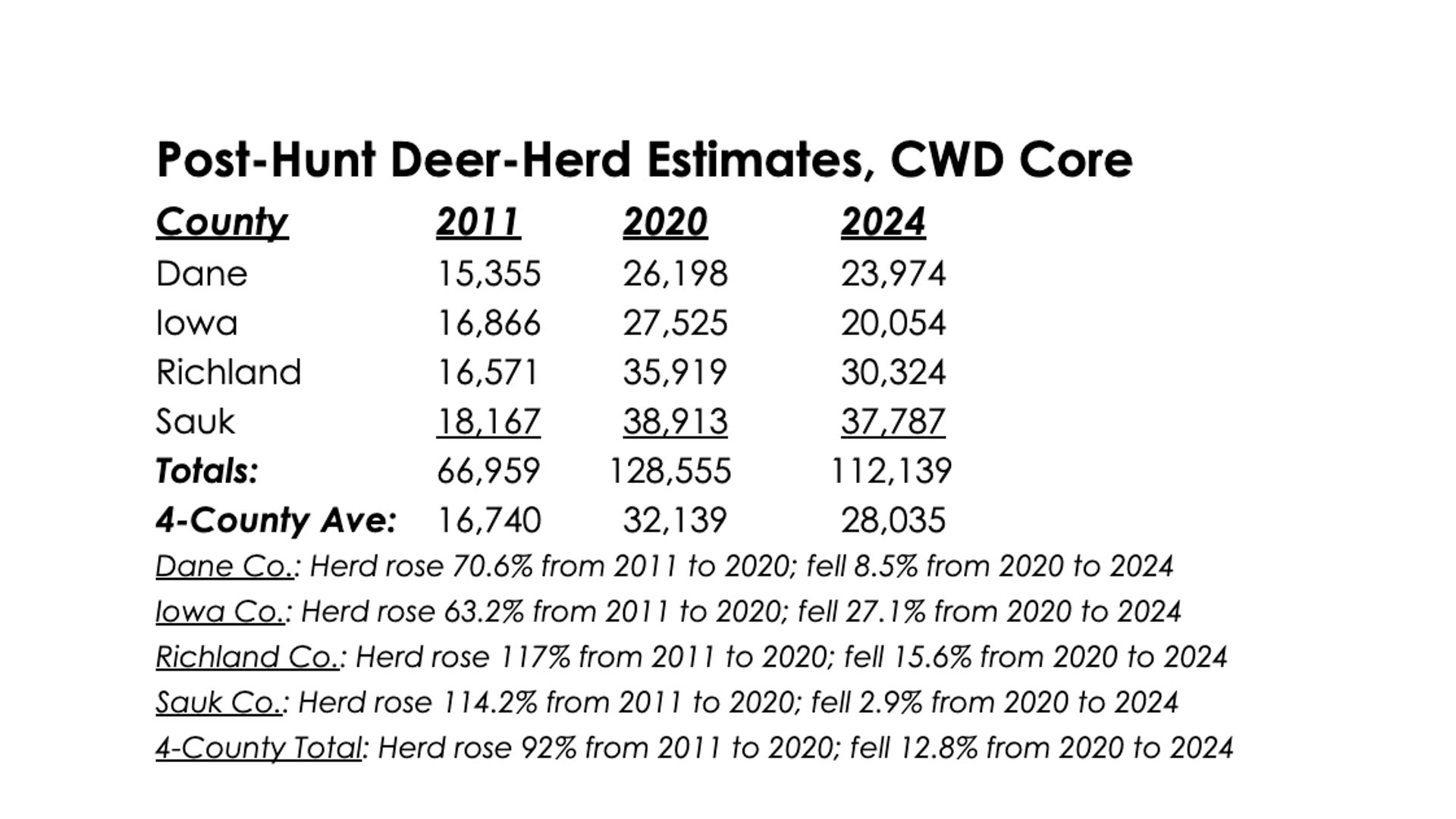
Those tactics reduced deer herds in Dane, Iowa, Sauk, and Richland counties to an estimated average of 16,740 by late 2011, which kept CWD rates at 4.6% for Dane, 8.6% for Iowa, 3.2% for Sauk, and 1.5% for Richland. But earlier in 2011, state lawmakers outlawed earn-a-buck and forbade gun-hunting before late November’s nine-day firearms season. By 2014, acting on the advice of Gov. Scott Walker’s “deer trustee” — Dr. James Kroll of Texas — “passive CWD management” became state policy).
Deer populations and CWD boomed in response. By 2020, deer numbers increased 92% in those four counties, peaking on average at an estimated 32,139 deer per county. Similarly, CWD rates hit 17% in Dane, 29% in Iowa, 26% in Sauk and 19.6% in Richland.
By 2024, CWD rates flattened to 17% in Dane and 25% in Iowa, but soared to 33% in Sauk and Richland. At those high levels, CWD helped cut deer populations in Dane, Iowa, Sauk and Richland by 13% to 28,035, on average.
Quirky B&C Entries
So how does Wisconsin’s Driftless Area keep producing record-book bucks despite record-setting CWD cases? For starters, CWD didn’t reach most of Wisconsin’s 21 Driftless Area counties until 15 or more years after its discovery in 2001 and 2002.
Plus, even where prevalent, CWD and deer — and hunters — aren’t evenly distributed. Isolated valleys, woodlots and other pockets of cover can create disease hotspots and deer safe havens. On Dec. 10, 2025, for example, a Dane County hunter, Steven Loomans of Madison, shot a 12-point buck he green-scored at 191-7/8 inches as a typical and 206-6/8 inches as a nontypical 18-pointer.
Further, even in Wisconsin and even without CWD, Booner whitetails are rare. Bucks must reach ages 4½ to 6½ to reach physical maturity and fully express their genetic antler potential. Wisconsin bucks typically face heavy hunting pressure. In 2011, when hunters killed 150,839 bucks statewide, most (54%) were yearlings (18 months old). Still, when a state-record 159 bucks from 2011 entered B&C’s record book the next year (2012), it represented only 0.10% of Wisconsin’s buck kill. (Bucks usually enter B&C’s book the year after they’re killed.)
They’re even rare in Buffalo County. During its biggest B&C years, its 10 B&C entries in 2000 represented 0.33% of its 3,037 buck kill in 1999. And Buffalo County’s 13 B&C bucks in 2010 were 0.42% of its 3,084 buck kill in 2009.
B&C entries also vary annually without obvious changes in predation, hunting pressure, food quality, or winter severity. Even though Buffalo County tallied 109 B&C entries for 1999-2024, it had only one entry in 1999; two entries in 2002, 2018, 2019, and 2020; and zero entries in 2013, 2017, 2023, and 2024.
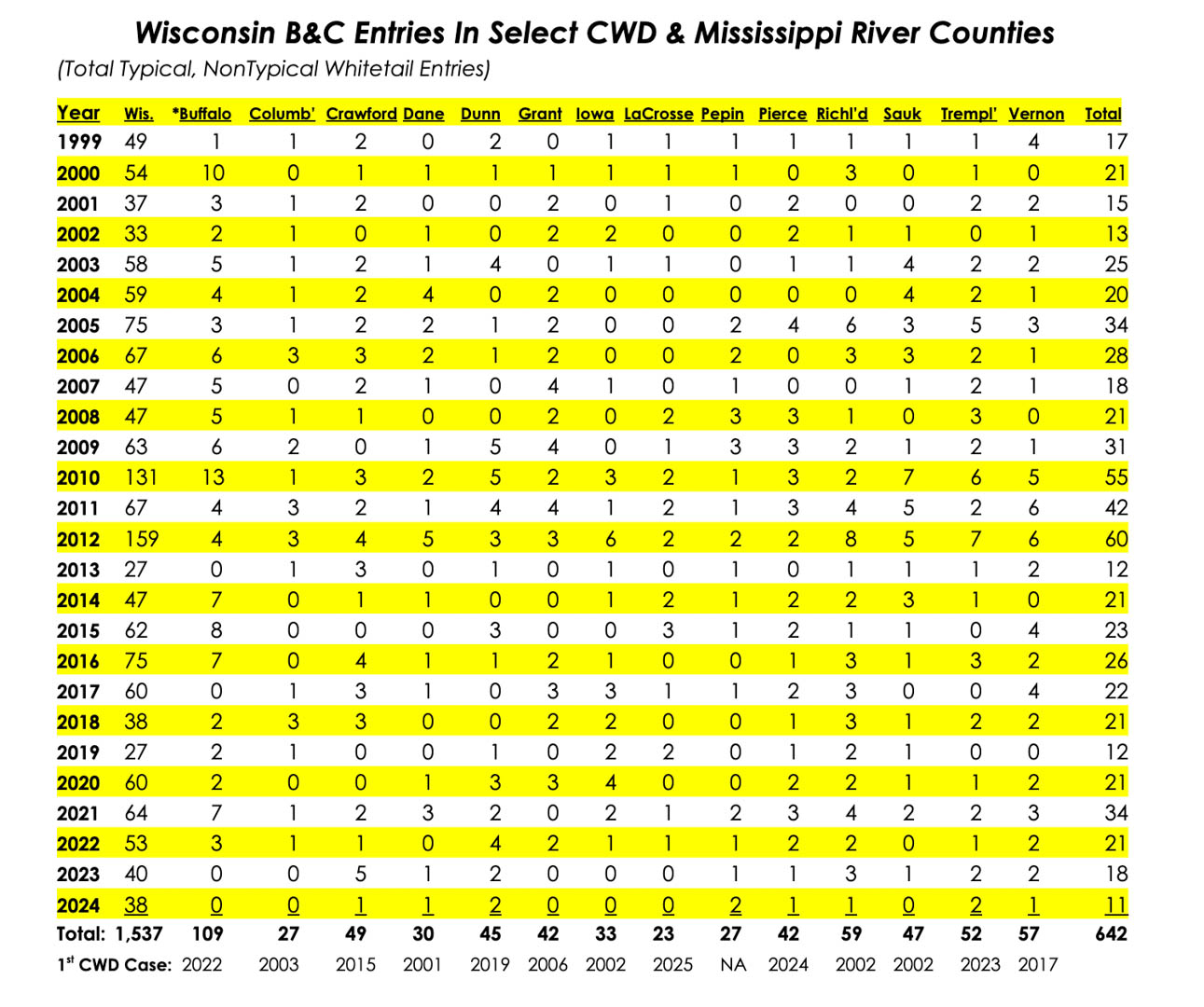
Therefore, at least for now, you’ll find no distinct trends or CWD-driven warnings when expanding the view to analyze 642 B&C entries for 1999-2024 from 14 productive Driftless Area counties in Wisconsin: Pierce, Pepin, Dunn, Buffalo, Trempealeau, La Crosse, Vernon, Crawford, and Grant, which are on or near the Mississippi River; and Columbia, Dane, Iowa, Sauk, and Richland in CWD’s core area north and west of Madison.
Those 14 counties’ combined B&C entries ping-ponged annually during 1999-2024 — ranging as low as 11 and as high as 60 — even as CWD spread farther across landscapes and more densely within infected herds. Yes, B&C entries for that group fell 11% from 340 in 1999-2011, when CWD was relatively new, to 302 in 2012-2024 entries, when CWD was accelerating. And yes, those counties’ annual B&C totals never fell below 13 (2010) for the 1999-2011 entries, but fell to 12 (2019) and 11 (2024) for the 2012-2024 entries.
Those same 14 counties, however, enrolled 105 B&C bucks the last five years (2020-2024), a 15% increase from 91 the first five years (1999-2003), even as gun-hunter numbers statewide fell 14% from 644,460 in 2012 to 553,652 in 2024.
The Human Factor
Bottom line: B&C entries are neither consistent nor predictable. And hunters help make it so. When hunters kill a potential Booner, it’s on them to find a certified scorer to measure the rack, and pay the club its $40 entry fee. Many hunters do neither. Some want to keep things secret. Others care little about antler scores and records.
Shane Indrebo, co-owner of the North American Shed Hunters Club since 2019, knows something about all that. He lives in Buffalo County and grew up helping his parents Tom and Lori operate Bluff Country Outfitters since 1993 from their farm near Cream. Since 2006, Indrebo has also taken studio-quality photos for hunters and their bucks. Each session takes roughly an hour, and one to two hours to edit and organize the images. At $300 per session, Indrebo takes 25 to 30 big-buck portraits during slow years and 50 in good years. That’s over 500 hunters/bucks the past 20 years.
Indrebo isn’t surprised when hunters don’t enter lower-end Booners in the book. To qualify for B&C’s all-time records, a whitetail’s rack must net-score 170 inches as a “typical” or 195 inches as a “nontypical.” Those minimums have been B&C standards since at least 1968.
“A large majority of big bucks never go into the record books, but I also think most elite bucks end up in the books,” Indrebo told MeatEater.
Indrebo said “elite” bucks score in the high 180s to low 190s as typicals, and 220s to 230s as nontypicals.
“Some bucks get labeled ‘200’ when they’re shot, but by the time they dry 60 days and get measured, a 189 nontypical won’t get entered,” he said. “Some guys will say, ‘I don’t want my name in no book.’ But when it’s a 189 typical, they start hearing some crap. When their buddies show interest, they realize it’s special. They feel peer pressure to go to a deer show and get it scored.”
Indrebo thinks Buffalo County’s B&C dominance isn’t just habitat, herd size, and limestone bluffs. “You see similar habitats throughout the Driftless Area,” he said. “Some of the biggest racks and sheds we’ve scored come from Richland County (80 miles to the southeast). But I’m not surprised there’s fewer entries across the (Mississippi) River in Minnesota. A lot of their record-book entries are from before 2000. Things are different there; maybe because their gun season opens during the rut in early November, two weeks before our (gun) season.”
A Tradition of B&C
Dan Storm, the Wisconsin DNR’s deer-research scientist, said B&C entries are as much about people as deer. “There’s more of a tradition for entering deer in some areas,” Storm told MeatEater. “Buffalo County has twice as many entries as Trempealeau County (109 vs. 52 for 1999-2024), but there’s no way Buffalo County produces twice as many bucks worthy of entry. Those counties border each other, and they’re nearly identical in size and habitat.” (Buffalo County covers 709 square miles, of which 527 (74%) square miles is deer range. Trempealeau County covers 742 square miles, and 514 (69%) is deer range.)
In contrast, two Minnesota counties across the Mississippi River registered just over half as many Booners for 1999-2024 as Trempealeau County’s 52. Winona County had 29 B&C entries those years and Wabasha 27. South of there, Houston County had 42 entries. Iowa’s northeastern counties along the Mississippi River differed little. Allamakee County had 39 entries for 1999-2024, followed by Dubuque, 36; and Clayton, 34. Across the river in northwestern Illinois, Jo Daviess County had 35 entries.
All eight of those Iowa, Minnesota and Illinois counties are in the Driftless Area, as are Wisconsin’s eight river-border counties. But of Wisconsin’s eight counties on the Mississippi River, only Pierce, 41 entries; Pepin, 27; and La Crosse, 23; had fewer B&C entries than Houston Counties’ 42: Buffalo,109; Vernon, 57; Trempealeau, 52; Crawford, 49; and Grant, 42.
A Matter of Pride?
MeatEater’s Spencer Neuharth, host of the MeatEater Trivia podcast, links Wisconsin’s B&C dominance more to pride than deer habitats or genetics. “It’s anecdotal, but I think Wisconsin has a prouder group of hunters than anywhere else in the country,” Neuharth said. “Part of that pride is entering their names in the record book. I love that. It’s really cool. I’m jealous of it, actually.”
The late Charles Kuralt of CBS-TV News made similar comments about Wisconsin in the early 1980s after touring the state for his “On the Road” reports. Kuralt noted the state’s small-town pride in Hayward, which proclaimed itself the “Musky Capital of the World;” and Fremont, the “White Bass Capital of the World;” Monroe, the “Swiss Cheese Capital of the World;” Eau Claire, the “Horseradish Capital of the World;” and Iola, the “Bowhunting Capital of the World.” Kuralt finally exclaimed, “Wisconsin is the capital of the capitals of the world.”
Make no mistake: Neuharth thinks Wisconsin’s B&C entries are legitimate, whether it’s all-time (2,132 Booners) or 1999-2024 (1,537). Still, he doubts Wisconsin hunters killed 32% more Booner-class bucks in 1999-2024 than did Illinois hunters (1,168 entries) or 157% more than Texas hunters (599 entries).
“My argument gets stronger when you look at Boone and Crockett black bear entries,” Neuharth said. “Wisconsin kills about as many black bears (3,724 in 2025, and 4,432 in 2024) as any state, but it has over twice as many Booner black-bears (959, all-time) as second-place Pennsylvania (467), and nearly four times as many as Alaska (257).
“Buffalo County also has three black bear entries,” Neuharth continued. “That’s the same amount as Minnesota’s Lake of the Woods County and more than Montana’s Flathead County (2). Both of those counties are much bigger, and have better bear habitat than Buffalo County. So, all that feels inflated.”
Too Soon for Clarity
Then again, that awareness suggests that if one state could use B&C entries to detect trends in CWD data, it’s Wisconsin. And when it comes to antler size, what’s the alternative? No state wildlife agency maintains systems for scoring antlers and cataloguing big bucks annually, historically or regionally. Nor do states track how many bucks taxidermists handle each year. And even if states tracked taxidermy workloads, how would they account for business fluctuations caused by economic factors, hunting-license sales, hunting and habitat conditions, and perceptions of each taxidermist’s skills or pricing?
If this were all about science, and not wall-worthy antlers, the best method is age-class data. Unfortunately, the Wisconsin DNR hasn’t systematically collected those details since 2015. That’s when it ended mandatory in-person deer registration and switched to mandatory electronic registration. Although the agency could impose temporary in-person check stations to collect data, Wisconsin’s political climate has blocked that option.
Storm, the Wisconsin DNR researcher, thinks CWD is probably reducing big-buck numbers, but he can’t predict or specify how it affects B&C entries. “That’s a different question,” he said.
Wisconsin native Jim Heffelfinger, the wildlife science coordinator for the Arizona Game and Fish Department, thinks it’s still too soon to identify CWD’s impacts on B&C entries, or the age structure of Wisconsin bucks.
“At this point, the numbers you’re showing are erratic,” Heffelfinger told MeatEater after looking at the 1999-2024 B&C data for southwestern Wisconsin. “It’s like the saying about measuring with a micrometer, marking with chalk, and cutting with an ax. Those numbers so far lack the resolution to detect anything caused by CWD. It would be better to get all the age-structure data and analyze that.”
Professor Mike Chamberlain at the University of Georgia’s Warnell School of Forestry made similar comments. Chamberlain helped do a 2021-2024 study of CWD’s impacts on Arkansas’ deer herds. The four-year project documented CWD reduced Arkansas’ deer numbers 17% annually, on average; with buck densities declining 23% annually.
“There’s nothing obvious in (Wisconsin’s 1999-2024 B&C data) at this time, but I think it’s too soon,” Chamberlain told MeatEater. “You wonder what those numbers will look like in 10 years, or maybe 20 or 30 years. At some point, it seems logical the numbers would have to drop off, given the high CWD prevalence in some Wisconsin counties.”
A Complicated Disease
Meanwhile, CWD rates mostly keep rising in Wisconsin, even though it hasn’t spread at the same rate in every direction, nor does it infect herds equally, no matter their numbers or population densities. In general, CWD in Wisconsin spreads faster in areas with clay-based soils, rural corridors, and areas of connected woodlands, abundant edge cover and high percentages of deer range. On the other hand, it spreads slower in sand-based soils, well developed areas, and open agricultural areas with large cultivated fields.
For example, Madison’s metro area with 700,000 residents has hampered CWD’s spread in eastern Dane County and beyond. Also, a four-lane highway heading west from Madison helps separate northern Iowa County from its southern half. CWD isn’t as prevalent in the relatively open agricultural landscapes south of the highway, which extend into Lafayette County and then Illinois. But CWD prevalence remains high north of that highway in Iowa County’s oak ridges, brushy ravines, and edge-rich valleys.
A recent eight-year DNR study by Storm’s team in northern Iowa County found CWD kills more female deer than do hunters once an area’s infection rate for does hits 29%. That rate has been exceeded across many parts of Dane, Iowa, Sauk and Richland counties. The rates are more obvious at the township level (36 square miles), than at the larger county-level scale. For 2025, Richland County’s CWD rate was 36% overall (both sexes), while CWD rates for its 16 townships ranged from lows of 21% and 23.5% to highs of 44% and 50%.
Regional CWD prevalence charts in 2024 also show those differences:
–Iowa County’s CWD rates in 12 regional charts vary from 25% to 47% for adult bucks, and 20% to 35% in adult females.
–Sauk County’s CWD rates in 10 regional charts vary from 30% to 58% for adult bucks, and 19% to 38% for adult females.
–Richland County’s CWD rates in eight regional charts vary from 40% to 55% for adult bucks, and 25% to 30% for adult females;
–Dane County’s CWD rates in two regional charts range from 25% to 35% for adult bucks, and 22% to 23% for adult females.
–Northwest Columbia County’s CWD rate was 55% for adult bucks and 35% for adult does.
–Northeastern Grant County’s CWD rate was 45% for adult bucks and 33% for adult does.
Views from the Ground
Meanwhile, many hunters in Wisconsin’s core CWD counties don’t need B&C data to confirm what they’re seeing firsthand. In Iowa County, buck kills have plummeted since gun-hunters killed a record 4,738 antlered bucks in 1995, and 1,978 bucks in 2011. During November 2024’s nine-day gun season, they registered 916 bucks. And during November 2025’s nine-day gun season, they registered 894 bucks. The last time Iowa County’s buck kill was near or below 900 in back-to-back gun seasons was 1970 and 1971—55 years ago.
Jason Munz grew up on his family’s farm in Iowa County, which had 33 B&C entries for 1999-2024. Munz arrowed a 12-pointer with an 18-inch spread in November 2023. That’s his biggest buck since he began bowhunting at age 12 in 1993. Even so, Munz said deer hunting grew increasingly difficult as CWD spread death. His family rarely found dead-heads during his youth, but his father found six in Spring 2023 alone, including one scoring 140 inches.
“When we see a big buck on our trail cameras, if we don’t shoot him that year, we never see him again,” Munz told MeatEater. “Maybe someone on a nearby farm got him, but we don’t know. They just disappear.”
Likewise, Paul Annear grew up bowhunting on his family’s farm in Richland County, which entered 59 B&C bucks for 1999-2024, including eight Booners in 2012, six in 2005, and four in 2011and 2021.
CWD took roughly 15 years to reach Annear’s land from its original sites 40-plus miles to the southeast, but eight of 11 deer he’s killed since 2019 had the disease. He has no doubt CWD—not hunters or epizootic hemorrhagic disease—decimated his area’s herd the past five to six years. Plus, neither the Annears nor their neighbors changed their buck or doe management those years.
In 2020, Annear had at least one photo of 30 different bucks he estimated to be ages 3.5 or older. But in 2024 and again in 2025, his trail-cameras photographed only eight to 10 bucks in that age class, even with 20 more trail-cameras on his family’s 115-acre property than in 2020.
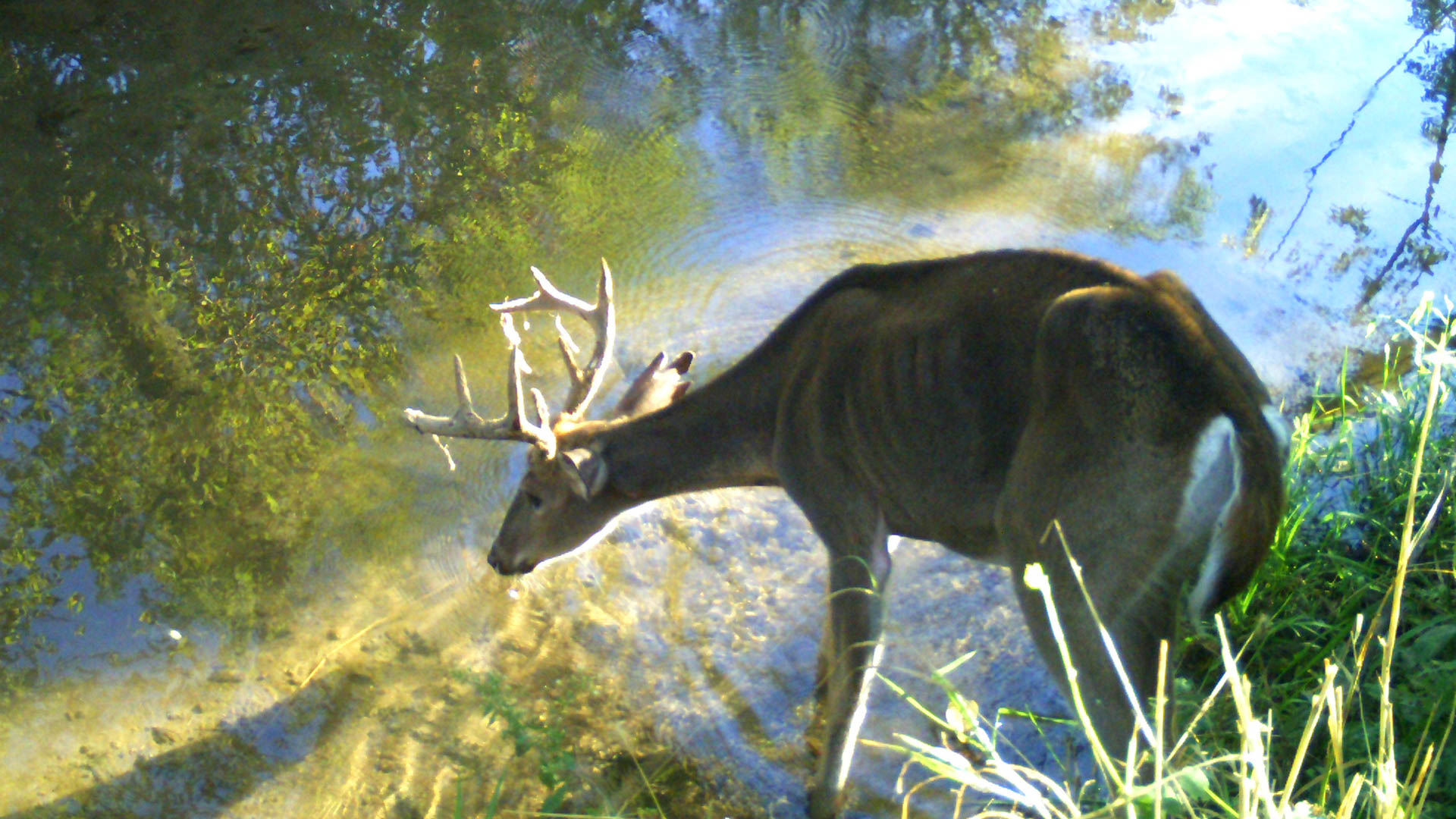
His trail-cameras also photograph sick, skeletal deer in their fields, woods, or creek. “So many people claim those sick, skinny deer are EHD victims,” Annear said. “But deer dying from CWD also go to water, and they live long enough to waste away. EHD kills deer in five to 10 days. That’s too quick for deer to lose much weight.” Further, EHD only strikes sporadically, and only in short outbreaks from late summer through the first frost.
Annear’s experience echoes what brothers Lloyd and Mike Purnell report farther east in Richland County. In 2006, the Purnells’ four properties covering 700 acres were CWD-free. In 2019, they found 10 dead deer. In 2020, they found eight bodies before April, usually just inside the woods near fields with cut corn or other crops. One doe died surrounded by corn.
During 2024, the Purnells and their friends shot 20 deer by mid-December. Nine (45%)—all bucks—had CWD. One year their properties’ overall infection rate hit 55%, with roughly half being does. In 2025, eight of 14 bucks (57%) they shot had CWD. “We had a 140-class buck running around last fall, but that’s the biggest we’ve seen in a while,” Purnell told MeatEater.
Looking to the Future
What lies ahead, now that Wisconsin’s CWD detection rates set records the past four years and seven of the past 10?
Bryan Richards was the U.S. Geological Survey’s longtime emerging-disease coordinator until retiring recently after decades of CWD work. Richards foresees a “new equilibrium” for deer herds in CWD-endemic areas. That means high disease rates, lower deer numbers, smaller and younger herds, and few “trophy” bucks.
“At some point, it’s impossible Wisconsin won’t see fewer (B&C) bucks,” Richards told MeatEater. “How many bucks can reach age 5½ in counties where young bucks have a 20% chance of having CWD at 18 months, and a 40% chance by age 4½ and 5½? Not many. A true Boone and Crockett whitetail is really, really rare to start with. With CWD, put a couple more ‘reallys’ in that phrase. CWD kills every deer that gets it, including half the bucks that must reach maturity to grow huge antlers. ‘Rare’ is a small number. ‘None’ is even smaller.”
How will CWD affect Wisconsin’s top five B&C counties, four of which didn’t detect the disease until 2015 or later?
–No. 1 Buffalo County’s first CWD case was 2022. It now has 34 cases. Its 2025 detection rate was 4.3%
–No. 2 Richland’s first case was 2002. It now has 2,904. Its 2025 detection rate: 36%.
–No. 3 Vernon’s first case was 2017. It now has 334. Its 2025 detection rate: 14%.
–No. 4 Trempealeau’s first case was 2023. It now has 22. Its 2025 detection rate: 4.2%.
–No. 5 Crawford’s first case was 2015. It now has 263. Its 2025 detection rate: 13.2%.
Storm said there’s no reason CWD won’t infect Buffalo and Trempealeau counties any differently than it did Richland, Vernon or Crawford. All five of those counties have fertile soils and high percentages of deer habitat. Buffalo County is 74% deer range; and Richland is 81%; Vernon, 71%; Trempealeau, 69%; and Crawford, 81%.
Once CWD detection rates hit 5%, the disease is considered “endemic.” That is, it’s not going away. After CWD reached 5% in Sauk, Iowa and Richland counties, it hit 10% to 15% within three years. If Buffalo and Trempealeau’s CWD rates follow suit, their infections would hit 10% by 2028 and 20% by 2031. And if Buffalo and Trempealeau infections mimic Richland’s, CWD rates would surpass 30% around 2035.
Mike Purnell and Paul Annear long feared CWD would hurt Richland County’s deer herd, and now they’re living with its impacts.
“Deer numbers are way down, and big bucks are nonexistent,” Mike Purnell said. “It’s a new world because of CWD.”
Annear doesn’t think whitetails will vanish from his area, but the average age of “mature” bucks has dropped from 5½ to 6½ to 3½ and 4½ for his area. If he could go back to when CWD first appeared, he would encourage and follow more aggressive deer management.
“It’s not too late in many areas of the country to do something,” Annear said. “Ignoring CWD might help short-term hunting opportunities, but it doesn’t protect the future of deer and deer hunting. I doubt there’s a perfect way to manage CWD, but sitting around accepting it doesn’t seem right, either.”
Read the full article here