

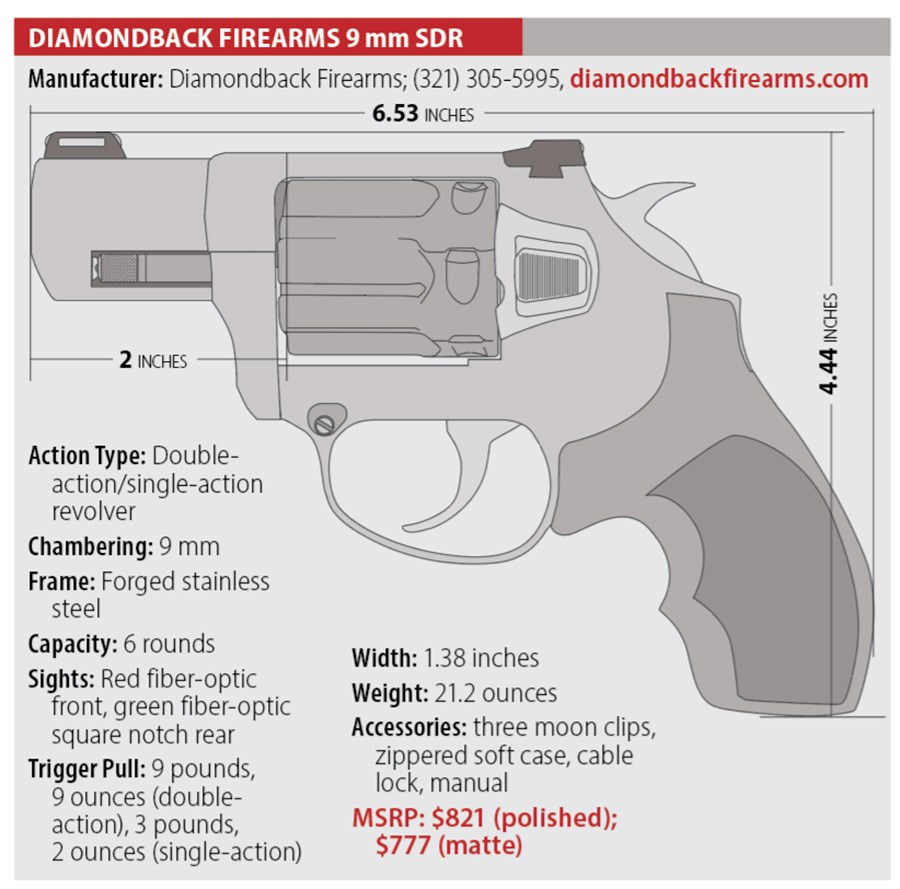
In 2024, Diamondback Firearms launched the company’s first series of double-action revolvers. Dubbed the Self Defense Revolver (SDR), it was initially offered as a 2-inch-barreled, six-shot, all-steel revolver with a forged frame and exposed hammer. Weighing in at 21.2 ounces unloaded, it is made here in the U.S. with a choice of matte, polished or two-tone finishes. Although it draws design cues from the Kimber K6s, it is 1.8 ounces lighter than that model. Originally launched chambered in .357 Mag./.38 Spl., the company released a 9 mm version in 2025.
Folks who are less familiar with double-action revolver history might be a bit surprised that Diamondback would choose 9 mm as the second caliber for the SDR. With popular rimmed calibers from which it could choose, why opt for a rimless semi-automatic-pistol round that requires the use of a moon clip? Let’s start by taking a closer look at what the SDR revolver brings to the table, followed by a few of the reasons why 9 mm is a solid caliber option for the platform.
Drift-adjustable, the rear sight features a notch flanked by two green, fiber-optic dots • The pinned front sight has a contrasting, user-replaceable, red fiber optic • Handsomely contoured, the full lug flows from beneath the barrel and houses the ejector rod • Deeply fluted to reduce weight, the cylinder is released to swing out for reloading by actuating the large cylinder-release latch • At the top front of the trigger guard on the right is a second cylinder-release latch that allows the cylinder assembly to be removed from the frame for easy cleaning of the SDR.
It’s not uncommon for subcompact revolvers to be outfitted with relatively simple, fixed-sight systems. In this case, Diamondback opted to upgrade the re- volver with a set of removable steel low-profile sights. The pinned front-sight blade supports a bright-orange, fiber-optic tube with the drift-adjustable, dovetailed, square-notch rear sight sporting a pair of green fiber-optic pipes. The barrel features a 45-degree crown and a full underlug that shrouds the knurled ejector rod.
The six-shot cylinder benefits from weight-reduction fluting and chamfered chamber mouths for easier reloading. With a measured diameter of 1.38 inches, the cylinder width is comparable to that of five-shot models in this class. The left-side cylinder release is a push-button style similar to those on Ruger and Kimber revolvers. This serrated button is wedge-shaped and larger than most, making it even more intuitive to operate.
A rounded trigger guard houses a deeply curved, smooth-face trigger, described as match-grade by the manufacturer. With small revolvers like this one, trigger feel is a key component of shootability. In this case, the SDR’s trigger did not disappoint. The smooth, even, double-action pull measured 9 pounds, 9 ounces according to a Lyman Products digital trigger gauge. The serrated hammer spur is just right for a concealed-carry revolver, which is to say, just large enough to be comfortable to operate while being trimmed to a compact size. Manually cocking the hammer for single-action fire shortened the trigger’s arch significantly and reduced the trigger pull weight to just 3 pounds, 2 ounces.
The SDR’s grip frame is intentionally shaped to accept some of the most common revolver grips available, namely, grips for Smith & Wesson J-frames. The SDR ships with a pebbled, soft, black rubber boot grip with finger grooves along the frontstrap and an open backstrap. This two-finger grip is both comfortable and just about as compact as possible.
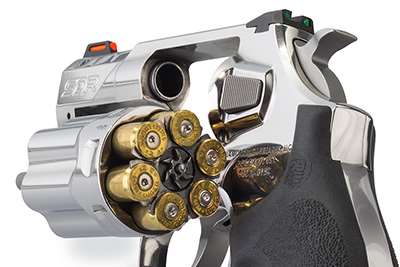
A pre-loaded moon clip allows you to insert (or extract) all six rounds at once. Fitting rounds into a clip or re- moving spent cases is tedious, but speeds reloading.
The SDR’s most uncommon feature is found on the right side of the frame at the front of the trigger guard. In the place of the typical cylinder yoke screw is a spring-loaded release button. With the cylinder in the open position, this button can be pressed to allow the entire cylinder assembly to slide forward and out of the frame. This type of release is usually reserved for caliber-convertible models that ship with a second cylinder group. Diamondback states the release is intended to simplify the re- volver’s cleaning process, which it does. But by producing a 9 mm version of the SDR, they have positioned themselves to eventually offer an SDR with a two-cylinder, caliber-conversion package that would allow one revolver to safely fire .38 Spl., .38 Spl. +P, and .357 Mag., along with 9 mm and 9 mm +P, via a quick and simple cylinder swap.
But, the potential for a caliber-convertible model is only one of the reasons to offer an SDR chambered in 9 mm. The most compelling is the cartridge itself. As of today, the 9 mm semi-automatic-pistol cartridge is among the most commonly used calibers in the U.S. and worldwide. This contributes to practice-grade and defensive ammunition being readily available and more affordable than some calibers. In fact, shooting a wheelgun chambered in 9 mm can save revolver aficionados money, as 9 mm practice ammo currently costs less than similar .38 Spl. loads.
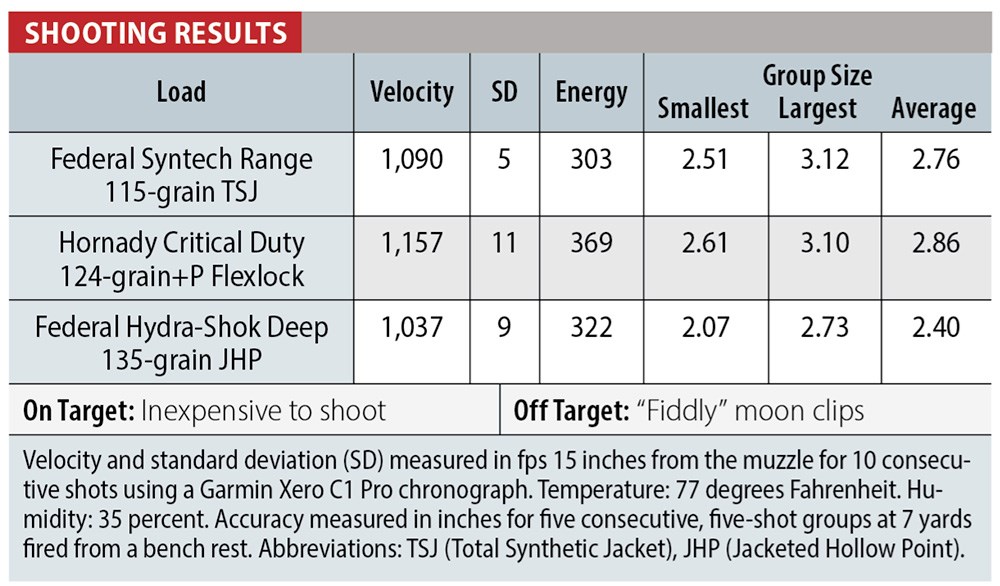
Another way it saves money is cartridge compatibility. For those who already shoot pistols or PCCs chambered in 9 mm, this version of the SDR can be added to the collection without the need to expand your stock of ammunition chamberings.
The SDR represents a nice addition to the wheelgun market, a market vigorously extolled and defended by revolver adherents. It is well-crafted, reliable and innovative, and offers ammo commonality with 9 mm semiautomatics. And the “chore” of moon clips becomes a distinct advantage during a hasty reload.
Read the full article here