

Ever since Beretta launched the A300 Ultima Patrol shotgun in 2024 as a less-pricey alternative to the 1301 Tactical, online gun forums and YouTubers have debated whether the 1301 is worth $650 more than the A300. Like any comparison, the answer lies in what features you value most and how capably each shotgun satisfies your intended use.
This article lays out the most consequential mechanical and features differences between these two Berettas. I’ll also compare their ballistic performance on 25-yard targets using Hornady Black and Rio Royal 00 buckshot loads and on 50-yard targets using Hornady American Gunner 1-ounce rifled slugs. The results may surprise you.
Dimensions & Capacity
Both shotguns hold 7+1 rounds and can chamber 2¾- and 3-inch shotshells. The overall length of both is essentially 38 inches, and you can add about 2 inches or subtract ½ an inch using spacers if you need to adjust the length of pull. The A300 weighs 7.3 pounds, which is about 9 ounces heavier than the 1301.
Both shotguns use a one-piece magazine tube rather than a magazine extension that consumers liked to add to earlier 5+1 versions of the 1301 to increase its capacity. Back then, the 1301 Tactical was configured with a five-shot magazine to meet ATF restrictions, but the 1301 Tactical C model introduced in early 2025 is legal to import with a seven-shot magazine, with a five-shot version still available if you live in a 2A oppressive state.
Construction
Both shotguns have receivers made from 7075-T6 aluminum or Ergal, which is the European-named equivalent. The 1301 receiver uses an Ergal forging, while the A300 is made from a 7075-T6 billet. Forgings offer greater strength because the metal is denser than billets. The barreled action and receiver of the 1301 are made in Italy while the A300 is predominantly made with American parts, except the barrel which is imported from a non-European country. Both have similar buttstocks and fore-ends equipped with M-Lok slots.
The Operating Systems
Both shotguns use reliable, self-regulating, gas-operation systems that worked perfectly for me shooting a variety of loads. Beretta touts the cycling speed of the 1301’s B-LINK system as being 36 percent faster than competitive shotguns, but fractions of a second are meaningless to most shooters. From my standpoint, the 1301’s locking system with its chrome-plated, two-lug rotating bolt made from a forging and nitride-finished bolt carrier are more persuasive reasons to buy it.
The A300’s breech-locking mechanics are much different, with a blued steel bolt and a tilting locking block that moves upward to engage a slot in the barrel extension. It’s a proven design that has some similarity to Remington 870 and 1187 shotguns, but the 1301’s locking method is stronger, and Beretta uses it on its A400 goose guns that fire powerful 3½-inch loads.
Moreover, because it is imported from Italy, each 1301 is subjected to a proof test using overpressure loads to ensure structural integrity while the U.S.-made A300 is not. The chromed and nitrided parts of the 1301’s action are also easier to clean and more rust-resistant. Finally, though the A300’s parts aren’t crudely made by any means, the 1301’s appear to have slightly higher quality metalwork and a smoother finish.
Buttstock Options
Perhaps the most consequential practical difference between these shotguns stems from the location of the recoil spring. The 1301’s spring is situated ahead of the receiver while the A300’s is housed within the buttstock, which precludes mounting a folding or collapsable stock. In contrast, the 1301 accepts stocks that reduce its length, allowing for significantly more compact storage, easier transportation in discrete cases and rapid deployment by occupants inside a vehicle at threats on the outside.
Beretta offers a 1301 with a telescoping and leftward-folding stock from Chisel Machining that measures 29.5 inches in length with the stock folded, and the gun is still operative with the stock folded. However, the Chisel stock I tested in January did not lock in the closed position and swung freely, creating a distraction when fired with the stock folded. An improved Chisel stock with a friction-fit hinge intended to keep the arm folded is planned, but for me, a stock at this price point should have a mechanical lock providing confidence that it stays folded under recoil.
Disassembly & Reassembly
Like most semi-auto shotguns, the 1301 and A300 take a fair amount of time to disassemble for cleaning, a process made more tedious by the need to remove a clamp connecting the mag tube to the barrel. However, reassembling the A300 can be a major source of frustration because the internal parts of its titling-lock bolt need to be oriented just right, the operating rod needs to engage a slot on the bolt while being inserted into the receiver and the bolt extension must fit over the hammer and into the recoil spring cup. Without question, the 1301 reassembles more easily, faster and with less chance for error.
The Barrels
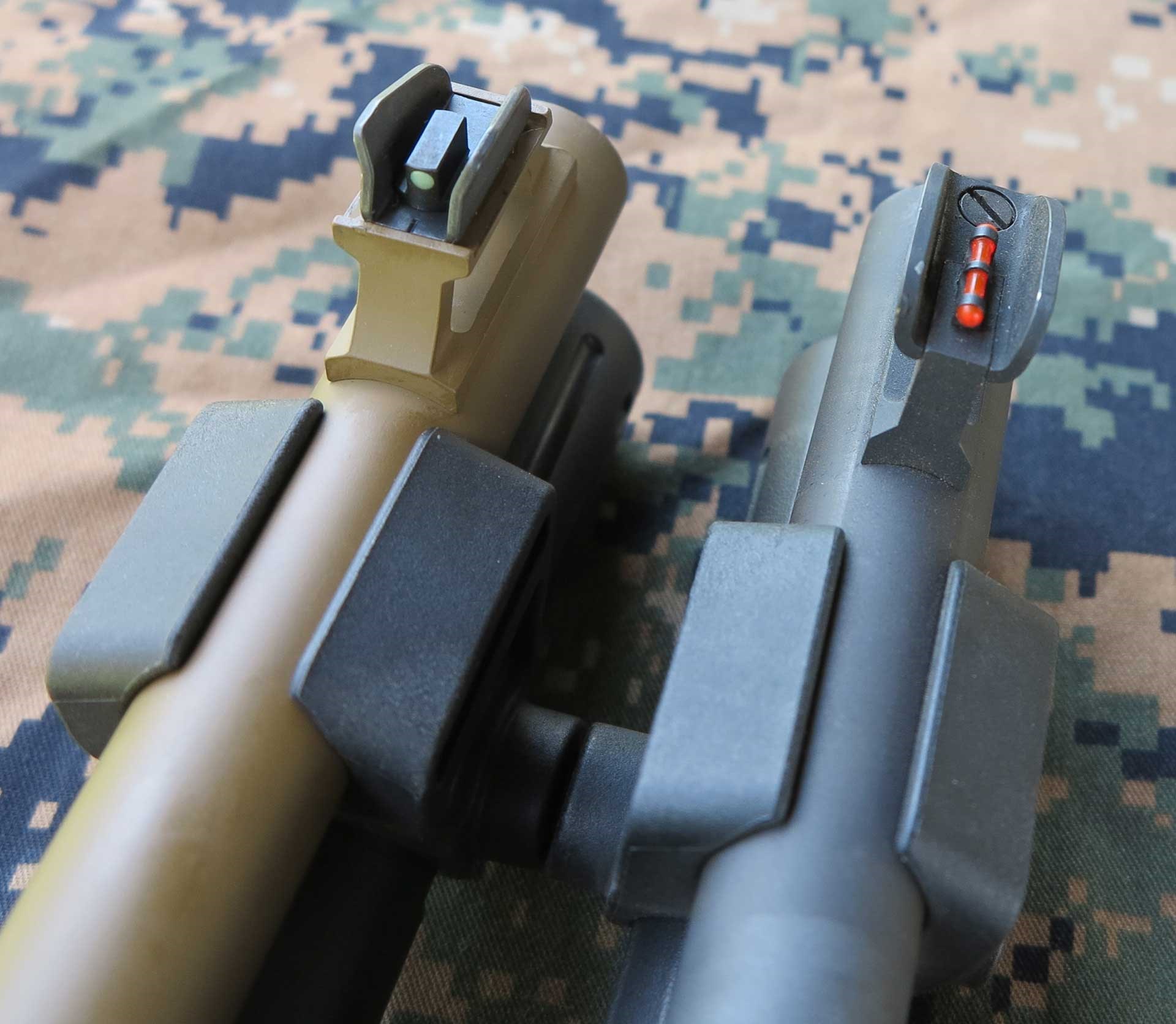
Both barrels accept removable internal chokes, but the 1301 uses Beretta’s “Steelium” barrel, which is far more sophisticated than the barrel of the A300. The 1301’s barrel is chrome-lined to extend its lifespan and resist rust and has a significantly longer forcing cone (80 mm vs. 35 mm) and choke tube (3 inches vs. 2 inches), which should provide tighter pellet patterns with fewer fliers. It also is back-bored, which supposedly lessens felt recoil and improves shot patterns. My live-fire tests using two buckshot loads, covered later in this article, illuminated differences in pattern density.
The Sights
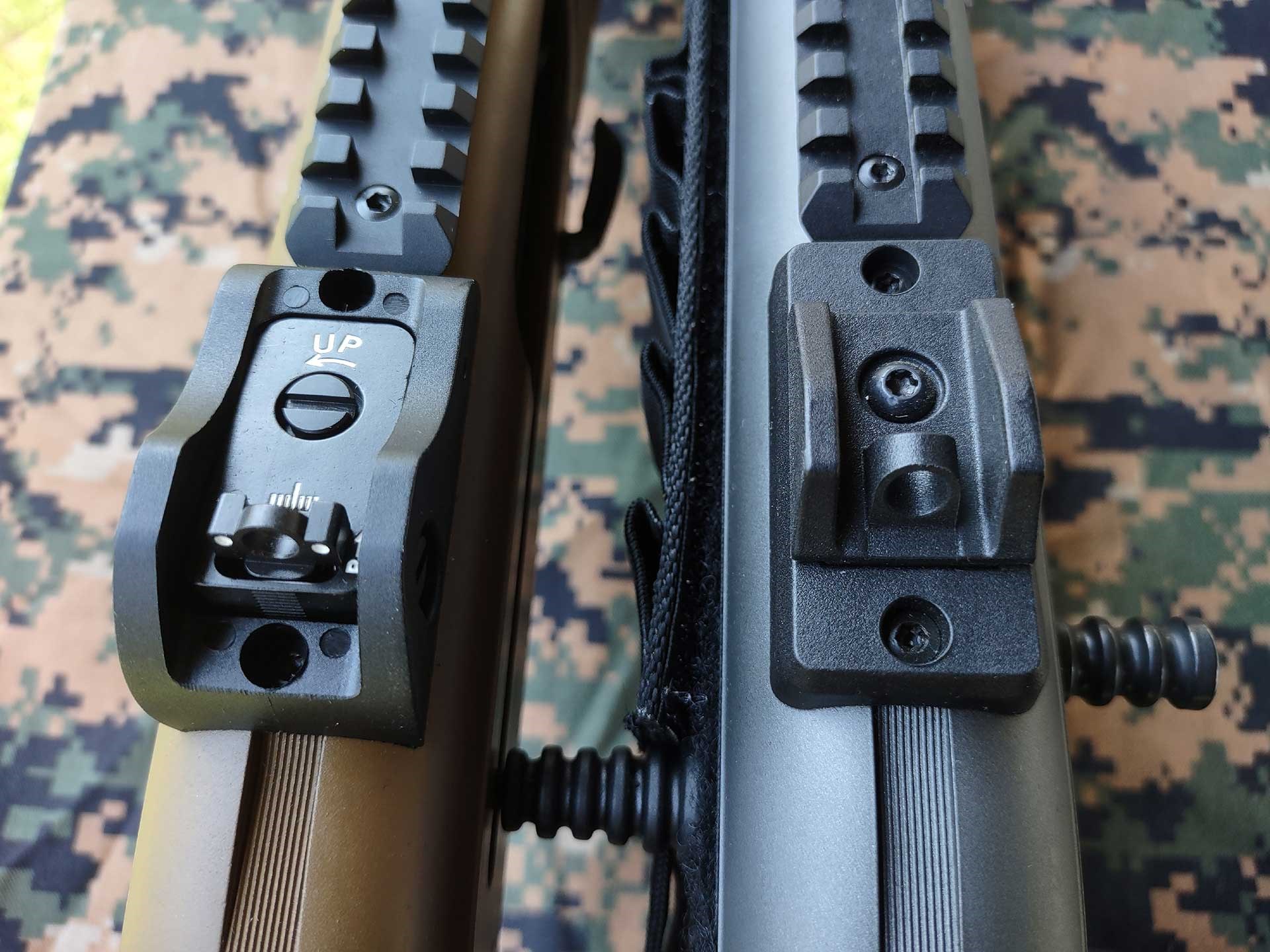
Both shotguns use a receiver-mounted, seven-slot Picatinny rail for mounting optical sights, but their iron sights differ materially. The 1301 has a fully adjustable aluminum ghost-ring rear sight with witness marks contained within a plastic housing, while A300’s ghost-ring sight is fixed and made from plastic. Both shotguns have removable protected front sight blades, but the 1301’s has a white dot and the A300 features a red fiber-optic pipe. While it’s tempting to conclude that the rear sight on the 1301 is identical to the sight used as the military-grade Benelli M4, the latter uses an aluminum housing. If you like the 1301’s sight, Beretta sells it for $85, and it fits the A300 Patrol.
Lifters & Charging Handles
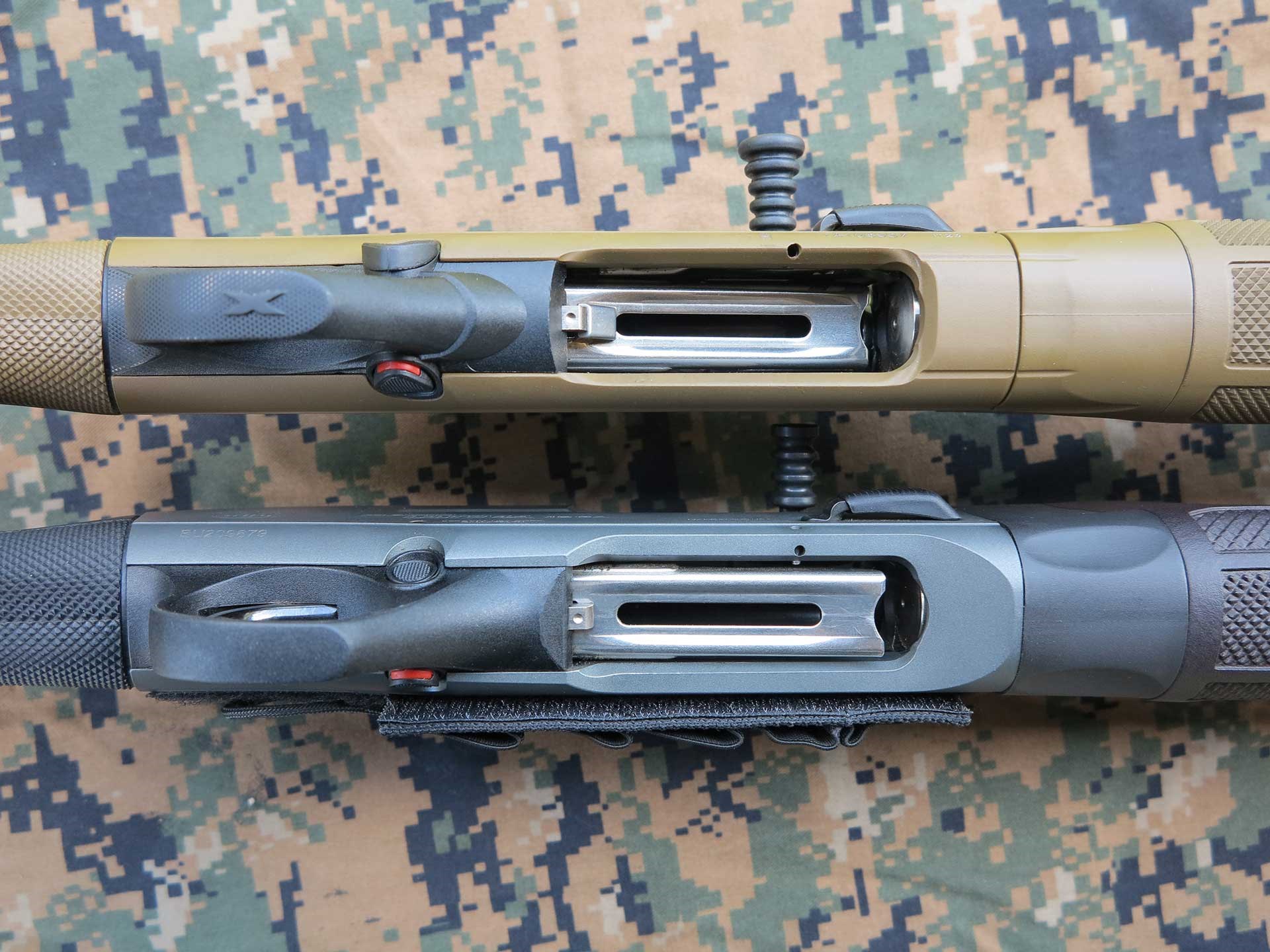
The lifter is a key component of all shotguns equipped with under-barrel tubular magazines. It functions by lifting a shell upward as the action is cycled and aligning it with the breech face as the bolt moves forward to chamber the round. Most lifters like the one used on the A300 rest in the downward position and are prone to catching the tip of your thumb when loading the mag tube. It’s annoying and slows reloading. The ProLifter on the 1301, however, rests in the upward position, which eliminates the thumb catch and significantly speeds reloading. A300 Patrol shotguns can be easily retrofitted with a ProLifter for $85.
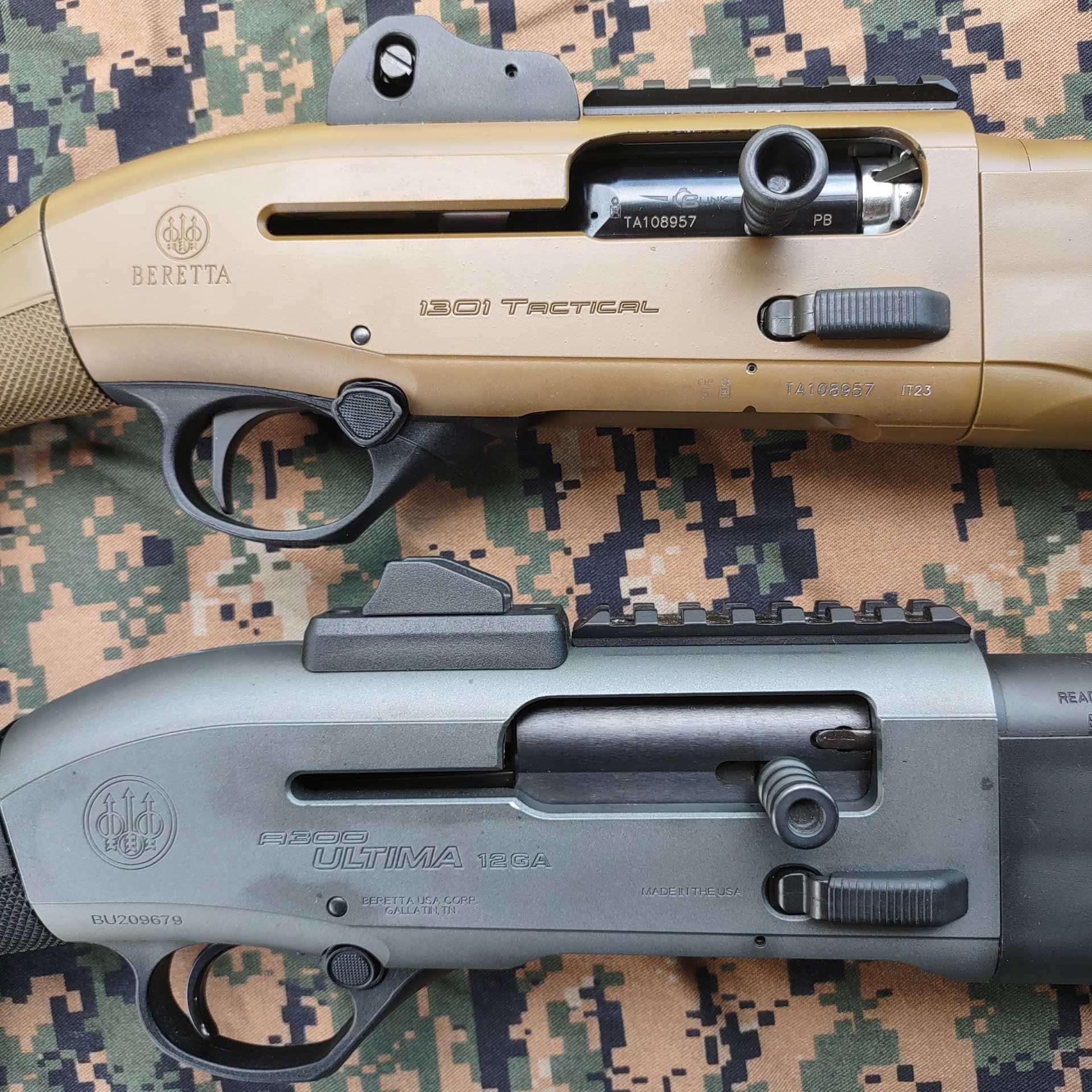
Several years back, Beretta switched to oversized charging handles on most of its self-loaders, which improved their ergonomics, especially when wearing gloves. The 1301’s handle is slightly longer and wider than the A300’s, giving it a small but noticeable advantage in certainty when a right-handed shooter reaches under the action with his left hand to retract the bolt rearward. Would you practice this maneuver in real life when speed and certainty mattered? Yes, when switching the load in the chamber without feeding a round from the magazine, for example, when switching from a magazine loaded with buckshot to slugs.
Triggers & Safeties
The A300’s trigger is curved while the 1301’s is semi-flat, which appears to favor competition shooters and implies a crisp, short break. However, both triggers broke at about 4.5 pounds after a small amount of creep. Worth noting is the fact that the trigger guard on the 1301 doesn’t extend downward enough to comfortably allow you to engage the bottom on the trigger to gain better leverage and a lighter weight of pull.
As for the cross-bolt safety, both are easy to engage and reversible to the opposite side, but the triangular one on the 1301 extends slightly lower than the rounded one of the A300 and is marginally easier to reach. That could matter for those who like to ride the safety with their index finger and disengage it as they come on target.
Available Aftermarket Accessories
Though the 1301 Tactical was introduced nearly a decade earlier than the A300 Patrol and presumably has more aftermarket accessories available, the A300 has become so popular that it now may be a tie as to which shotgun has more custom accessories. A variety of companies equip both platforms, including Strike Industries, Midwest Industries, Mesa Tactical, Langdon Tactical and others.
However, there are only a few aftermarket front sight blades available for the 1301, including a day/night sight from XS Sights that is made of steel with a bright yellow or orange ring surrounding a tritium insert. It’s sturdy and far easier to acquire than the standard Beretta sight but is higher, requiring you to re-zero your shotgun on target. I couldn’t find any aftermarket front sights for the A300 Patrol, however.
Another easy-to-install option is the Truckee Forend from Mesa Tactical. It’s made of aluminum and more rigid than the OEM plastic version. That rigidity matters a lot if you intend to mount a vertical foregrip on the fore-end that will facilitate the “Push-Pull” firing technique. Pioneered by Ron Haught of Symtac Consulting, this technique mitigates felt recoil and enhances speed and accuracy.
Range Time
Both shotguns functioned flawlessly using four different 2¾-inch loads, including three-dram equivalent birdshot practice shells. Measured velocities of the buckshot loads were essentially equivalent between the two shotguns, though less than the factory-advertised velocity presumably caused by the longer barrels on test guns.
To assess how each shotgun patterned, I used performance and economy buckshot loads from Hornady and Rio, respectively. Hornady Black is a tactical load that uses a specially designed wad that keeps pellets more concentrated together compared to conventional wads, thus allowing you to engage targets at longer distances and deliver more pellets on target. The Rio Royal load, in contrast, costs much less but only uses a flat plastic disk as a wad that sits behind the pellets.
Patterning was done at 25 yards, and the number of pellets landing within a 12-inch circle over 10 shots was noted. The results show that the far more sophisticated Beretta-made 1301 barrel delivered only 4 percent more pellets (89 percent versus 85 percent) within the 12-inch circle than the A300 using the Hornady Black load.
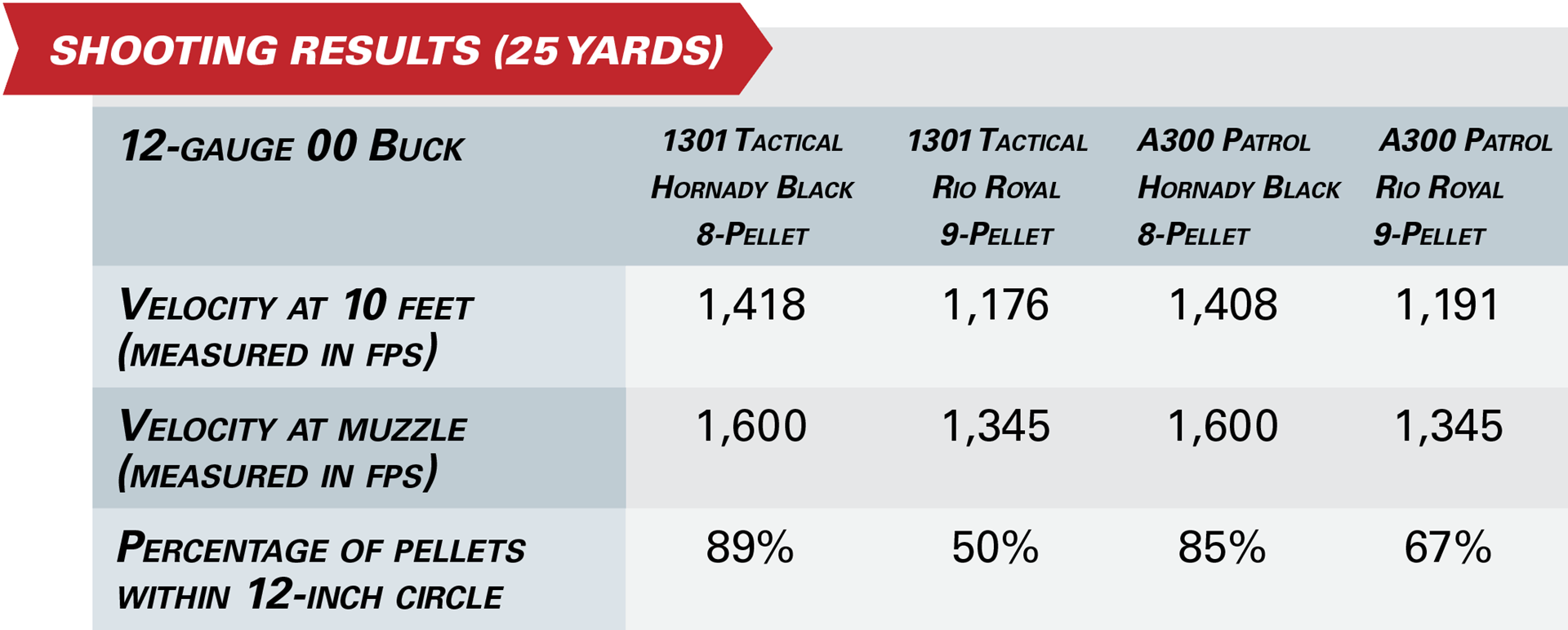
More surprisingly, the A300 delivered 17 percent more pellets (67 percent versus 50 percent) into the circle with the economy Rio load than the 1301. Another favorable discovery for the A300 was the fixed sights were fairly regulated with the center of the patterns typically slightly low and right from the point of aim.
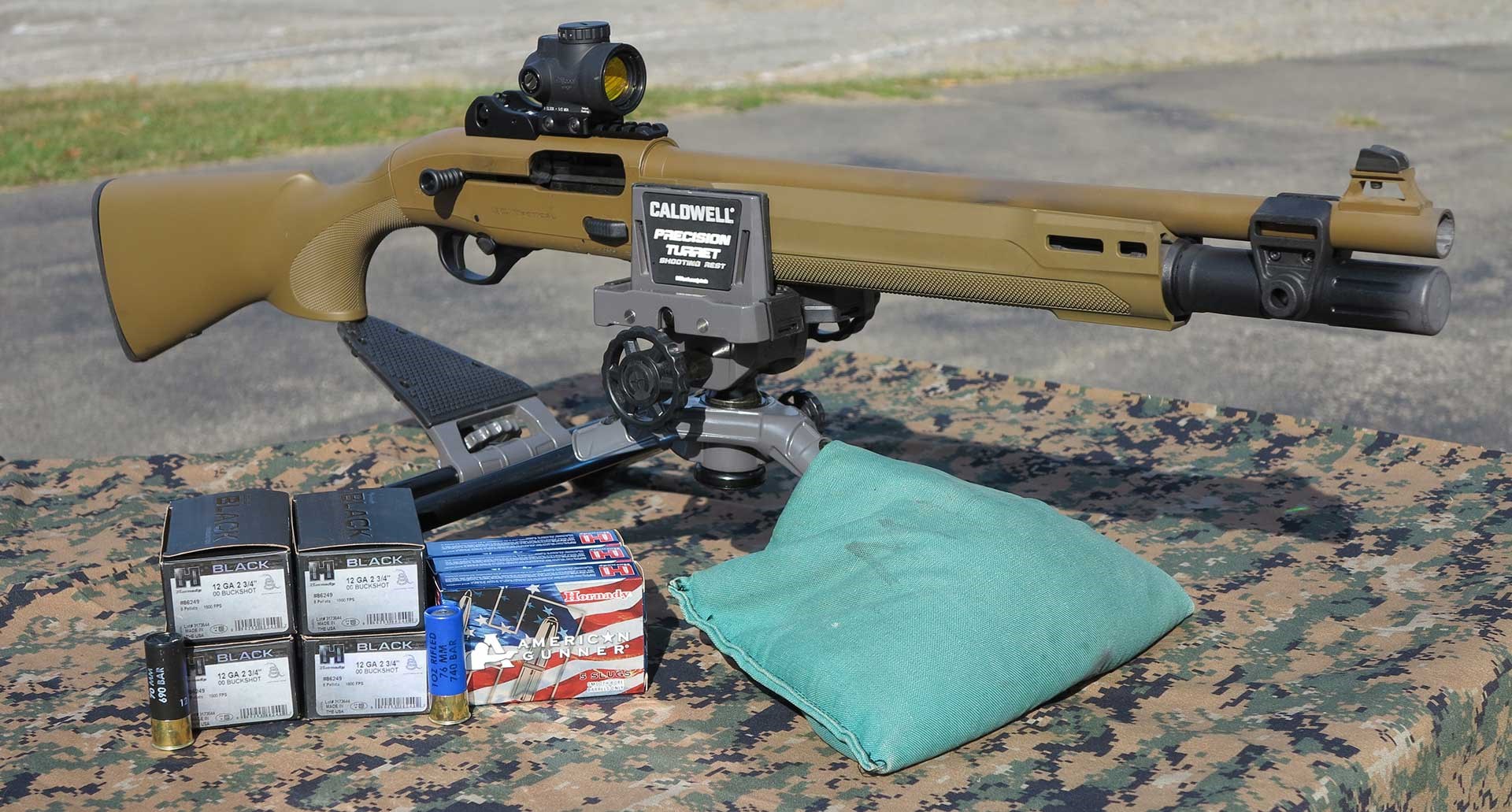
Slug accuracy at 50 yards was tested briefly using Hornady American Gunner 1-ounce rifled slugs with each shotgun equipped with a Trijicon MRO optic and fired off a Caldwell Precision Turret rest. However, the results were disappointing, and I ceased testing after firing 20 rounds from each platform because the five-shot groups ranged from 5 to 8 inches. Those results may vary with different ammo, but I was expecting much tighter groups like those I shot with the Benelli M4 using Hornady American Whitetail slugs.
Both shotguns handled well, and I couldn’t perceive any difference in recoil. I preferred the tactile feel of the curved trigger on the A300 and its red fiber-optic front sight was far easier to pick up than the white dot on the 1301. As for the ergonomics of the safety and charging handle, the 1301 has a slight edge over the A300, which is most apparent at night and when your drills involve dynamic movement.
Conclusion
There’s no universal answer on whether the added $650 of the 1301 is justified, especially when two of the 1301’s best features—the ProLifter and adjustable rear sight—can be purchased and added to an A300 for less than $180 and the performance using Hornady buckshot and one type of slugs was equivalent.
However, the 1301’s breech locking system, chrome lined barrel, easier reassembly, rear sight, marginally better controls and ability to accept a folding stock were collective advantages that moved me to buy one over the A300. It’s not a perfect shotgun for me, but as many of you can relate to, customizing and improving my 1301 is a work in progress as funds permit.
|
KEY SPECIFICATIONS |
||
|
|
1301 Tactical C |
A300 Ultima Patrol |
|
Length |
37.8 inches |
38 inches |
|
Weight |
6.7 pounds |
7.3 pounds |
|
Barrel |
18.5 inches |
19.1 inches |
|
Accessories |
2 stock spacers, choke wrench, lock, oil |
2 stock spacers, choke wrench, lock, oil |
|
KEY DIFFERENCES |
||
|
|
1301 Tactical C |
A300 Ultima Patrol |
|
MSRP |
$1,849 |
$1,199 |
|
Breech locking system and finish |
Chromed two-lug rotating bolt |
Blued tilting block |
|
Folding stock capable? |
Yes |
No |
|
Receiver |
Forged Ergal aluminum |
Billet 7075-T6 aluminum |
|
Rear Sight |
Fully adjustable metal ghost ring |
Fixed plastic ghost ring |
|
Front Sight |
White dot on protected blade |
Protected red fiber-optic |
|
Barrel |
Steelium, chrome-lined, made by Beretta-Italy, backbored with elongated forcing cone |
Imported, non-Beretta, standard length forcing cone |
|
Barrel Choke length |
3 inches |
2 inches |
|
Lifter |
ProLifter |
Standard |
|
Controls- Safety, Charging Handle |
Oversize + |
Oversize |
Read the full article here