


I’ve long advocated for varmint hunting, specifically prairie dogs, as a fantastic way to test and hone one’s long-range shooting skills. It can be quite tempting to aim for the largest steel target when on a static range—the dopamine of the clang on steel is really hard to beat, especially when reaching out past 800 yards or so. That time-of-flight delay gives just enough time to reacquire the target, and if you can spot your own impact before the sound reaches your ears? Bliss.
But, maybe you want a greater challenge for your shooting skills. Hitting a 24-inch plate at 800 yards is 3 MOA (sorry guys, I know mils are all the rage, but I’m an old man who thinks better in MOA…), which is decent enough shooting especially when factoring in wind. A prairie dog, though, even the really *ahem* well-fed ones, might reach 6 inches wide. That’s sub-MOA shooting. On a target that can (and usually will) move at literally any moment.
I recently spent three days out in Wyoming chasing dogs, and with an influx of high-quality, long-range based ammunition from Hornady, we were encouraged to “go long”—there were “awards” for the longest rifle and handgun shots, as well as special prizes for those who connected with prairie dogs out past 1,000 yards. Rifles and ammunition have progressed to the point where hitting a 6-inch target at 1,000 yards or more is easily achievable for (moderately) competent rifle shooters. And, to pat myself on the back, I joined the club with a hit on a prairie dog at 1,123 yards. To bring myself back down to earth, the longest shot bested that distance by more than 200 yards…
We had rifles chambered in .25 Creedmoor, 6 mm ARC and .22 ARC, as well as others in .204 Ruger, .223 Rem. and several rimfires. It’s genuinely hard to say which of the rifles and chamberings was “best,” as they’re all slightly different for different purposes. The .25 Creedmoor was way overkill for prairie dogs, save for having slightly more wind resistance at distance, while the .22 ARC was simply a joy to shoot. I think I ran through 80 or 100 rounds the first morning, and the only reason my shoulder was even moderately sore had to do with the odd contortions I had to do on the short bench rather than any recoil.
If pressed to name my favorite, though, I’d have to say the 6 mm ARC. Granted, the rifle chambered in 6 mm ARC was a custom long-range rig weighing in well over 12 or so pounds with a heavy barrel and rock-solid action, so it felt like a subsonic .22 LR. At distance, though, it was a true champion, dropping dogs at distances well into the four figures. I mentioned my long shot of 1,123 yards earlier, and out of the three media attendees, the others all reached even farther. At that distance, a ~ 12-inch prairie dog is—at best—barely a 1-MOA target (and, not really, because that’s lengthwise. Width-wise it’s more like ½-MOA).
The second day of shooting, we spent the morning in a different field and opted for intermediate-range shooting with more traditional calibers, namely .223 Rem. and .204 Ruger as well as .22 LR and .17 HMR. Even at 300 yards, where wind doesn’t play quite as much of a factor, locating, ranging and then hitting dogs is quite challenging to one’s skills. Again, remember that even a large prairie dog might be a 2-MOA target at that distance—and if one opts for smaller targets, it quickly shrinks down. The basics are always in style, and even on a single-shot bolt gun, you have to press the trigger carefully and follow through. I know I missed several dogs because I was already picking my head up to see the target (and yes, I know I shouldn’t do that—believe me, Chris Cerino has scolded me several times now for it …). Applying the basics rewards you with confident hits and the ability to choose even smaller targets. I won’t specify, but we’ll just say you can really get ahead if you remember the basics…
There is one last thing I want to mention about varminting: it’s fun. A lot of fun. I’d say it’s easily in my top-three favorite things to do with a firearm, up there with spending an afternoon with a brick of .22 LR, several .22 LR revolvers and rifles and a heap of steel or connecting at a mile or greater. It’s a phenomenal way to test your shooting ability, as you need to be able to spot targets, range targets, acquire targets and effect a proper trigger press both rapidly and accurately. Prairie dogs move erratically and can run at literally any time, so efficiency of operation and proper skill application are critical. Press that trigger carefully, follow through and be ready to send another shot.
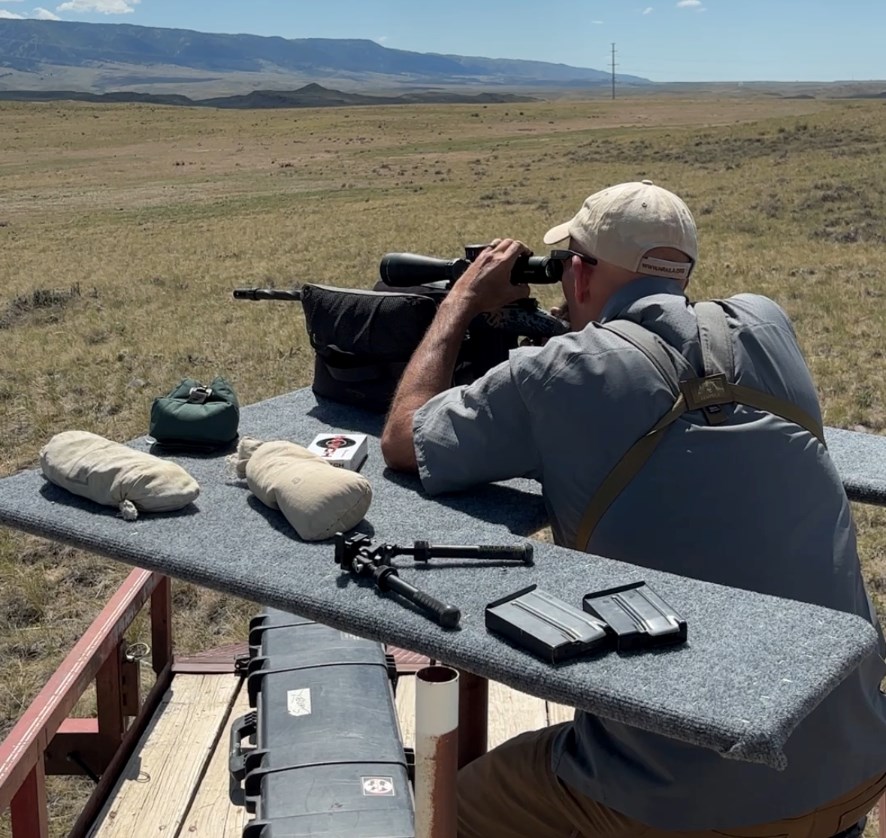
I’ve had the opportunity to go after dogs both up close with suppressed .22 rifles and pistols as well as at long distance, and I’m genuinely stumped as to which is my favorite. Up close is a true test of one’s snap-shooting skills, but going long after a prairie dog gives those long-range muscles a real workout. I’ll close with this, though: Before this trip, my longest hit on a prairie was at 381 yards, and I thought that was pretty far—as I put it, “you’re hitting a target the size of a football from four football fields away.”
I’ve now taken that distance to eleven football fields, on the same-size target. Granted, there’s a lot to be said about quality equipment: everything from the custom bolt-action rifles to the Hornady ammunition and the Leupold binoculars worked perfectly (as expected). There are those who rightly point out that “you can’t buy skill,” and there’s a lot of truth to that; however, having the right equipment that’s tested and proven takes a lot of the guesswork out of the long-range equation.
When you press that trigger and watch the round impact the target (and believe me, you know it when a .25 Creedmoor round hits a dog at 400 yards), it rewards proper form in a way that even ringing steel doesn’t. If you get the chance, I highly recommend testing your rifle skills against prairie dogs. Whether you want to go long, intermediate or even try your hand at close range with a .22 LR, you’ll hone your shooting with an unpredictable target that rewards good form and is unforgiving of mistakes. And, again, it’s a crazy amount of fun.
Read the full article here