

The Mingo Ultimate Firewood Marker enables someone who is processing firewood to buck logs into rounds of remarkably uniform length. It does this by placing a spot of inverting marking spray at precise intervals onto a log that is being prepared for bucking.
This precision is especially helpful for those who heat with smaller wood stoves. The fireboxes of smaller stoves have less margin for error than the fireboxes of larger stoves. A piece of cordwood even one inch too long can make it impossible to shut the door on the firebox of a smaller stove.
Variations of the Marker are designed to mark at 6, 12, 14, 16, 18, 20 or 24-inch intervals. They cannot be retrofitted to adjust length, so you’ll have order them separately, to match the capacity of your stove’s capacity.
The Mingo Marker is made in the USA. At the time of this writing, the version with the 18-inch wheel cost $37.99 at mingomarker.com
Background
My wife, “Kari”, and I heat our home primarily with wood.
For the past seven years, most of our heat has been provided by an outside wood boiler. That boiler also provides our hot water. The firebox on the wood boiler is 34 inches deep. I usually try to cut my rounds 18 inches long. If I accidentally cut one 19 or 20 or even 24 inches long, it is not a big deal. There is plenty of room in the firebox for the longer pieces of cordwood.
Prior to the installation of the wood boiler, we heated our home primarily with a wood-stove-insert in the fireplace in the living room. The firebox on the fireplace insert is only 19 inches deep. Back when we heated primarily with that insert, I typically tried to cut my rounds 16 inches long. Sometimes I accidentally cut them longer. Pieces of cordwood that came from rounds longer than 19 inches would not fit in the firebox. If the cordwood was too long, I would need to trim it down before I could use it.
I currently try to cut my rounds 18 inches long. This allows me to use the resulting cordwood in either the boiler or the insert. But I often find myself with a load of 20-plus-inch pieces of cordwood. When that happens, I need to trim them down before I can use them in the insert.
This situation made the Mingo Marker an item of interest to me. When I heard about the tool, I contacted The Mingo Marker, LLC to see if they could provide me with a sample for testing and evaluation. They were kind enough to agree. About a week later, a package arrived at my home.
First Impressions
The Marker arrived in an 11.88 x 12.13 x 3.25 box, wrapped in white plastic. It was sent via UPS Ground Saver from The Mingo Marker, LLC, 284 Ridge Ave., Benton, WI 53803.
Removing the plastic wrap revealed the product box for “The Mingo Ultimate Firewood Marker.” The back of the box was imprinted with contact information: email (TheMingoMarker@gmail [the .com was omitted, probably to make the email address similar in length to the web address and phone number]), web address ( www.MingoMarker.com ), and phone number (1-800-815-1344). I did find the website to contain a lot of helpful information, including helpful tips for measuring, stacking, and drying firewood.
The back of the box had two similar but distinct sets of instructions for using the tool. Upon opening the box, I found an 8 x 8 inch card with a third distinct set of directions for use, a 7 x 5 inch card with a fourth distinct set of directions for use, and a fifth distinct set of directions for use printed on the side of the tool itself.
To collate and summarize these various instructions, here is how to use the tool:
1. Shake the paint can and insert it into the tool.
2. Loosen the wing nut on the hub of the wheel so that the wheel can rotate freely.
3. Gently drag the tool backward on the surface of the log until the wheel stops turning, and the paint nozzle is directly over the edge of the log.
4. Roll the tool down the log keeping the paint can in a vertical position.
5. Clear the nozzle of the paint can when the marking is finished.
6. Re-tighten the wing nut to prevent accidental spraying.
There was also warranty information in the box. The tool is warranted against defects in material or workmanship for the lifetime of the original purchaser.
The wheel was detached from the tool during shipment. It was a quick and easy process to attach the wheel.
The manufacturer recommends that the user wear eye protection and gloves while using the Marker. They also note that fluorescent paints have a tendency to clog prematurely. They recommend using the colors red, white, or blue instead.
One can of paint is estimated to mark about 75 full cords of wood. This varies greatly depending on the length and thickness of the rounds. For example, a single can will mark roughly four times as many cords of 24-inch-long rounds as 6-inch-long rounds assuming that the rounds are of the same diameter. Similarly, the can will mark roughly 16 times as many cords of rounds that are 24 inches in diameter as rounds that are 6 inches in diameter assuming that the rounds are marked to the same length. If the rounds are both four times as long and four times as thick, then the can will mark roughly 64 times as many cords.
Testing
I was putting on my boots to go outside. Kari asked, “What are you doing this morning?”
I replied, “I am testing a tool that marks a log every 18 inches. Then the log can be cut into rounds that are of uniform length.”
Kari responded, “Isn’t that what you have been practicing for the last 13 years.”
I replied, “Yes, but hopefully this will be more precise.”
It was a foggy morning in early March. The temperature was 42 degrees Fahrenheit. The gray morning light was barely penetrating the mist as I made my way into the sodden forest behind the pole barn. There was a small, wind-fallen tree in the woods behind the barn that I wanted to buck into rounds to be split into firewood.
I had about a dozen cans of ancient “Super Stripe Traffic Power” paint. I had rescued the cans from the trash at our church a decade or so in the past. They were a relic of a long-ago youth ministry bike trip.
Following the directions on the back of one of the cans, I shook the can for one minute after the agitator balls in the can started rattling. It took more than a minute of shaking to get the balls to start rattling in the first place.
After the can was thoroughly shaken, I tested the can on a piece of cardboard. Much to my surprise, it worked well.
Take note that standard spray paint cans will not work with an inverted marking device, because inverted marking spray paint cans have a special design that allows them to expel paint when inverted. Standard spray paint cans will only spray out propellent when they are activated upside down. And that, in fact, is the best way to clear a paint nozzle tip, when you are putting away a partially-used can of spray paint.
 I inserted the can into the Mingo Marker and ran the tool down the log in accord with the directions that I summarized above. The Marker performed as advertised. I verified the spacing between the marks with a tape measure. The spots sprayed on the log were precisely 18 inches apart except for a few places where I had detoured around knots or the wheel had slipped off of the side of the log due to carelessness on my part.

 Next, I gassed up the chainsaw, bucked the log at the center of each marked spot, and moved the resulting rounds to the wood pile. I was very pleased with the uniform length of the resulting rounds.
Suffering From CDO
Some people say that I have CDO. CDO is like OCD (Obsessive Compulsive Disorder), but it is in the correct alphabetical order, to wit: Compulsive Disorder of Obsessiveness (CDO). I feel less anxiety when I say it that way. The correct alphabetical order is important. Can’t you understand that?
If you have CDO or even OCD and you heat with wood, then The Mingo Ultimate Firewood Marker is a must-have tool for you. It is wonderfully aesthetically pleasing to have all of your firewood rounds exactly the same length.
(Full Disclosure: I don’t really have CDO or even OCD. My desk is often a mess, my lawn consists of more weeds than grass, and Kari wishes that I would clean up my workbench. It is true that I enjoy cleaning my guns even more than I enjoy shooting them, but that is because it is easier to admire their engineering while taking them apart and reassembling them. And it is true that firewood rounds of uniform length are more aesthetically pleasing than rounds of irregular length. But I don’t have CDO. Really, I don’t.)
Conclusions
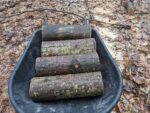 The Mingo Marker sprays dots of inverting marking spray at remarkably consistent intervals onto logs that are about to be bucked. This enables the logs to be cut into rounds of uniform length. This consistency is helpful for producing cordwood for use in stoves with smaller fireboxes. There is also a certain beauty to rounds of uniform length.
Disclaimer
The Mingo Marker, LLC provided me with a sample of their Ultimate Firewood Marker with an 18-inch wheel for testing and evaluation. I tried not to allow their kindness to impair my objectivity in this review, and I believe that I have succeeded. I did not receive any other financial or other inducement to mention any vendor, product, or service in this article.
Read the full article here