
Colt’s Police Positive revolver was one of the most popular firearms made in the early 20th century and remained in the company’s line for nearly half a century. Or so they say. But during my research on the Colt Police Positive revolver, I discovered something unexpected. Colt actually made two versions of the Police Positive. At the same time. In fact, from a certain perspective, you could say they made three versions at the same time. And it lasted a whole lot longer than most sources say. Let’s take a look.
Colt Police Positives are small-frame, six-shot, double-action revolvers produced starting around 1905. They are an improved version of the Colt New Police revolver first introduced in 1896 and incorporated a internal hammer-block safety, named the “Positive Safety,” to prevent it from firing if the hammer was struck or if dropped, allowing the gun to be carried safely with six shots, hence the incorporation of the term “Positive” in the name.
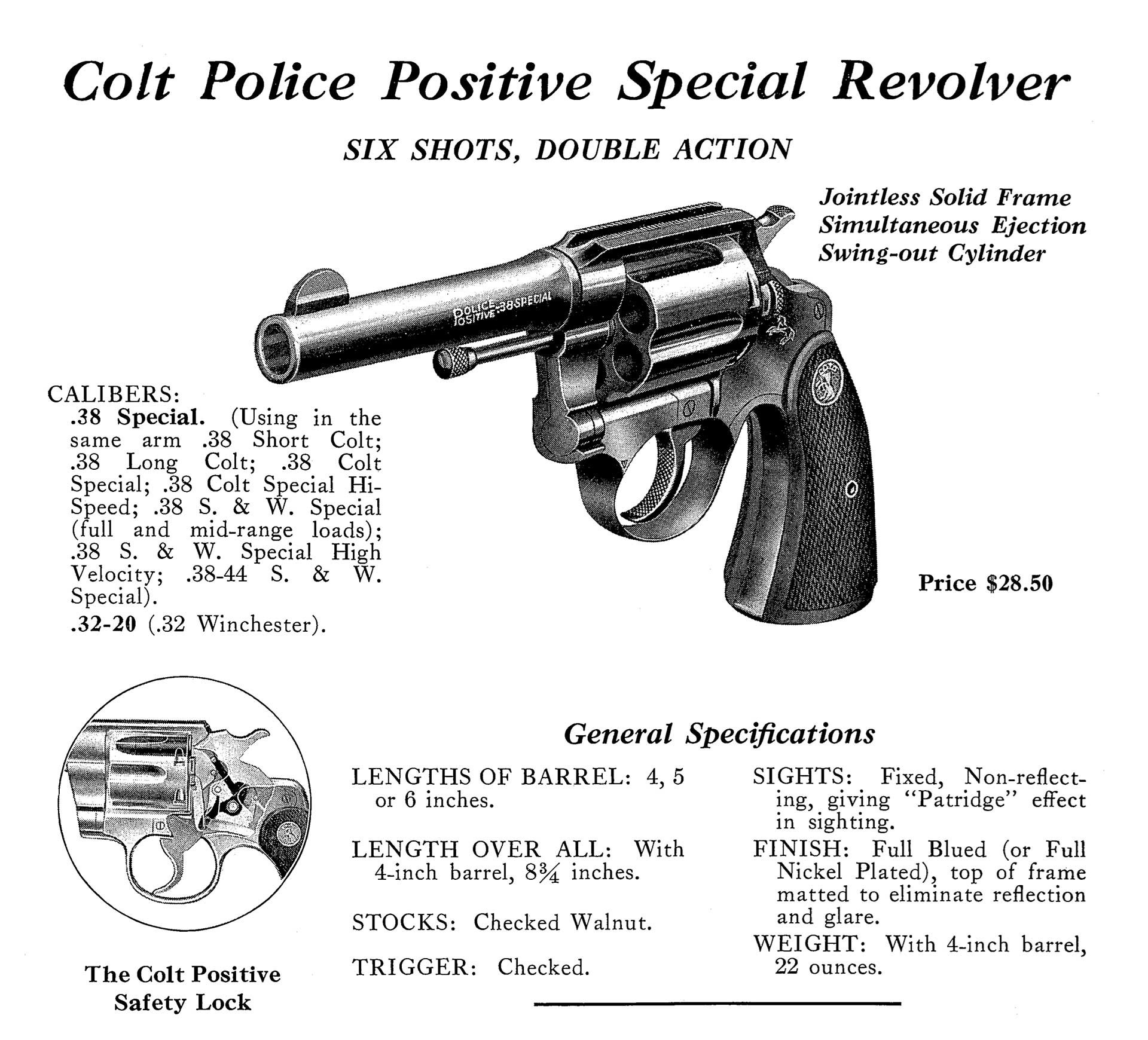
There were two Police Positive models in Colt’s lineup: the Police Positive and the Police Positive Special. The distinction between them was the length of the frame and cylinder, which determined what calibers they would handle. The Police Positive had a short cylinder measuring 1.25 inches long. The Police Positive Special had a longer cylinder of 1.57 inches that was required to fit the longer .32-20 Winchester and .38 Special cartridges.
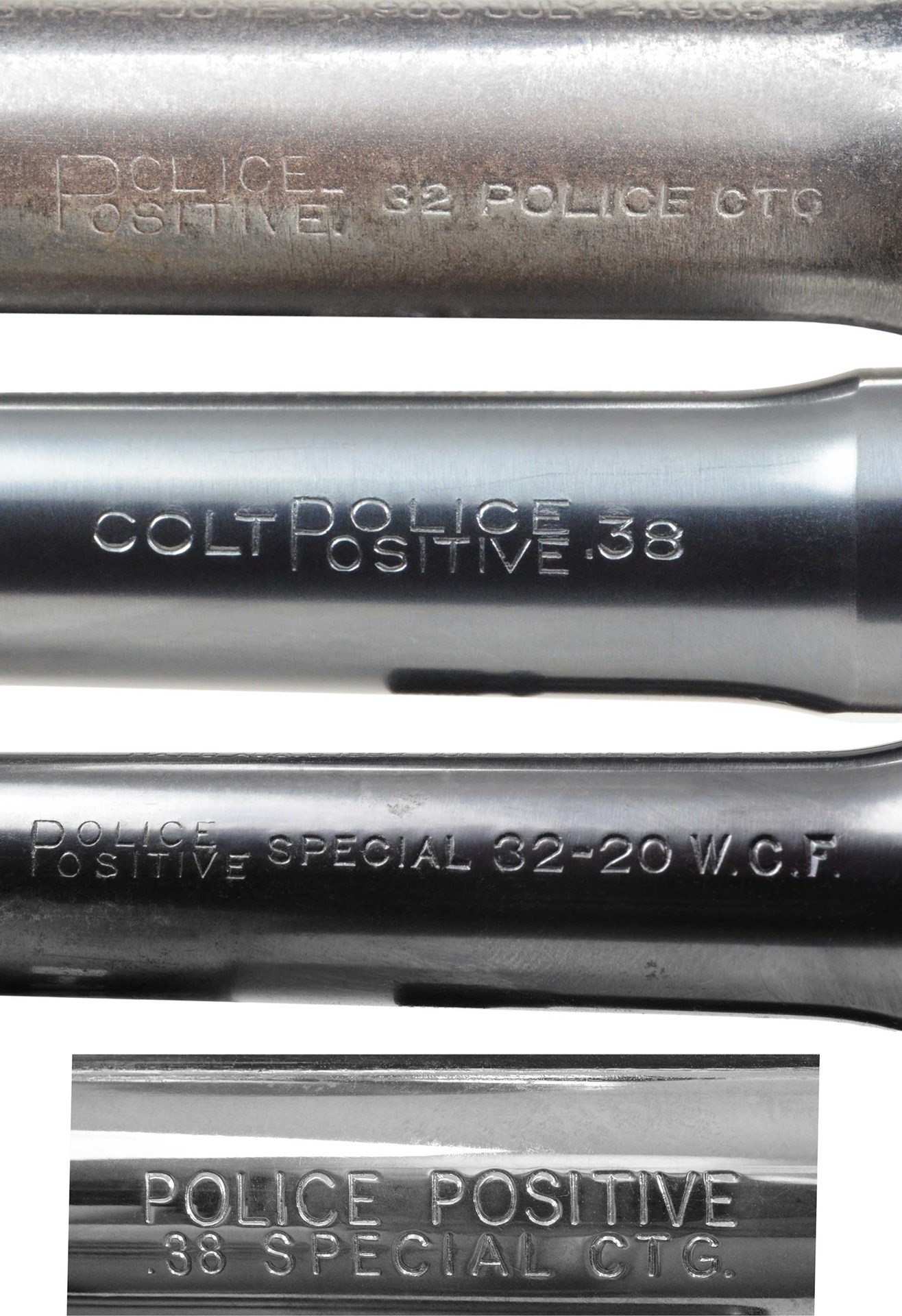
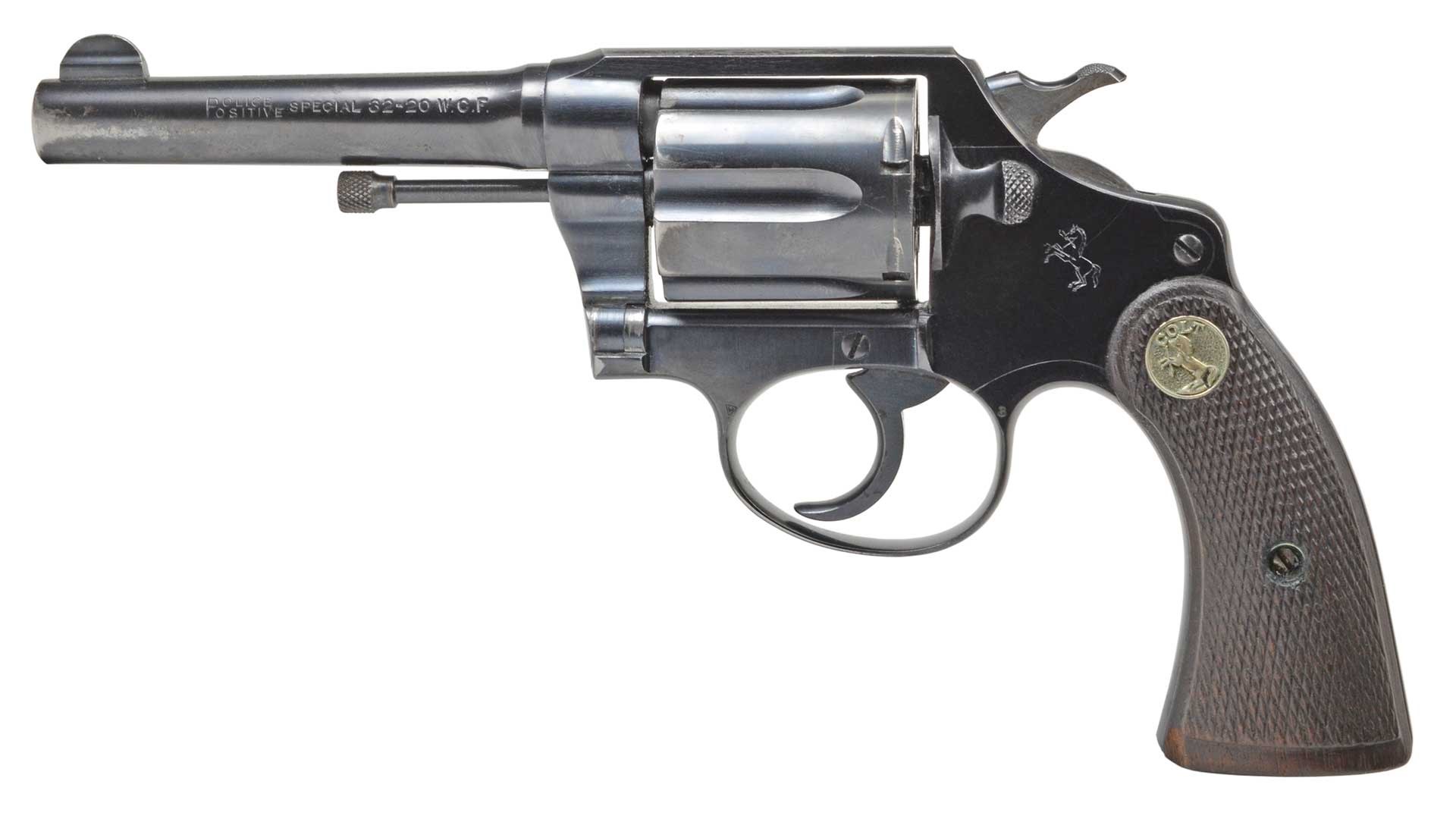
On each example, the revolver model was stamped on the barrel along with the cartridge name. With Police Positives, Police Positive was stamped on the barrel. So far, it’s all simple enough. With Police Positive Specials, though, things were less certain. Sometimes, “Police Positive Special” was stamped on the barrel, and sometimes, it was stamped just “Police Positive.” The only way to know it was a Police Positive Special was if it was chambered for .32-20 Winchester or .38 Special, or by the cylinder’s length in the case where it was chambered for shorter calibers.
Chamberings, Chamberings Everywhere
The Colt Police Positive was produced from 1905 to 1947. It was chambered in .32 Colt (.32 Long Colt and Short Colt), or .32 Colt New Police (aka .32 Colt Police Positive, aka .32 S&W Long) or .38 Colt New Police (aka .38 S&W; not to be confused with .38 Short Colt, which is a different cartridge). The .32 Colt New Police and .38 Colt New Police cartridges were just modifications of already existing .32 S&W Long and .38 S&W cartridges, respectively.
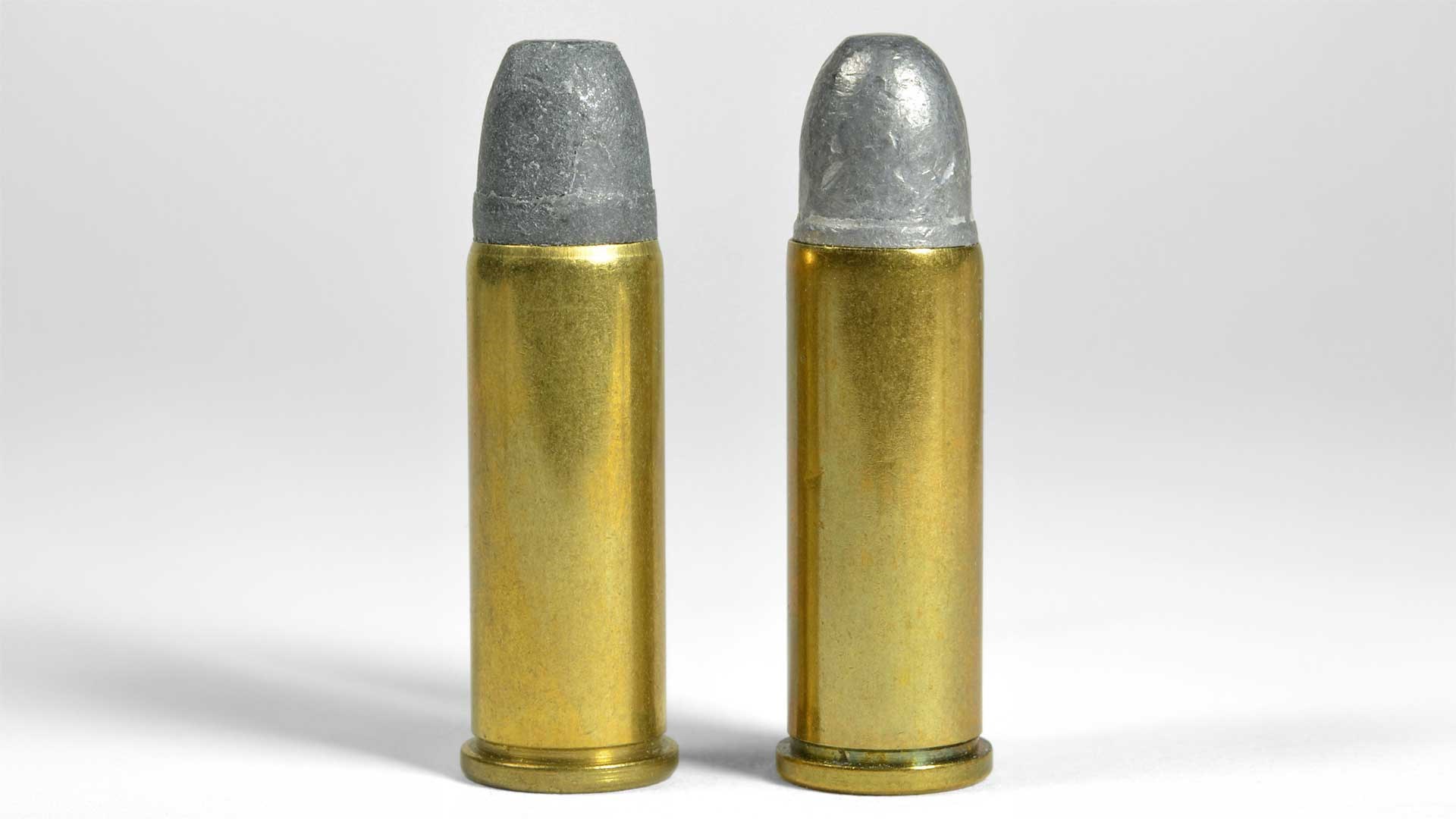
Colt’s versions had flat-nose bullets compared to the round-nose bullets of the S&W named versions. Colt did this so the Colt caliber name could appear on their guns and ammo, since the company did not want to give S&W any free advertising. Available barrel lengths were 2, 2.5, 4, 5, and 6 inches. About 200,000 Police Positives were made.
Despite the potential confusion of caliber that was stamped on the barrel, Colt’s catalogs listed both the Colt and S&W cartridges for these guns. For example, in Colt’s 1935 catalog under the company’s description of the Police Positive, it listed the following description under the .32-caliber cartridge:
“.32 Colt Police Positive. (Using .32 Colt Police Positive (New Police); also .32 S. & W. Short and Long Cartridges, when the barrel is stamped “.32 Police Ctg.”)”
Under the .38-caliber cartridge they have:
“.38 Colt Police Positive (New Police). (Using .38 Colt Police Positive (New Police) and .38 S. & W. Cartridges.)”
Perfectly clear, right?
Confused by all this caliber-speak? Don’t worry, they were confused at the time, too. Many ammunition catalogs of the day had a page listing “interchangeable” cartridges. For example, the 1933 Remington UMC catalog showed these cartridge names as interchangeable: .32 S&W Long, .32 S&W Long Gallery, .32 Colt’s New Police and .32 Colt’s Police Positive. (The gallery load was a low powered load made specifically for shooting galleries and were common to some handgun calibers at the time such as the .38 Special.)
The same was the case with the .38 ammo, but fortunately, there were just two common names, .38 Smith & Wesson and .38 Colt New Police (although you could add .38/200 and .38 Super Police when loaded with a 200-grain bullet). In ammo catalogs from that era that I looked at, the .32 Colt New Police ammo was almost universally referred to as .32 Colt New Police, with “Police Positive” sometimes indicated in parentheses. And the same for the .38 Colt New Police and “Police Positive” sometimes in parentheses.
The .32 and .38 Colt New Police ammo are long out of production, though vintage ammo can sometimes be found on gun-auction sites on the internet. Since the .32 Colt New Police and .32 S&W Long are the same ammunition with different names, when we see .32 Colt New Police, we should just think .32 S&W Long (colloquially referred to as just .32 Long). And for .38 Colt New Police, think .38 S&W. The .38 S&W is still available because so many old guns are still in circulation.
The 2022 Sporting Arms and Ammunition Manufacturers Institute (SAAMI) specifications manual lists both names under their cartridge description. Their pressure and dimensional standards for the .32 S&W Long has the name .32 Colt New Police just under it. The same holds true for the .38 S&W and .38 Colt New Police.
Differences Between Colt and Smith & Wesson Cartridges
As previously mentioned, the bullet shape of the Colt versions of .32 and .38 bullets were different than their S&W ammo counterparts, the Colt bullet being flat-nose compared to the round-nose S&W named ammo. Bullet weight was sometimes the same for the two .32-caliber rounds, but more often than not, the Colt version was usually 100 grains and the S&W version was 98 grains.
Ballistics with the .32-caliber rounds were usually loaded very closely to one another. Sometimes the .32 Colt New Police load was faster, and sometimes the .32 S&W Long load was faster. Often, the differences were 5-10 fps, and not always from the same barrel length, but small enough as to be insignificant. Speeds from a 4-inch barrel were in the range of 720 to 800 fps range, depending on the manufacturer and year of production. Remington’s 2025 catalog lists a speed of 705 fps with a 98-grain lead round nose bullet from a 4-inch barrel for the .32 S&W Long.
The .38 Colt New Police and .38 S&W comparison in the past was a little different. Some of the speeds listed for these two cartridges were the same, but the .38 S&W was often loaded faster by around 50 fps from the same barrel length. For example, the 1941 Peters catalog listed a speed of 695 fps for the New Police round and 745 fps for the S&W round, both from 4-inch barrels. And this isn’t the only example.
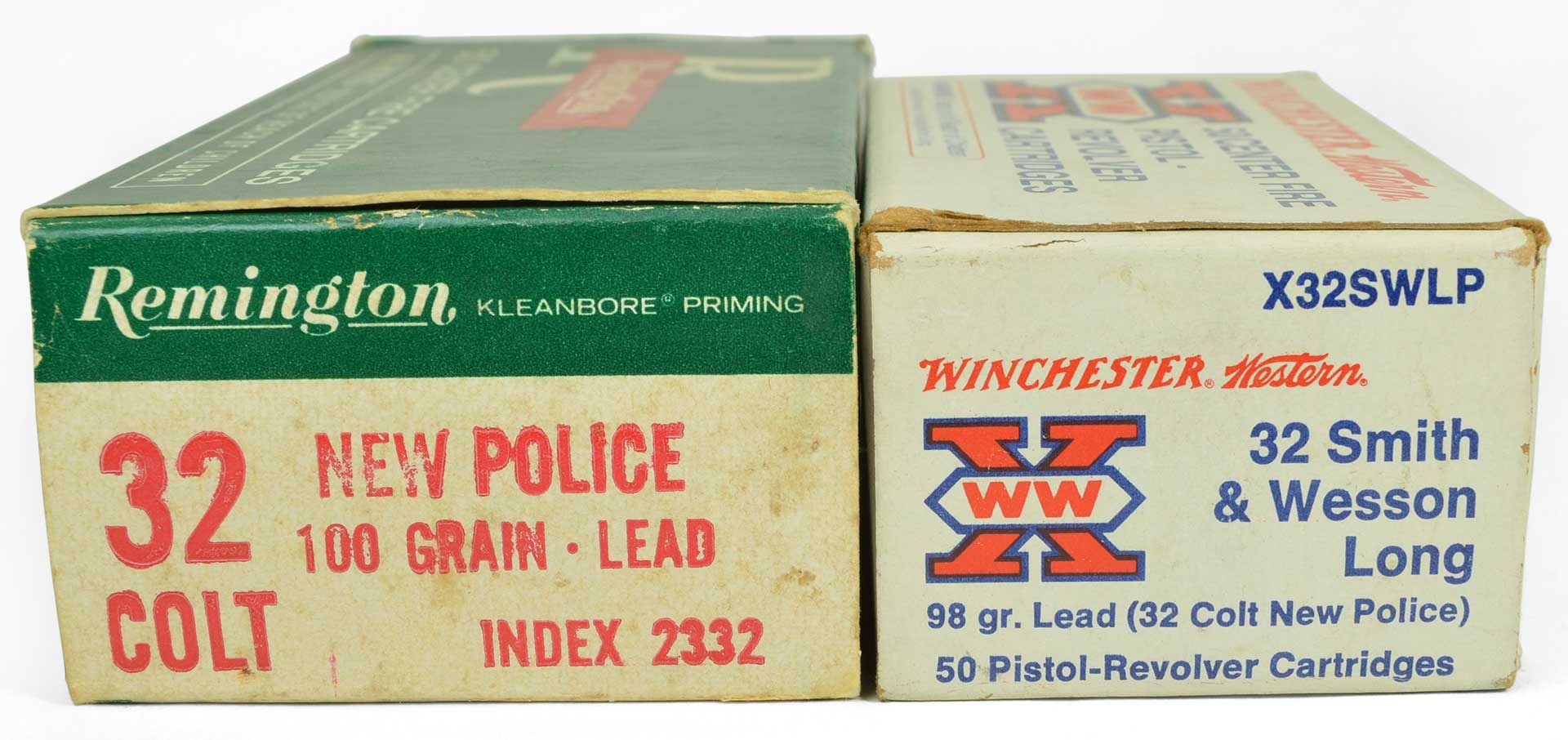
The .38 Colt New Police round usually had a 150-grain bullet, and the .38 S&W usually had a 146-grain bullet. Interestingly, Remington and Peters loaded a 146-grain bullet in the .38 S&W, while Winchester loaded a 145-grain bullet. Today, Remington lists a speed of 685 fps with a 146-grain lead round nose bullet from a 4-inch barrel for the .38 S&W.
Police Positive revolvers marked D.A. .32 were chambered for .32 Long Colt, and guns marked .32 Police were chambered for .32 Colt New Police. I have seen one stamped with .32 Colt, as well, and I presume this means .32 Long Colt. With .38 stamped on the barrel, it meant .38 Colt New Police.
Of the Colt guns I’ve seen on various websites chambered for .32 Colt New Police, the barrels are usually stamped “.32 Police” on Police Positives. But I did see a 1907 production Police Positive stamped “Colt New Police 32” on the left side of the barrel and “Police Positive” on the right side. I found “.32 Colt N. P.” stamped on a Police Positive Special. So it appears Colt had different names on the guns, just like they had different names for the ammo. That will keep collectors on their toes!
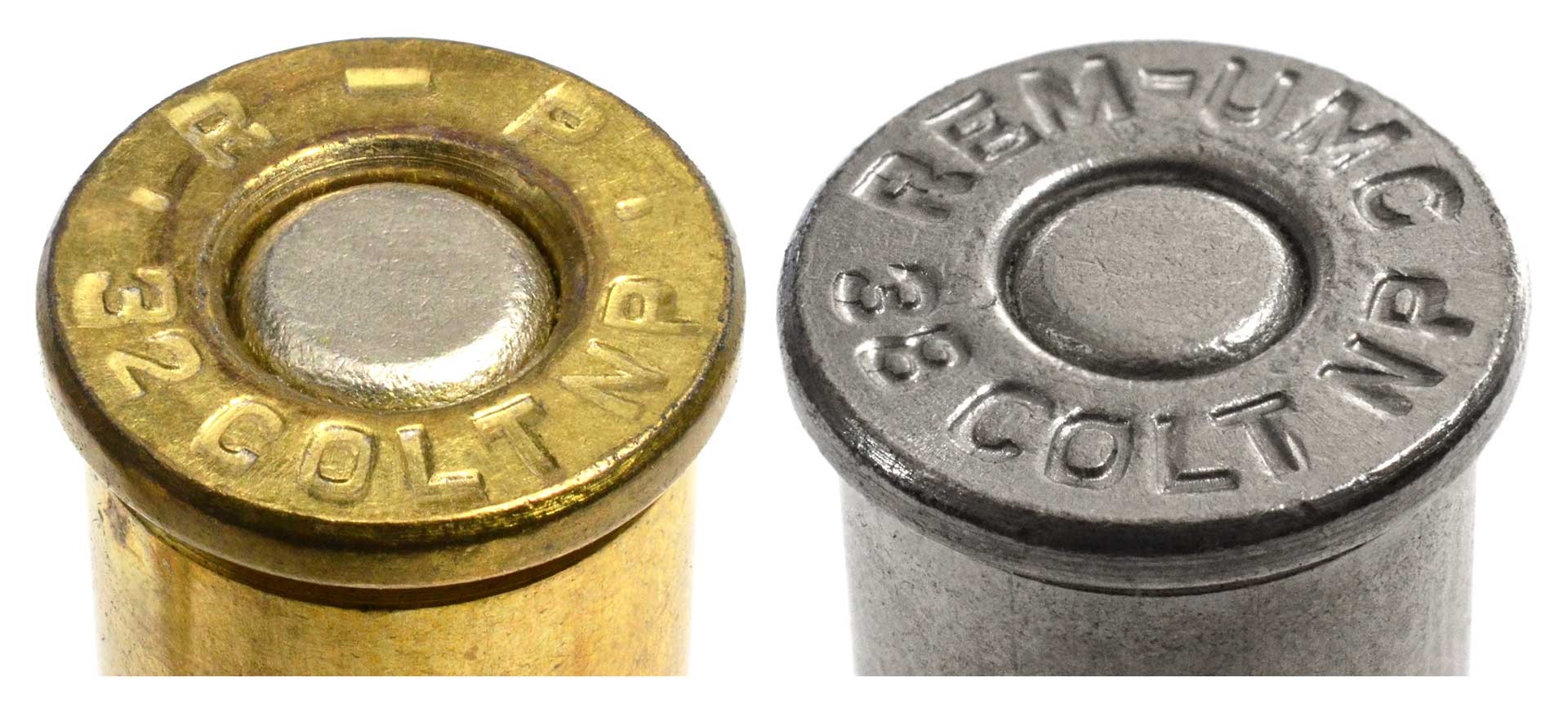
To make this clear, .32 Long Colt and .32 S&W Long (.32 Colt New Police) are different cartridges. The .32 Long Colt has a smaller case diameter (.318-inch), and guns chambered in .32 Long Colt will not accept the larger diameter .32 S&W Long case (.337-inch). Guns marked .32 Police (or .32 S&W Long) will accept .32 Long Colt ammo, though one should not fire them due to safety concerns because the undersized cases might split.
The .32 Long Colt ammo is long obsolete and hard to find, while the .32 S&W Long is alive and well because some match-quality, semi-automatic .32 S&W Long pistols are still being manufactured. It is offered by several ammo manufacturers, including Remington, Fiocchi, Magtech, Aguila, Lapua and others. Guns chambered in .32 Colt New Police/.32 S&W Long can also shoot .32 S&W (aka .32 S&W Short). But all is not lost for .32 Long Colt guns, because Winchester still catalogs the .32 Short Colt (X32SCP).
Variations on the Colt Police Positive
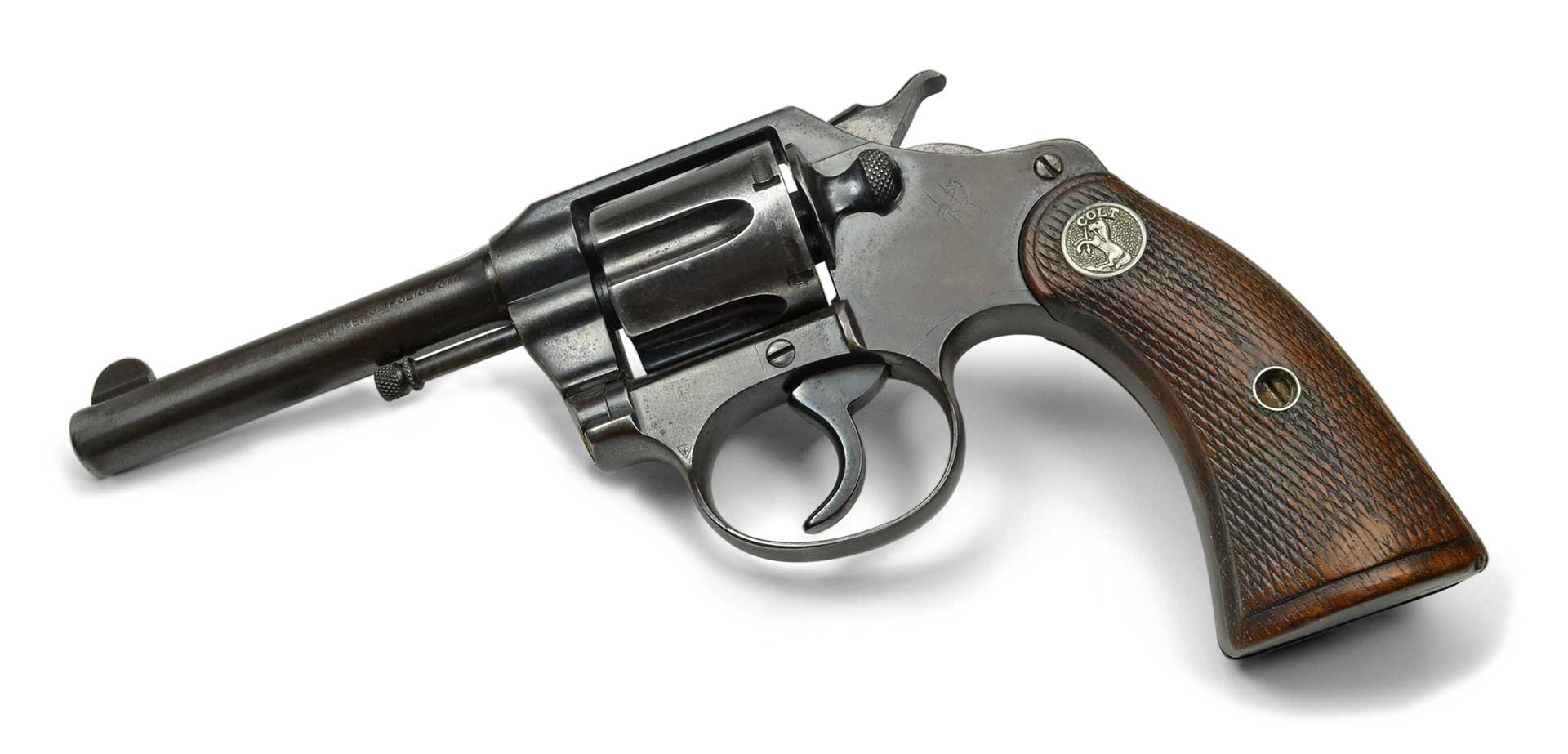
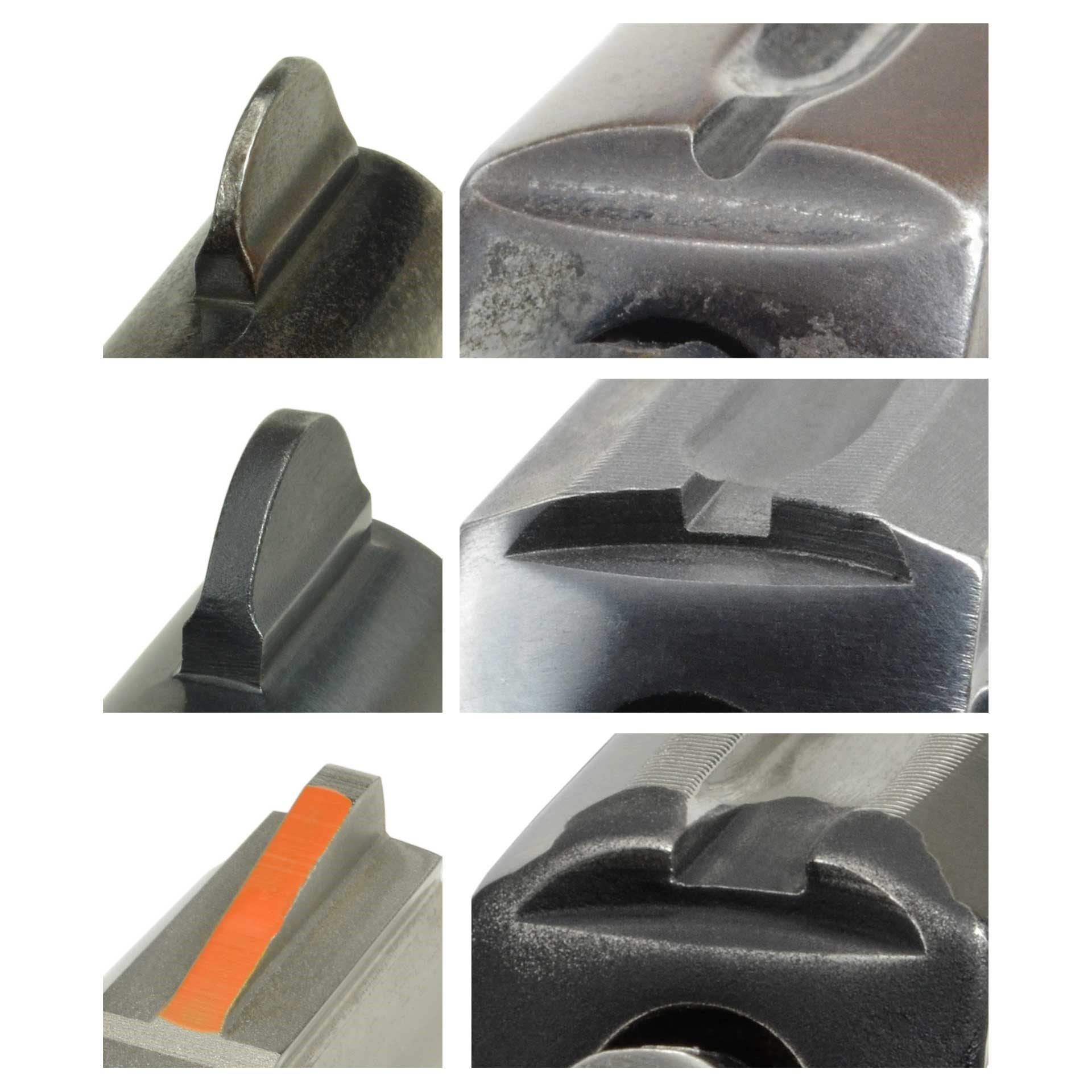
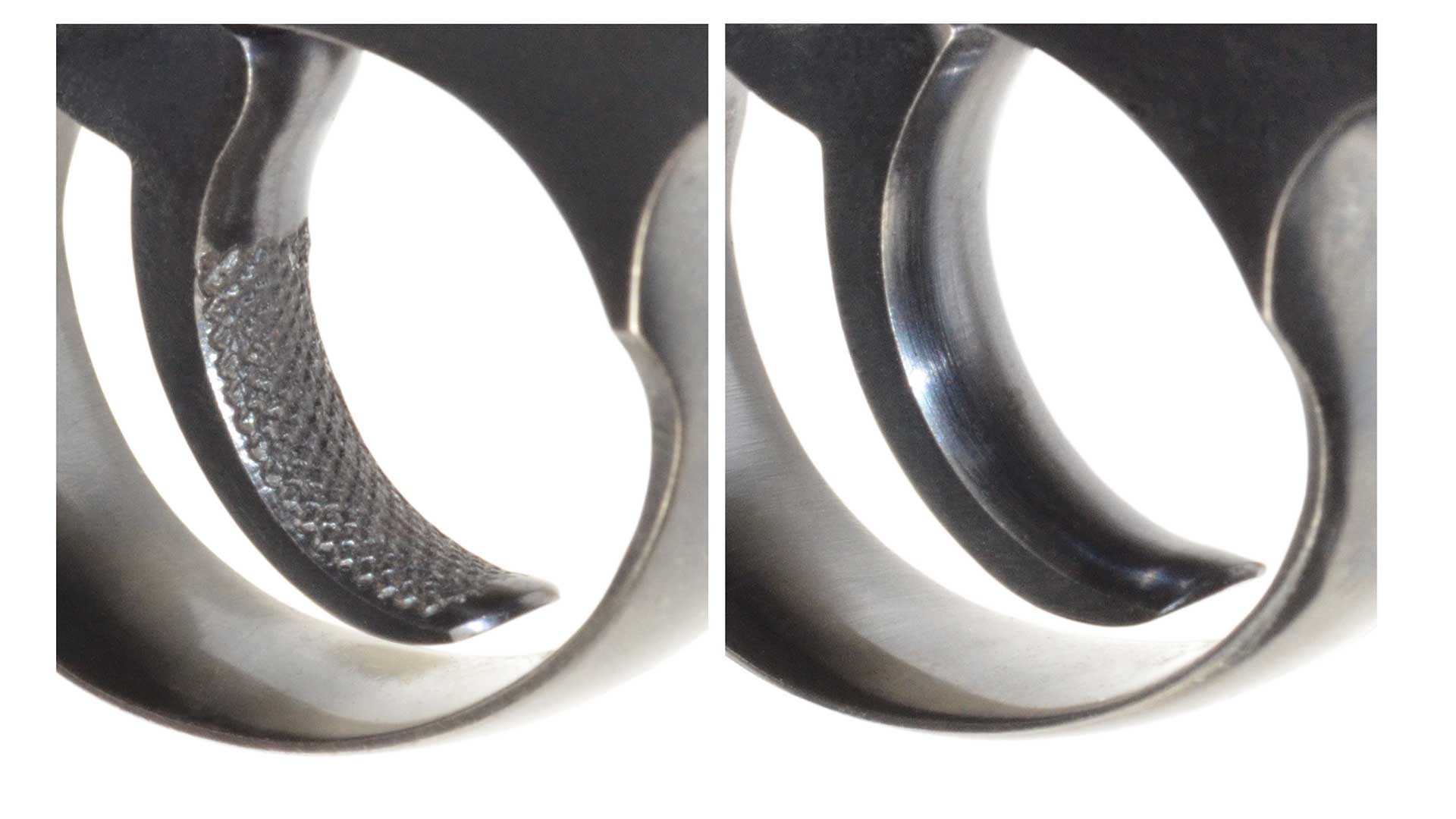
The First Issue Colt Police Positive ran from 1905 to 1927. A Second Issue was made from 1928 to 1947. This issue added a serrated topstrap to reduce glare and changed to a checkered trigger (based on the Second Issue guns I’ve seen). The sights were improved as well. First Issue guns had a thin front sight and a V-cut in the topstrap for the rear. Second Issue guns had a wider front sight and a square notch cut for the rear, giving them a larger sight picture.
Colt also produced target versions of the Police Positive, with 6-inch barrels and adjustable front and rear sights. They were available in .22 LR, .22 WRF, .32 Long Colt and .32 Colt New Police. These guns also have a first issue (1907 to 1925) and second issue (1926-1941/1943?), that change being the slightly heavier frame.
One variation on the Police Positive was the Banker’s Special. It had a 2-inch barrel and was chambered in .22 LR or .38 Colt New Police (.38 S&W). It was made from 1926 until 1940. Additionally, some of the early Police Positives were transitional guns from the previous Colt New Police revolver, which continued to be produced as late as 1908, and will have “New Police” stamped on the frame.
Colt also had a series of .32-caliber Police Positives labeled “Pequano” (Spanish for small) on the barrel that it sent to other countries and within the U.S. that were considered, by some, as less high-quality than the company’s usual quality standards. These guns were marked Pequano or had the letter “B” stamped on the barrel between Police Positive and the caliber. The “B” model Police Positives on the Old Colt website (oldcolt.com) were made in 1941 and appear to be made on the smaller first-issue frames (based on measurements of cylinder size) in spite of being produced during the second-issue era.
But that was it. According to most sources, the Police Positive’s production run ended in 1947. I was surprised by this, because I have a .38 Special Colt revolver made in 1977 marked “Police Positive.” It’s stamped right there on the barrel. You can see why people get confused. But that’s because we haven’t gotten to the full story of the Police Positive Special.
Colt’s Police Positive Special
The long-cylinder Police Positive Special was produced from 1907 to 1995 (but not continuously). It was chambered in .32-20 Winchester and .38 Special. Some were chambered in .32 Colt New Police and .38 Colt New Police. It came with 2, 4, 5 and 6-inch barrels, and there was possibly a 1.5-inch-barreled version in there, too. This frame size (D frame) grip was shortened over time to become the same size they would use for all small-frame revolvers (e.g. the Detective Special) until they were discontinued in 1995. More than 750,000 were built.
Colt’s 1935 catalog lists the following calibers under the .32-20 chambered guns, “.32-20 (.32 Winchester).”
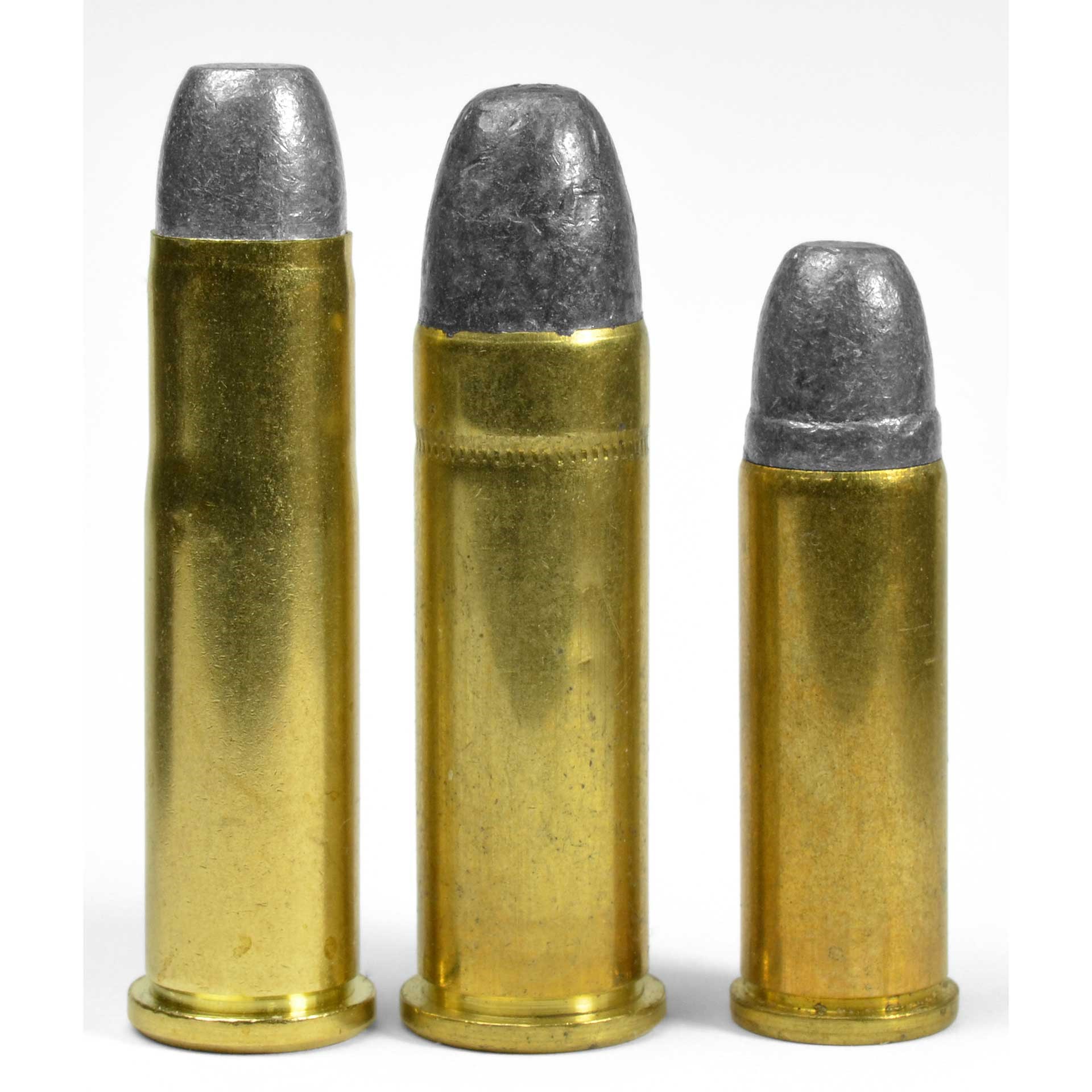
That looks simple enough, but the .32-20 had many, many names, with just about every manufacturer trying to put their name on it. A return to the 1933 Remington catalog shows these names as interchangeable: .32 Win.-Mar.-Rem., .32 Win. & Marlin, .32 W. C. F. [Winchester Center Fire], .32 Winchester, .32/20 Marlin, .32/20 Colt L. M. R., .32/20 W. C. F., .32/20 Win. & Mar.
The .32-20 Winchester had some popularity in the past, because it offered good ballistics and was available in rifles as well. Thus you could have a rifle and revolver in the same chambering. There were two versions of the .32-20, one for handguns and a more powerful load for rifles. The handgun load was a 100- to 115-grain bullet running around 950 to 1,030 fps from a 5.5- or 6-inch barrel. This load ran at around 1,300 fps from a rifle. The high-speed rifle load, with the same bullet weight, added 300 fps in the rifle. Current ballistics from Winchester show a 100-grain bullet at 1,210 fps from a rifle.
You might expect the .38 Special (aka .38 S&W Special) chambering was simpler, but Colt had its own cartridge for this as well, named the .38 Colt Special. Competition was really fierce back then! It, too, had a flat-nose bullet compared to the usual round-nose bullet in the .38 S&W Special. In the 1933 Remington catalog, both the Colt & S&W Special rounds shot a 158-grain bullet at 860 fps from a 6-inch barrel.
There was a very interesting thing in Colt’s description of what ammo you could shoot in the company’s Police Positive Special in the old days. Here’s what it listed in the 1935 catalog as appropriate ammo in .38 Special caliber:
“(Using in the same arm .38 Short Colt; .38 Long Colt; .38 Colt Special; .38 Colt Special Hi-Speed; .38 S. & W. Special (full and mid-range loads); .38 S. & W. Special High Velocity; .38-44 S. & W. Special).”
The .38 Short Colt and Long Colt are just shorter length and lower powered rounds with the same case diameter as the .38 Special, so they are able to be shot in any .38 Special-chambered revolver. The surprise is that Colt approved the use of the Colt and S&W ‘Hi-Speed/High Velocity’ .38 Special and .38-44 rounds. These were really powerful loads that would fall into a .38 Special +P+ category today.
Turning again to the Remington 1933 catalog, the .38 Colt Hi-Speed and the .38-44 S&W Special Hi-Speed both shoot a 158-grain bullet at 1,125 fps from a 6-inch barrel. Today’s .38 Special +P loads shoot a 158-grain bullet at 890 fps from a 4-inch barrel. A 2-inch difference in barrel length means about 100 fps difference, which would put today’s .38 +P load at 990 fps from a 6-inch barrel. Those old Hi-Speed and .38-44 loads were a considerable boost over that. They must have recoiled painfully in the lightweight, 22-ounce Police Positive Specials, not to mention being rough on the gun, too.
The Police Positive Special had five issues. The First Issue was from 1907 to 1927. The Second Issue was from 1928 to 1946. This change included the serrated topstrap and a checkered trigger.
The Third Issue was from 1947 to at least 1973/1976(?). A ramped front sight replaced the half-moon design. The trigger was grooved, and there was an improved, simpler cylinder-retention system (see the Colt Fever website). Some sources say the Third Issue ran until 1976, but they are not in Colt’s 1974 and 1975 catalogs. The Colt Fever website said the Third Issue were only chambered for the .38 Special, but I found some in .32 Colt New Police made in the 1960s.
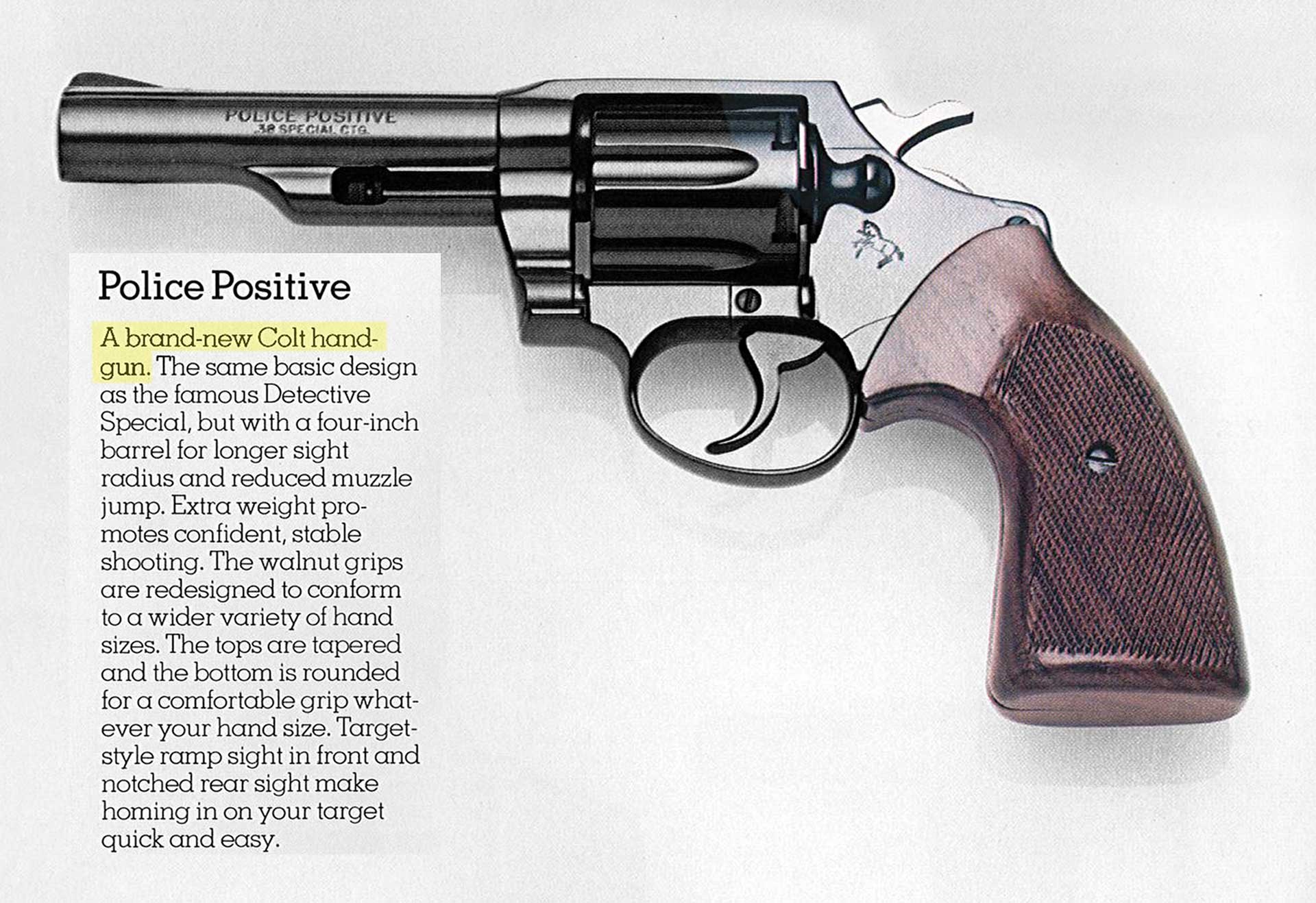
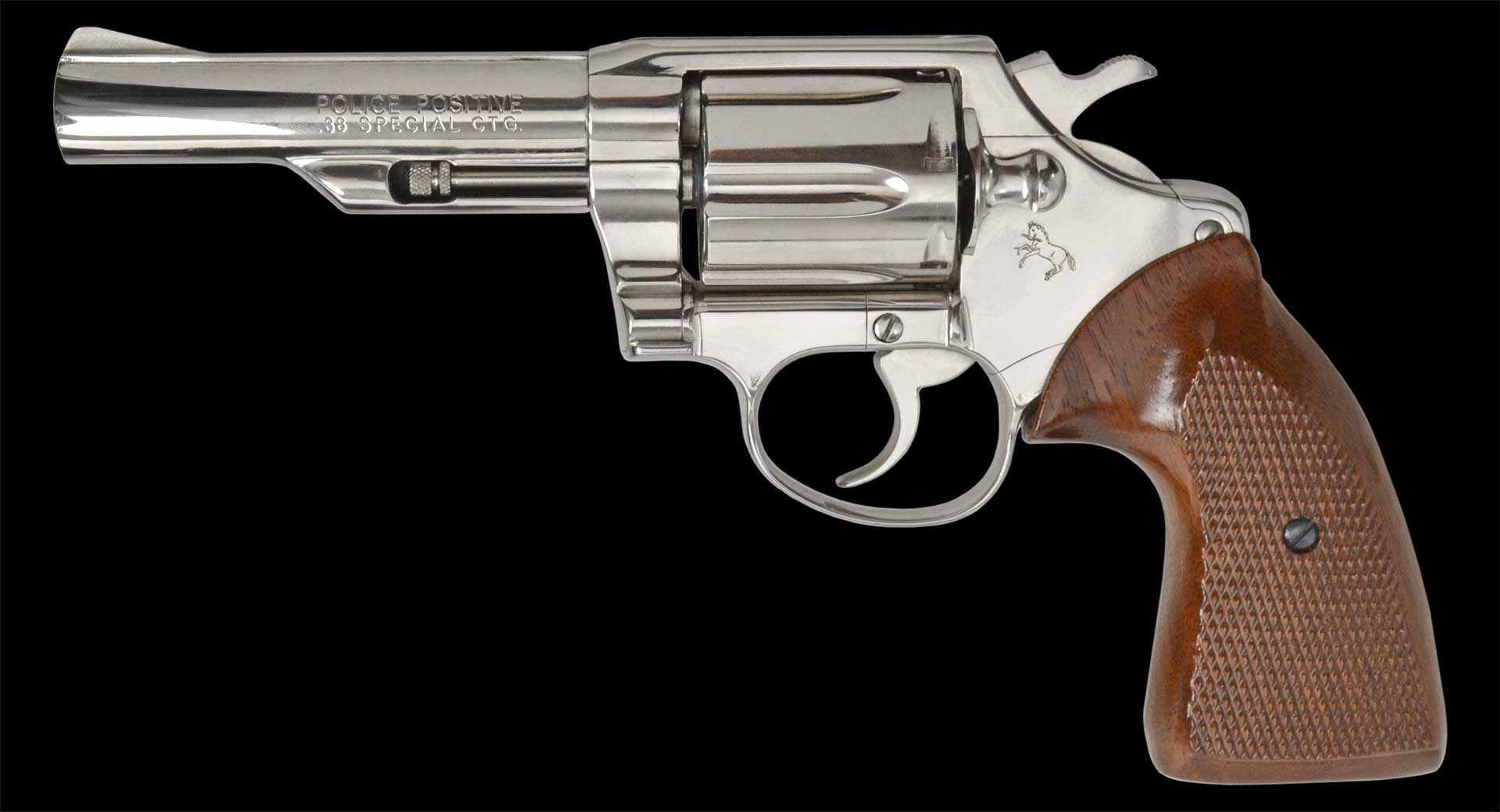
The Fourth Issue, produced from 1977-1978/1979(?), added a heavy, shrouded barrel to protect the ejector rod. For this issue, the barrel was marked “Police Positive.” However, I’ve seen some Colts on the internet that have an unshrouded barrel of the Third Issue but with a circa-1977 serial number. The Fifth Issue ran from 1994-1995 and had a full length underlugged barrel, with “Police Positive MK V” stamped on the barrel.
Colt’s 1977 catalog describes the (Fourth Issue) Police Positive (Special) as, “a brand-new Colt handgun.”
Really?
The barrel design is different than previous issues, so there is that. In that catalog, it was now only chambered in .38 Special and only available with a 4-inch barrel. It could be had with either a Colt blued or nickel finish.
So there it is. My 1977 Police Positive is actually a Police Positive Special. I knew it was special to me, I just didn’t know it was a bona-fide “Special.”
Shooting the Colt Police Positive Revolver
I have five Colt Police Positive/Specials, all with 4-inch barrels. They range from fair condition to excellent. In spite of their outward condition, all have bright bores with strong rifling. Some statistics on the guns are listed in the table below. They include two First Issue guns (.32 Colt New Police, .32-20 Winchester), two Second Issue guns (.32 Colt New Police, .38 Colt New Police) and one Fourth Issue .38 Special.
I was able to find some vintage .32 Colt New Police and .38 Colt New Police ammo. I fired it alongside some current-production .32 S&W Long and .38 S&W ammo. I did not find vintage .32-20 Winchester or .38 Colt Special ammo at the time I was looking, so I used current-production .32-20 Winchester and .38 Special. Velocities and accuracy results are listed in the table.
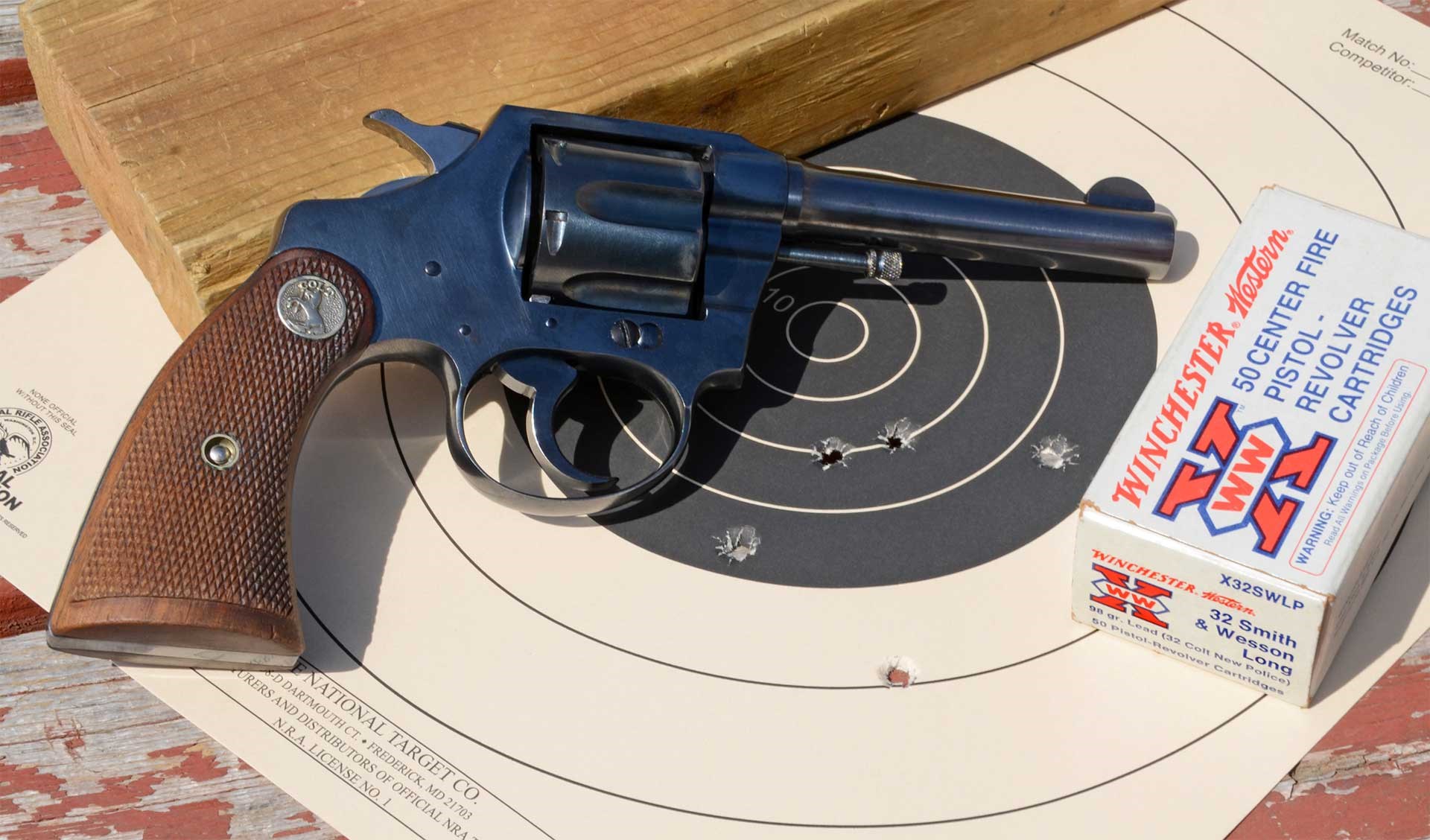
Vintage Remington .32 Colt New Police and vintage Winchester .32 S&W Long ammo was fired in two Police Positives, a First and Second Issue, both with 4-inch barrels. In both guns, the old Remington New Police was faster by around 50 fps, giving the Remington New Police round about 20 ft.-lbs. more muzzle energy. The speeds of the vintage .32 Colt New Police (748 and 786 fps from my guns) were in the range of the advertised speeds in the old days (720-800 fps). Current Remington .32 S&W Long ammo was in between the speed of the two vintage loads. For the full results, see the table.
Vintage Remington .38 Colt New Police rounds clocked an average of 666 fps from my 1941-made Second Issue Police Positive with a 4-inch barrel, a little on the slow end of speed. However, it was a little faster than the modern-production Magtech .38 S&W ammo I recorded at 620 fps. In general, the .38 Colt New Police and .38 S&W have a slight power edge over the .32 calibers, but it depends on the specific load (and gun) because the speeds recorded from my particular .38 were on the slow side.
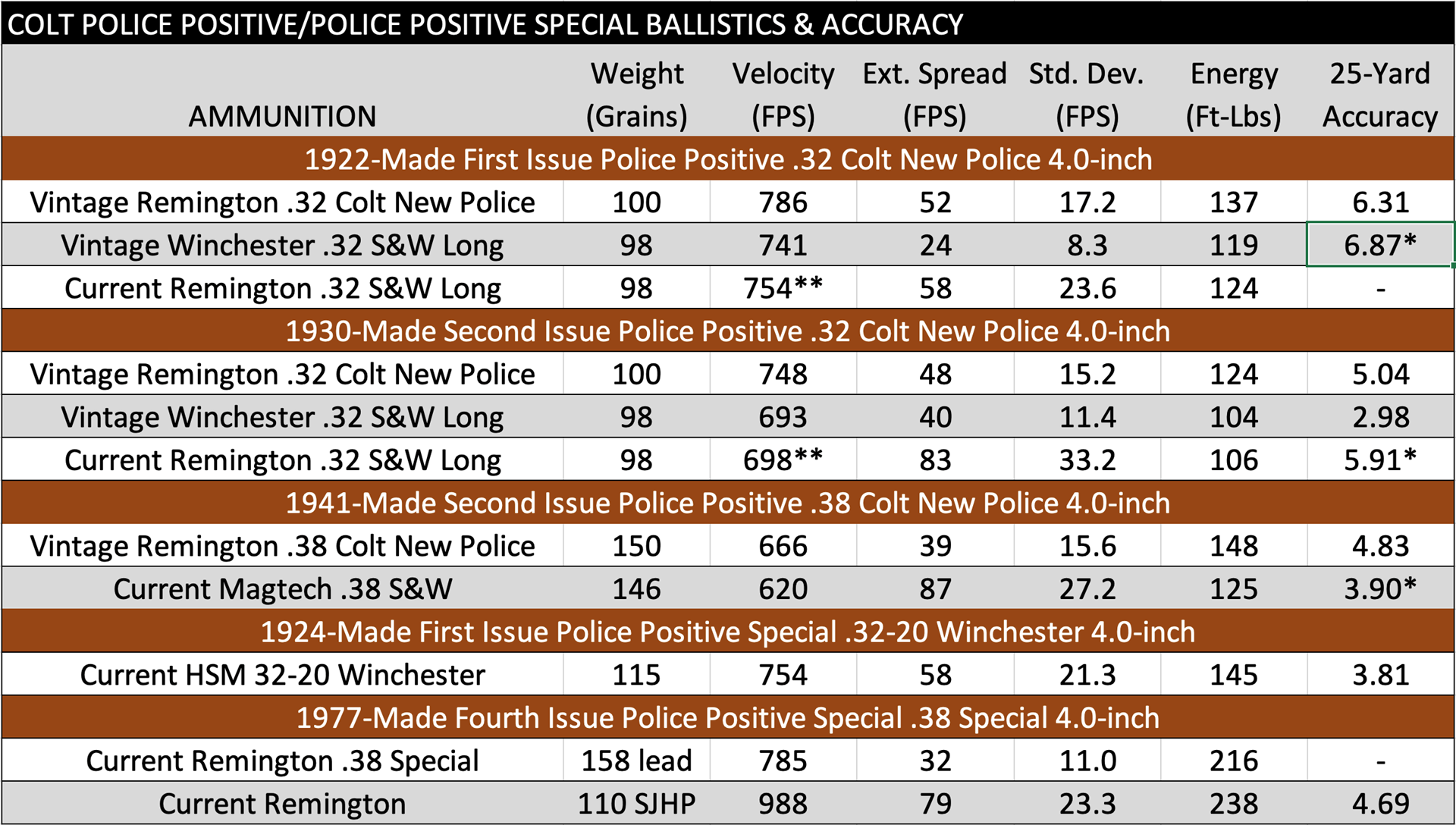
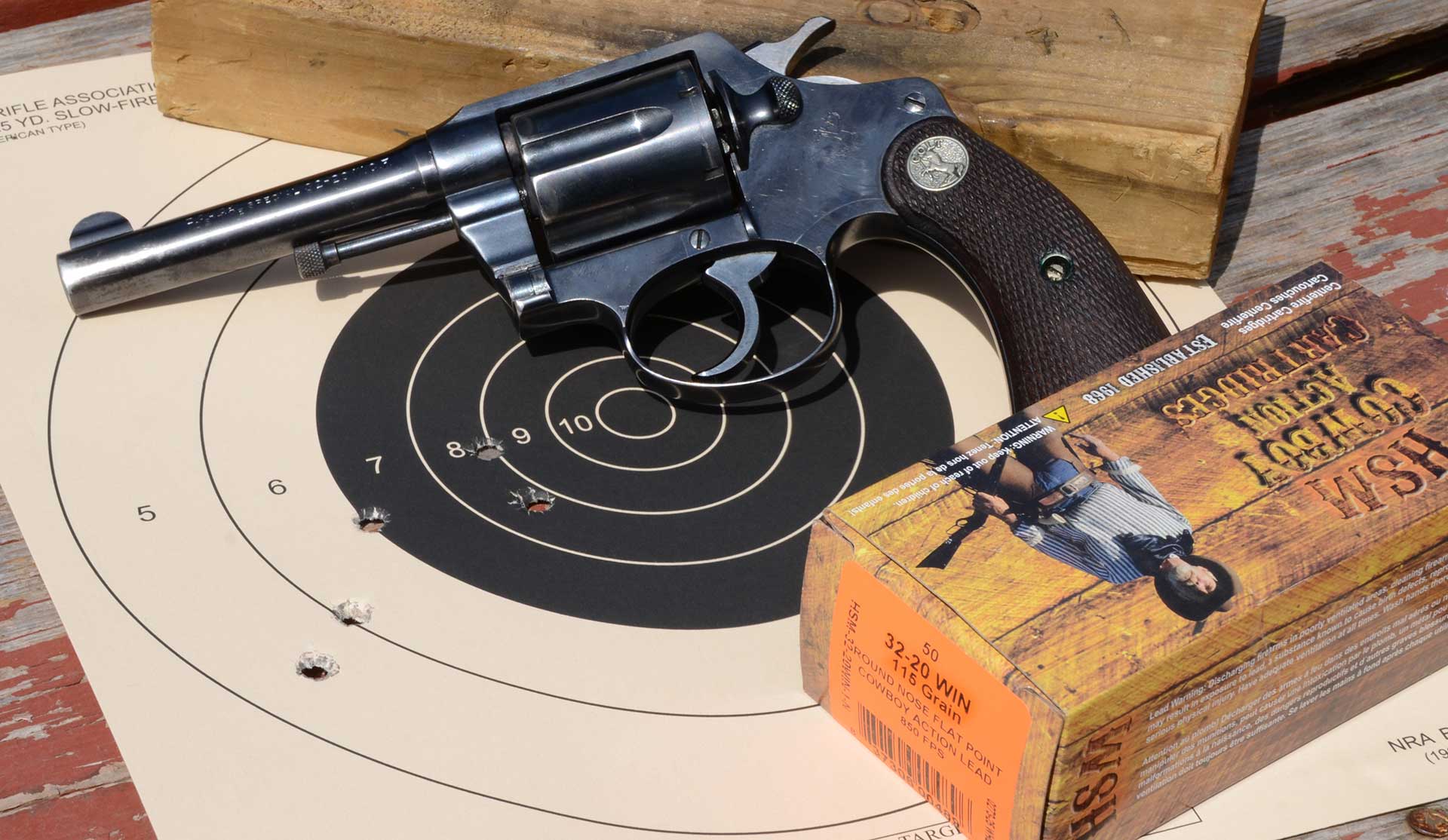
HSM .32-20 Winchester ammo clocked an average of 754 fps in my 4-inch Police Positive Special, which is lower than expected based on vintage velocities. This HSM ammo is marketed as Cowboy Action competition ammo, and they are often downloaded to reduce recoil for faster follow-up shots.
Velocities from the .38 Special ammo were in the range expected from a 4-inch barrel. The lead round nose 158-grain load ran at 785 fps, and the 110 grain SJHP load ran at 988 fps.
I fired the guns off sandbags at 25 yards for accuracy. The poor sights of the First Issue guns made getting a confident sight picture difficult for me. The improved sights of Second Issue guns were easier to work with. Sights on the nickel-plated gun were painted, orange for the front and flat black for the rear, because nickel-plated sights are nearly impossible to see in bright sunlight. Five-shot groups were variable, from 3 inches to 7 inches, but I suspect some of this was due to my less-than-stellar eyesight.
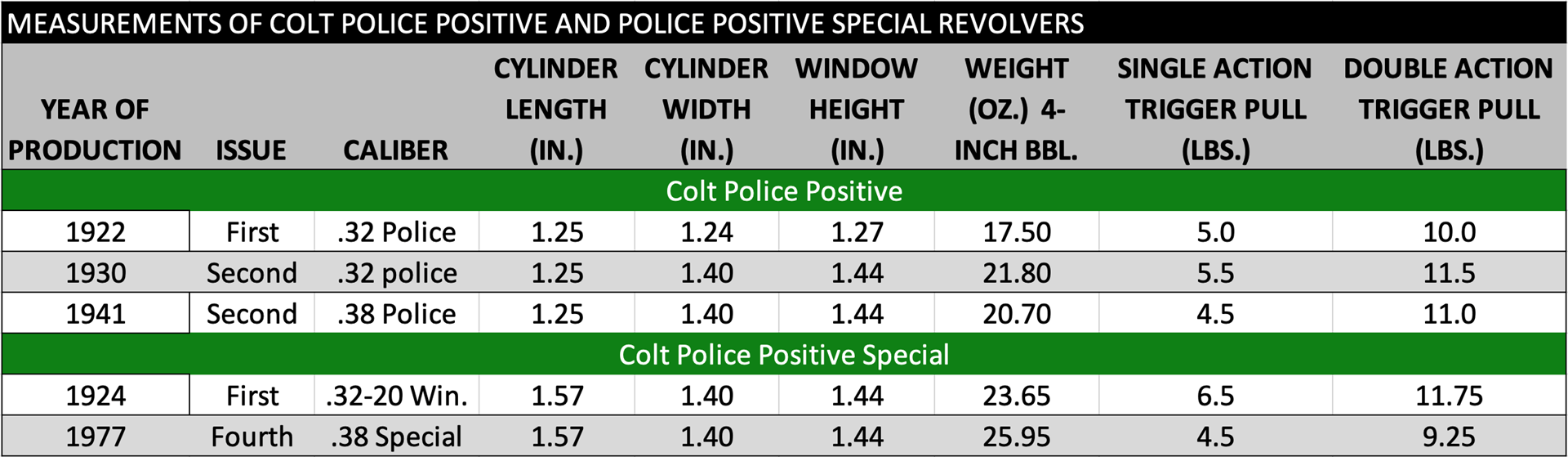
The single-action trigger pulls, measuring 4.5 pounds and up, were a little heavy for me for precise target-shooting. I kept thinking, “When is this thing going to go off?” The double-action trigger pulls were okay but nothing special, save for two exceptions. The double-action pull on the Second Issue .38 Colt New Police was quite smooth, even if a little heavy at 11 pounds. The double-action pull on the nickel-finished .38 Special was especially smooth and the lightest of the bunch at 9.25 pounds.
I did not like the feel of the checkered triggers on the Second Issue guns. The checkering is light and rounded, but the trigger is not very wide (.230-inches) and has a sharp edge. My trigger finger wasn’t happy after firing more than a box of .32 S&W Long handloads double-action.
A Note on Police Positive Frames
Several sources say there were changes to a larger frame between the First and Second Issue Police Positives. Frames for the First Issue .32 and .38 calibers were different sizes. The .38-caliber frames had to be bigger to accommodate the larger cylinder diameter needed for the larger diameter .38-caliber cartridge. The .32-caliber cylinder was 1.24 inches wide, and the .38 cylinder was 1.4 inches wide. This required a larger window in the frame. Since the cylinders were the same length (1.25 inches), the window needed to be taller but not longer. See the table for more details.
The .32-caliber Police Positives made during the Second Issue were built on small and large frames. My 1930-made Second Issue .32 Police Positive has a large frame the same size as my Second Issue .38 (and see oldcolt.com). As previously mentioned, the “B” model .32 caliber Pequano guns made in 1941 were made on the small frame.
One website (coltfever.com) said there was an increase in the distance between the trigger guard and grip from the First Issue to the Second Issue to allow more room for the fingers. I did not see evidence of this in my guns.
I also didn’t see any obvious change in the frame size of First and Second Issue .38-caliber guns. It looked like the .38-caliber Police Positives used the same frame over time, based on comparing frame-size proportions of guns at oldcolt.com. It is possible some changes were made that were not apparent in those pictures.
Summing Up
Police Positives had two different frame sizes during their run. Short frames housed the .32s, and the tall frames housed the .32s and .38s. Add the long-framed Police Positive Special guns that were sometimes labeled just “Police Positive,” and that makes three frame sizes, all of which were produced concurrently during at least a portion of the Colt Police Positive’s life.
Police Positives can be found for sale on several websites and run from around $400 and up depending on their age, rarity and condition. If you’re looking for these old Colt revolvers, pay close attention to what caliber is listed. Some sellers don’t know what they are selling. I’ve seen countless examples of this. My First Issue .32-caliber Police Positive was listed as being “.32 ACP” (.32 Automatic Colt Pistol) caliber of .32 semi-automatic pistols, even though “.32 Police” stamped on the barrel was visible in the photos. My Second Issue .38-caliber Police Positive was advertised as being a .38 Special, even though it is chambered in .38 Colt New Police. If there is any question, ask the seller for a close-up photo of what is stamped on the barrel.
Notes on the Colt Police Positive
Production Dates: Resources claim different dates for production, so keep an open mind on this. Other information is questionable for lack of confirmation from the sources I had available and might be accompanied by a question mark (?). Also, this is not meant to be a comprehensive, detailed historical account of the Police Positive. One complication of looking at their history is that resources have conflicting information. This article runs the same risk because the resources are limited or simply don’t agree. Please read with a forgiving eye. History is not an exact science!
Naming Conventions: Colt double-action revolvers in years past were popular with law enforcement and used names to appeal to cops. They used the name “Police” in several different models: New Police, Police Positive, Police Positive Special, Official Police and Metropolitan Police. You can see why it might be difficult to keep track of which was which. And Colt didn’t stop there. The company named several of its other revolvers with law-enforcement themes, like Lawman, Marshal, Detective Special, Agent, Trooper and Border Patrol. And, of course, the company is famous for its “Snake” series guns as well – Python, Anaconda, Cobra and so on.
Other Chamberings: The 1960 Colt catalog lists the Police Positive Special as chambered in .38 Special and .32 New Police. It says the ammunition is .38 Special (mid-range and regular), .38 New Police, .38 S&W, .32 New Police, .32 S&W Short & Long. The oddball stuff here is the .38 New Police and .38 S&W. These cartridges are physically wider than the .38 Special and generally won’t fit in a .38 Special chamber. I point this out because it does not specifically say is was chambered in these two cartridges, only .38 Special for the 38s. Is this an overlooked error, or did Colt chamber them to fit the wider cases? Certainly, more research is needed on the confusing history of one of the most popular revolvers ever made.
Read the full article here