


Lately, I’ve had more hands-on trigger time with bullpup carbines. Primarily, this involves the long-stroke gas piston IWI Tavor X95 chambered in 5.56 NATO; there was also a range session in which I got to shoot a magazine through a Springfield Armory Hellion, too. However, I’ve been getting to know my Tavor X95 fairly well, and I’m taking the time to write this compare-and-contrast piece about bullpup versus conventional [AR-15 pattern] carbines because, for the most part, the American shooting public seems to look sideways at bullpups.
In this article, I’ll lean on my IWI Tavor X95 and my LWRC IC DI-15 5.56 NATO carbines to compare and contrast bullpups and conventional carbines. Both firearms are decently current examples within their particular categories. My Tavor is a bone-stock factory left-handed model, and my IC DI-15 carbine more or less represents the typical direct gas impingement 16-inch general-purpose carbine with an ambidextrous lower receiver.
Bullpup And Space Efficiency
The bullpup’s biggest strength lies in the efficiency of its overall size. In other words, bullpup layouts use space quite well. By virtue of their “abbreviated” designs, bullpup actions and magazines sit further to the rear, behind the grip and trigger areas.
Conceptually, placing an action behind the fire control group is nothing new. Bullpups (and the term itself) actually dates back to 19th-century Great Britain. Their rear-set construction allows modern bullpup rifles and carbines to possess full-length barrels whose muzzles barely protrude or get in the way.
Design-wise, the bullpup’s “efficiency of space” reminds me of RVs. Inside of an RV, there’s only so much space, and everything within needs to mesh together to function properly. Of course, this comes with trade-offs, but trade-offs are inevitable. For example, whereas a conventional carbine has a standalone stock, the stock area for a bullpup firearm is also where the action is housed. This knocks out two birds with one stone, so to speak, and it’s the lynchpin for the entire bullpup concept.
Though various bullpup makes and models have shorter barrel assemblies available to them, by default, standard models tend to be outfitted with 16-inch+ barrels. This means that end-users get to enjoy a rifle with a “full-size” barrel that otherwise handles like a short-barreled rifle (SBR) without having to go through the extra steps of getting a tax stamp or the rest of the NFA process. As long as the entire firearm measures 26 inches or longer, it is not considered an SBR.
For the end-user, this translates into having a compact and handy long gun that is not only easier to maneuver with but also to stow away when not in use.
Centuries-Old Conventional Layouts
Conventional rifles and carbines have followed the architectural layout found on firearms after they evolved from early handgonnes to the first arquebus muskets–with the actions forward of the shooter. Generally speaking, it’s a very logical layout for long guns.
On the one hand, the concept of the bullpup didn’t really take off until the advent of self-contained metallic cartridge ammunition. This makes sense considering that guns relied on external pyrotechnics for ignition until those metallic cartridge ammunition came onto the scene in the mid-19th century. Having a flintlock tucked under the shooter’s cheek wouldn’t have been practical.
Even in modern times, the conventional layout of a long gun still brings forth many advantages. Having the action and receiver in front rather than behind the shooter places the “core” of a gun in a nice centralized location that’s easy to get to, especially for the shooter’s hand. Ports, chambers and charging handles are all there. For the shooter, having the action in front of them also means that long-guns can be easier to manage in various positions.
From an overall length perspective, the traditional “stock, lock and barrel” layout only comes with one real drawback. It’s the sunk cost of having to add an extra 10-14 inches to the long-gun.
Granted, I wouldn’t call this a “waste,” however. Over the centuries, gun designers have taken advantage of using this space to house action springs, receiver extensions and even magazines. Guns like the original FN FAL, the standard AR-15 and the US Civil War-era .54-caliber Spencer Carbine come to mind.
Moreover, many rifles rely on their stock and chassis structures to not only support them during precise fire but to also balance them out. It’s definitely easier to shoot a conventional rifle with a bipod and/or front or rear bags, especially off a bench.
The Way Bullpups Handle
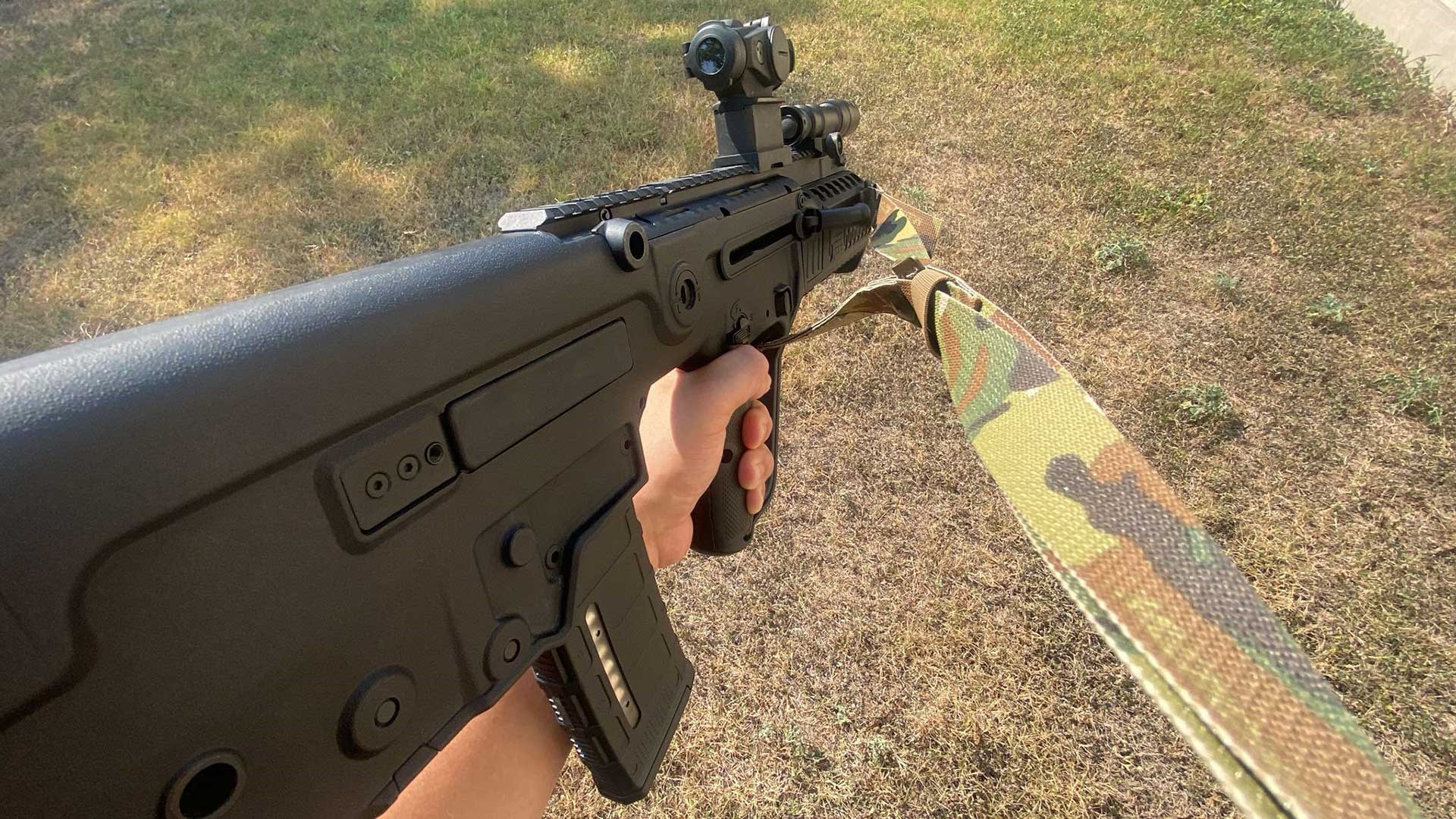
Beyond the capability to easily handle corners and tight spaces, the bullpup layout can also reward the shooter with other benefits. A byproduct of having the core of the gun towards the rear means that the center of mass for most bullpups is biased towards the rear. In other words, when I shoulder my Tavor X95, I can feel most of its weight closer to my body.
Consider a person that picks up a basic 10-pound dumbbell. He or she will have an easier time holding that dumbbell close to their chest as opposed to holding it with their arm fully extended. Extended and holding the weight on the opposite end, the arm becomes an annoying lever working against the body. It’s always easier to “hug” weight versus holding out in front of you.
This is why bullpup firearms’ rear-weight distribution is another aspect that makes these firearms shine. Because their heaviest point is braced close to the body, they can be easier and less fatiguing to hold for longer periods of time–especially when using the help of a two-point sling to cinch down and help bear some of that load.
The set-back center of mass also means it is easier to swing the sights and muzzle from target to target. Again, there is nothing in front of the shooter causing leverage against them, so muzzles tend to move without too much effort. With my Tavor, this unique lack of leverage also means that hinging the carbine from low-ready and up to target also feels effortless.
Swinging Around ARs
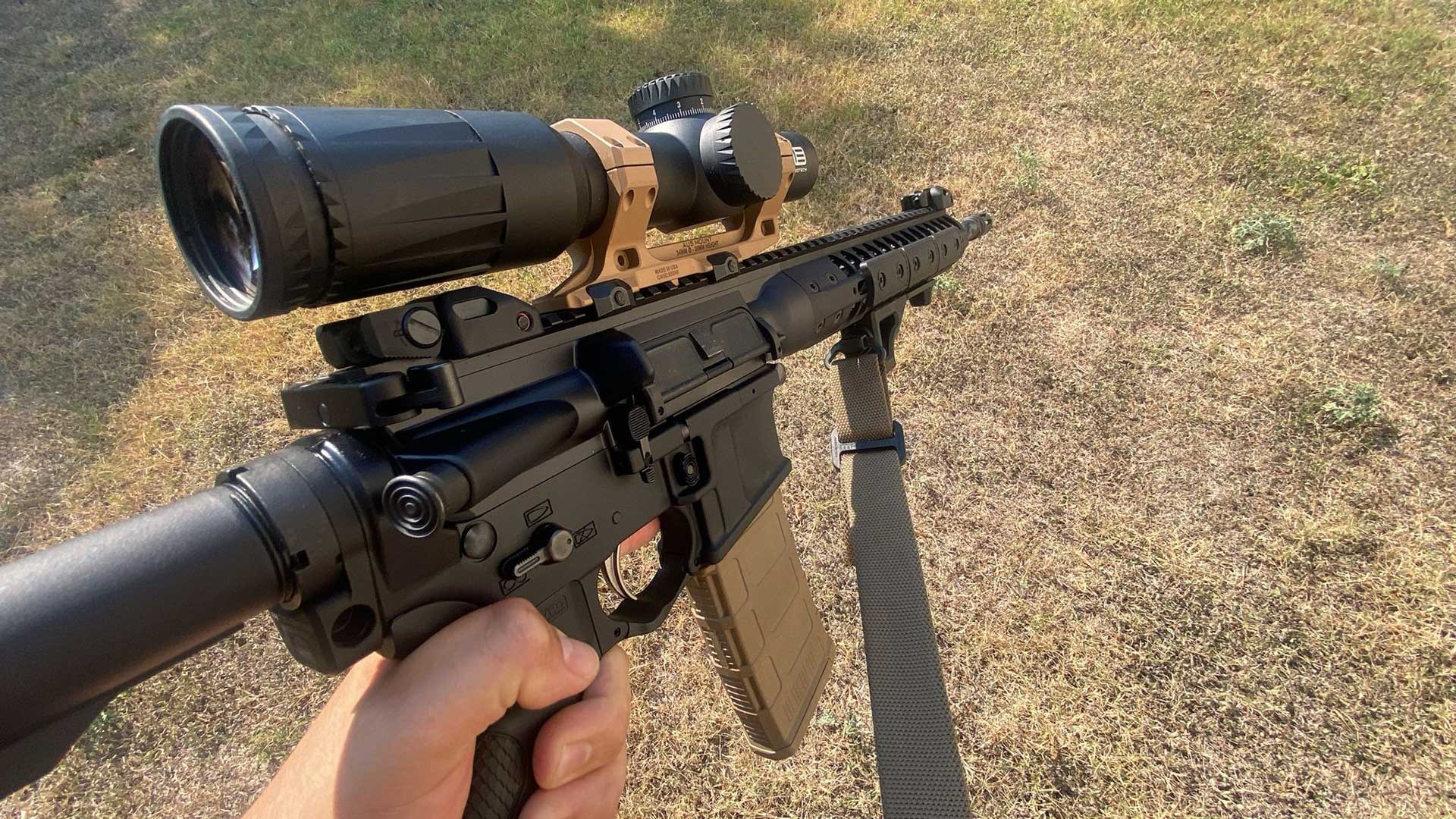
Whereas bullpups have their center of mass towards the rear, conventional carbines have their weight forward, usually around the area where the breech and the receiver meet. Does this mean that it’s harder to control a standard long gun? Not necessarily. It’s why these things are nuanced. But the shooter does have to contend with the barrel and weight in front of them.
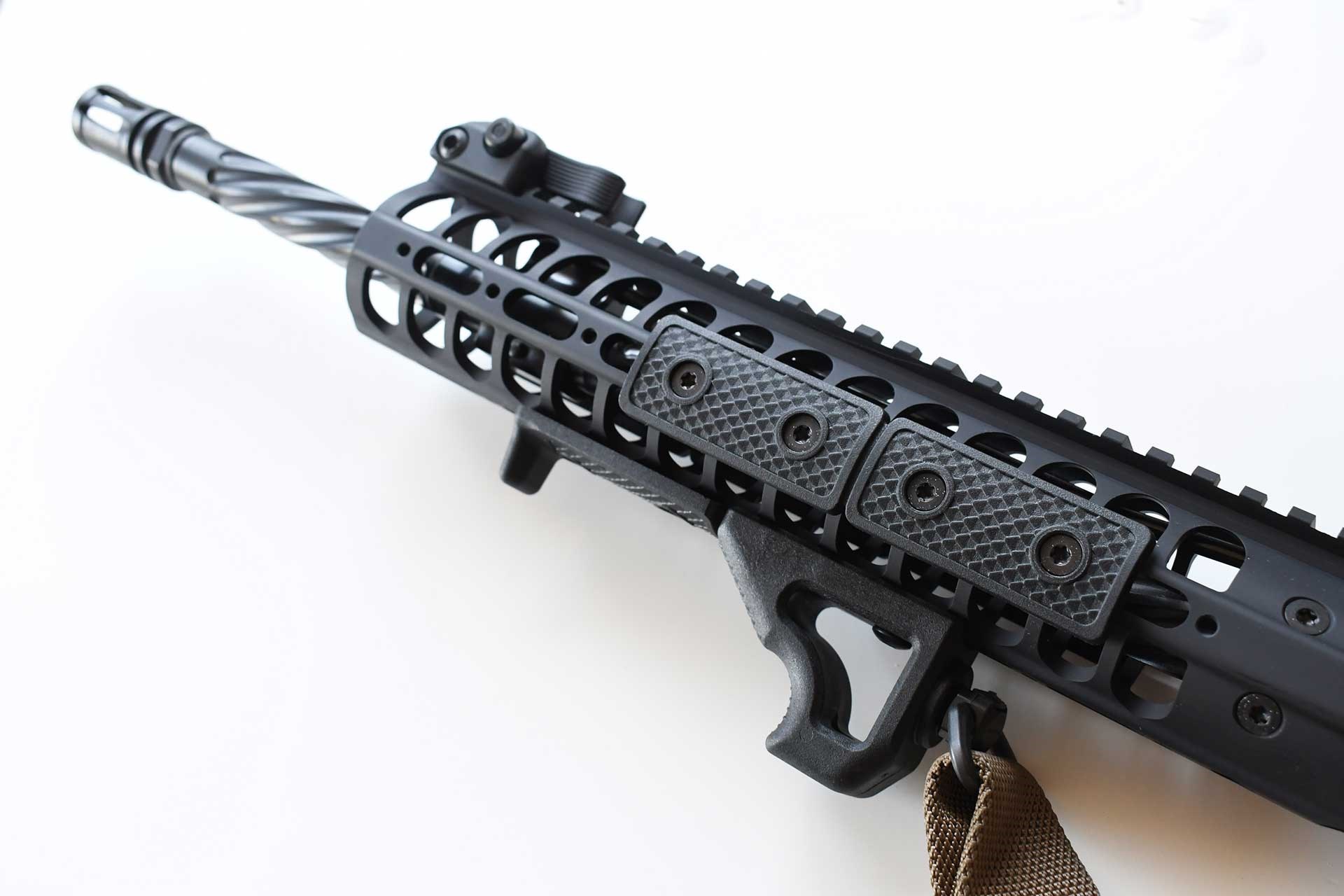
Modern conventional carbines can be configured in different ways to balance out how they swing and how they feel when mounted for the shoulder. For example, LWRC includes these visually stunning fluted barrels on its IC DI-15. In addition to being a “signature” thing that LWRC does to its barrels, the spiral flutes remove extra mass from the barrel. As a result, there’s less material that the shooter has to fight, leverage-wise, when hinging up the muzzle or swinging from target to target.
If there’s an aspect where conventional carbines generally beat most bullpups, it’s the degree to which they can be configured and accessorized. For example, I could swap my LWRC’s included stock with something heavier like a Magpul STR stock to add more “ballast” to the rear. Or I could do the opposite and use a minimalist lightweight stock.
Besides barrel contour, the heft, size and weight of modern carbine handguards are also huge variables that affect how a gun balances and swings, too. My IC DI-15 is built with a reasonably-balanced proprietary monolithic upper-receiver and handguard. Were I building a carbine from the ground up, I’d opt for a thin and sturdy M-Lok handguard that I wouldn’t have to fight.
Manual Of Arms: Tavor vs. AR
Something I really like about the Tavor X95 specifically is how “at home” it feels to shoot, as someone who is used to AR-15s. Because of this, it takes me about the same amount of time to bring a locked-and-loaded AR or X95 to action.
Sure, AR-15 and X95 magazine wells are different, as are their charging handles. ARs have that “awkward,” centrally placed charging handle in the rear. On the other hand, X95 charging handles are located right in front of the shooter’s workspace where it’s easy to reach.
In terms of accessing its safety selector and magazine catches, X95 safety selectors emulate the classic AR-15 version. Likewise, the X95 specifically is outfitted with an ambidextrous and synchronized mag catch that is actuated by the shooter’s index finger in a nearly identical fashion to AR-15s.
With regards to reloads, the time it takes to reload a Tavor X95 is generally close to the same time it takes to reload an AR-15. The X95’s smart magazine catch and neutrally placed bolt release make it easy to keep up. Not to mention, shooters of either handedness can easily reach the Tavor’s magazine well. It sits roughly 4-5 inches in front of the shooter’s face. Referencing a point I already made earlier, it’s also easy to reload the X95 while keeping it on the shoulder, thanks to its overall compact size and rear-weight bias.
I can’t speak for other bullpup designs, but I always assumed that having the magazine well behind meant that reloads would be more cumbersome. I was pleasantly surprised to find out that wasn’t the case. Practicing with empty magazines and going through the motions is always recommended.
Bullpup Trigger Pulls
There are two areas where conventional long guns outclass bullpup firearms. The first and most obvious to me is the feel and function of their respective triggers. Conventional rifles don’t require a linkage that connects the trigger bow to the actual fire control group in the rear. It’s why precision-oriented AR-15s and bolt guns can enjoy very light and crisp trigger pulls. Their fire control groups are physically close and directly connected to their actions.
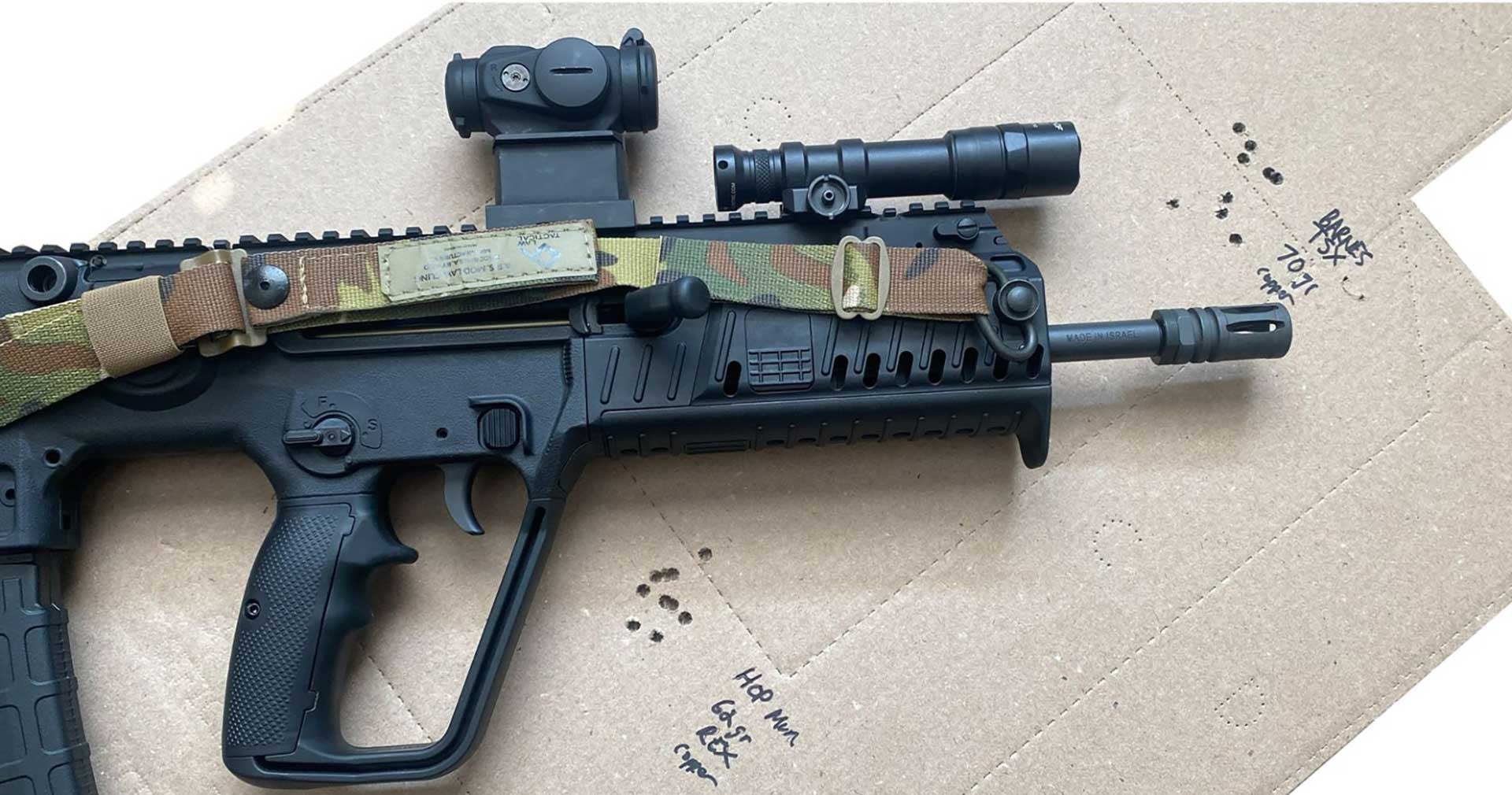
But that isn’t to say that bullpup triggers are worthless either. Even though my Tavor X95’s trigger pull measures a little over 7 pounds, it won’t constrain the shooter in terms of self-defense applications either.
Here’s another example: I recently shot some 10-round groups using premium defensive cartridges from Barnes and HOP Munitions for a different assignment about bullpups in the home defense role. Both groups were shot using an Aimpoint RDS reflex sight at 50 yards, and both 10-shot groups measured 1.49 and 1.96 inches, respectively. All things considered, 2-MOA groups inside of 50 yards are more than satisfactory in terms of lawful civilian defense in the United States. And that’s before taking into account the other benefits of a bullpup design.
It’s fair to point out that Geissele offers some Tavor-specific trigger upgrades that reduce a lot of that long travel and liken the feel to more of an AR-15; these upgrades aren’t cheap, however. With AR-15-pattern firearms, this discussion is null. The market offers plenty of single-stage, double-stage and cassette-style triggers to suit every shooting need and taste. It’s arguably one of the black rifle’s strongest points.
The Takeaway
In the world of defensive guns, it’s better to look at different options in terms of trade-offs, not in terms of “good” or “bad”. It’s why I can’t say one style of rifle is better than the other. Ultimately, it depends on the task at hand. Compared to conventional self-loading rifles, bullpups sure do have odd-looking layouts and visuals reminiscent of science-fiction movie props. They also seem to set a very foreign tone, so it’s no surprise they may get some funny looks. Are bullpups the answer for everything? No. But they can offer some useful and compelling features in contrast to conventional long guns.
Read the full article here