


Back in the days when I was starting to learn more about handgun related endeavors, I found an engaging magazine article about “kit guns.” The author was referring to the small-frame rimfire revolvers that were favored for outdoor adventures when he was growing up. These compact wheel guns were handy little traveling companions tucked into a backpack, automotive trunk space, fishing tackle box or just slipped into the pocket of a pair of jeans. They came in handy for keeping camp site pests at bay, potting small game for dinner when the fish weren’t biting or the casual ventilating of empty soup and soda cans with friends and family.
Today, semi-automatic pistols are more popular than ever. But little rimfire revolvers have a charm and practical utility that still makes them handy options for walking around the woods. The most common examples of the breed are, with rare exceptions, chambered in either .22 Long Rifle (LR) or .22 Winchester Magnum Rifle (WMR). These cartridges’ diminutive size, low recoil and rimmed cartridge cases make them an ideal fit for small-frame revolvers. But despite the fact that they share the .22-caliber designation, these two rounds have distinct differences in their histories, external dimensions, bullet types and performance potential. Is one a better choice than the other for kit gun applications? Let’s take a look at some background and shooting results to find out.
The Ubiquitous .22 LR
It would be difficult to overstate the popularity of the .22 LR with the American shooting public. It has been estimated that around 2 to 2.5 billion rounds of .22 LR ammunition is manufactured each year, which is roughly one quarter of all cartridges produced annually. Over the years, it has found its way into just about every long-gun action type, along with semi-automatic pistols and various single-action and double-action revolvers.
Launched by the cartridge maker J. Stevens Arms & Tool Company in 1887, the .22 LR’s development history can be traced back to the .22 BB Cap (1845) which evolved into the .22 Short (1857) followed by the .22 Long (1871). The .22 LR was originally topped with a 40-grain bullet that launched at a higher velocity than its predecessors, resulting in superior performance for target shooting and small-game hunting. Its affordable pricing, low recoil and flexibility keeps the .22 LR at the top of the small-caliber heap.
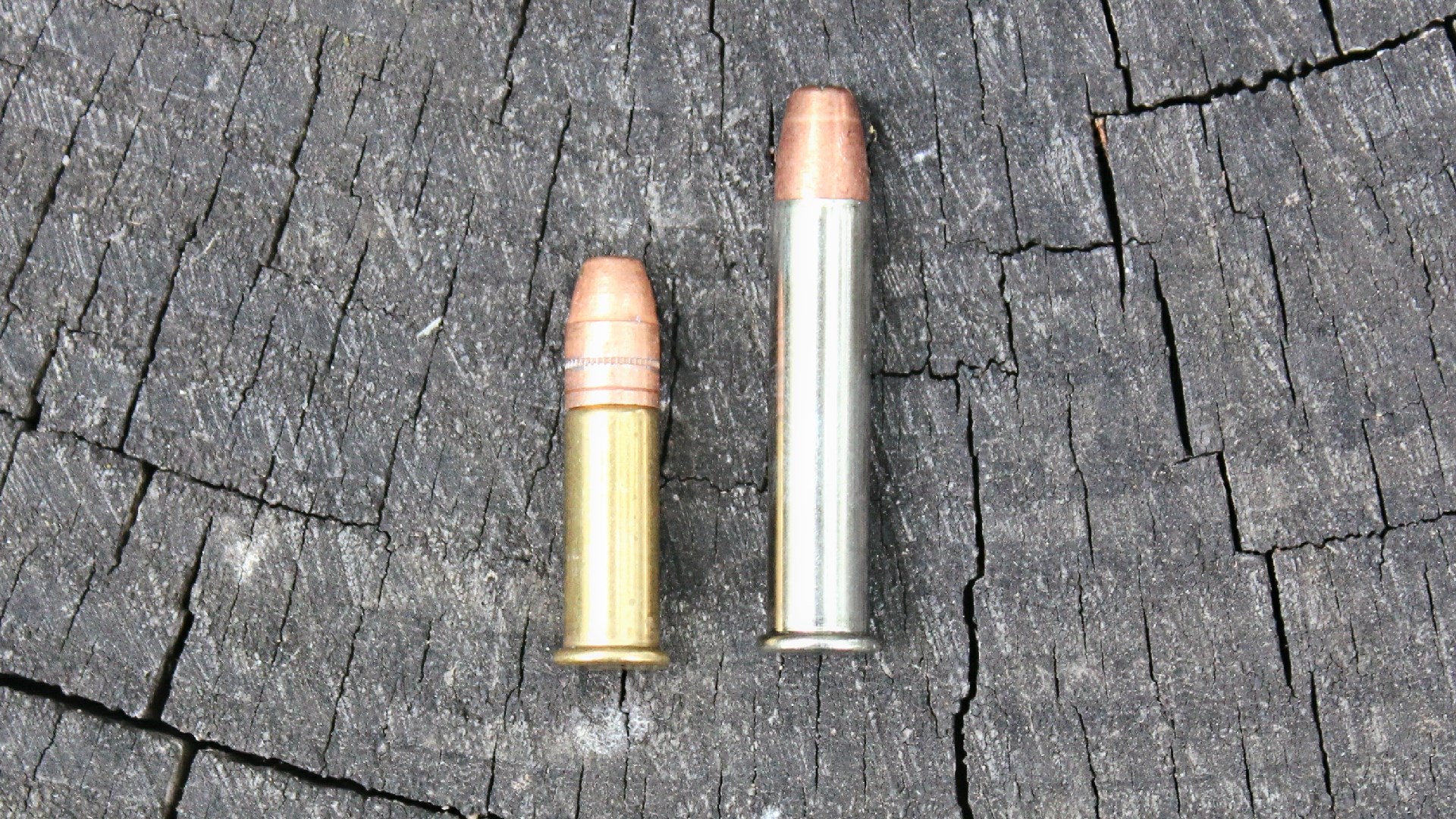
The .22 LR features a .613-inch long, straight-walled cartridge case for a nominal overall length of 1 inch. The rim is .043-inch thick with a diameter of .278 inch. This is a rimfire cartridge, which means it employs a primer compound that is spun into the hollow of the rim at the base of the case.
These rounds are topped off with .223-inch diameter heeled bullets made of a relatively soft lead. The exposed base of the bullet is nearly the same diameter as the cartridge case itself (.223-inch) with a short extension, or heel, crimped into the case’s mouth. This is an early black powder bullet design that has been supplanted by non-heeled bullets, which are the same diameter as the cartridge case mouth. The wax-lubricated lead bullet styles include round-nose, flat-nose and hollow point options. Some bullets are plated with copper, brass or nickel to reduce bore and action fouling or a polymer coating that takes the place of the wax.
The More Potent .22 WMR
Introduced by Winchester in 1959, it is a common misconception that the .22 WMR represents the next evolution of the .22 LR cartridge. Because the .22 WMR is commonly referred to as the .22 Magnum, or .22 Mag., some folks think that the .22 LR’s straight-walled cartridge case was simply lengthened a bit to make this cartridge, much as the .38 Special was stretched in the process of developing the more powerful .357 Mag. revolver round. But this is not the case.
The .22 WMR is actually a longer version of the .22 WRF (Winchester Rim Fire) which was developed for the Winchester Model 1890 rimfire rifle. As a result, all of the .22 WMR’s dimensions are larger than those of the .22 LR. The cartridge case is slightly tapered, not straight-walled, and 1.055-inch long for a nominal overall cartridge length of 1.350 inches. The rim is .050-inch thick with a diameter of .300 inch. And this round is designed to launch conventional (non-heeled) .224-caliber projectiles.
This allows for more sophisticated bullets, including full-metal jacket, jacketed hollow point and expanding polymer-tipped options. This makes the .22 WMR a suitable option for use as a short- to medium-range varmint rifle round, as well as small-game hunting. As the second most popular rimfire round, it’s not particularly hard to find, although it is not nearly as prolific or diverse as the .22 LR.
Because .22 LR ammunition costs less, and it fits into the cylinder’s chambers, it can be tempting to try shooting it from a .22 WMR revolver. This is not a safe shooting practice. The larger .22 WMR chambers do not properly support the smaller .22 LR cartridge cases, leading to bulged or split cases. This, in turn, may lead to high-pressure gas leakage from the rear of the chamber, along with the potential for bullets striking the chamber throat at an incorrect angle. Generally speaking, fast moving bullets that do not exit a firearm as intended will, at least, perform poorly down range or possibly cause injury to the shooter or bystanders. Either way, feeding your revolvers the ammunition for which they are chambered is always the safest path forward, meaning you need to pick one or the other.
Short-Barrel Revolver Performance
Despite their differences in size, .22 LR and .22 WMR both operate at a SAAMI maximum average pressure (MAP) of 24,000 PSI with a comparable range of bullet weights. But because the .22 WMR sports a larger cartridge case capacity than the .22 LR, it has the performance potential edge when it comes to bullet velocity and energy when fired from a rifle-length barrel.
However, the game changes when shooting rifle rounds from handguns. The vast majority of rimfire rounds are stoked with powder charges configured to maximize bullet performance using a closed rifle-action chamber paired with barrels between 16- to 24-inch in length. The performance drops noticeably when firing the same rimfire loads from a revolver with a cylinder gap and a barrel that is 2, 3 or 4 inches long. In fact, I’ve seen premium-grade, hyper-velocity .22 LR loads that lose more bullet velocity than less expensive practice-grade loads when fired from a handgun. This is most likely due to the more specialized powder charge not having enough time to burn fully, due to the short barrel.
It’s also worth noting that the .22 WMR costs more to shoot. As of this writing, .22 LR is available for around $.08 to $.52 per shot, depending on the brand, grade and bullet style. Available .22 WMR loads are listed at $.24 per round for entry-level fodder, with premium options listed for up to $.48 per shot. For those who need a rimfire option with a bit more kick to it, the increased cost of ammunition can be justified.
This brings us to the question that inspired this evaluation. When fired from a small-frame revolver, can the .22 WMR provide enough of a performance boost to justify the added ammunition expense? Or, is the short-barrel performance of the .22 WMR going to be similar enough to a .22 LR revolver that you might as well go with the less-expensive ammunition option?
In order to find out, it was important to level the playing field as much as possible. It’s not always easy to find two guns with the same features in two different calibers. But Taurus USA offers just what I had in mind.
Taurus 942 Rimfire Revolvers
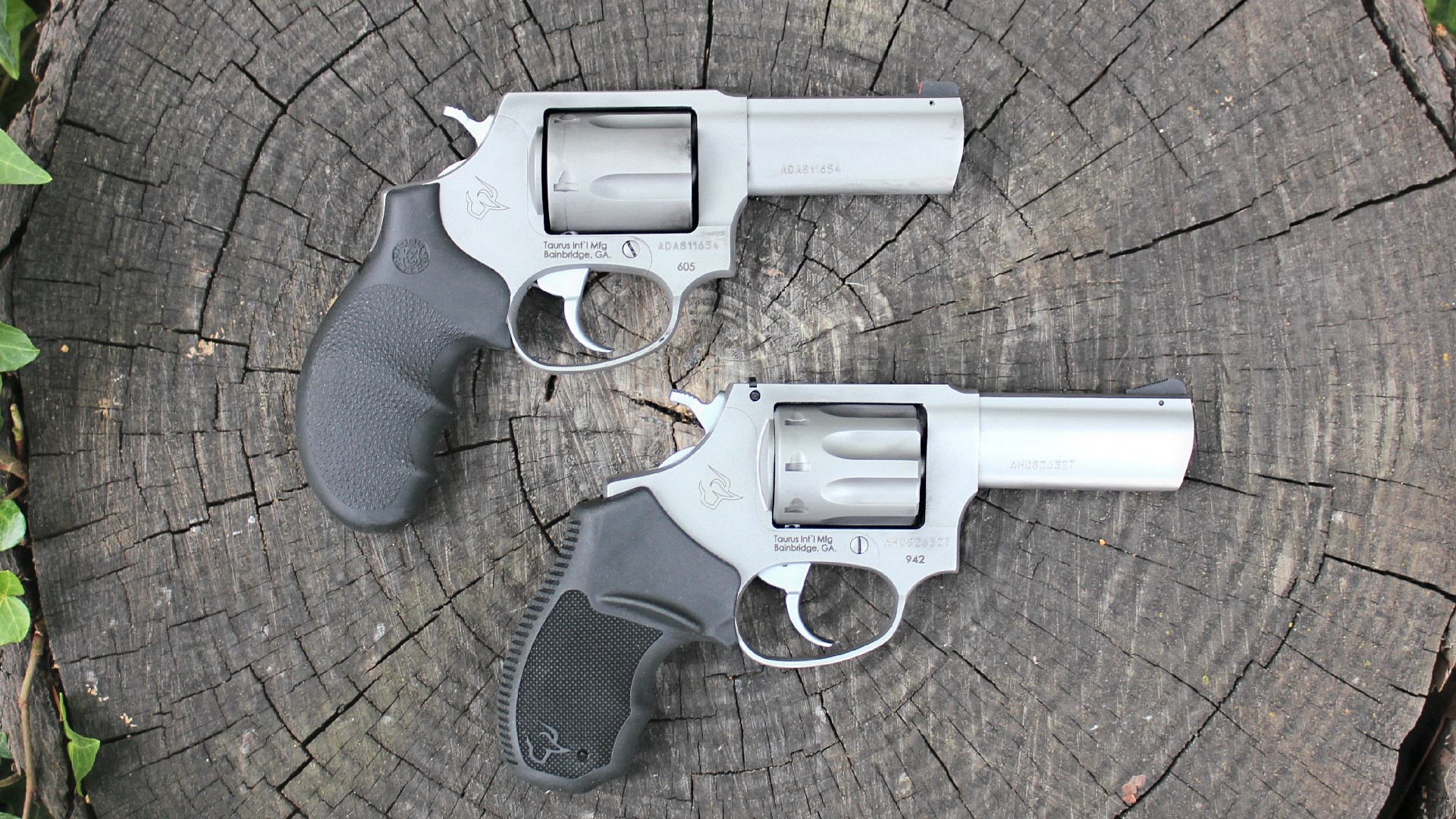
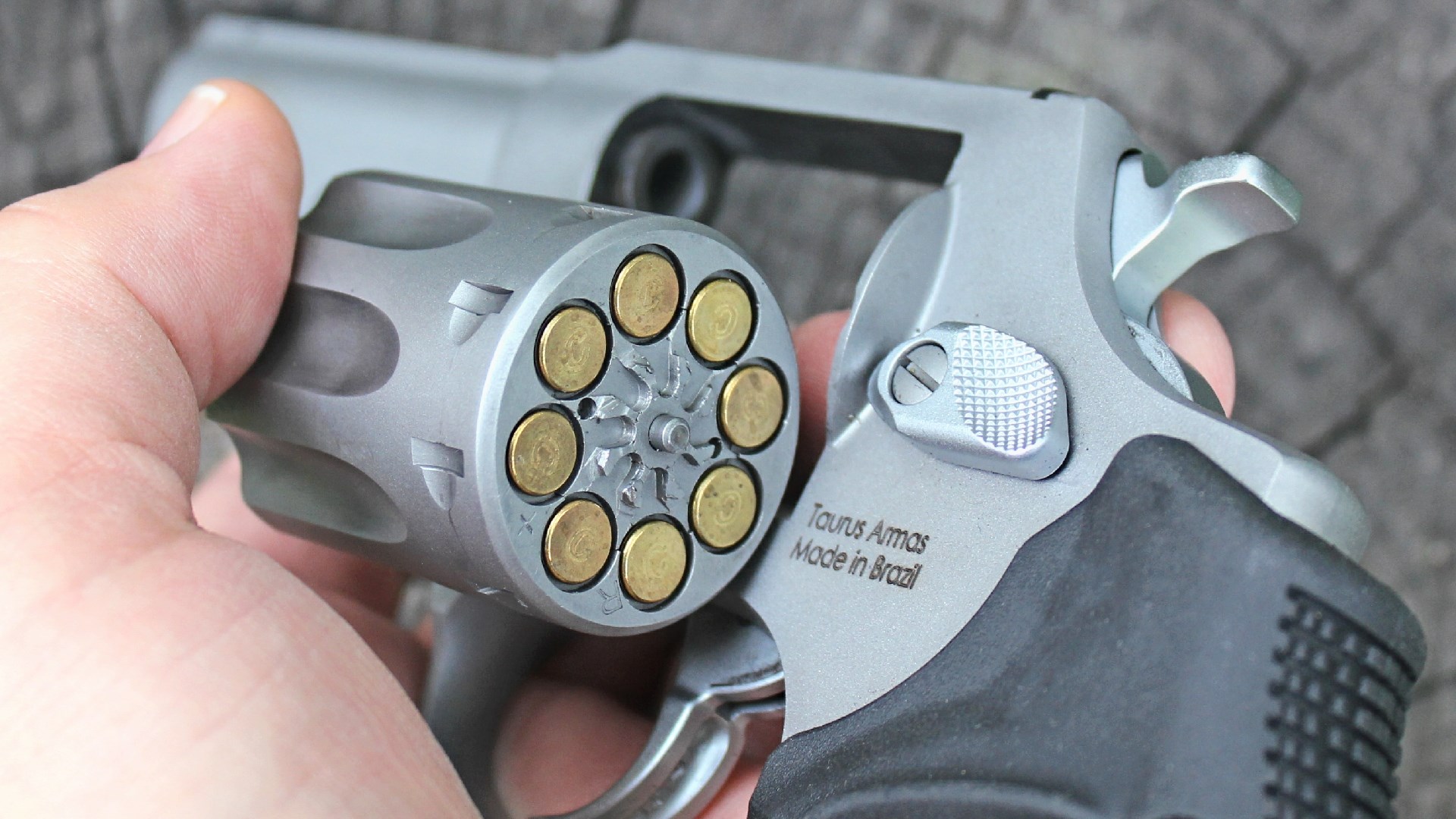
The Model 942 series of compact double-action revolvers is in the same family of Taurus small-frame options as the centerfire guns, like the Model 605 and Model 327. The Model 942 is built using the same full underlug barrel, cylinder and frame configurations, which means they can be carried in the same holsters or fitted with the same aftermarket grips. However, the rimfires hold up to eight rounds of ammunition instead of the five- and six-shot cylinders of the centerfire models.
Looking through the Model 942 line-up revealed a total of 10 configurations currently in production. They are chambered in either .22 LR or .22 WMR with 2- or 3-inch barrels. The finish options include an all-blued steel construction, all-stainless steel or an Ultra-Lite version featuring an anodized aluminum frame in place of a steel frame. The 2-inch barrel Ultra-Lite is the lightest model available with an unloaded weight of 17.8 ounces, while the 3-inch barrel steel guns tip the scales at 25 ounces.
Which revolver weight is “best” depends on your personal preferences and needs. Aluminum-frame rimfire revolvers do carry more comfortably. But I’ve found that really lightweight snubby wheelguns, with their heavier double-action trigger pull, require more work on the shooter’s part to keep them on target when firing. Recoil is tame with these calibers, but the gun does want to shift around more with each shot.
The relatively heavy, all-steel guns may tug at a hip holster a bit more in the course of a day. But once they are out and pointed at an intended target, they are noticeably more steady in the hand and faster to bring back on target after each shot. When firing .22 LR or .22 WMR from 25-ounce guns, the recoil ranges from nearly non-existent to mild.
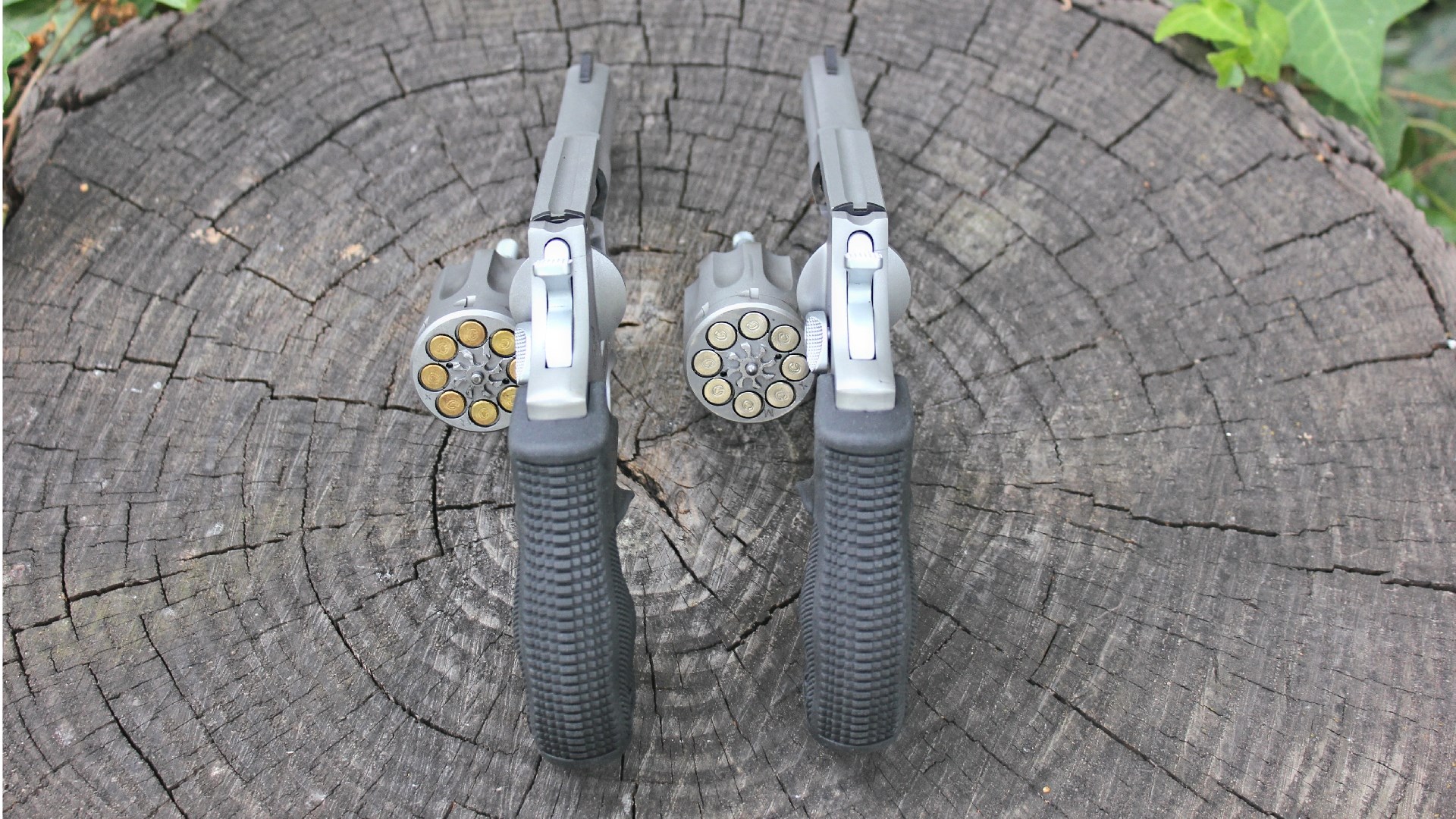
For this battle of the rimfire kit guns, two of the 3-inch barreled, all-stainless-steel Model 942 revolvers were requested, one in each caliber. Made by Taurus Armas in Brazil, both weighed in at 25.1 ounces and were physically identical, with just two exceptions. The serial numbers are, of course, different. They also made a small change to the model markings on the right side of the frame. The .22 LR version is stamped “942,” while the .22 WMR reads “942M.” Otherwise, these guns look like identical twins.
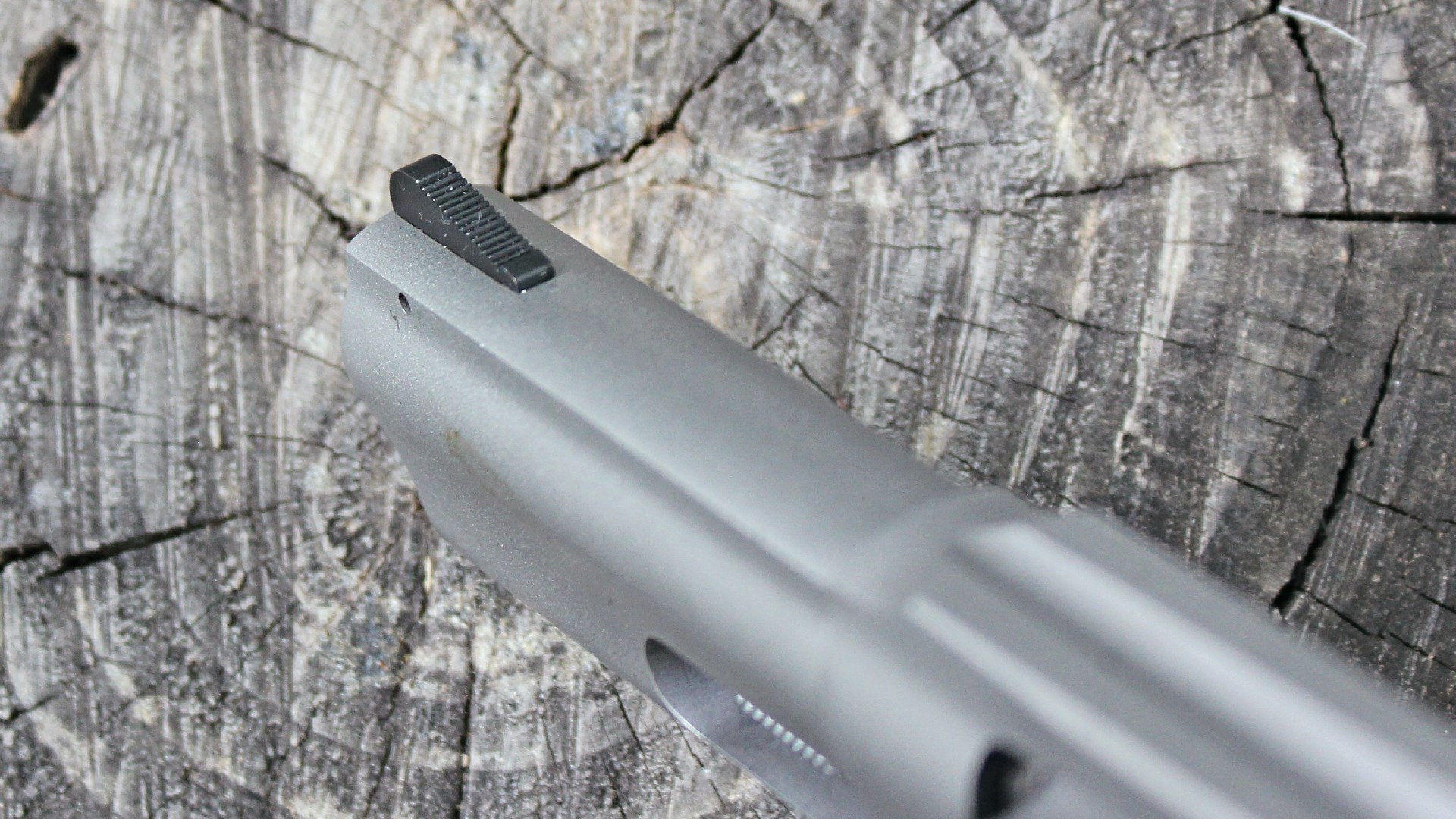
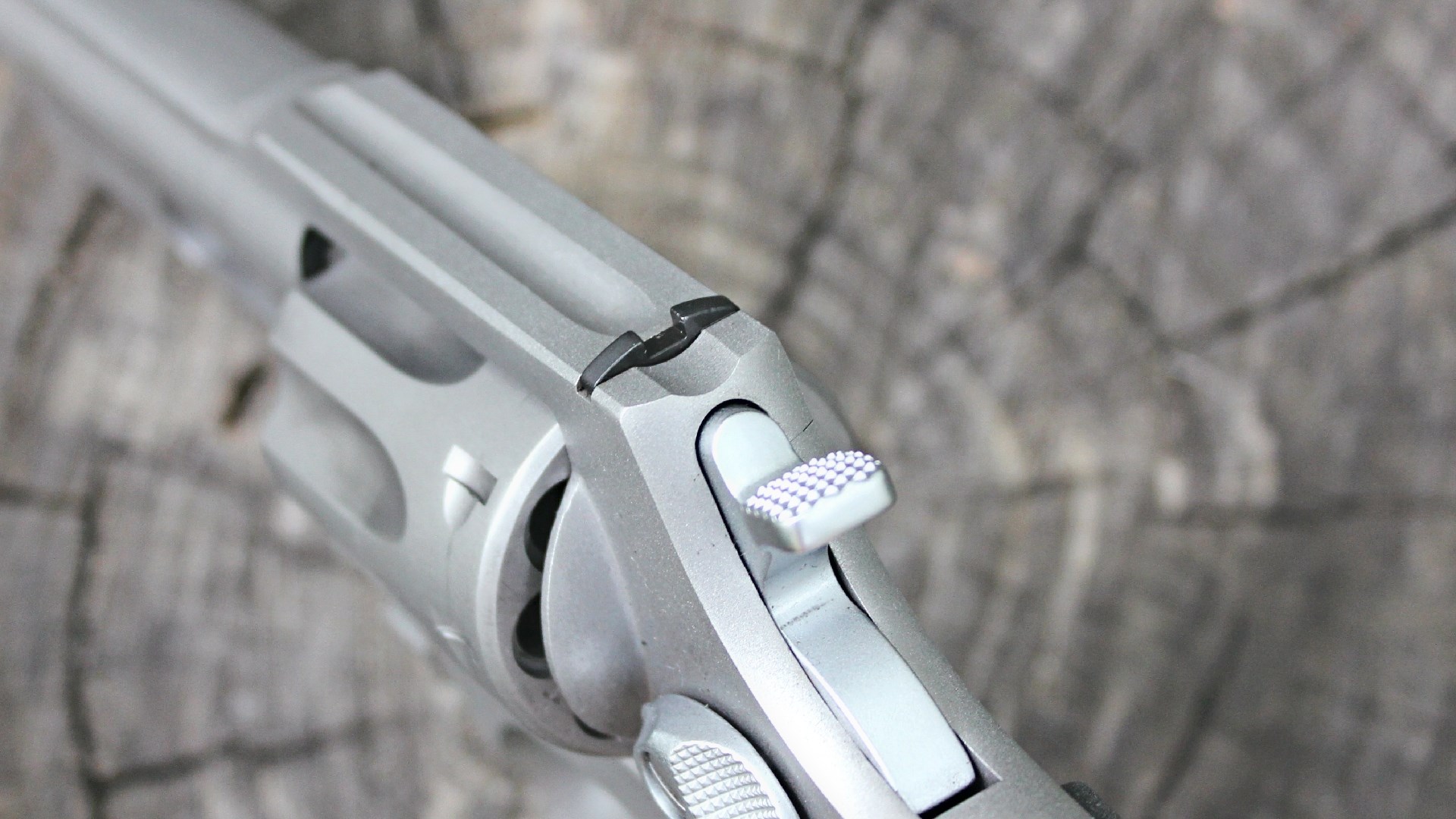
The majority of Taurus small-frame revolvers are outfitted with a pinned, serrated ramp front sight and fixed square-notch rear sight. However, the Model 942 has been outfitted with a thin-profile rear sight plate that can be shifted for windage using the right-side adjustment screw. Although this is not exactly a target-grade sight system, it does lend itself nicely to sporting revolver purposes.
The exposed hammer has a checkered spur that allows this revolver to be manually cocked for single-action fire. The wedge-shaped cylinder release, located on the left side of the frame, is pressed forward to open the action for loading. The cylinder rotates counter-clockwise and swings out to the left side of the frame. Each of the cylinder’s eight chambers is receded so that the cartridge rims rest flush with the cylinder face.
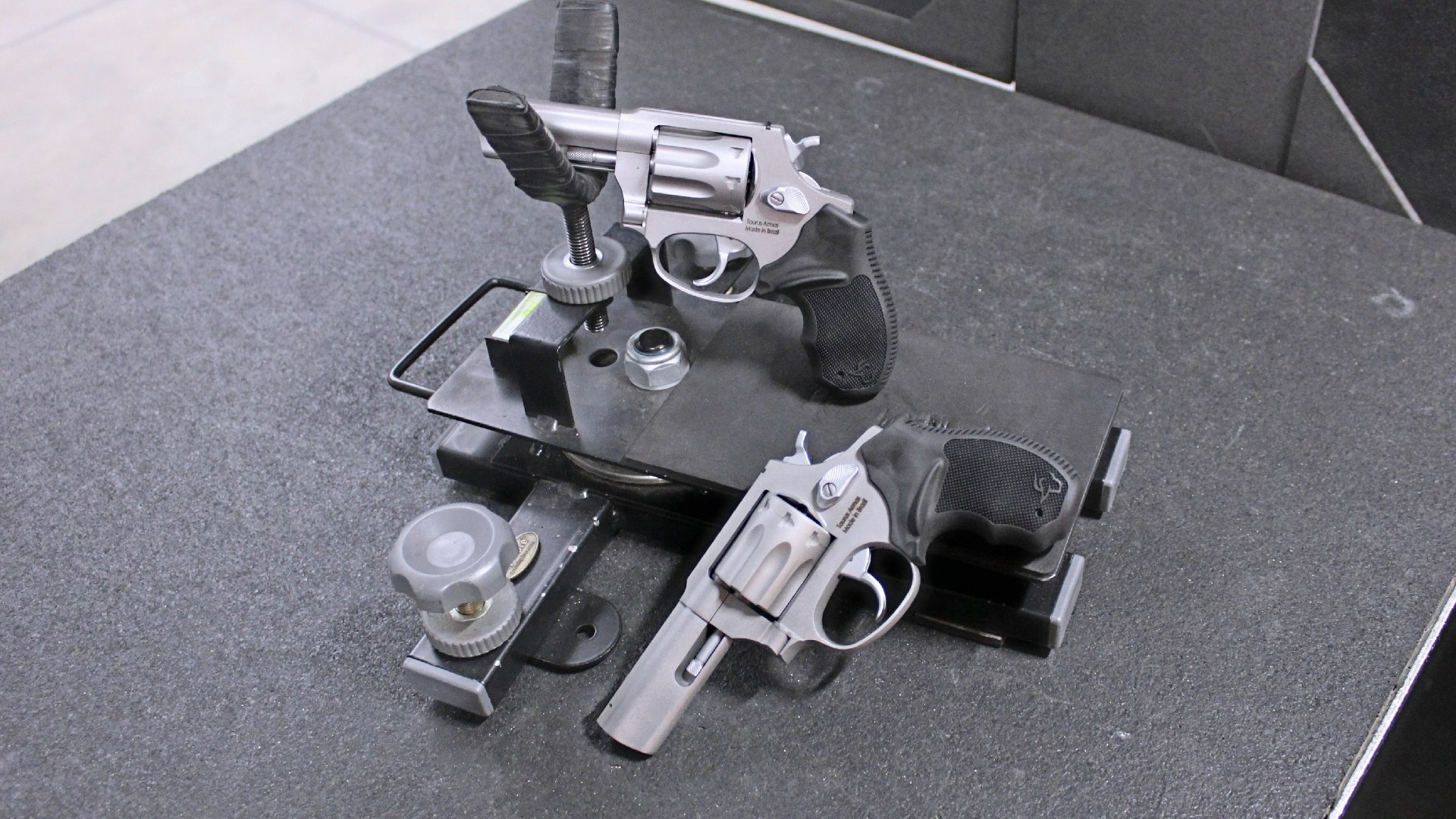
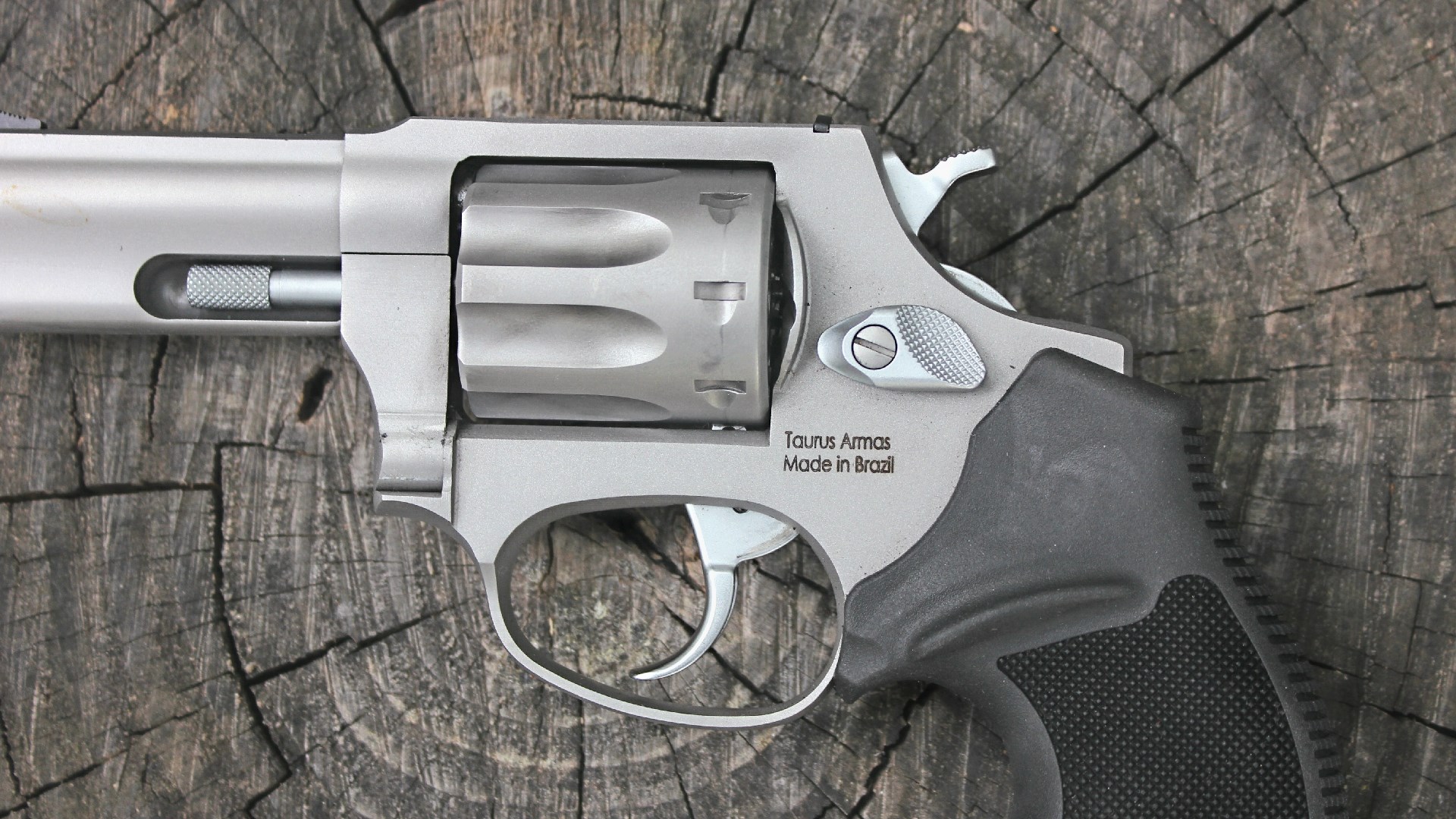
The traditional, rounded trigger guard houses a deeply curved double-action/single-action trigger. Both revolvers exhibited smooth, clean double-action trigger pulls with the .22 LR measuring 11 pounds, 5 ounces and the .22 WMR measuring 9 pounds,. 3 ounces, according to a Lyman digital trigger gauge. With the hammers cocked, the trigger pull was much shorter and broke with 2 pounds, 4 ounces and 2 pounds, 6 ounces of trigger pull, respectively.
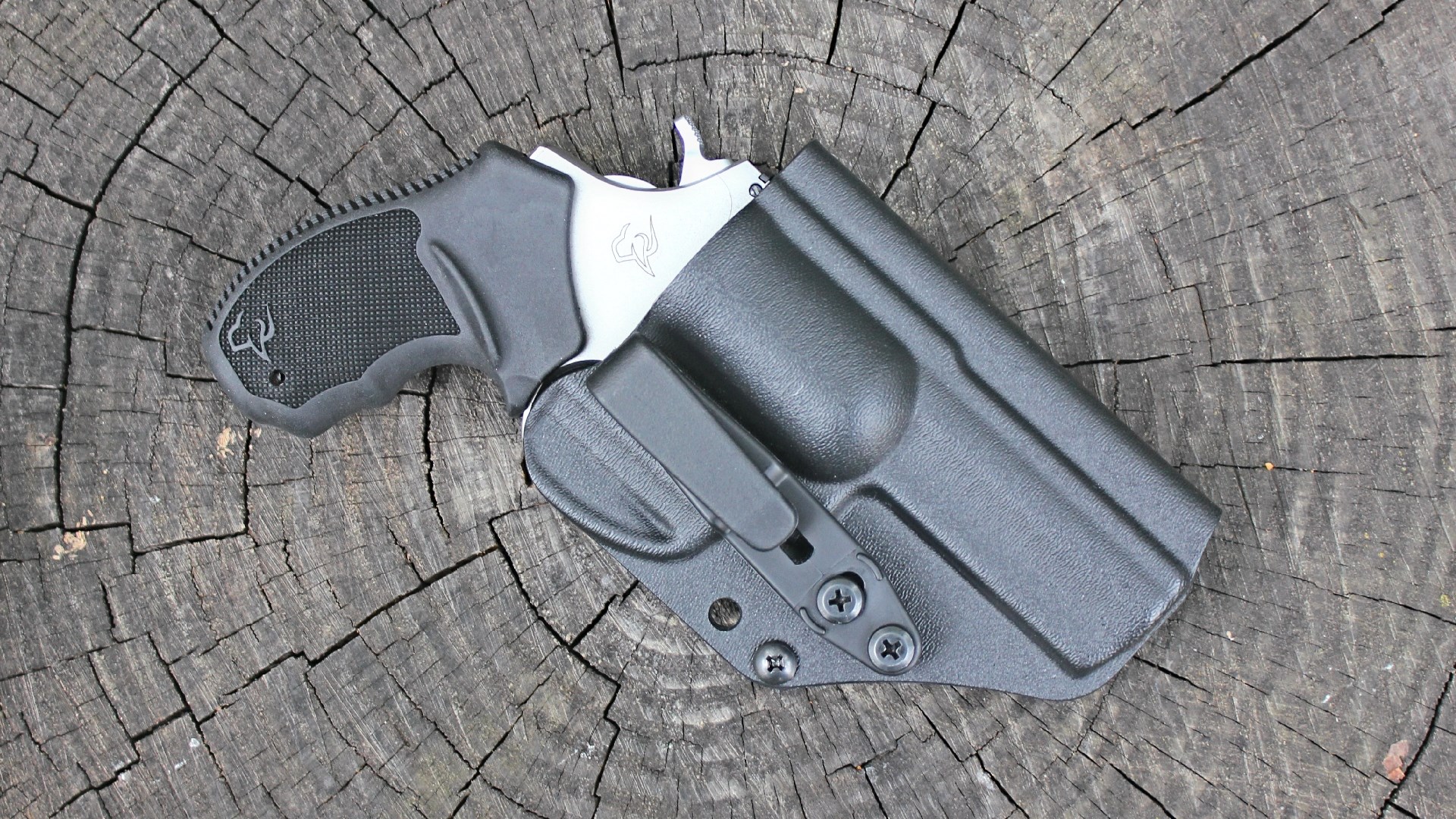
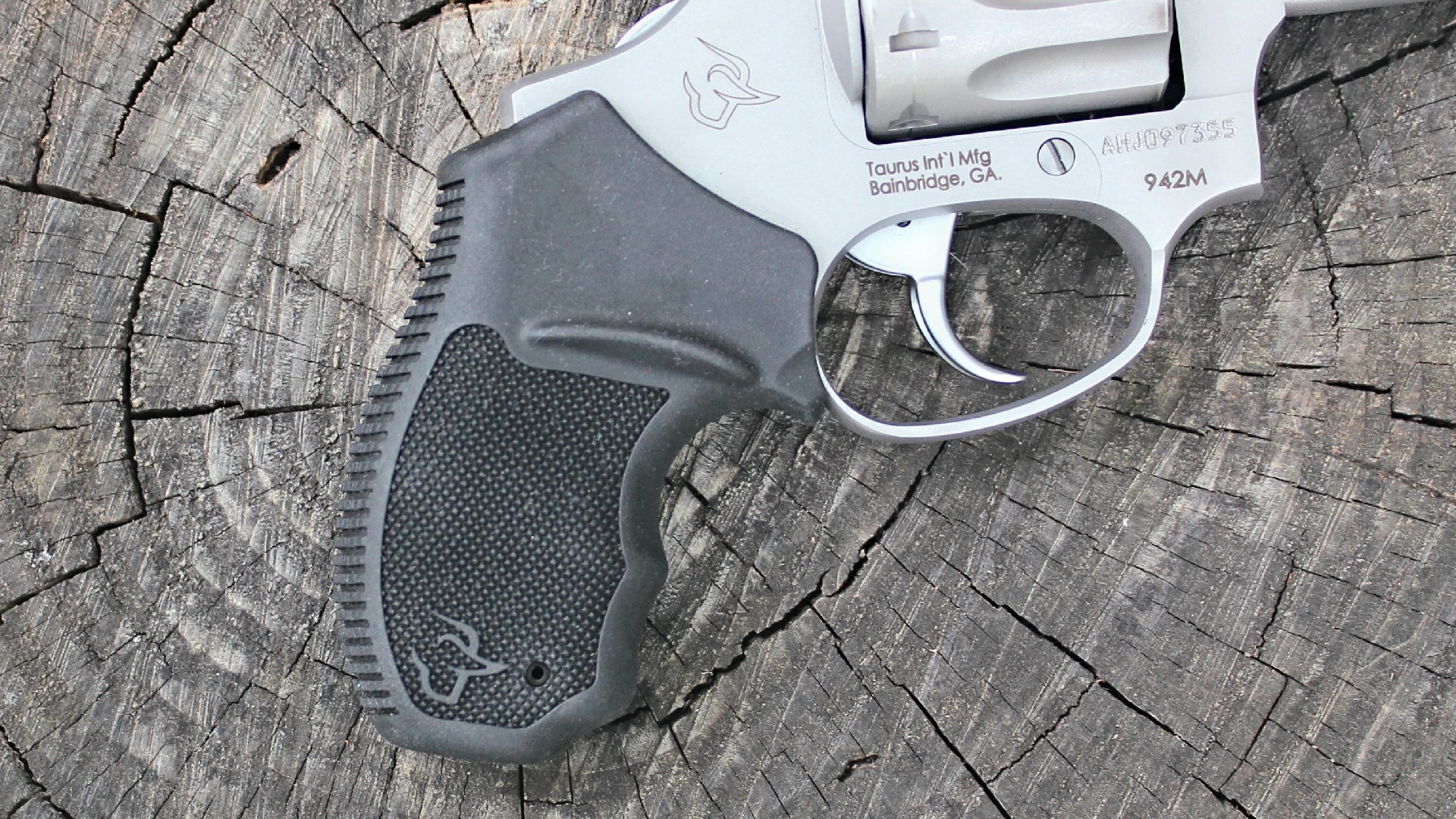
Each revolver is capped off with the same compact, textured black rubber grip found on Taurus’ other concealed-carry, small-frame revolvers. Personally, I would prefer the slightly longer three-finger grip of the Model 605. But with the low levels of felt recoil the Model 942 produces in either caliber, this grip is comfortable to work with and provides plenty of purchase.
Range Results
At the shooting range, the Model 942 revolvers exemplified the enjoyable shooting experience that rimfire revolvers provide. Well balanced with a handy feel, rimfire wheelguns do not exhibit the ammunition pickiness or sensitivities that can plague some semi-automatic pistols. Yes, performance and accuracy can change, depending on the load fired. But if the cartridge’s primer is sound, the revolver will go bang every time and remain jam-free with each pull of the trigger.
In this case, there were no revolver-related malfunctions throughout the course of testing both guns with a mix of practice and premium-grade loads. There was just one bad primer among the .22 LR practice-grade loads, which is par for the course. But every other round fed, fired and ejected properly. Most of the spent cartridge cases popped out and dropped free with a smart slap of the ejector rods. Some of the spent cartridge cases of the hotter .22 WMR loads were a bit more tightly wedged into the chambers, but a second tap of the ejector rod shook them loose.
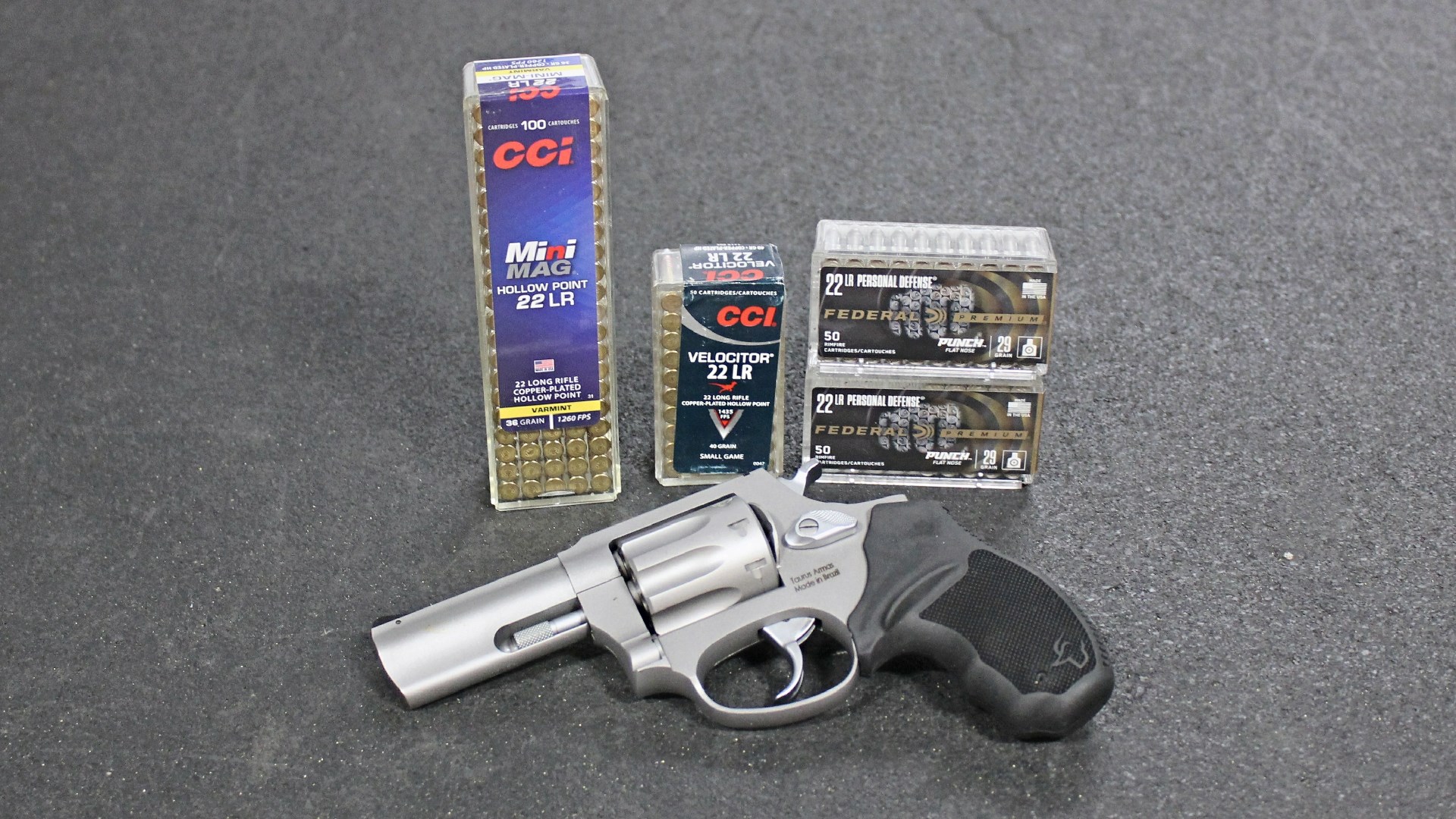
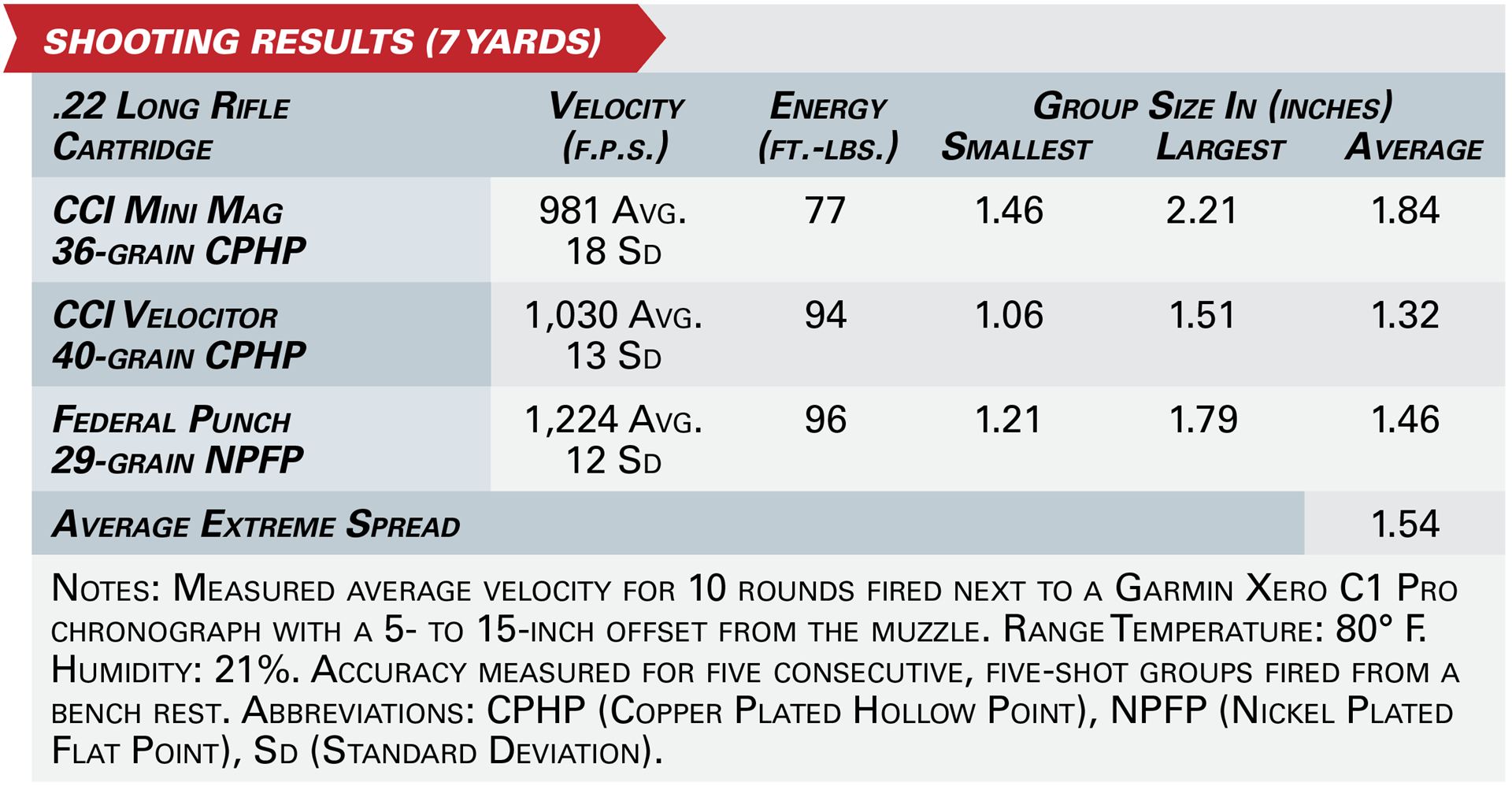
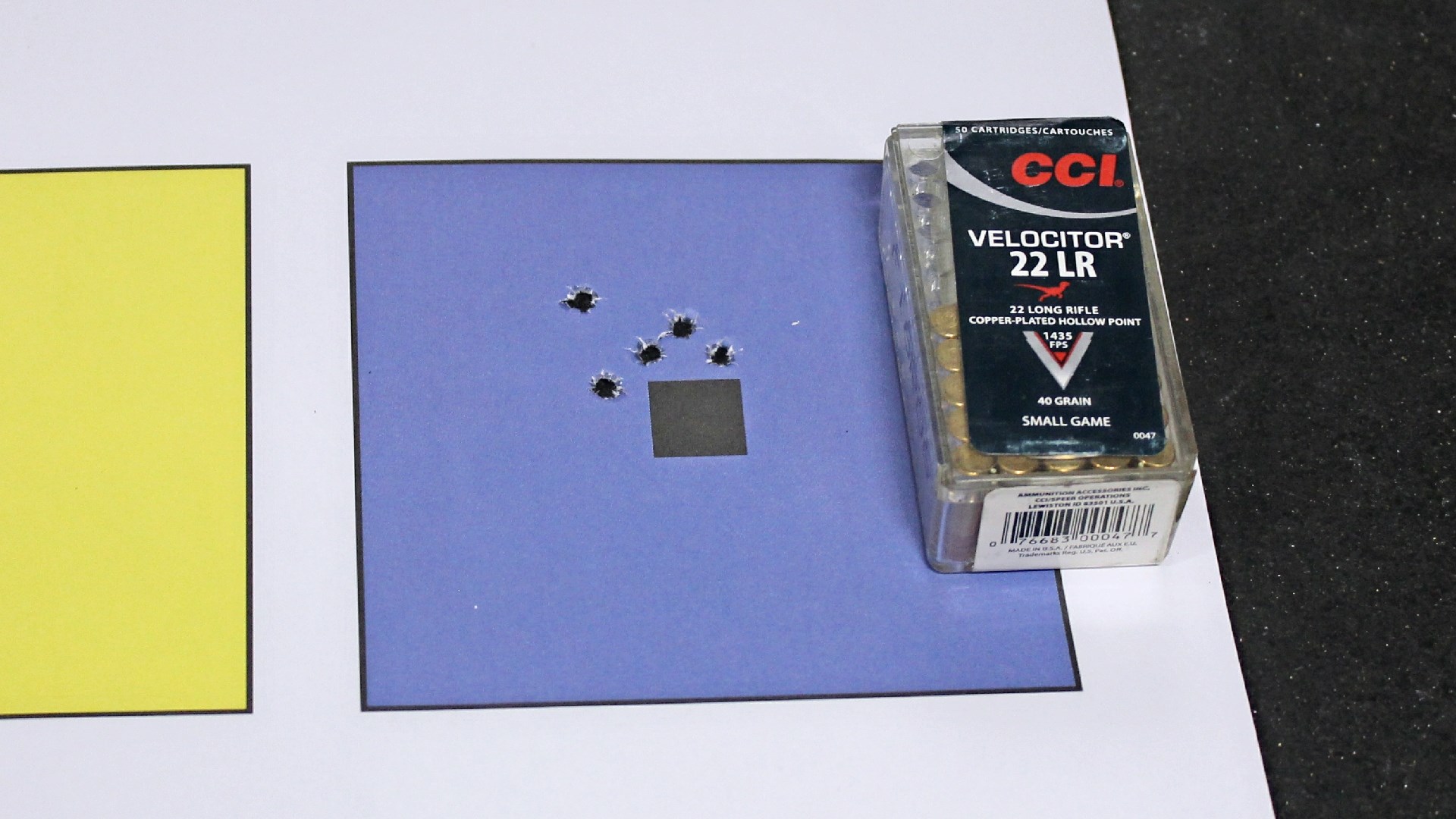
It was mentioned earlier that most rimfire ammunition is configured for long guns. However, there are a few exceptions. For short-barreled .22 LR revolvers, Federal offers the Personal Defense Punch load topped with a 29-grain flat-nose, nickel-plated bullet. With a listed 2-inch barrel velocity of 1,070 fps, it is intended to provide deep penetration with defensive handguns. The remaining formal test slots were filled with two CCI loads that have been favored for small revolvers for some time, including the 36-grain Mini Mag and the 40-grain Velocity, both of which launch copper-plated hollow points.
Formal benchrested accuracy testing was conducted by firing five, five-shot groups using three loads of ammunition into paper targets posted at a distance of 7 yards. A Garmin Xero C1 Pro chronograph was used to measure bullet velocity averages for 10-shot strings. Here are the .22 LR results:
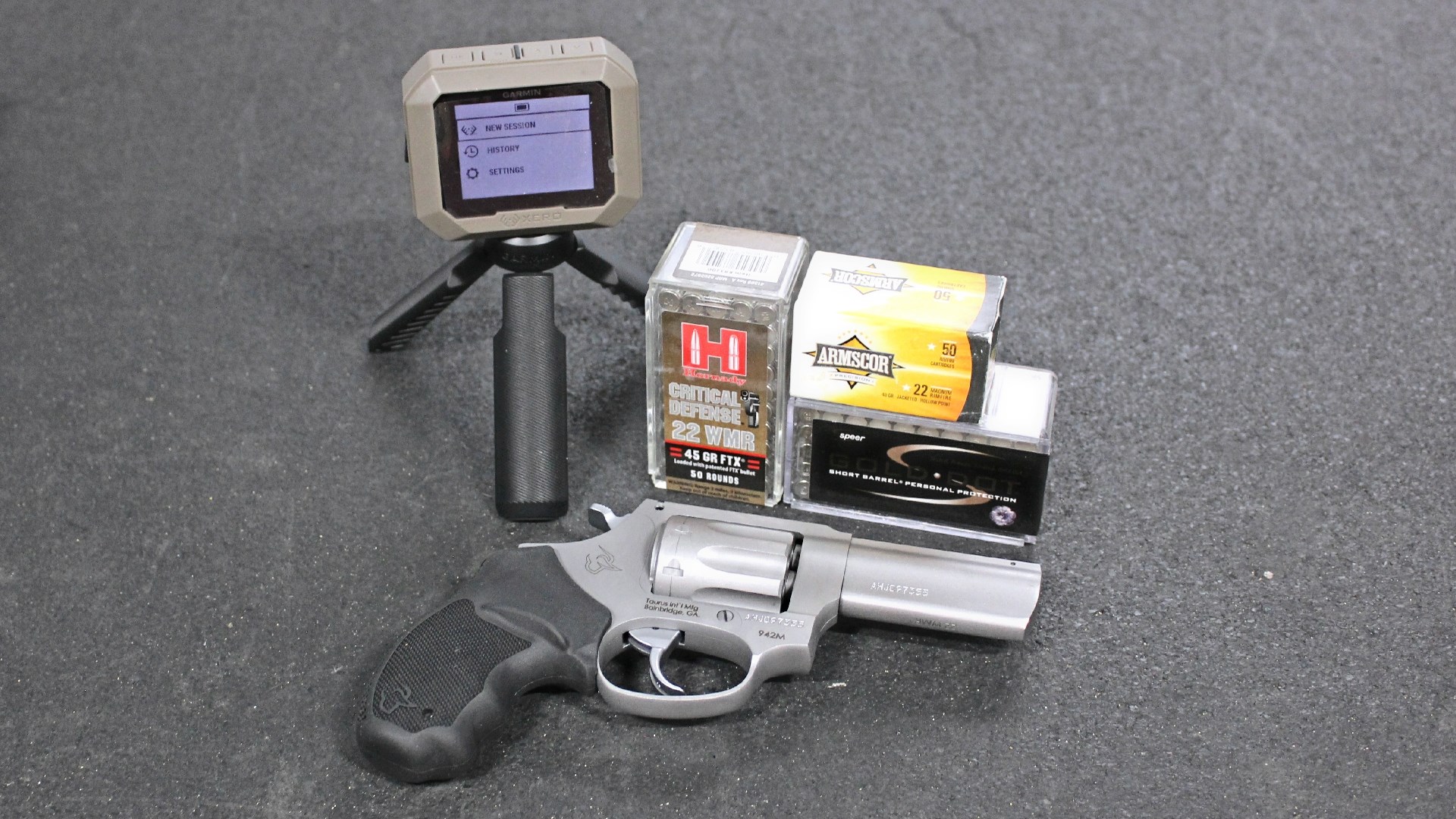
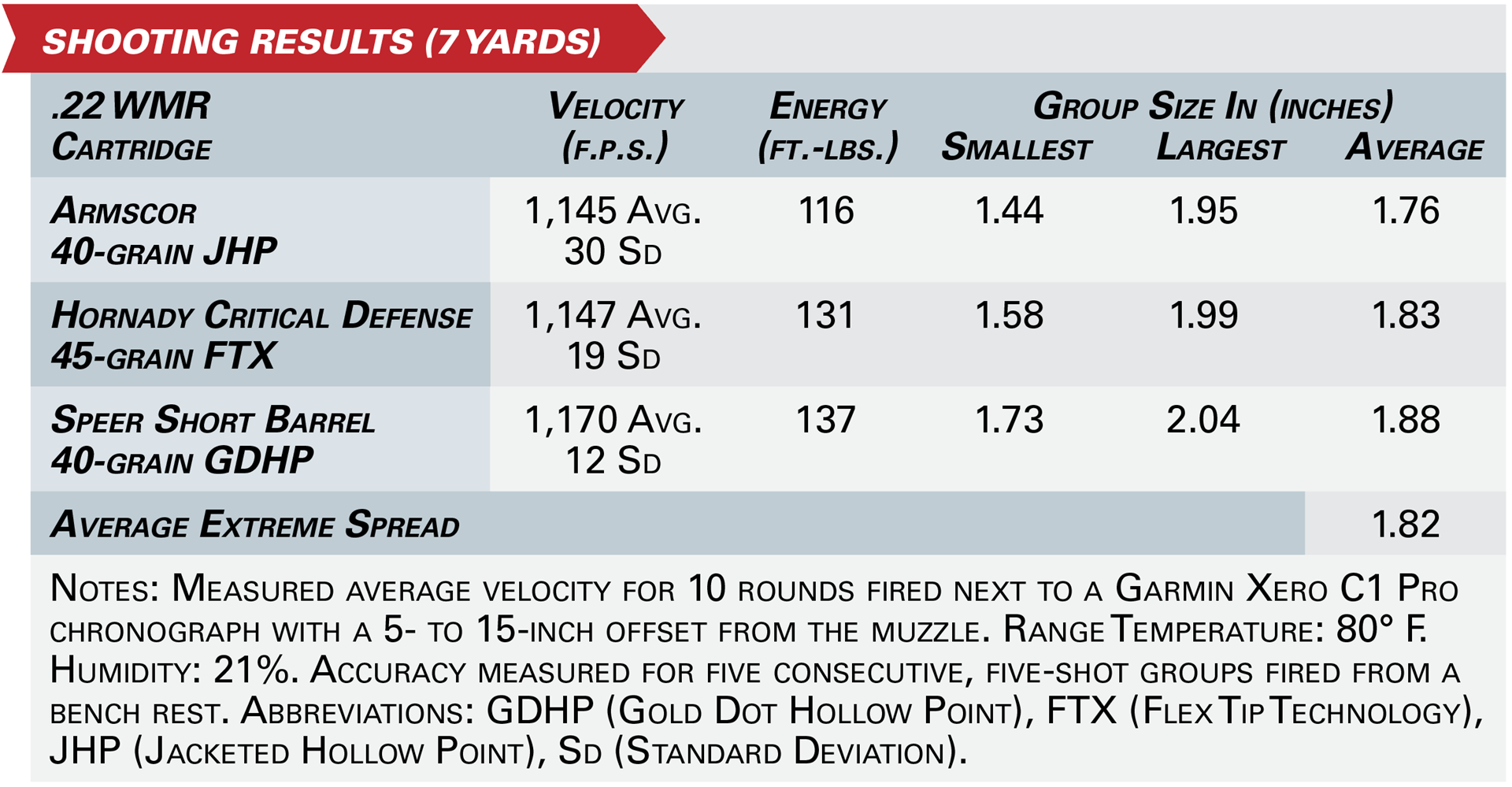
Snub-nose .22 WMR revolvers have garnered a quiet following among self-defenders who what to carry low-recoil handguns for personal protection. To meet their needs, Hornady’s Critical Defense 45-grain FTX and Speer’s Short Barrel 40-grain Gold-Dot hollow point loads are configured specifically for small revolvers. The third test slot was filled with Armscor’s sporting 40-grain jacketed hollow point load.
It should be noted here that the .22 WMR revolver was the more energetic gun of this test set. It produced more recoil, a louder report and sometimes a brighter muzzle flash with some loads. While the .22 LR Model 942 would warm up, the .22 WMR got hot. With these differences in behavior I was quite curious to see if the .22 WMR’s louder bark translated into a bigger bite. Here are the numbers:
Wrapping Up
With these performance numbers in hand, let’s go back to the primary question. Do small .22 WMR revolvers provide enough of a performance boost to justify the added ammunition expense when compared to compact .22 LR revolvers? In regards to accuracy, the .22 LR Model 942 was a tighter shooter with an average extreme spread of 1.54 inches compared to the .22 WMR’s spread of 1.82 inches.
As for bullet energy at the muzzle, the .22 WMR was harder-hitting than the .22 LR across the board. Comparing the energy average of the least energetic .22 LR to the slowest .22 WMR round, we find the .22 WMR yielded 38 ft.-lbs. more than the 22 LR. For the middle-man performers, there was a difference of 37 ft.-lbs., while the hottest rounds exhibited a performance gap of 41 ft.-lbs. of energy.
Is roughly 40 ft.-lbs. of additional bullet energy worth the .22 WMR trade-offs of greater noise, brighter muzzle flash and more costly ammunition? I would say it depends on how the little revolver is going to be used most of the time. For more casual pursuits, the .22 LR will continue to be king. It’s simply too fun, affordable and flexible for its crown to slip any time soon.
However, if a rimfire revolver is more likely to be pressed into service as a survival or defensive handgun, then the more potent .22 WMR would be the better choice. Whichever rimfire caliber turns out be the better fit for your needs, the Taurus Model 942 is a sturdy, reliable kit gun that’s up to the task. For more information, visit taurususa.com.
Taurus 942 Revolver Specifications
Manufacturer: Taurus Armas (Brazil)
Importer: Taurus USA
Overall Length: 7.60 inches
Barrel Length: 3 inches
Height: 4.64 inches
Chambering: .22 LR (#2-942039); .22 WMR (#2-942M039)
Action Type: double-action/single-action revolver
Frame: stainless steel, matte finish
Rifling: six-groove, 1:16.5 RH Twist
Cylinder Capacity: eight rounds
Sights: serrated ramp front, adjustable square notch rear
.22 LR Trigger: double-action pull 11 pounds, 5 ounces; single-action pull 2 pounds, 4 ounces
.22 WMR Trigger: double-action pull 9 pounds, 3 ounces; single-action pull 2 pounds, 6 ounces.
Width: 1.34-inch (cylinder)
Weight: 25.1 ounces, unloaded
Accessories: cable lock, owner’s manual
MSRP: $553
Read the full article here