


“That’s not a knife. This is a knife!” (Paul Hogan as Mick Dundee, in Crocodile Dundee, 1986).
When I took the Cold Steel Recon 1 XL out of its box for the first time and deployed the blade, the attempted mugging scene from Crocodile Dundee immediately came to mind. The Recon 1 XL is bigger than the average everyday carry (EDC) knife: a lot bigger. It has a 5.5-inch blade that is 0.15 inches thick and 1.63 inches wide. It is 12.25 inches long when the blade is deployed. And it weighs 8 ounces.
The knife is 6.75 inches long, when folded. I thought that might be too long to fit in my left front pants pocket, but I was wrong. It made it a little more challenging to stick my hand in that pocket to retrieve the ink pen, Swiss Army SD Classic knife, or plasma lighter that I store there. But after a few days I got used to it, and forgot the knife was there unless I happened to need it.
The blade is made of CPM XHP stainless steel. The handle is made of G-10. (G-10, aka Garolite is a high-pressure fiberglass laminate.) The blade deploys using dual thumb studs, and is held open by Cold Steel’s famous Tri-Ad Lock.
A pocket clip can be attached to either side of the butt of the handle. Cold Steel supplies an extra clip in the box just in case a replacement should be needed.
The knife is made in Taiwan and cost $279.99 at coldsteel.com at the time of this writing.
If you would like a larger than average EDC knife, you may want to take a look at this one.
Background
I always carry an everyday carry (EDC) knife. It is handy to have something sharper than my teeth and longer than my fingernails to help with the tasks of day-to-day life. There are always things to open, things to trim, and even things to pry.
I don’t carry a knife solely for my own benefit. My wife, “Kari” often asks, “May I borrow your knife?” She knows that a good blade is useful for a multitude of tasks even though she doesn’t carry one herself.
I also enjoy reviewing EDC knives more than almost any other product. I know that when a new knife comes, I pretty much just have to stick it in my pocket, and the review will practically write itself. Most other reviews I have to actually work at.
So when I got a press release about a new EDC knife from Cold Steel, I was interested right away. I requested a sample for testing and evaluation, and they were kind enough to agree. I went out of town for a few days, and by the time I got home, there was a box waiting on my doorstep.
First Impressions
When I opened the shipping box and took out the product box, my first impression was, “Boy, this thing is heavy.” Most EDC knives that I test weight about three to five ounces. At eight ounces, the Recon 1 XL weighs roughly twice as much.
That additional weight is not too surprising, because the 5.5 inch blade is also about twice as long as the blades of the more typical EDC knives that I test.
 The Recon 1 is available in a variety of sizes from the three-inch blade of the Mini Recon 1 to the 5.5 inch blade of the Recon 1 XL. The Recon 1 also comes in several blade configurations (spear point, clip point, and tanto). The black physical vapor deposition (PVD) finish on the blade proved itself to be quite durable during my testing. The blade came out of the box shaving sharp.
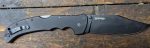 As I mentioned above, the blade is made of CPM XHP. That steel, also known as CTS-XHP was developed by Carpenter Technology. It can be viewed as a stainless version of D2 or as a more wear-resistant version of 440HC. Since 440HC and D2 are my two favorite knife steels, this made CPM XHP particularly interesting to me.
“CPM” stands for “crucible powder metallurgy.” In the CPM process, high-pressure gas atomizes molten steel into tiny droplets as it is forced through a nozzle. The resulting droplets are then subjected to high temperature and pressure to produce a fine-grained and homogeneous microstructure.
The G-10 handle is molded with a Micarta-like texture. The lanyard hole in the handle looks large enough to accommodate paracord, which I appreciate.
In addition to imprinted specifications about the knife, I noticed a couple of other things about the box that it came in. One of those things was a California Proposition 65 (CP65) warning. I typically ignore CP65 warnings, but I happened to notice that this one was about nickel. The problem with this type of warning is that it ignores the fact that nickel in its solid form is not dangerous. Long-term exposure to nickel dust or fumes in mining or industrial settings can be dangerous, but the five cent piece in your pocket, which is composed of about 75% copper and 25% nickel, is not at all dangerous. CP65 warnings are kind of like putting a warning on a glass of ice water in a restaurant, because water can be dangerous if inhaled and toxic if ingested in excessive amounts. By making something sound dangerous in a context in which it is safe, CP65 warnings function much like the boy who cried wolf. They tend to desensitize people to warnings to the extent that they ignore warnings about things that are genuinely dangerous.
Speaking of desensitizing people to warnings, the box also stated, “Please use caution when handling Cold Steel products. Knives are extremely sharp.” I don’t blame Cold Steel for seeking to reduce their exposure to litigation in this way. But I am old enough to remember a time when we would have laughed to read something like that on a knife box. We would have thought that any society that needed to write something like that on its boxes must be pretty foolish. And we would have been right.
That doesn’t mean that safety precautions in themselves are silly. In the law that God gave to the nation of Israel, He instructed them to put parapets around their flat roofs to keep people from falling off (Deuteronomy 22:8) and to cover pits that they dug to prevent animals from falling into them (Exodus 21:33-34). But although you can help to prevent accidents, there is little that you can do to cure foolishness. As the old saying goes, “It is a waste of water to wash a donkey’s head.”
Testing
Over the course of the following weeks, I used the knife for a variety of tasks:
Opening a shipping box containing an electric bike that I bought Kari for her birthday.
Kari used the knife for cutting greens off of beets that she had just picked and was preparing to pickle.
Opening suet for bird feeders.
Opening a package containing a replacement battery for a key fob.
Opening a box of fire starters to be reviewed.
Opening a box containing a new vise for the work bench in the pole barn.
Opening a package of frozen pizza.
Opening the dog’s monthly dose of heartworm medicine.
Cutting some fatwood shavings to be used in igniting a fire.
Opening the dog’s monthly flea and tick treatment.
Cutting a piece of Danish almond kringle to eat for dessert after lunch. (Note: I washed the blade first).
Opening mail.
Removing old shipping labels from an airbow box so that a new label could be attached for return to the manufacturer after testing.
Cutting packing tape for sealing up the airbow box.
Cutting cardboard to make a shipping box for returning a rifle to the manufacturer after testing.
Opening a box containing a rifle rest.
Cutting a piece of coffee cake for dessert after lunch (see note above about washing).
Opening boxes containing books for explaining the gospel to children.
Cutting beanstalks away from cylindrical tower made of fencing material for stalks to climb. It was time to store the tower for the winter.
Opening a box containing a package of ink pens.
Stripping wires to replace a male plug on an extension cord. The large blade was a little awkward for somewhat fine work like this, but it functioned adequately.
Cutting zip ties while taking down a sukkah after a children’s ministry activity about the Feast of Succoth.
Opening packages of cheese to be shredded for a taco dinner at church.
Opening a box of minibooks for distribution in the church foyer.
Opening a box containing The Ancient Christian Commentary on the book of Romans.
Opening a box containing a prefabricated greenhouse so that I could get out the assembly instructions.
Opening a box containing a scope for an air rifle so that I could mount the scope on the rifle.
Opening a package of Our Daily Bread devotionals to be distributed in the foyer of our church.
Breaking down boxes for recycling.
Opening boxes with fire sticks, bullets, targets, primers, and a clip and trim attachment for a chainsaw.
Batoning a board to recover a bullet after some ammo penetration testing.
Conclusions
The Recon 1 XL is a nice knife. Since it is a bit larger than I prefer, I hope to test some of the standard and mini-sized Recon 1 models in the future as possible alternatives.
Most tasks can be accomplished more gracefully with a smaller blade. There is a reason doctors use a scalpel rather than a machete for surgery.
I also noticed that the size of the blade was embarrassing in some contexts. I found myself digging out the Swiss Army Classic SD at times just so people would not see the size of the Recon 1 XL. When Kari and I went to Grandparents’ Day at our grandkids’ school, Kari specifically asked me to leave the Recon 1 XL at home.
On the other hand, there are times when bigger truly is better. If I needed to hack at underbrush, baton firewood, or defend myself from an attacking predator (either four-legged or two-legged), the larger blade would be an advantage. In those circumstances, the Recon 1 XL provides a more convenient package than a sheath knife with a blade of equal length.
A Keeper
Although I give away most of the knives that I review for SurvivalBlog, I decided to keep the Recon 1 XL. It seemed like a good solution for large blade situations.
Disclaimer
Cold Steel provided me with a sample of their Recon 1 XL Folding Knife for testing and evaluation. I tried not to allow their kindness to interfere with my objectivity in this review, and I believe that I have succeeded. I did not receive any other financial or other inducement to mention any vendor, product, or service in this article.
Read the full article here