

I recently tested a number of FrogLube products for effectiveness for firearms cleaning, lubrication, and corrosion resistance. I tested FrogLube Lubricant-Protectant and FrogLube Extreme Lubricant and Preservative for corrosion resistance. I tested FrogLube Super Degreaser and FrogLube Solvent for cleaning. I tested FrogLube Extreme Lubricant and Preservative for its effectiveness as a lubricant.
My standard gun care products are kerosene for cleaning and Breakfree CLP for lubrication and corrosion resistance. I found the performance of FrogLube products to be roughly comparable to my standards under temperate conditions. In my limited testing, I felt that FrogLube Extreme Lubricant and Preservative was slightly more effective than BreakFree CLP as a lubricant. I concluded that BreakFree CLP provided marginally better corrosion resistance than either FrogLube Extreme Lubricant and Preservative or FrogLube Lubricant-Protectant.
When exposed to cold, FrogLube Extreme Lubricant and Preservative seemed to be slightly less effective as a lubricant than Breakfree CLP. Since I often depend on my firearms in cold weather, I plan to continue to use Breakfree CLP instead of FrogLube for now. If any SurvivalBlog readers have more extensive experience with using FrogLube products in below-freezing conditions, I invite their comments. Please submit them to the weekly Snippets column, or drop me a note at ThomasKChristianson at gmail dot com.
The cleaners were appropriate to the products to which they were matched. The FrogLube Super Degreaser and FrogLube solvent worked effectively with the FrogLube Extreme Lubricant and Preservative. The kerosene worked well with the Breakfree CLP. FrogLube recommends not mixing their products with petroleum-based products in the same firearm.
The FrogLube products are bio-based, biodegradable, and nontoxic to the extent that they are even classed as food grade. They have a pleasant, minty scent that my wife, “Kari”, does not find objectionable when I clean guns at the kitchen table. FrogLube products are made in the USA.
At the time of this writing, a four-ounce bottle of FrogLube Super Degreaser cost $20.59 at froglube.com. A four-ounce bottle of FrogLube Solvent cost $17.50. A four-ounce bottle of FrogLube Extreme Liquid cost $21.62. By comparison, a four-ounce bottle of Breakfree CLP cost $13.16 at safariland.com and a one-gallon can of kerosene cost $14.99 at acehardware.com. FrogLube products are not exorbitantly expensive, but they are not particularly inexpensive, either.
If you live in a warm climate, FrogLube may have a slight edge over Breakfree CLP. If you live in a cold climate, Breakfree CLP may have a slight edge over FrogLube. I recommend doing some testing with your own firearms before making a final decision.
Background
I was recently testing Ballistol for a future review in SurvivalBlog. As had been my experience with a number of other cleaning products, I found Breakfree CLP to provide much better corrosion resistance than Ballistol.
I wondered if anyone else on SurvivalBlog had ever found a product with better corrosion resistance than Breakfree CLP. I decided to do a search of SurvivalBlog using the term “Breakfree CLP.” There, amid JWR’s Recommendations of the Week for November 29, 2017, I found his comments about FrogLube CLP. He also shared a link to an article on the Day at the Range website reporting on the extensive testing of 46 gun cleaning products for corrosion resistance.
I thought that sounded pretty interesting, so I contacted FrogLube and requested a sample for testing and evaluation. Not long afterward, I received a box in my mailbox.
First Impressions
The shipping box was 6.25 x 4.25 x 3.5 inches and was delivered via USPS Ground Advantage. It came from FrogLube, 251 SW Wilshire Blvd. Ste 124, Burleson, TX 76028-4779.
The box contained a card with information about FrogLube Solvent and Super Degreaser, a card with basic instructions for using FrogLube CLP, a packet of five 8 x 8 inch wipes that were pre-moistened with FrogLube CLP, five disposable tubes of FrogLube Lubricant-Protectant, 1 empty plastic container (perhaps to hold the contents of an opened disposable tube), one spray bottle with one ounce of FrogLube Super Degreaser, one small bottle of FrogLube Solvent, and one small bottle of FrogLube Extreme Lubricant and Preservative.
Corrosion Resistance
I began by taking two rusty drawer glides and nailing them to a piece of plywood. I sanded away the surface rust and then went over the surface with a wire brush for good measure. Next, I cleaned the surface with denatured alcohol and divided the test surface into three-inch sections.
The temperature in the pole barn was 85 degrees Fahrenheit. Using a piece of clean paper towel, I rubbed FrogLube CLP into the upper left test section using a circular motion. I did the same with Breakfree CLP in the upper right test section. I kept the upper middle test section untreated.
I had heard some good reports about coconut oil, so I rubbed some of that substance into the lower left test section. Finally, I rubbed some FrogLube Extreme Lubricant and Preservative in the lower right test section. I left the lower middle test section untreated.
Next, I put about a teaspoon of calcium chloride in a spray bottle with about six ounces of water. I shook the bottle, and attempted to spray the test surface. The sprayer on the bottle refused to function, so I poured the calcium chloride solution out over the test surface instead.
After 20 days, the untreated portions of the test surface displayed significant corrosion. All four of the treated sections showed almost no corrosion. There seemed to be some very slight hints of corrosion on the FrogLube CLP, coconut oil, and FrogLube Extreme Lubricant and Preservative sections. The Breakfee CLP section may have had a barely discernable hint of corrosion, but it was less than any other section.
So in a close race, I think Breakfree CLP won by a nose in terms of corrosion resistance. I was interested in the good results attained by the coconut oil, and invite comments if any SurvivalBlog readers have any experience using that substance as a firearms lubricant and protectant.
Function Testing Preparation
I previously owned a Walther P22 that was finicky. In order to operate reliably, it demanded consistent cleaning and careful ammo selection. It was not especially accurate either. I got rid of the P22 in favor of firearms that are more reliable under a wide range of conditions.
That was a good decision for day-to-day use, but I missed the P22 when it came to lubricant testing. It would have made an ideal test platform for testing lubricant effectiveness since it perpetually teetered right on the edge of unreliability.
As I considered my various firearms, I finally decided that the EAA Witness .22LR Conversion Kit for my Rock Island Armory MAPP FS might be the least reliable firearm that I still owned, and thus the best platform for lubricant testing.
With that in mind, I installed the kit on the MAPP frame. As is my standard practice, both the kit and the frame were lubricated with Breakfree CLP.
Next, I selected a variety of standard and low-velocity ammunition to establish a performance baseline that I could later compare with performance while using FrogLube. I also marked the base of one of the magazines with a piece of green vinyl tape so that I could consistently use the same magazine throughout my testing.
Range Session One
It was a sunny evening in late summer. The temperature was 79 degrees Fahrenheit. There was no wind. Humidity was high.
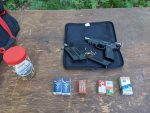 I took the Breakfree CLP lubricated frame and kit out to the improvised range behind my pole barn. I set up a target stand in front of the backstop, and a table 15 yards away. I first loaded 10 rounds of MaxxTech Standard Velocity 40-grain LRN into the magazine. As has been typical with the kit, it needed a little help chambering the first round. After that, all 10 rounds fed and fired flawlessly.
Next, I loaded 10 rounds of CCI Standard Velocity 40-grain LRN into the magazine. The kit needed help chambering the first and third rounds. The other rounds fed and fired well.
Then I loaded 10 rounds of Remington Hi-Speed Kleanbore .22L. After requiring some help chambering the first round, the kit managed to feed and fire four of 10 rounds without help.
The next ammo was Remington Hi-Speed Kleanbore .22S. I was unable to chamber any of these rounds.
Finally, I loaded 10 rounds of Aguila Colibri 20-grain Powderless (primer only). The kit was able to chamber these rounds with some help, but they of course were too weak to eject. This ammo was so quiet that my first shot left me fearing that I might have a barrel obstruction.
Converting to FrogLube
I took the frame and kit into the pole barn, field stripped them, and sprayed the various parts thoroughly with FrogLube Super Degreaser. I then thoroughly wiped all accessible metal surfaces with a shop rag and then blew any remaining degreaser out of the inaccessible surfaces with compressed air. Next, I moved to the comfort of the kitchen table to continue my cleaning.
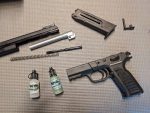 I cleaned the bore with patches of FrogLube Solvent until a patch came through clean. This was followed by a dry patch, which was followed in turn by a patch with FrogLube Extreme Lubricant and Preservative. I repeated the solvent-patches/dry-patch/lubricant-and-preservative-patch process with all accessible metal surfaces, which were already quite clean from the degreaser.
I then reassembled the frame and kit, and was ready for further testing.
Range Session Two
It was a sunny summer afternoon. The temperature was 80 degrees Fahrenheit and rising. There was a gentle breeze from the north.
I placed a DA Targets rifle target in the backstop, and set up a table 15 yards away.
Once again, I began with 10 rounds of the MaxxTech ammo. The kit was able to chamber the first round without help, but needed help with the sixth round.
With the CCI ammo, the kit chambered the first round without help, and fed and fired all subsequent rounds flawlessly.
With the Remington .22L ammo, the kit failed to feed rounds two through six, but chambered the first round without help and fed and fired rounds seven through 10 without problem.
So using FrogLube, the kit was able to successfully chamber the first round in each magazine, something it was not able to do using Breakfree CLP. Other performance using standard velocity rounds was similar to performance while lubricated with Breakfree CLP. The Kit was able to feed one more round of .22L unassisted while using FrogLube in comparison with Breakfree CLP.
I returned to the kitchen and cleaned the frame and kit using FrogLube Solvent and FrogLube Extreme Lubricant and Preservative.
Cold Testing
I placed the frame and kit in a pistol rug along with a magazine loaded with 10 rounds of MaxxTech ammo. I then placed the rug in a Ziplock bag and placed the Ziplock bag in our chest freezer set to zero degrees Fahrenheit.
After more than 24 hours, I removed the Ziplock bag from the freezer, wrapped it in a towel, placed the towel in my range bag, and made my way to the range.
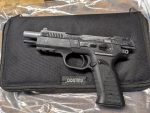 As I removed the frame and kit from the rug, the slide quickly became covered with frost. I inserted the magazine into the kit and aimed at the backstop. The first, second, fourth, and fifth rounds needed help chambering/feeding. Cold/frost significantly reduced the reliability of the kit.
Cross-Checking
Now I needed to determine what impact cold/frost would have when the kit was lubricated with Breakfree CLP.
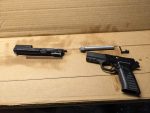 I took the frame and kit into the pole barn and field stripped it. I then sprayed the parts generously with denatured alcohol, and wiped all of the accessible surfaces using a shop cloth. Next, I blew all remaining alcohol from inaccessible surfaces using compressed air.
I then made my way to the kitchen table, and cleaned the frame and kit using kerosene and Breakfree CLP.
After I reassembled the frame and kit, I placed it in the pistol rug along with a magazine loaded with 10 rounds of MaxxTech ammo. I then put the rug back in the Ziplock bag and put the Ziplock bag back into the freezer.
After more than 24 hours, I returned to the range. As I removed the frame and kit from the rug, frost once again developed on the slide.
The first and tenth rounds needed help chambering/feeding. All other rounds fed well.
So, in my limited testing, Breakfree CLP manifested better performance under cold conditions than FrogLube Extreme.
Conclusions
During limited testing on the ragged edge of reliability, FrogLube products produced largely similar results to kerosene and Breakfree CLP. FrogLube seemed to have marginally better performance in warm weather conditions, while Breakfree CLP seemed to have marginally better performance for corrosion resistance and in cold weather conditions.
Since I often operate my firearms under cold weather conditions, I plan to stick with Breakfree CLP for now. If you generally operate your firearms during above-freezing conditions, you may want to consider using FrogLube products instead. If your spouse hates the smell of kerosene or other petroleum-based solvents in the house, then that is another point in favor of using FrogLube.
Disclaimer
FrogLube provided me with samples of their FrogWipes CLP, Lubricant-Protectant, Super Degreaser, Solvent, and Extreme Lubricant and Preservative. Rock Island Armory loaned me a sample of the MAPP FS for a previous review. I subsequently purchased that handgun. I tried not to allow the kindness of these vendors to interfere with my objectivity in this review, and I believe that I have succeeded. I did not receive any other financial or other inducement to mention any vendor, product, or service in this article.
Read the full article here