

(Continued from Part 1. This concludes the article.)
To give a vivid image of what it is still like here, the next smaller village over where my girl grew up still has a single electrical wire held up by bamboo poles with a 3W LED bulb dangling off every 100m (330 ft) or so for street lights, and house wiring running off that same single wire. But the sand roads were concreted over a few years ago, so there is improvement happening.
As you can imagine in the tropics solar power works great, in dry season we have full batteries by 9:30am and produce over 5KW of excess electricity throughout a sunny day, in wet season it’s generally pretty good but the last typhoon sat offshore for 4 days straight we still managed to get an average of 11% efficiency from the panels which got us 90% charge back each day.
I have ordered and will be adding another 4KWh battery shortly to give us more reserves. “Shortly” because it had to be ordered to Manila then awaiting a family member to bring it down on the bus, which is a 30 hour trip, not due to the distance but due to the state of the roads and it has been delayed due to the ferry not being able to cross from Luzon, the main island to our island, due to rough seas. “Soon” and “shortly” have different meanings here than in the West, and that can frustratingly carry over to all aspects of life.
Most of the farm machinery we are now starting to see as useful runs a 2KW to 4KW generator, so that is a no-go fro cahrging the 2KW Bluetti power station. (That allows up to 5-second 4KW spikes, but there is a precise 2KW cut off, as I tested it with an inverter welder. I can run that at 1900W which is 1/3rd power on the welder dial which can do the jobs we need. So an upgraded solar setup for a workshed for farm machinery will be needed in future. That will include a rice mill, a feed pellet maker, etc.
Getting so much sun does have its downsides: heat and humidity. In the tropics, if you’re not drenched from sweat you’re drenched from rain. Still, for me, being Australian, it beats the cold which I never really experienced while growing up. Having said that, it is currently cool season which lasts 2 to 6 weeks and the temperature gets quite cold, for here, down to 22C (71F) at night – it got so cold the other morning I had to put a long sleeve shirt over my t-shirt for a few hours.
We do have and regularly use Baofeng UV5R 2-way radios. A friend was making fun of me for going full prepper when I originally told him I had bought these. Turns out the cell towers are down once a week on average. These outages vary from a few hours to a few days. One of the two regional 4G providers has been down for 10 days straight this time. So the radios already get regular usage to the point where the radios are the primary point of contact with the sister in the village.
A SHTF scenario plays out daily. It is just normal life here.
With our PV power set-up, we easily run warm spectrum 5W LED lights, a 300W rice cooker, a low-power 15W fan and a small 115W 5 cu ft two-door refrigerator. A 64W 4 cu ft chest freezer was purchased recently and will be added “soon” when the additional LiFePo4 battery arrives. This should let us run 3.5 to 4 days with absolutely no sun if we do not use the rice cooker for rice, boiling water, or stews. Rice cookers are extremely versatile and a great addition to off-grid solar setups that no one in the West seems to consider. They are basically a cheap slow cooker for pretty much anything you want to throw into it.
We’ve had precisely five days so far out of nine months where we produced no useful amount of solar power throughout the entire day. The Bluetti can dual charge with solar and mains (grid) power. This allows us to intake 700W of solar plus 400W from a secondary solar array connected via a separately purchased D0505S converter brick plugged into the AC charging port. Only 45 minutes of direct sun will recharge our usual overnight usage. Maximise your panels and then overpanel. It really does help.
I have worked out that an 12% efficiency of the total 1600W of panels will recharge the Bluetti to 100% each day so we’re generally okay in rainy season even with with clouds and light rain.
The Bluetti was chosen mainly as a single point of contact if there is a failure, add in warranty is done via their head office in Hong Kong, meaning I do not have to argue and push and shove local distributors to uphold their end. Having a single point of failure saves me arguing with multiple vendors who will all point fingers at anyone else.
To give you an idea online shopping platforms give you a one-week warranty, thus many items have a one week warranty, returns are often near impossible or as close to it as the seller can make it.
The other benefit with the all-in-one one solar system is that I could test it out in Manila before assembling it on the farm. Bluetti here in the humid tropics does a 2-year warranty, the same unit in the US has a 5-year warranty. As an aside, here Stanley tools come with a one-year manufacturer warranty in the Philippines, yet in the US they come with a lifetime warranty. I have heard a bar rumour that products that fail US or EU quality assurance get sent to South East Asia for sale. There’s also a ton of cheap stuff that’d never pass Western safety standards for sale here. Some of it is pretty ingenious, much of it is total garbage designed to outlast the one week warranty and a potential fire hazard to boot.
One benefit of the coconut farm, besides free coconuts daily, which we make coconut milk for cooking and for ground up meat for an addition to the chicken feed, is that the empty shells can be used to make charcoal for cooking (we only sell the dried coconut meat), this provides us with free fuel for about half the year, we’ve taken a Maori idea and started adding meat and vegetables wrapped in aluminium foil as the coconut shells slow burn to charcoal in a pit covered with banana leaves then a layer of dirt to restrict oxygen and stop a full burn. Otherwise, for cooking we use the very smokey dried coconut husks (keeps mosquitoes away), wood, the electric rice cooker or a couple of small single burner propane tanks during bad storms and for quick egg cooking in the morning.
One issue with it being cheap living here is that though we do produce an abundance of coconuts and rice, the commodity prices that they sell for are low. We’ll harvest about 800 kg, (1760 lbs.) end product rice this year. We also have 250-odd chickens running amok. We’re still learning the ropes with farming. One issue is that the produce sells cheap, too. So, although we do okay by local standards and we can live off the farm produce in a pinch we don’t really get an income worth talking about in terms of Western incomes. For example, this year we’ll make roughly USD $400 from our share of the coconut meat sales which covers our phone and Internet bills plus soap, shampoo, cooking oil, and so forth for the year.
We do get sharecroppers in to manage and farm the rice and coconuts. This givies us more knowledge, more produce and more time to concentrate on figuring out the next steps in other areas. So the aforementioned figure is our share of the coconut meat sales. We do expect the coconut production to double as the previously “stale” trees get back into production mode with constant picking of the fruit. Yep, coconuts are technically fruit. This is another advantage of being here.
Many of the local people, even in the nearby village, live “off grid” as electricity was only widely introduced to this area about 15 years ago. Many get by with charcoal or wood for cooking and solar lights with USB chargers for phones or tablets for the children. There is no town water. Wells are used, usually with manual pumps. Internet is provided by satellite at Internet shops or via 4G phone towers. So we basically live in an entire region of self-sufficient off-gridders.
If you are ever short of food, then a quick walk through the jungle will net you a variety of edible leaves, fruits and root crops. A quick trip to the ocean will get you octopus, small fish, possibly mud crabs and a seemingly infinite supply of shellfish. Salt can and is evaporated from the clean waters. And in a pinch, cooking oil can time-intensively be made from coconuts.
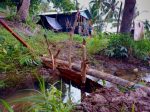
Fresh running water and rainwater are in abundance.
Even though English is the second official language of the Philippines (and as a bonus to expats, all official documents, contracts and laws are in English) almost no one here speaks more than a few phrases. Of those who do speak English most have limited vocabularies so they can speak enough to do their job. But unless you listen carefully and use the words that they know, they do not understand. Everyone here speaks Tagalog, the official national language but, like much of the Philippines, day to day they use the local dialect. (Each region has their own.)
The last point, which makes this whole adventure a lot easier is that my girlfriend is from this area originally and is fluent in the local dialect. Though she moved to Manila as a teen, she grew up like this, without any electricity, spending most of her youth on a remote coconut farm where everything had to be provided from the land or the ocean. So, for her, our life on the farm is returning to her youth, but in a far more comfortable way. She knows many people here, and some of her family still lives here. So we have those additional contacts and people that they know which is helpful as family and family ties are strong.
For myself growing up as an urbanite Australian this would all be too much to do on my own and I certainly would not have tried. It would all be too much even for a seasoned expat. My partner very happy to return to her roots, but as a land owner now. Life with reliable solar electricity and an assortment of battery-operated power tools makes day-to-day chores easier. Unlike in her , on our farm the machete is no longer the be-all, end-all tool for all occasions.
In her youth there were no roads, only jungle tracks, and a machete could be swapped for land, that’s how remote this area was 30 years ago. It took a month to get to Manila back then. We have 4 machetes of various sizes here now – I told you we were rich.
Overall, even though in Manila we exercised regularly, ate “fresh” foods all the time our health has improved considerably now on the farm, eating real food.
When I first came down here, my girlfriend bought pork belly for a BBQ from a local farmer who said: “I know you have a foreign husband, so I feel I must apologise, we don’t have money for pig food so the pig was raised on vegetation on our farm only”. It was the best pork I have ever tasted, just with salt and it was better than any restaurant could possibly serve.
In conclusion, though it is rather nice here, it does get on my nerves at times for various reasons. My girl has figured out that locking the house up and going for a walk to the beach for the day followed by a nice BBQ meat dinner with a couple of beers fixes that for a while. Failing that, she sends me back to civilisation to our house in Manila, though I am still trying to figure out: Is that is to give me a break, or punishment?
We are far enough away that we rarely get any visitors, and only those we invite. The smell of fresh growing rice and chicken poo has replaced the smog and car pollution of the city. My girl is the busiest and happiest she has been since I met her. I am slowly learning to relax over my previous high-drive need to do something daily to grow my old career and constantly push myself to the limits in whatever I was doing.
Like the jungle constantly trying to reclaim our farm and our house, tropical farm life is growing on me.
Read the full article here