

Since 2011, the AAC .300 Blackout has been the benchmark for subsonic performance. By necking-up a standard .223 Remington case to .30 caliber, the new cartridge could accept heavier bullets for use in close-quarters combat. When overpenetration is a concern, but you still need to ensure speedy neutralization of a hostile threat, this is the cartridge you want in your magazine. While it excels within the confines of a building or even down a short alleyway, however, it isn’t the best choice for private citizens merely looking to harvest game. Without being too graphic, feral hogs or even whitetail deer require more energy to dispatch. Additionally, as the civilian market includes hundreds, if not thousands, of combinations between loads and firearms, reliability gets a bit tricky, especially when you consider that the cartridge was developed for suppressed use in a short-barreled firearm.
As American gun owners started to field the .300 Blackout, frustrations began to mount, and many eventually abandoned the cartridge. The suppressor renaissance put a little bit of life back into it, but its insufficiencies still left the door open for cartridges such as the Q company’s 8.6 mm Blackout to gain some steam. Designed to be its bigger brother, that cartridge is based on a 6.5 mm Creedmoor case, which is derived from the .30 Thompson Center, that has been adapted to take .338″-diameter bullets. On paper, it shows a lot of promise, especially when supersonic performance is concerned. However, once you dig a little deeper, you start to see a few chinks in its armor. First, the cartridge is designed around a hyper-fast 1:3″-twist barrel; this rotates the bullet to a critical speed, even to the point of spinning the jackets off less robust designs. As bullets intended for subsonic use typically employ the thinnest jacket available, they are especially vulnerable. Second, if unused, as it typically is, in subsonic loads, the extra case capacity becomes a liability, as it allows the powder column to shift. This sets the stage for variable and oft-erratic ignitions. Lastly, the cartridge’s longer case precludes it from use in the AR-15, forcing gas-gunners to turn to the larger, less popular AR-10 platform. In a way, it almost seems like the 8.6 mm Blackout was built to favor supersonic performance, as opposed to how the .300 Blackout was built with subsonic use in mind. Being that most shooters who are exploring solutions like this are interested in a compact subsonic package, there was still room for improvement.
The Black supersonic (l.) being flatter-shooting and the suppressed Subsonic (r.) being easier on the ears.
Nearly 10 years prior to this writing, at the request of a clandestine government entity, Hornady (hornady.com) sought to best the .300 Blackout. The thought was to shape a case to accept modern, high-BC bullets while limiting the size to just what is needed to hit roughly 1,050 f.p.s. This velocity would ensure subsonic function in any inhabitable environment and keep it within the parameters for use in the smaller AR-15 platform. As bullet speed is fixed, the only way to create more muzzle energy is to add mass, which is already essentially maxed out in the .30-cal. case. The idea of going much heavier would require a twist rate faster than the conventional 1:8″, which would limit barrel makers and begin to introduce issues with jacketed bullets. So, much like Q, Hornady arrived at the .338-cal. diameter for the payload. With the specs on the table, the 338 ARC, or Advanced Rifle Cartridge, was born.
If you’re up on your timeline, you’ll notice a significant gap between the inception of the 338 ARC and its commercial release in late 2024. This space was enough for the company to create and launch both the 6 mm ARC and 22 ARC cartridges, which effectively makes them the children of the 338 ARC and not the other way round. The simple reason for this was a leadership change within the original client’s command, swinging its focus away from short-range use nearly as a whole. Alas, a return to manufacturing normalcy and the completion of other projects pushed the 338 ARC back to the top of the drawing board, reigniting the development that would eventually bring it to the market.
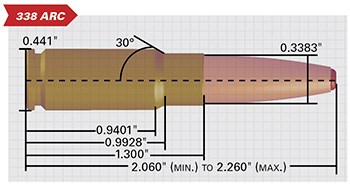
Like the rest of the ARC family, the 338 version is spun from a .220 Russian case, which was derived from the 7.62×39 mm Russian. The inherent accuracy of this envelope is indisputable, as generations have enjoyed success using cartridges such as the 6 mm PCC and 6.5 mm Grendel. In doing so, it retains the popular 0.441″ case-head diameter, which is compatible with Type II Grendel bolts. Coupled with a SAAMI overall length of 2.260″, it is ideal for use in the AR-15. Continuing in that direction, Hornady settled on a 30-degree shoulder angle to balance reliable feeding with consistent bore alignment, a mindset that would also carry over to the cartridge’s minimal tapering. Lastly, the listed Maximum Average Pressure, 52,000 p.s.i., protects even the most delicate gas systems.
As you’d imagine, Hornady is currently the only manufacturer making this cartridge, but it wouldn’t surprise me if that eventually changes. Initial offerings cover both subsonic and supersonic use, with the emphasis lying on the former. This cartridge is an extension of the appropriately named Subsonic line and features the company’s latest Sub-X bullet. At 307 grains in weight, it is roughly 50 percent heavier than the typical subsonic .300 Blackout projectile and is built explicitly to expand at lower impact velocities. The bullets in this series accomplish that through elongated jacket grooves paired with a flex tip that initiates expansion. The .338-cal. variant carries a G1 ballistic coefficient of 0.375, which is a fair bit lower than its 190-grain .30-cal. counterpart’s 0.437, but considering that it’s only intended for use inside of 200 yards, it’s a moot point. Those looking to reach out farther are invited to try the supersonic offering from the Black Line. Built with a hollow-point 175-grain bullet, it leaves the muzzle at roughly twice the speed and has a higher 0.385 G1 BC to help it stay on course. The bullet has a sectional density of 0.219, higher than that of most .300 Blackout loads, making it more suitable for game. Conversely, the 307-grain Sub-X’s SD of 0.384 is superb, to ensure better penetration at its slower speed.
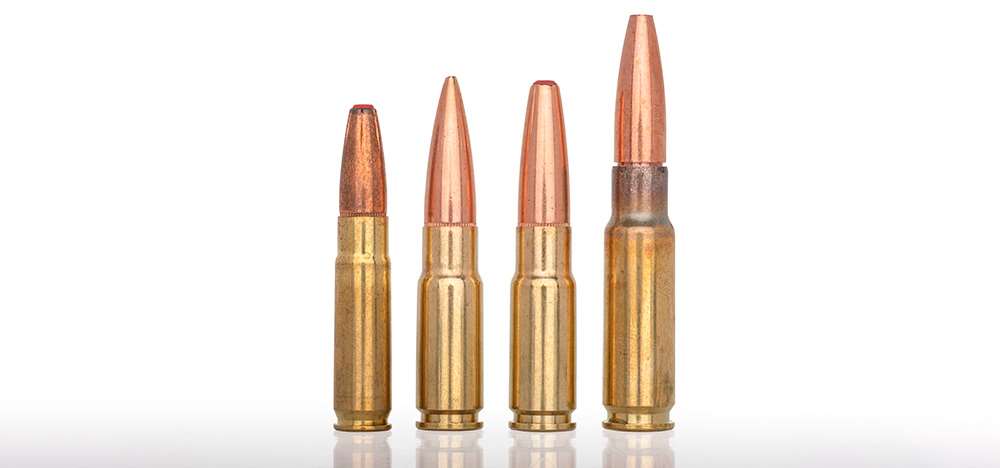
Mid-bore subsonic/supersonic cartridges include (l. to r.): Hornady 190-grain Sub-X .300 Blackout; Hornady Black 175-grain HP Match and 307-grain Sub-X 338 ARC; and Gorilla Ammunition 190-grain 8.6 mm Blackout.
Handloading the 338 ARC isn’t out of the question, as several companies are already offering die sets to do so, and it’ll fit the same shell holders and plates as the 6.5 mm Grendel. Hornady doesn’t offer either factory projectile as a component yet, but Hodgdon lists at least seven that are suitable at hodgdonreloading.com. Powders that are common to loading .300 Blackout are also used in this cartridge, with favorites like CFE BLK, H110 and Accurate 5744 leading the list. As the pressure is generally low and the bottleneck minimal, you can expect several reloads out of fired brass, but Hornady is already stocking factory-fresh cases for those who want to start from scratch.
I had my first opportunity to work with the 338 ARC on a feral hog hunt at the Lowrance Ranch of Truscott, Texas. The facility boasts more than 40,000 acres of some of the finest whitetail hunting in the country; however, like most of the state, it is on the brink of being overrun with hungry pigs. Joined by a group of other outdoor writers, we were each outfitted with a carbine made by CMMG. Among the pack were a handful of Dissents and Resolutes, all fitted with 16.1″ barrels. The Resolute is built with a conventional AR action, while the Dissent action is made to be bufferless, which allows it to use a reduced-length or folding stock. It’s also an optimal base for a large-format pistol. Each rifle was configured with a suppressor and a thermal scope, as we planned to conduct most of our excursions at night when the hogs would be most active.
Prior to our first hunt, we spent some time on the range to ensure that our zero hadn’t shifted during transport and to build some basic familiarity with the firearms. The plan was to spend one night with the Subsonic fodder and the next with the Black line to gather field data on each. To that end, I squeezed off my first shots with the subs and rejoiced at the minuscule report. I found the overall volume to be well within my personal comfort threshold, with the loudest part of the experience being the ringing of the steel targets. After confirming our 100-yard zero, we loaded up into the trucks and hit the road.
Texas regulations are extraordinarily loose for these nuisance creatures, so we were allowed to shoot directly from the vehicle. Each rig was outfitted with a high-rack system, which is akin to a flybridge on a boat. From it, a pair of hunters would ride and signal down when we wanted to stop to observe and engage targets. It didn’t take long to find pigs, and putting a few on the ground was equally effortless. I was able to harvest several with the Subsonic load, each with a single round and each experiencing full pass-through. I also experienced the rainbow trajectory of the cartridge, which made things tough when using a thermal, as judging distance based on a two-dimensional image is virtually impossible. A good rangefinder would have been handy in this instance, particularly one built into the scope.
Day two started with a bit of target shooting with the supersonic Black load, again for experience and zeroing. Suppressed, it was quiet enough for a shot or two, but I found myself reaching for a pair of earmuffs in short order. As predicted, the trajectory of this load was much flatter, with virtually half the drop of the Subsonic ammunition. As I was still zeroed with the Subsonic from the day before, I found that I needed to come down about 11″ to center up with the supers. As we had time to spare, some of us pushed things out to 500 yards and enjoyed better success than I expected.
 As the sun set, we embarked on another journey and again had a rather successful night. Although the Black load has more than twice the power of the Subsonic, both seemed to have the same effect on game in terms of lethality. I can’t say that it dropped pigs sooner or cleaner than the subs, likely because both bleed off the same amount of energy into the target. More importantly, I feel our supersonic hit rate was higher, likely on account of the flatter trajectory.
Returning home, I was eager to have a 338 ARC of my own, so I set out to build one. I was also curious about its performance with a shorter barrel, so one quickly became two. This is another advantage to being AR-friendly, as doing this is exceptionally affordable. Likewise, creating a gun from a stripped lower receiver doesn’t involve any true gunsmithing skills. Additionally, if you already have an AR, the process can be as simple as purchasing a mail-order upper receiver and magazine and replacing it with the one on an existing gun.
For my builds, I turned to KAK Industry, as it had nearly everything that I needed under one roof. I selected a 10.5″ barrel for a pistol build and a 16″ barrel for a carbine, each cut with a 1:8″ twist. Per Hornady’s recommendation, both are built with a pistol-length gas system to ensure the action sees enough gas for reliable cycling. Interestingly, you don’t need a pistol-weight buffer for reliable cycling, so that simplifies matters a bit. Another recommendation encourages the use of a 400 Legend magazine for better cycling of the blunted 307-grain Subsonic bullets, which I’ll admit were troublesome during my first run with this cartridge. To that end, I requested a pair of those, as well as a pair of 6.5 mm Grendel magazines from DuraMag, as its adherence to specifications is superb.
I went with a UTG Pro receiver set for the pistol and an Anderson Mfg. set for the carbine. Using lower parts from Geissele, I had both assembled in about an hour and moved on to picking out furniture. For the pistol, I went with SB Tactical’s latest brace, the SBA-5. This device slides over a standard mil-spec tube, making installation a toolless endeavor. I paired it with a FAB Defense grip and a UTG fore-end for a compact, yet controllable, shooting package that was exceptionally sharp-looking. I fitted the carbine with a FAB Defense GL-CORE stock, as it offers an affordable upgrade over standard M4 hardware, and it was joined by a Mission First Tactical grip and fore-end.
As each firearm was crafted for short-range hunting, I went with low-power variable optics. I gave the pistol a Leupold 1-4.5X unit, while I reserved a slightly higher-powered EOTech Vudu X 1-6X scope for the carbine. This just left the issue of suppression, so I chose a Silencer Central Banish 338, as both firearms were compact enough to handle the additional length.
Range testing went exceptionally smoothly, as neither action required any sort of break-in period. Working with the 400 Legend magazine solved 100 percent of my woes with the Subsonic ammunition and worked just fine with the Black line as well. I can’t see a reason for using the 6.5 mm Grendel magazines other than if you already own them, so if you’re new to the ARC family, you might as well skip right to the Legend offerings. I will note, however, that the pointier, 175-grain bullets had no trouble in the Grendel mags, and I suspect any future loads made with similar bullets will be the same. Also, in regards to reliability, KAK warns that a suppressor is required for proper function with the Subsonic fodder, which I found to be true with the pistol, but not the carbine. While that might sound irritating at first, I expect this with ARs wearing shorter barrels; however, I did not expect success in the longer firearm without a can, so I chalked it up as a win. Besides, I can’t imagine an instance where I would turn to this ammunition type and not want a suppressor anyway. Those in states where suppressors aren’t allowed, or who are waiting for their tax stamp to come in, can use the Black ammunition, as they’d likely want to anyway due to its higher energy, flatter trajectory and longer range.
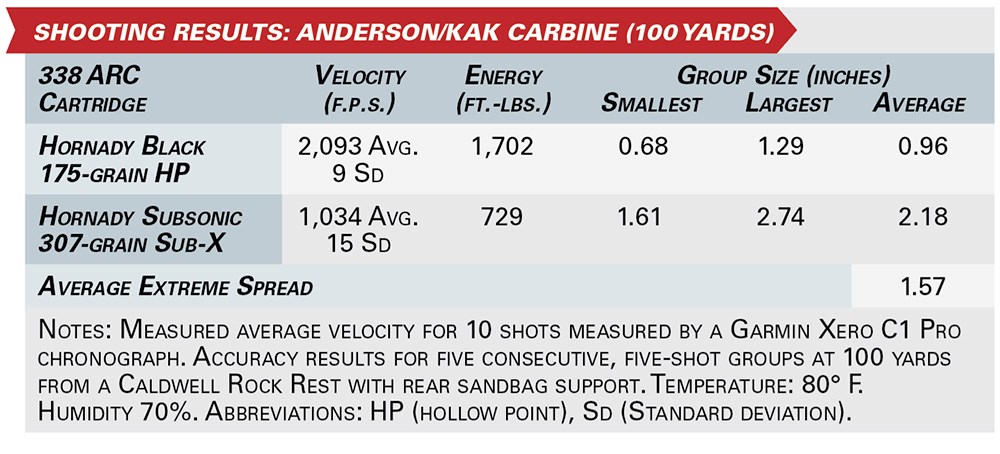
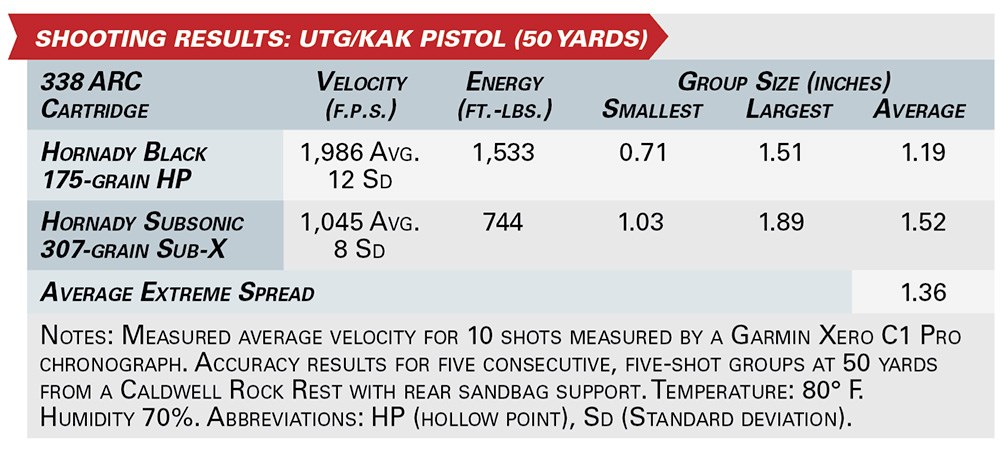
Having paper at my disposal, I was able to conduct a proper accuracy and trajectory test and was more than happy with the results. The carbine proved to be around a 1.5-m.o.a. gun, while the pistol grouped around 2.5 m.o.a. Considering that both barrels are within what most would consider the seasoning period, and this cartridge is built for power over precision, I’m certainly happy. With regards to velocity, I wasn’t surprised to see the Subsonic ammunition leave the muzzle at virtually the same speeds out of both platforms, with the carbine actually a few f.p.s. slower. This is interesting to note, as with all the powder burning up within a short space, the extra 4.5″ of barrel becomes nothing more than drag. The Black load picked up about an extra 100 f.p.s. in the longer barrel, though, so there is indeed a reason to build a long gun—it’ll just come down to your intentions.
My opinion on the 338 ARC is that, in time, it stands a fair chance of reaching the popularity of the .300 Blackout, especially since it is currently on its way up while the latter is fading from fashion. My experience has shown me that it indeed has what it takes to excel as a game cartridge, which means it will likely also serve defensive needs equally well. Having first-round success with two builds, even to the tune of unsuppressed subsonic reliability in a carbine, also shows me that it is well-suited for the consumer market, as it’s flexible with regard to component selection. It’s a good day when a product comes out that solves a unique set of problems—it’s an even better day when it actually works.
Read the full article here