


(Continued from Part 1. This concludes the article.)
Kaw Mach 3 Linear Compensator Conversion
The suppressor-making cognoscenti tell me that the Kaw Valley Precision Mach 3 Linear Compensator is a great starting point for a .22 to 9mm-size suppressor home build. These clever devices are NOT classified as suppressors by the ATF. They are sold nationwide, with no paperwork. They are a modular design, meaning that sections can be assembled incrementally, to whatever length you’d like. (Kaw also makes 2″ and 3″ extensions, and sells them separately.)
It was probably just a coincidence, but the inside diameter of a Kaw Mach 3 is just a hair over one inch. That is a perfect fit for a C-Cell battery. (See my mention of “C” spacers, above.) The possibilities are endless. You can often find a complete Kaw Mach 3 for less than $60 on eBay.
Using Fake Suppressors?
Someone might be tempted to convert a fake sound suppressor into a real suppressor. But that is problematic, because fake suppressors typically have very small inside diameters. They are just glorified oversize barrel extensions, and typically they are welded on. So it is actually much easier to start with a MagLite or a Kaw Valley Mach 3 Linear Compensator.
Solvent Trap Conversion
Starting in the early 1990s, a number of enterprising individuals and small companies began marketing screw-on or clamp-on muzzle devices designed to capture bore cleaners and lubricants that were mostly marketed as “solvent traps.” Some of these outwardly appeared to be mostly-complete suppressors that lacked only centerline drilling of components to allow the passage of bullets. In November of 2023, after more than two decades of vigorous solvent trap sales, the ATF issued an “Open Letter” decree that effectively banned the sale of any solvent traps that had any internal parts that resembled baffles or spiral diffusers.
Sodapop Bottle Adapters
A plastic sodapop or water bottle can serve as an ersatz suppressor. There are no internal components, so they just fill the role of a large expansion chamber. With an approved Form 1, it is legal to make a thread adapter to fit standard soda bottle threads. To use these, you just cut a cross or X-shaped pair of slits in the center of the bottom of an empty plastic soda bottle. The thicker the bottle, the better. (Perrier will become your favorite brand of bottled water.) There are also several online companies that sell precision-made pop bottle thread adapters, such as www.FreedomGear.org. You can also find them for sale with a search on “Soda/Top Bottle/1/2×28 TPI/Cleaning/P
Oil and Fuel Filter Adapters
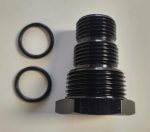 Another popular do-it-yourself approach is using an oil filter or a large alloy fuel filter, and simply drill its centerline clear of obstructions. Most popular is using a “triple adapter” that has threads to match your gun’s muzzle at one end and that has a stack of three successive sizes of thread patterns at the other end, to allow the attachment of various oil filters or fuel filters. Remember: Capturing volatile and toxic bore cleaning solvents is Environmentally Friendly. I’m sure that Greta Thunberg would approve. To find ready-made solvent trap adapters, just do a search at eBay with phrases such as “1/2-28 to 3/4-16, 13/16-16, 3/4NPT Automotive Threaded Oil Filter Adapter“. It is amazing what you can find available on eBay…
Improvised Baffles and Packing
Over the years, a lot of items have been used for suppressor baffling material by home builders. Just a few examples include: Aluminum rivet halves, stainless steel wool (loose or compressed), brass wool (loose or compressed), bent washers, springs (linear or jumbled), bobbins, stepped grommets, freeze plugs, and even virgin (unused) steel beer bottle caps. Just be careful that any loose packing is completely blocked from entering the suppressor’s centerline axis. Also, refrain from using anything that might melt. And, of course, you need to drill a hole through each successive layer of baffles, right at the centerline.
Take heed that you have to make sure that those baffles cannot tip to their sides under pressure, for fear of a dreaded “baffle strike”, which could embarrassingly spew all of your suppressor internals out on the ground in front of you. Heavy-duty large-diameter springs are your friends, to keep baffles in their proper position, even under full gas pressure and recoil. I have read that if you stoutly shake a newly-constructed suppressor and it sounds like a maraca, then you will almost certainly have a baffle strike.
Important Safety Note: Absolutely DO NOT use standard mild steel wool (aka “black steel wool”) such as pot scrubbers for suppressor packing. It is flammable! But stainless steel wool is quite safe.
Improvised wipes
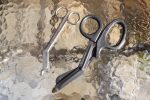
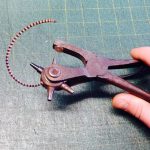 Many suppressor designs utilize a rubber disc washer with a center hole punched, right at the suppressor’s muzzle — just inside the end cap. These discs are commonly called “wipes.” You can find sheets or rolls of 4mm to 10mm thickness neoprene rubber online at eBay. I do not recommend getting the varieties with an adhesive backing. Because when a can heats up, such adhesives are likely to cause a sticky mess. A few companies that sell solvent traps also sell wipe cutting punches, of various diameters. If you take your time, you can crudely cut your own wipes with scissors, and punch a center hole with a cup-ended hand punch or even a typical rotary leatherworking hand punch. Heavy-duty scissors like EMT shears would be best, especially for cutting thicker rubber. (Those are the type of scissors carried by paramedics, ambulance crews, and Emergency Room nurses.)
Finishes and wraps
You can complete a home suppressor build with any high-temperature engine paint. (Regular paints tend to crackle, bubble, and peel, when a can gets hot.) Or, if you want it to look really nice, then you could find a local Cerakote craftsman, or even an anodizing shop.
Because cans get very hot when firing, you may want to make a protective can wrap. These are typically made with temperature-resistant sheet Dupont Nomex between 4mm and 8mm thickness. This is expensive material, so you should first create a full-size paper pattern. After cutting the Nomex to size and doing a test stretch fit, the lengthwise seam can be stitched together with heavy-gauge monofilament fishing line, with holes that are well back from the edges.
Pen Engraving
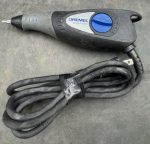 Legally, under the NFA, you need to place a serial number somewhere on each suppressor. In accordance with 27 C.F.R. §§ 478.92 and 479.102, the markings must be “conspicuous and legible.” The markings may be placed on any external part, such as the outer tube or end cap. Typically, this is on the largest tube section. But, if the registered “suppressor” part is just an adapter for a standard soda bottle, oil filter, or fuel filter, then the logical place for engraving a serial number is on the adapter. (Since the bottle and filter canisters are consumable/expendable, and intended to be discarded fairly frequently.) Although their markings look slightly crude, the least expensive way to serialize metal parts is with a typical Old School 120 Volt AC pen engraver. These tools can be found used on eBay for as little as $10, postage paid. The depth and clarity of pen engraving is sufficient to satisfy the ATF. (Note: Practice on some scrap sheet metal for a while, before you serialize anything of value. It does take some practice to make pen engraving look neat.)
Notes on Paperwork
If you are planning to register suppressor builds on Form 1s in the name of your Trust, then I recommend that you get started on working on your Responsible Person Questionnaire, right away. (See the ATF website, for details.) Even if the registration(s) will be the name of a trust, you will still need to have fingerprints taken, provide a 2″x2″ portrait photograph, and provide a copy of the form to your local Sheriff or Chief of Police. (But they no longer need to sign it — that has changed.)
It is important for me to mention that the ATF Form 1 includes a place that is intended for photographs of a suppressor. However, as an unlicensed individual, you cannot legally build a suppressor or even possess the requisite parts until after a Form 1 is approved. So, in that location on the form it is best to print out the following statement, and take a photograph of it, to place on the form, as a JPEG:
| “I don’t possess any parts or materials to manufacture a Silencer, nor will I purchase any parts or materials until after I have an approved Form 1.“ |
As previously mentioned, you can create complete sets of draft registrations that can be filed at a later date. (Up to 60 days in advance.) All that you’ll need to do on January 1st is log in to eForms page and click “submit” on each of them.
Cut to size, File to Fit…
As with other hobby gunsmithing activities, the quality of the suppressors that you make at home can range from “Bubba” to Expert Craftsman. It is just a matter of study, practice, and patience. But to get started, you can just “Cut to size, File to Fit, and Paint to Match.”
In closing, I have three pieces of advice: 1.) Have fun. 2.) Be safe. 3.) Keep it legal! – JWR
Read the full article here