


These days, handgun slides come with pre-cut slides that are optics-ready. They’ll easily accept adapter plates and/or a micro red-dot optic directly with the aid of a few screws. The red-dot trend is so pervasive that consumers can choose to buy from bargain brands all the way to the fully-featured top-tier units.
Along with this energetic market segment, nationally renowned firearms training instructors and organizations have been offering red-dot specific training curricula. Aaron Cowan even authored a white-paper on the role of slide-mounted red-dot optics. If you’re into guns and shooting, you’re probably aware of these reflex sights’ existence.
But, what about adding red-dots to revolvers?
Mixing revolvers with red-dots isn’t actually anything new. Competition shooters have been mounting the larger “scope-like” red-dot sights to revolvers for years now. However, the new crop of micro red-dots has also been rubbing off on contemporary revolvers.
Taurus, for example, deserves some praise for launching its T.O.R.O. revolvers, the first optics-ready revolvers that directly accept modern red-dots.
By all means, adding a red-dot sight to a revolver rewards the shooter with the same benefit they’d reap off a semi-automatic pistol: a higher degree of precision and ease of aiming. But the marriage of this style of red-dot to revolvers does bring forth some unique nuances that shooters should be aware of. It’s the revolver’s shape and design that drives these changes.
Revolver Architecture, Layout & The Relationship To The Sight(s)
A revolver’s most definitive feature is its rotating cylinder. This central component holds cartridges and spins into alignment with the barrel. It’s also the namesake for this type of handgun. Because cylinders must be suspended across the revolver’s central axis, this placement dictates architecture and layout. No matter the brand, most revolvers share the same main features (even more so than semi-automatic pistols). The cylinder, frame, barrel and grip must be in the same location for the revolver to logically work.
Revolver frames cradle cylinders. Grips and barrels append to frames. Revolver grips must sit low, towards the bottom in order to clear space for the lockwork that actuates the hammer and turns the cylinder via trigger pull. Barrels are screwed-in on the other end of the frame, usually towards the top. The consequence of this layout results in a tall gun with a high-bore axis. I’m not here to pass judgement on that. Even those Italian-designed revolvers (Matebas and Rhinos) with bottom-firing barrels are still “tall” guns. Overall height and barrel placement has downstream effects on revolver sighting systems, whether the sights are analog or electronic.
Revolvers are tall handguns: that’s what I want the reader to understand from my articulation of architecture and appendages above. No matter their size, revolvers always sit taller with higher bore axes relative to “equivalent” semi-automatic pistols. I lined up my Glock 19 (the benchmark for a modern 9 mm pistol if there ever were one), and relative to the compact-frame Rossi RP-63 or Taurus 856, the top of the Glock’s slide sinks down ½ to ⅝ of an inch below the topstrap of either revolver.
From my pile of revolvers, the only guns that come anywhere near close to evenly lining up with the Glock 19 are my original J-frames, my no-dash Smith & Wesson 640 or Model 34-1 Kit Gun and the like. The only reason these guns reach parity with the Glock 19 is because they’ve got even smaller frames and grips. Unsurprisingly, these J-frames will still tower over a Smith & Wesson Bodyguard 2.0 because of revolvers’ inherent height.
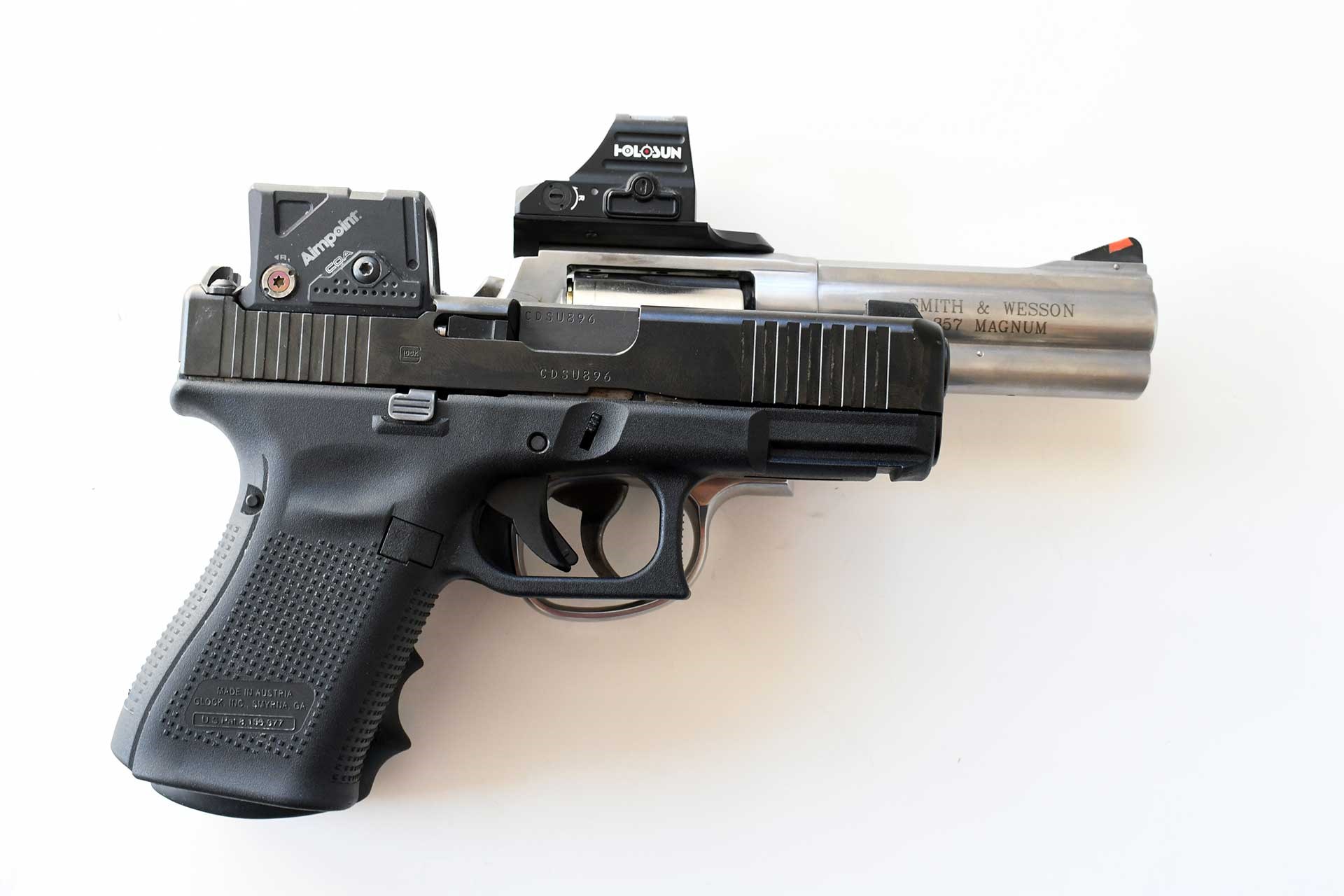
That height means that iron sights already sit high on the guns. Mounting most any micro red-dot to a revolver only extends this height even further. There’s no way around this, and as they say in French, “c’est la vie.” From a practical standpoint, carriers and shooters simply need to be aware of how the dotted-revolver’s extended height takes up space during concealment.
More importantly, they must drill and train to get used to the correct pistol presentation and sight-picture. This already takes some getting used to with semi-automatic pistols–even more-so with a revolver.
Learning About Height Over Bore The Hard Way
Here’s the other part of it. Ever notice how the typical revolver has a fairly tall front sight compared to its typical semi-automatic counterpart?
Anytime a handgun has a front sight taller than its rear sight, it generally drives the resulting point of impact lower. Revolvers rely on those taller ramp or patridge sights for two main reasons. First, the taller sights compensate for the higher bore axis. Second (and this is very cartridge-dependent), most standard-pressure revolver loads push relatively heavy bullets at slower velocities.
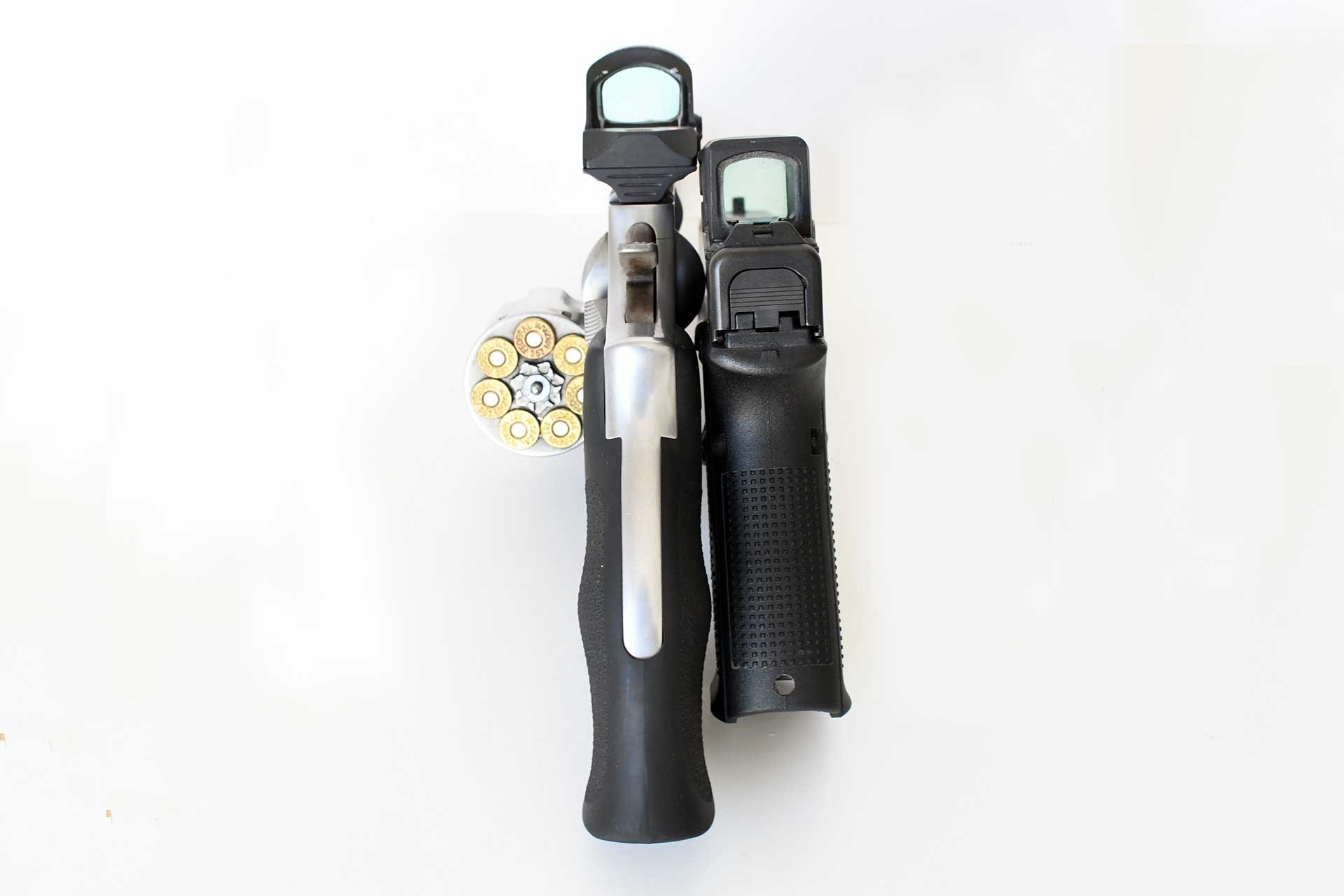 Slower-moving bullets tend to print higher than faster-moving bullets of the same caliber. Raising the front sight helps lower that higher point of impact. So it makes sense why the Colt Python has its signature vent-rib that raises its sight height or why other models like my Smith & Wesson 686 or Taurus 692 Executive Grade have pedestals machined over the barrel for their front sights to sight on. Then look at older pre-war and late 19th century single-action models. Many of these revolvers’ front sights are so tall that they almost resemble shark fins.
This is why perching micro red-dots on top of revolvers can present some sight-alignment challenges. Red-dot sights themselves already sit taller than most iron sights, and this becomes more exaggerated when securing them over revolver topstraps.
I learned this lesson the hard way. My first red-dot pistol wasn’t a Glock or an M&P. It was actually my Smith & Wesson 686-5. At the time, I had no optics-ready pistols at my disposal, but it turns out 686-5s were made late enough to include drilling and tapping for optics mounts. I added an Alchin Trijcon RMR mount and a Holosun HS407C. Then came the most embarrassing zeroing session of my life. It didn’t help that I was brand-new to dots either.
Degrees Of Elevation
During my maiden voyage with my first red-dotted handgun of any kind, it did not take me long to realize that I was shooting off the paper, roughly about 15 inches low at 10 yards. In hindsight, it was a simple issue of the Holosun’s POA not being in alignment with the 686’s actual sights and the standard-velocity .38 Special handloads fired. I cranked the HS407C’s 100 MOA elevation dial all the way to the top, which seemed to do the trick. Then, I shot a few cylinders at an NRA B-8 target at 25 yards with Federal’s .38 Special 130-grain FMJ American Eagle (AE38K) and proceeded to shoot my first-ever “100” on a B-8, albeit informally. While I can shoot pistols modestly, this time, I got lucky.
Fortunately, the Holosun 407C had enough adjustment range to keep me on target. However, by relying on the sight’s own adjustment limit, I potentially curtailed myself. Had I been shooting milder .38 Special target loads (think slow-moving 148-grain wadcutters), I might not have been able to mechanically adjust the red-dot as precisely. In my case, the 100 MOA total adjustment range of the Holosun and the 4 inches of barrel kept me on the safe side.
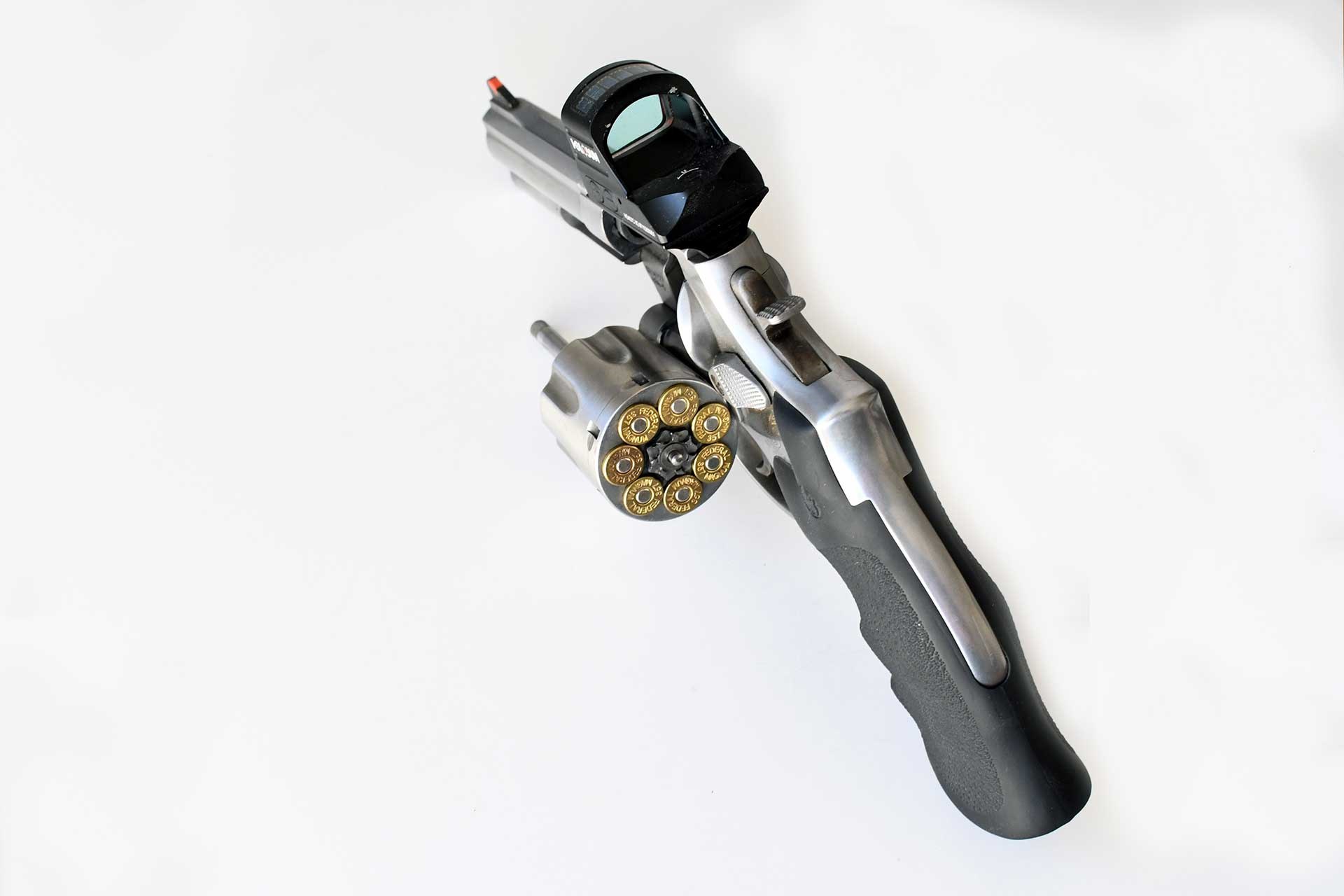 I mentioned Taurus’s T.O.R.O. revolvers earlier in this article. The Brazilian gunmaking giant was the first major manufacturer to launch an optics-ready carry revolver with the Taurus 856 T.O.R.O. These revolvers have a drilled and tapped topstrap and an OEM mounting plate that accepts red-dot sights with Shield RMSc or Holosun-K footprints, the smallest micro-red dots on the market. These are meant for slim, easy-to-carry handguns. They also have smaller windows and smaller elevation adjustment ranges.
Wedging The Issue
As forward-thinking as launching an optics-ready carry revolver, many shooters also ran into similar sight-alignment issues that I described above. But the combined factors of “tall” guns, .38 Special muzzle velocities from 3-inch barrels and red-dot sights with less adjustment exacerbated the issues.
While I don’t have any experience with .38-caliber 856 T.O.R.O models, I previously reviewed a Taurus 327 T.O.R.O. Like the 856 T.O.R.O., the 327 version is also equipped with a 3-inch barrel. Shooting full-power .327 Federal Magnum loads out of that 3-inch barrel yields about 450 fps more than the typical .38 Special from a similar-length barrel. The .327 Fed Mag’s trajectory is flatter, and even so, I had to max out the elevation on the Holosun EPS Carry red-dot sight I mounted to the 327 TORO for its review. I ended up zeroing it at 20 yards, which is a perfectly reasonable distance for any pistol with a red-dot, especially one with a cartridge that averaged 1,300 fps.
For perspective, EPS Carry sights have 60 MOA of total adjustment. Again, the muzzle velocity kept me in the clear, but I’d be concerned in mounting a red-dot sight with a smaller total elevation adjustment.
There are companies that sell angled shims manufactured from Derlin, a high-strength polymer material. These shims keep the same optic footprint and sit between the mounting surface and the bottom of the optic. Because they’re angled, they provide an incline for the optic to sit on, which increases the total range of elevation adjustment. It’s a clever workaround and is conceptually no different than mounting a riflescope over an angled 20- or 30-MOA scope base.
The Takeaway
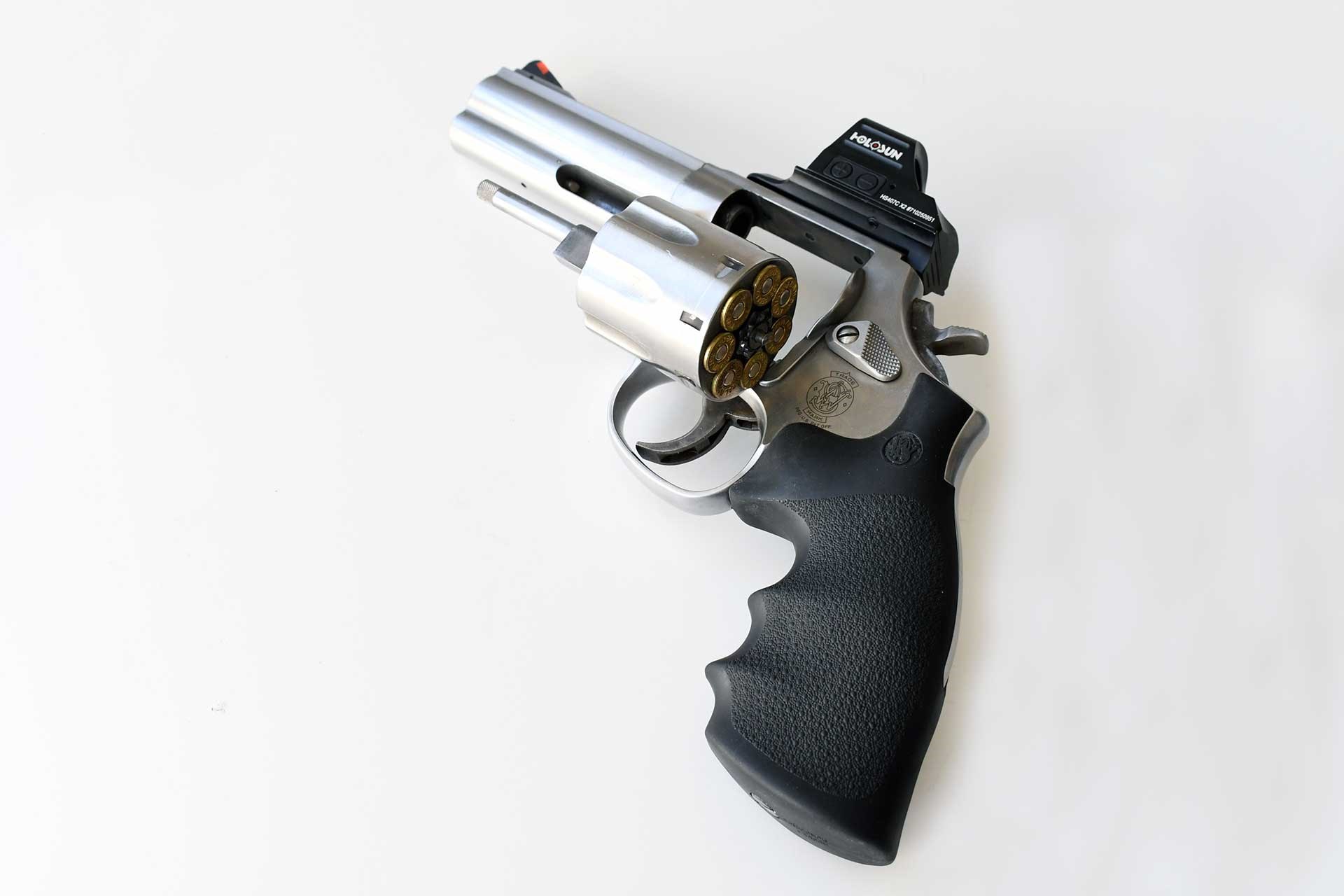
All of this is to say that adding a red-dot sight to a revolver can be a worthwhile upgrade. Doing so most definitely leverages the inherent accuracy found in many revolver models. Shooters just need to contend with two primary trade-offs: excess height and possible elevation adjustment issues.
Unfortunately, there’s not much to be done with total height, other than choosing a suitable red-dot sight with a reasonable deck height. It’s one of the reasons I like Holosun’s EPS and EPS Carry sights; they sit low.
The elevation adjustment issue can be rectified by either choosing a red-dot sight with enough total adjustment range and/or to determine whether your red-dot sight might function better with the aid of a wedge.
The good news is that, once the elevation ranges are dialed in, tailoring a certain load for the gun becomes quite easy. The shooter won’t be at the mercy of the fixed sights, and adjusting for slower .38 Special loads in a .357 Magnum (or .32 H&R loads in a .327 Federal Magnum revolver) becomes a breeze.
Read the full article here