


The firearm world is entertaining, to say the least. Things that were once old-fashioned become cool again, but with new and interesting twists. Since the AR-15 platform hit its peak popularity toward the latter half of the Global War on Terror, enthusiasts have been chasing the next cool thing. The last several years have seen waves of interest in specific platforms, such as precision bolt-actions, 2011-style pistols and cutting-edge cartridges designed for long-range performance.
At the 2024 SHOT Show, lever-action rifles were clearly due for their time back in the sun. They were everywhere on the show floor, even coming from companies typically only associated with tactical rifles and accessories. The trend continued in 2025, with yet more announcements about lever-actions entering the market.
The old, classic styles are still there, of course, reminiscent of the guns in spaghetti Westerns. But, there was another type of lever-action gaining traction: the tactical lever-action rifle.
Rise of the Tactical Lever Gun
To be honest, I never paid much attention to lever guns. I was deep into my money-burning adventures exploring precision-rifle competition when I saw Chris Costa (of Magpul Dynamics fame) whip out a lever-action on YouTube and go to work against steel.
The gun was unlike the ones I remembered from those old Westerns. The handguard was metal, with a flashlight mounted to it. Modern optics graced the top, and the skeletonized stock sported carriers for copious spare ammunition.
I realize that a lot of traditionalists appreciate their time-honored walnut furniture and blued metal. The most advanced thing might be a set of peep sights. I respect that. I’m not traditional, though. My favorite 1911 pistol has a rail, a light, front cocking serrations and an optic. It’s even chambered in 9 mm. There’s a place for valuing function over form.
Combining styles of both the Old West and modern carbines, the SPD Hush is a viable alternative option as a PCC.
But, why a lever gun? My background is mostly in individual pre-paredness, with light competition on the side. I’ve never been much for hunting, where the lever-action has many enthusiasts. In my safe full of 9 mm pistols, 5.56 NATO AR-15s and .308 Win. bolt rifles (along with a 12-gauge semi-automatic shotgun), a lever-action shooting a classic revolver cartridge just looks out of place.
Given that, I decided to approach this review from a different angle. I wanted to figure out how the new Henry SPD HUSH fits in with my personal-firearm philosophy of use. To that end, it’s best to think of a lever-action rifle much as you would a pistol-caliber carbine (PCC) in a common chambering like 9 mm, 10 mm or .45 ACP, assuming you’re using a .357 Mag. or .44 Mag. and not a traditional .30-30 Win. or .45-70 Gov’t.
There’s a certain level of convenience that comes with using a short, light and handy carbine that shares ammunition with your sidearm. From my experience, lever guns feel particularly lively given their slim profiles and light weight.
The 19th-century design of the operating system, absence of a detachable box magazine, (typically) reduced firepower and relative lack of anti-freedom censure make them particularly attractive to those living in jurisdictions with absurd infringements on the right to own modern sporting rifles, including semi-auto PCCs. Others may be on the hunt for a general-purpose rifle—something that you can keep ready in your vehicle while out on a road trip or carry in backwoods areas—and there’s a strong argument in favor of the lever gun for that reason alone.
Another advantage of the lever gun is that they perform magic on handgun-cartridge velocity. The longer barrel and sealed breech combine to add several hundred feet per second compared with a shorter handgun barrel, providing a significant boost to both range and penetration power while using the same ammunition.
Already well-known for its lever-actions, the SPD HUSH represents a further tilt toward the modern for Henry Repeating Arms. The company already manufactures the Big Boy X model, which features several modern features like black-polymer furniture, a side gate for loading, fiber-optic sights and a threaded barrel.
Henry later formed its Special Products Division (SPD), designated as the home of Henry’s most technically advanced firearms, and engineered those guns from the ground up to meet the ever-evolving needs of current and future outdoor enthusiasts, hunters and hobbyists. The Henry Ultimate Suppressor Host (HUSH. Get it?) is the first product to come from the SPD. As of this writing, Henry also announced a similarly-equipped CRUSR (Compact, Rugged, Ultralight, Suppressor-Ready) in .45-70 Gov’t. for use as a guide gun.
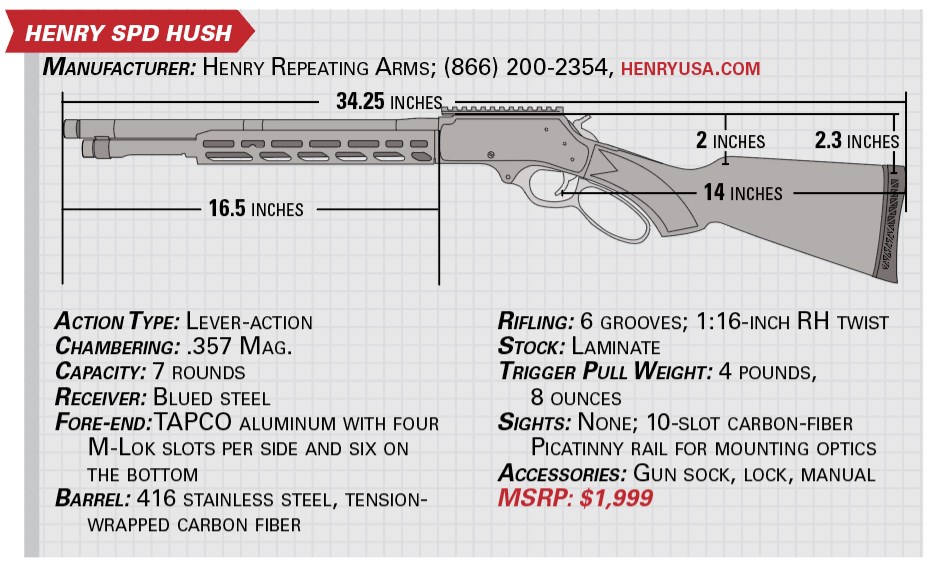
My sample HUSH is chambered in .357 Mag., which is my personal preference for an all-around carbine sharing revolver ammo. Changes from the standard Big Boy X model include a TAPCO aluminum handguard featuring M-Lok slots along the sides and bottom, a laminate wood stock, machined carbon-fiber 1913 Picatinny rail on the top of the receiver and, most conspicuously, a 16.5-inch, carbon-fiber-wrapped, 416 stainless-steel barrel manufactured by BSF.
Henry lists the weight of the SPD HUSH as 6.4 pounds, and the test sample tipped the scale at 6 pounds, 13 ounces. This is nearly a full pound of weight savings compared with the standard Big Boy X model, owing largely to the carbon-fiber-wrapped barrel. Out of the box, I noted a distinct tail-heaviness to the gun. When equipped with a suppressor—as intended—the balance point shifts forward to a good place.
The action itself feels smooth, with no binding or gritty points that I could detect. This is especially important for a lever gun that is intended for, among other things, home defense.
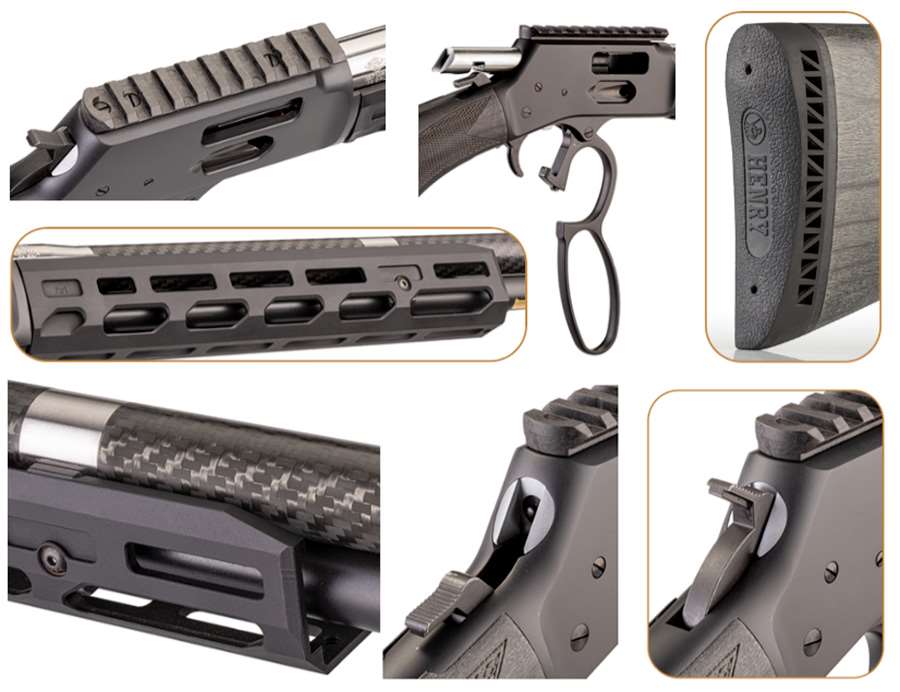
The carbon-fiber optics rail provides a means to mount an optic, which is necessary since iron sights are not present. The author would have preferred a longer, metal option, but it functioned well in testing nonetheless. An M-Lok-festooned fore-end speaks to the SPD HUSH’s modernity and versatility. Among the easiest and most-reliable action types, the rifle’s lever was smooth. The gun will not fire unless the lever is fully in the rearward (closed) position. A rubber buttpad cushions against recoil and prevents slippage when the rifle is shouldered. Wrapping the barrel in carbon fiber helps prevent overheating, particularly during rapid-fire strings. The hammer features a large spur, but no half-cock position.
There is no external safety to on the rifle. Instead, Henry relies on a transfer-bar system that prevents the rifle from firing unless it is fully cocked, the lever in the up and locked position and the trigger pulled. The hammer has a long spur on it to aid in decocking, but this should only be done with the gun pointed in a safe direction on a range.
The trigger’s single-stage pull is crisp, with minimal to no squish-iness. As for pull weight, it averaged 4 pounds, 7.9 ounces, over 10 pulls with a digital trigger gauge. I found the trigger to be perfectly adequate to the task of a PCC-type firearm.
The SPD HUSH has no provisions for iron sights at all. Henry clearly intended this rifle to use optics from the get-go.
Perhaps the most interesting feature of the SPD HUSH is its 16.5-inch, tension-wrapped barrel. BSF doesn’t just wrap barrels with carbon fiber like you might think. Instead, it uses a sleeve, leaving an air gap between the 416 stainless steel and the carbon fiber. This reduces heat transfer to the carbon fiber, eliminating problems associated with excess heat and that material. The barrel is not fully freefloated, as the handguard attaches to an exposed portion of stainless steel about midway down the barrel. The muzzle on my sample has 5/8x24 tpi threads protected by a knurled, stainless steel thread protector.
Shooting Performance
Given the .357 Mag. chambering and short, 4.5-inch machined carbon-fiber optic rail, the Henry SPD HUSH screams for a compact red-dot sight rather than a magnified optic. I opted to use a Shield Sights SIS2, which is a rugged, enclosed, miniature dot system with selectable reticle and exceptionally clear glass. I did attempt to mount a 1-4×24 mm low-power variable optic (LPVO), but found that it added too much height and upset the balance of the rifle.
The SIS2 proved to be a fantastic match for the Henry. Its small size didn’t affect handling whatsoever. I still had to employ a bit more of a chin weld rather than a cheek weld, but that’s nothing that a good stock pad wouldn’t remedy.
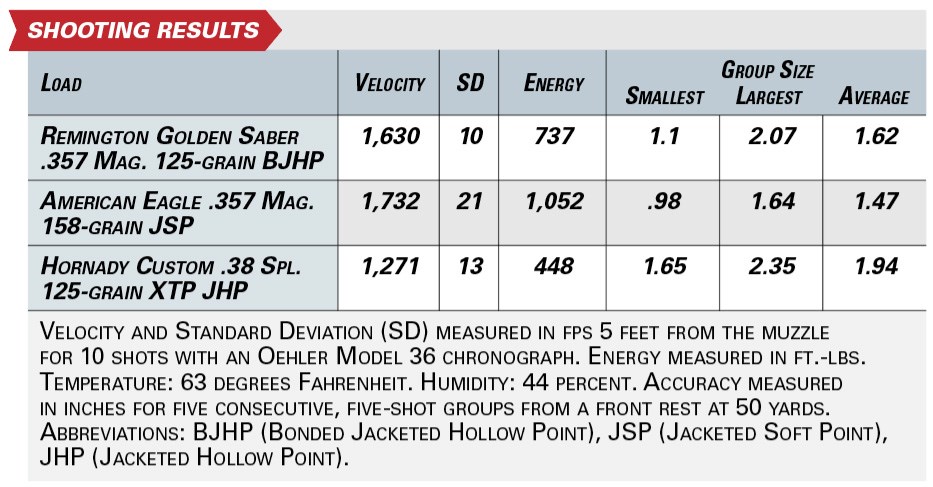
For testing, I selected three loads: 125-grain Remington Golden Saber .357 Mag., 158-grain American Eagle .357 Mag. and Hornady Custom 125-grain XTP .38 Spl.
My all-around favorite load was the Remington 125-grain Golden Saber, which provided the perfect balance between the oomph of the 158-grain Federal American Eagle and the soft-shooting Hornady .38 Spl.
Suppressor Performance
Of course, a test of Henry’s Ultimate Suppressor Host wouldn’t be complete without actually testing it suppressed. I mounted a Banish 9 can to the Henry to see how well it suppressed and what to expect as far as point-of-impact shift.
Measured 10 inches to the left of my support side ear, the Banish 9 brought the report down from about 151 dB to 137 dB. Velocity saw a modest 1-percent increase compared with unsuppressed shooting. Since I was firing handgun ammunition, there really wasn’t much gas left in the barrel to get velocities above and beyond the already accelerated speeds from using a sealed, 16.5-inch barrel. The point of impact shifted about 8 inches high at 50 yards, surprisingly.

Checkering along the wrist of the polymer stock helps provide solid purchase. The Henry SPD HUSH’s trigger broke crisply and cleanly at 4.5 pounds, which is appropriate for a home-defense or short-range hunting carbine. Loading the seven-round, tubular magazine is accomplished via the gate beneath the ejection port. The rifle was easy to load in testing, though obviously slower than a detachable-box magazine. Shipping with a thread protector, the raison d’être of the SPD HUSH is its threaded muzzle, allowing for the easy attachment of a hush-making device.
Shooting the SPD HUSH with the can attached was a joy. It ran flawlessly, balanced well and, since it is a manually operated action, there were no issues with gas in the face or other unpleasantness associated with shooting a suppressed firearm.
Closing Thoughts
As a practical carbine to pair with a revolver, the Henry SPD HUSH proved itself a worthy companion. The action itself was smooth and free of any binding or grittiness. The gun performed flawlessly through 300 rounds of .357 Mag. and .38 Spl. I had two induced malfunctions, owing to my failure to fully cycle the action in between shots. This is more of a learning point for me when it comes to lever-actions than it is a knock against the gun.
If I have any critique, it’s the top rail. I get the theme that Henry was going for by machining it out of carbon fiber to go along with the carbon-fiber barrel, but I would rather have something more traditional like aluminum and have it be a bit longer for better accommodating a variety of magnified optics. The existing rail is fine for red-dots, especially small ones like the Shield SIS2 that I used, but I prefer flexibility in options.
The SPD HUSH proved easy to shoot quickly and was especially a joy to shoot suppressed. Positional shooting proved to be no issue at all from kneeling, squatting, sitting and other common, stable positions. Prone would be a bit more of a chore, given the need to cycle the action from the bottom and breaking position to do so, but that is true of all lever-actions.
For an MSRP of $1,999, Henry certainly has something unique and interesting on its hands. If you’re in the market for a modern “tactical” lever-action, then it’s certainly a worthy contender for your atten-tion given its performance, handling and apparent custom touches out of the box.
Read the full article here