

Releasing a new revolver, especially one aimed at the concealed-carry/self-defense segment of today’s firearm market, with plentiful micro-9 mm, double-stack pistols, seems about as sensible as releasing a new automobile with a standard transmission. I mean, modern automatic transmissions are far from the clunky, three-speed horror shows of the malaise era, right? The manual transmission is an anachronism, championed mainly by drivers who harken to a romanticized version of the past where automatic transmissions were expensive, slow and took all the driving experience out of the hands (and feet) of the driver. You know, much like how semi-automatic handguns were finicky and required break-in periods and specific ammunition to run properly, so a revolver was a better choice overall. Stick with me here, I’m going somewhere with this.
Consider that even with advances in automatic-transmission technology and “flappy paddle” gearboxes, manual transmissions are still offered by most automobile manufacturers out there. Heck, even Cadillac, which more or less pioneered the automatic transmission in the 1940s, started offering its CTS with a five-speed manual after a more-than-60-year hiatus from stick shifts, and continues to offer manuals even today. Sure, automatics are faster and arguably more economical than manuals now—flipping the script from when I was a new driver, mind you—but there’s still a large-enough pool of drivers who fancy shifting their own gears that it’s worth it for a luxury-based company to offer manual models.
Thanks for the brief history of manual transmissions, Jay, but what the heck does this have to do with Taurus’ new revolver? That’s a great question; I’m glad you asked, nameless person who exists solely so I don’t appear to be talking to myself. Taurus’ new 66 Combat revolver offers what might be considered one of the best setups for a modern, fighting revolver yet. However, it’s offering the 66 Combat at a time when tiny, pocket-size 9 mm handguns are cheap, plentiful, reliable and carry quite a bit more ammunition than even the seven-round cylinder of the 66 Combat. So, why then would the company go through all the trouble of designing what might be the best fighting revolver in at least a generation and a half?
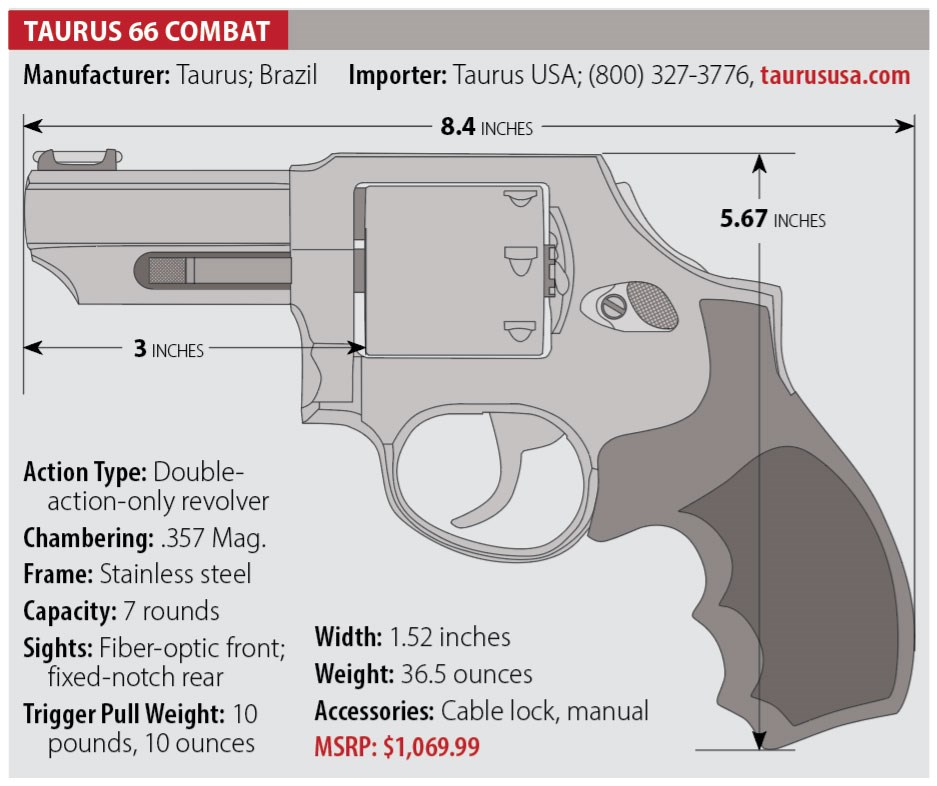
Overall, the dimensions of the 66 Combat make it slightly larger than compact 9 mm semi-automatics, but the ease of operation and powerful chambering are in its favor. While the 66 Combat is double-action-only, the trigger is quite smooth and manageable. Opening the cylinder involves sliding the release toward the muzzle, much like a Smith & Wesson revolver. Up top, two screw holes come pre-drilled to allow the addition of an optics-mounting plate for fans of powered optics on handguns.
Another great question. For the answer, I asked Caleb Giddings, Taurus USA general manager of marketing (and resident revolver guru) to walk me through the idea behind the 66 Combat. “The 66 Combat is in many ways like the 856 Executive Grade,” he said. “This gun was born in a room with serious revolver shooters and people who carry these guns every day. It is everything you want in a proper fighting revolver—a 3-inch barrel, concealable grips, amazing trigger, usable sights and of course we go the extra step and make it optics-ready. A big feature is the double-action-only hammer, which is by design because a revolver specifically for personal protection isn’t going to need a single-action function, especially considering how good the Combat’s trigger is.”
If you’re going to carry a revolver despite other, more capacious offerings, you’re best served with a purpose-built firearm, engineered with input from serious shooters and folks who know their way around wheelguns. And Giddings isn’t kidding about that trigger—when I first shot the 66 Combat, I was stunned by how good that trigger actually is. The pull weight is slightly more than 10.5 pounds, but that really doesn’t tell the whole story. It’s smooth. Real smooth. Like, the closest comparison I can come up with is the double-action pull of a Langdon Tactical Beretta smooth (which, if you’re not familiar, is amazing). The trigger on the 66 Combat is easily one of the best DAO triggers I’ve ever pulled, and I do not get along with most DAO triggers.
So, now we’re getting somewhere. The 66 Combat has a really good trigger. That’s important. Capacity is seven rounds, and the 66 Combat is chambered in .357 Mag., so you’ve got a powerful round, but not a ton of them. The 10 mm is roughly equivalent in power to the .357 Mag., and the Glock G20 is about the same size as the 66 Combat and carries more than double the number of rounds. So, realistically, if you wanted the power of the magnum, you could carry a semi-automatic with double the capacity. What it comes down to, basically, is what we like and are comfortable and familiar with, and there’s nothing wrong with that.
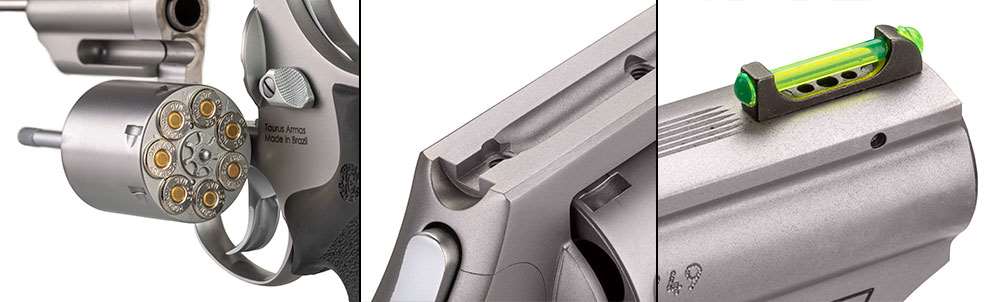
Containing seven rounds rather than the expected six, the cylinder of the 66 Combat is also devoid of fluting, adding weight for recoil mitigation (and making cleaning easier). Cut into the topstrap, the rear sight is fixed, while the front sight is a pinned fiber-optic pipe that catches the eye immediately for excellent target acquisition.
In fact, I pressed Giddings on the revolver-vs.-semi-auto argument, and he agrees: “[The] official answer is that if you’re purely looking at CCW as a numbers game, a medium-frame, heavy, low-capacity revolver doesn’t make sense when compared to say, a [Taurus] GX4 Carry. But, at the end of the day, what we carry is a personal choice, and since I personally enjoy shooting revolvers more than semi-autos, I want my carry gun to be the best possible version of the thing I already like.”
That makes a ton of sense. I mean, I’m an old man, so revolvers appeal to me. I grew up in a time where the 9 mm cartridge was not thought of as a viable defensive round (which, honestly, was unfair considering that this was all post-Miami shootout and Hydra-Shoks were on the market), whereas the .357 Mag. was (and still is) quite viable out of any length barrel and a medium-frame revolver with a 3-inch barrel was (is) eminently concealable, even with the rudimentary holster options of the Pleistocene era. Viable semi-automatic options for concealed carry at the time were Officers Model 1911s and, well …
Yes, there were options, but they were few and far between. And it didn’t help at all that right as concealed carry was really starting to take off, we were faced with the nonsensical and anti-rights 10-round magazine limit of the Federal Assault Weapon Ban of 1994. The capacity of the then fairly new Glock G19 was blunted by nearly 50 percent—which does put a damper on carrying one. Besides, if you’re going to carry the heft of a 1911, why wouldn’t you carry a six-round Model 19 (the other Model 19, the .357 Mag. revolver designed by Bill Jordan)? In summation, carrying a revolver in the early days was not as unusual a choice as it is in the present.
If you were to peek into my handgun history, you’d see I spent a good deal of time searching for the perfect concealed-carry revolver, too. I started my journey with a Smith & Wesson Model 36, an exposed-hammer Chiefs Special, which had been my dad’s backup as a Massachusetts State police officer. I had a Taurus 431 in .44 Spl., but that was too expensive to shoot very much. I found a Colt Lawman .357 Mag. revolver with a 2-inch barrel that, on paper, sounded perfect—except that it weighed about as much as a framing hammer and had about the same number of holster options. Lastly, I alternated between a Smith & Wesson Model 13 with a 3-inch barrel (the last revolver issued to FBI agents) and a Model 242 Ti (the only-made-for-one-year, ultra-rare L-frame, hammerless, seven-round .38 Spl.), in addition to various J-frames.
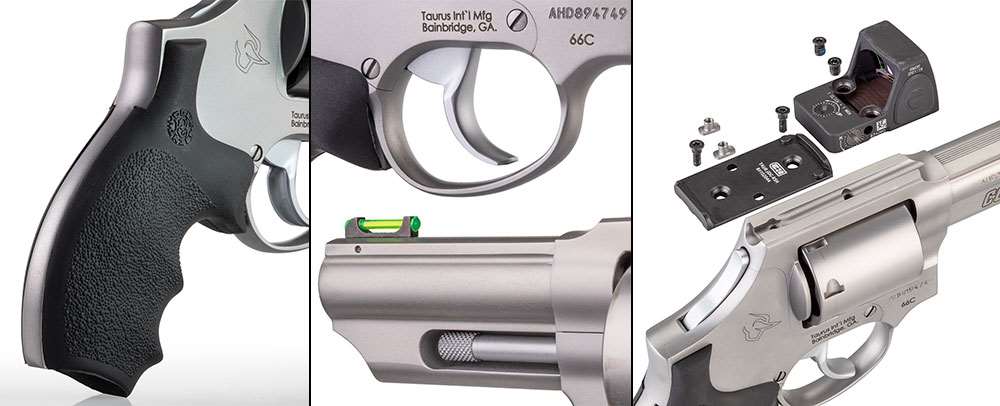
Hogue Monogrip stocks keep the 66 Combat firmly anchored in the hand, but watch out to make sure it doesn’t catch on a cover garment. Despite the heavy pull weight, the trigger was very smooth and allowed for surprisingly good accuracy. The shrouded ejector rod allows most spent cases to be ejected easily. Adding an electro-optic involves bolting a plate to the topstrap and then the optic to the plate.
When it comes to revolvers today, though, there are so many excellent choices that it comes down to carrying what you like and shoot well—and it is easy to like the Taurus 66 Combat and shoot it well. There’s a concession to modernity up top: Two screw holes allow an optic plate to be attached so you can have a powered optic if you prefer (an RMSc-footprint plate is available from Taurus; while other footprints, such as the RMR footprint plate shown in this review, are available from companies like C&H Precision). Believe me, as we get older and our eyesight diminishes, that’s a big plus. Even if you don’t care for powered optics, the front sight is a bright-green, fiber-optic pipe, which readily draws the eye to it. The rear sight is the standard notch carved into the top strap; an aiming convention that’s about as old as the revolver itself.
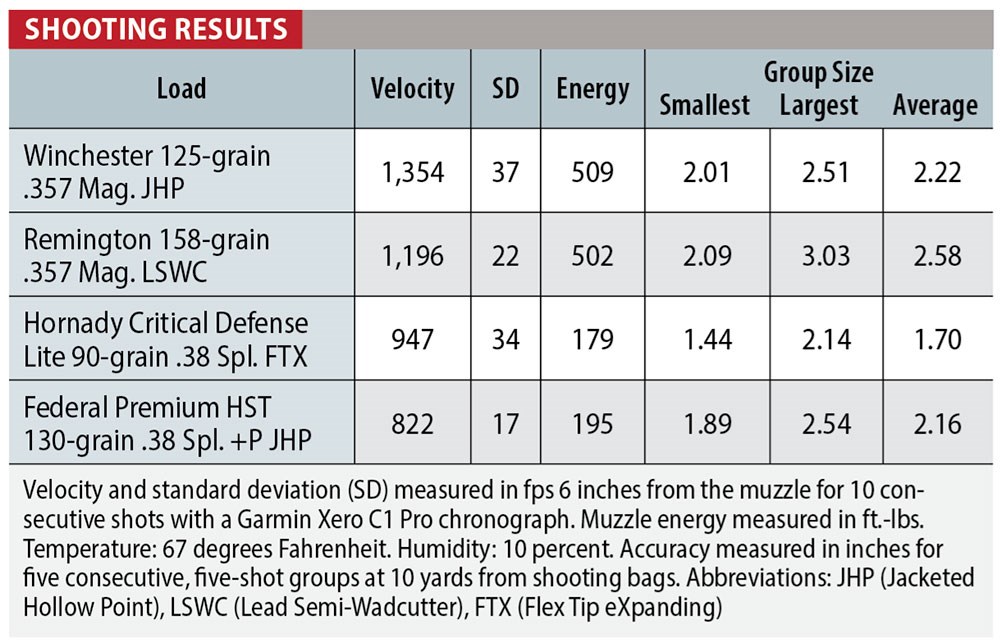
The 66 Combat is a solid piece of steel, weighing 36.5 ounces unloaded. That means that even a steady diet of .357 Mag. isn’t going to break your wrist, and shooting standard .38 Spl. is downright fun. This does highlight one of the advantages of the revolver, which centers on ammo choices and construction. The .357 Mag. chambering of the 66 Combat allows you to choose both .357 Mag. and .38 Spl. for carry and practice, and since there’s no feed ramp on which a hollowpoint edge might catch, just about every bullet design will work. Even shotshells are available for those who live in snake-infested regions. You can practice with light .38 Spl. rounds and carry hot .357 Mag. (just be sure to practice occasionally with the magnums, of course). As an interesting side note, the gamut of .38 Spl. and .357 Mag. ammo used to test the 66 Combat ranged in muzzle energy from a low of 179 ft.-lbs. (similar to a mid-level .380 ACP) to a high of 509 ft.-lbs. (slightly less than 10 mm). That’s quite the range of options.
Rounding out the 66 Combat, the discerning eye will note the Hogue Monogrip rubber stocks, which are helpful when it comes to holding onto the revolver under recoil, but not so helpful when carrying it concealed—the grippy rubber does have a tendency to catch on cover garments. This is by no means a knock on the 66 Combat; the choice of the Monogrip is a solid one across the industry (Smith & Wesson, Ruger and Colt offer revolvers with Monogrips as standard equipment). But, this leads to another advantage of the revolver: Changing grips is as simple as turning a screw, and other options are available from Taurus and Hogue. Whether you want a wider grip to better fill your hand, a smooth wooden grip that won’t catch on clothing or something different entirely, it’s easy to change to suit your needs.
On the range, there were no surprises while shooting the 66 Combat. It’s a revolver; it’s like a fork—you pick it up, it works. But, I really shouldn’t say that, feeding into the incorrect assumption that revolvers never jam or break, which they certainly can and do. In testing, however, no malfunctions of any type occurred, with either .357 Mag. or .38 Spl. In excess of 250 rounds ranging from 90-grain .38 Spl. to 158-grain .357 Mag. were expended in testing. I even ran a handful of timed drills to get a feel for how it handled compared to small 9 mm handguns, and while I’m no Jerry Miculek, I can run a wheelgun fairly quickly. I didn’t have any problems with the turning of the cylinder keeping up with fast shooting, as can (infrequently) be experienced in revolvers. If you want to shoot this revolver fast, you absolutely can—Taurus (and Giddings) wouldn’t have it any other way.
So, what’s the verdict on the 66 Combat? If you’re a revolver fan, you owe it to yourself to at least check one out. If you carry a revolver and are looking to upgrade, this should be high on the list of wheelguns to investigate. Between the excellent trigger, carry-friendly size and ability to add powered optics, Taurus’s newest purpose-built revolver is a rock-solid choice. It’s reliable, accurate and just plain fun to shoot—and that’s a fantastic combination.
What does the future hold for Taurus’ new wheelgun? I’ll close with a quote from Giddings, again: “Guns like the 66 Combat and 608 Competition fall in the middle of our line, above the standard 66 or 608 models, but not fully custom guns like you’d get with the Executive Grade series. The names of these models signify very much what their design intent is, and it’s a pretty safe bet there will be more named models coming.”
Read the full article here