

I first heard about the Taurus RPC when I received an invitation to the product launch for the TX9 in September of 2025. The RPC was a teaser, listed only as “RPC platform” on the program, leading attendees to wonder if this was another handgun (as we were there for the TX9 launch), a carbine (the “PC” in “RPC” led to speculation about it being a pistol-caliber carbine) or something else.
That event had to be canceled—something about major hurricanes in the area and not wanting attendees to be whisked away to Oz. So, we only found out what the RPC was a few days before it actually launched (so much for the glamour and exclusivity of the gunwriter …), and clearly the “something else” crowd had won out, as it was revealed to be a large-format pistol with a stabilizing brace, creating a PDW-like firearm.
For Taurus, the timing is fortuitous, as the PDW market has been growing. Various Turkish manufacturers offer semi-automatic, MP5-based large-format pistols, and Heckler & Koch even has its SP5 for those who prefer the original. CZ, B&T, Springfield Armory and others have all offered some form of large-format pistol chambered in 9 mm that fills the PDW role, in most cases as an adaptation of a military or law enforcement submachine gun, but semi-auto-only for the civilian market. While the MP5 clones were originally more curiosities than anything (given price-point and availability), as more became available, an interesting thing happened: these firearms’ utility as PDWs (Personal Defense Weapons) started to become more appreciated.
Ample space atop the RPC allows for a wide variety of sighting options, including backup sights • With the Strike Industries FSA brace extended, there’s an extra point of contact to help steady your shooting, yet it folds compactly to allow the RPC to fit in a small case • M-Lok slots allow attachment of accessories, while a small handstop is molded into the bottom of the fore-end for a solid grip • Slightly flared, the magazine well allows rapid changes and facilitates smooth reloads.
The RPC had a similar trajectory: “The RPC began life as a submission for Brazilian LE/mil requests for a compact submachine gun,” said Caleb Giddings, Taurus USA’s general manager of marketing. “The roller-delayed action allows the gun to be more compact than straight-blowback guns while also reducing the felt-recoil impulse to the shooter, which makes the gun more controllable. The decision to bring the RPC to the US market was a no-brainer,” he continued. “The US market for PCCs, PDWs and large-format pistols is hotter than ever, and the RPC offers better features than any other gun in that market while maintaining a reasonable price.”
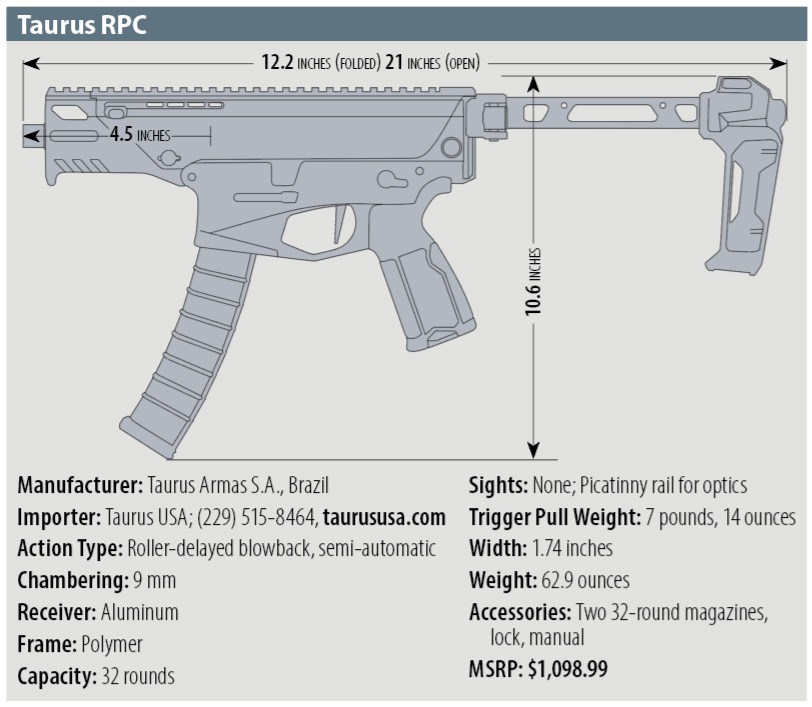
I’ve often wondered about large-format 9 mm pistols, in that there’s not a big difference between, say, a Glock G17 and a large-format 9 mm pistol. The RPC, for example, has a 4.5-inch barrel. So does the G17. There’s literally no ballistic difference between the two. The RPC has a Picatinny rail for optics, while the G17 can be had in MOS guise, allowing a variety of powered optics to be attached. Advantage here goes to the RPC, as there are more options available up to and including adding a magnifier to a red-dot system or even an LPVO. Cap-acity, oddly enough, goes to the G17; while the RPC’s standard magazine capacity of 32 rounds beats the 17-round standard G17 mag, there are both 33-round stick magazines and even 50-round drums available for the Glock.
Where the RPC and similar large-format 9 mm pistols really shine, though, is with the brace. Taurus opted for the Strike Industries FSA brace—which seems to be becoming somewhat of a standard in the world of large-format pistols—to stabilize the RPC, and with it attached, the platform becomes something more than just an unwieldy pistol. It’s a “home-defense gun away from home,” as some have called it; it’s easier to shoot than a handgun, yet not as punishing as an AR-based pistol in a traditionally rifle-centric caliber. The RPC’s roller-delayed action helps on this aspect as well.
Add a suppressor to the end of the RPC, and the overall length is still far less than that of even a basic 16-inch-barrel AR-15, without the muzzle flash and much quieter. Take the suppressor off, fold the brace and the RPC stows easily in a briefcase, backpack or messenger bag—no obvious rifle case needed.
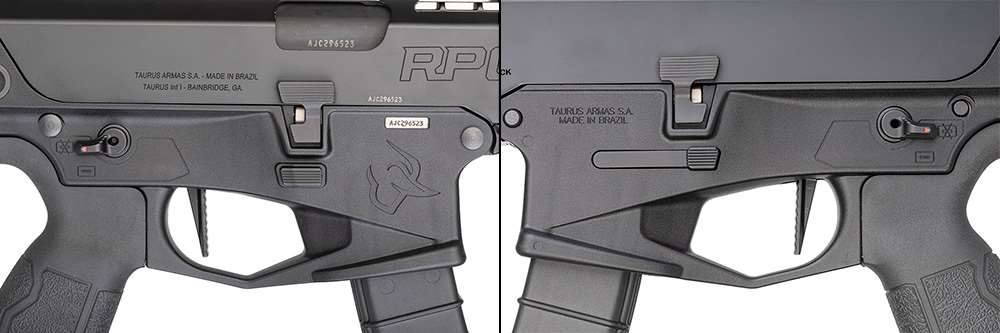
All controls—safety selector, magazine release and bolt release—are duplicated on both sides of the RPC, making it a boon for southpaws and those who smartly train with either hand for defensive applications. In testing, accessing the controls with either hand was easily achieved.
So, why choose the RPC for your large-format, braced-pistol PDW? There’s no getting around the ease with which you can add to it, for starters. The full-length Picatinny rail means you can add backup sights and a red dot for aiming, while M-Lok attachment slots at the muzzle end allow lights, lasers or other accessories. There’s a cleverly molded handstop to keep fingers away from the loud end, which is a thoughtful touch considering the barrel barely extends beyond the handguard.
Controls are ambidextrous, too—the safety selector, bolt release and magazine release are mirrored on the right and the left, while the non-reciprocating bolt handle can be swapped to the right of the pistol for southpaw operation. QD sling mounts are available on the left and right of the receiver as well as at the rear for a variety of mount options.
The trigger has a flat face, is single-stage and breaks at 7 pounds, 14 ounces. While on the heavier side, it’s a smooth pull that doesn’t stack or have a mushy takeup. Compatible with most AR-15-style grips, the pistol grip can be swapped if needed. However, the one that ships with the RPC is a decent overmolded rubber grip with storage inside, handy for extra batteries for optics.
Two 32-round magazines ship standard with the Taurus RPC, with 10-round magazines available for those in restrictive locales. Rumors abound of a 20-round version; however, no evidence for that exists as of yet. Magazines are double-stack, double-feed for easier loading (like the old Colt or Uzi 9 mm magazines, you can simply push rounds in from the top rather than having to work them under the feed lips like in a double-stack, single-feed magazine such as the Glock style).
The Strike Industries FSA folding brace adds an additional point of contact for stability, aiding in accuracy as well as controllability when speed is of the essence. But, one of the neatest parlor tricks the RPC has up its (proverbial) sleeve has to do with the threaded muzzle. No, there’s nothing special about the standard 1/2×28-tpi thread; rather, it’s what’s inside the bolt-carrier group for suppressed operation. Two different locking tips are provided with the RPC: The 110-degree tip is designed for standard operation, while the 85-degree tip should be used when a sound suppressor is attached.
Swapping out the locking tips involves removing the bolt-carrier group from the upper receiver, a process delineated in excellent detail in the included instruction manual (and also available on Taurus’s website, taurususa.com). After ensuring the RPC is unloaded and completely devoid of any ammunition, push the rear takedown pin out of the receiver and hinge the upper receiver forward. This allows the bolt assembly to be removed from the upper, at which point it can be taken apart if needed for cleaning and lubrication, while the barrel and internals can also be maintained. Reassembly follows the same procedure in reverse.
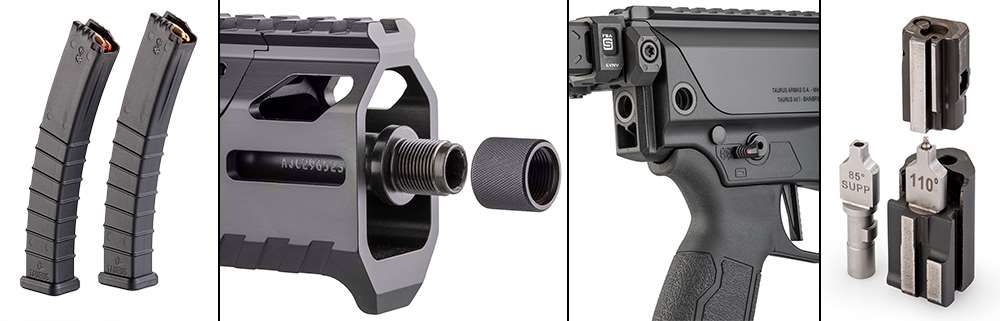
Two 32-round magazines come standard with the RPC, and extras are available for a reasonable price from Taurus • Should a sound suppressor be desired, the muzzle is threaded at the standard 1/2×28 tpi • QD sling mounts are present on the rear of the receiver as well as on either side, should you wish to attach a single-point sling • Two locking tips in the bolt assembly allow for suppressed or unsuppressed operation, and can be swapped out in a matter of seconds.
One of the more baffling complaints seen about the RPC in comments at its launch centered on the price point. Some felt that the $1,100 price tag was too high “for a Taurus,” disregarding both the PDW/large-format-pistol market and the current state of inflation. Looking at other large-format pistols in 9 mm currently on the market, the RPC comes in, if not as the lowest, definitely on the “more affordable” side of the bell curve.
I ran a quick search of more than half a dozen large-format pistols in 9 mm and could not find one within a couple of hundred dollars of the RPC, and most didn’t come with braces at their respective price points. Yeah, $1,099 is a lot more than $310 for the GX2 handgun, but those are completely different firearms—no one complains that the Chevrolet Corvette costs more than the Trax. Continuing the automotive analogy, yes, the Corvette is pricey among American cars, coming in at more than $200K in its highest trim. Compare it with Ferraris and Lamborghinis, however, and it’s a downright bargain considering the performance. I think you see where I’m headed with this.
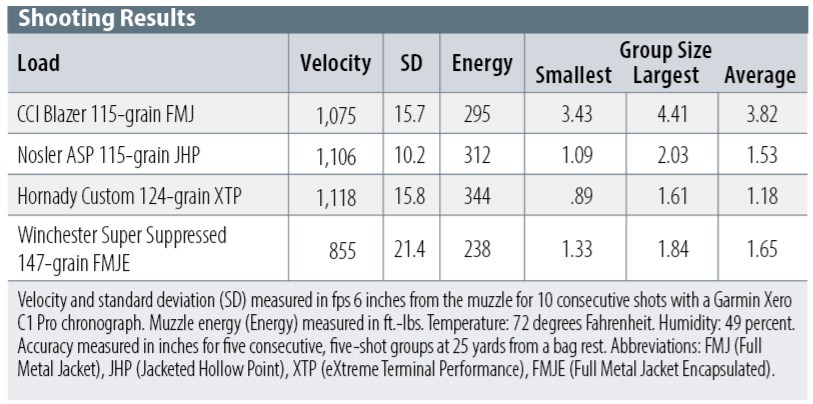
Speaking of performance, the best test is how the RPC handles on the range. With that in mind, I brought a variety of 9 mm fodder to run through the RPC, ranging from standard 115-grain full metal jacket practice ammunition through subsonic, suppressor-friendly offerings and a few defensive loads as well. The most important criteria—reliability—was spot-on. Approximately 350 rounds were expended over the testing period with zero failures of any type: The RPC fed all rounds regardless of construction and ejected all empty cases cleanly. Accuracy was pretty good considering the heavy-ish trigger and short barrel, with one notable exception.
And, I do want to discuss that a little bit. Normally, our testing protocols call for three entries from different manufacturers and three distinct bullet weights for testing, and the discerning eye will note the presence of two 115-grain entries. This has to do with my curious nature: I ran the CCI Blazer 9 mm first and was a bit surprised at the results. I expected the RPC to shoot tighter groups at 25 yards than 3 to 4 inches—a suspicion that was confirmed once I changed ammunition to the Hornady 124-grain XTPs.
I added Winchester Super Suppressed 147-grain to the mix, with significantly better results than the CCI, so I wanted to check to see if the RPC just didn’t like the CCI rounds, or if it was the 115-grain bullet weight. As the Nosler ASP results show, the culprit was the specific load and its interface with the RPC. I do want to note that I ran a good 150 rounds of the CCI Blazer through the RPC at 10 yards in a series of rapid-fire drills with excellent results (for instance, an entire magazine devoted to failure drills had one lone round outside the “A” zone in the head box). So, that load is fine for close-range work, but look elsewhere for match-grade performance out of the RPC.
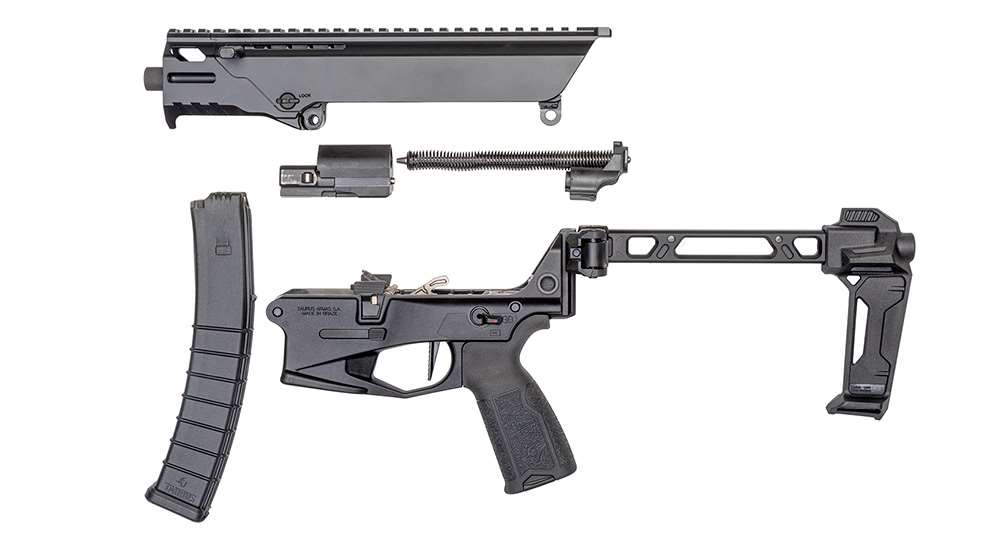
Taking the RPC down for simple cleaning is easy and involves pushing out a captive pin, then removing the bolt assembly. Should further cleaning be needed, consult the manual for instructions on taking the bolt assembly apart.
That happens. I couldn’t tell you the number of times I—and most of us, I’d wager—have had a gun-and-ammo combination that just plain didn’t work well. It might be a semi-automatic .22 LR handgun that chokes on one particular rimfire load, or a bolt-action rifle that sees much larger groups with a different manufacturer’s recipe. This is why we test everything, especially if it’s going to be a firearm that gets used for self-defense, whether as a home-defense gun like the RPC or as a concealed-carry handgun. Test a number of options, then stock whatever functions and shoots best. Thus endeth the sermon.
What’s the bottom line on the RPC? I have to say, I was impressed with how it ran. This is a firearm that is most likely going to serve in a defensive role, so performance is jobs one and two. It’s got to work no matter what, and it does. Running the RPC fast is made simpler with the extra contact point of the Strike Industries FSA brace, and the full length of Picatinny rail means you can add whatever optics—and backups—you’d like. All this, and it can fit in a standard messenger bag for a less-obvious method of transport. Keep it set up as a home-defense gun and you can add a suppressor, light and single-point sling and still have a rig smaller than a standard AR-15 carbine. It’s quite versatile, which is nice, and it just plain works, which is even nicer.
What does the future hold for the RPC? I’d be curious to see what it’s like with a longer barrel; there’s an RPC with an 8-inch barrel depicted in the owner’s manual, but not listed on Taurus’s website (it is “in the works” per Giddings). Maybe an SBR or carbine option? Given the recent increase in factory SBR offerings, in conjunction with the NFA tax reduced to $0 thanks to your NRA, that wouldn’t surprise me in the least. Beyond that, the sky’s the limit. Obviously, the door is open for additional caliber options along with different barrel-length variants, al-though there’s no official word on that front as of yet. And no, before anyone asks, I haven’t heard if Taurus is going to offer an RPC in 10 mm …
Read the full article here