


For those who haven’t been keeping up with American handgun trends, 2011-style semi-automatic pistols have been making notable inroads from the competition circuits into the civilian self-defense and law-enforcement markets during the past few years. In 2025, European American Armory (EAA) and Turkish gun manufacturer Girsan teamed up to provide pistol enthusiasts with more affordable 2011-type options. Although some competing models can cost upwards of $3,000, the Girsan Witness2311 series includes competition-style, concealed-carry and handgun-hunting configurations with suggested retail prices ranging from just $749 to $1,179.
As is often the case, the 2011-style platform is continuing to evolve based on customer demands and current trends. To keep up with these changes, EAA is launching the new Girsan Witness2311 CMX semi-automatic chambered in 9 mm Luger. It features key changes to the safeties and grip configuration intended to better serve the needs of law-enforcement personnel and civilian self-defenders. To better understand this model, we will first take a look at its origins and then delve into its features.
The story of the 2011 pistol platform begins with gunsmith Virgil Tripp and engineer Sandy Strayer. Their goal was to blend the accuracy potential and single-action trigger of the well-respected M1911 with the reduced recoil and ammunition capacity of polymer-frame 9 mm pistols. The pistol they developed, dubbed the 2011, was patented in 1994. Among the key design features is a two-piece frame that consists of a metallic “upper,” the serialized receiver proper, which supports the slide assembly, and a polymer “lower” grip module sized for double-stack magazines. The first models were produced by Strayer Tripp International (STI) and soon became a staple on the pistol competition circuit.
In 2020, STI’s management decided to officially change the company name to Staccato. Their goal in this re-branding effort was to show their intentions to evolve the company’s 2011 lineup to include duty-pistol and personal-defense models. In just a few years, Staccato’s efforts, along with those of other manufacturers, have transformed the 2011-type pistol into one of the top options preferred by SWAT teams and patrol officers around the country. Some features of the original design, however, are not the best fit for law-enforcement applications. Some departments do not allow officers to carry pistols with grip safeties because, under duress, an improper grip may result in the gun failing to fire. Another common design requirement is a built-in drop safety, such as the firing-pin block commonly found in striker-fired pistols. And there is also the matter of the grip shape; the standard 2011-style grip module has a bit too much girth for some hand shapes.
Early in 2025, Staccato tackled these law-enforcement pistol requirements with the release of the well-received 2011-pattern HD series. EAA has chosen to mirror some of those alterations in the Girsan Witness2311 CMX model. Although the CMX is not intended to be a clone of the latest Staccato offering, the HD model’s influence on its features is clearly evident.
Like the other members of the Witness2311 line, the CMX will be manufactured by Girsan Gun Industry in Giresun, Turkey. Founded in 1993, Girsan offerings have passed Turkish military trials, earning the company several contracts with law-enforcement and military organizations in its home country. Its catalog includes a variety of popular pistols, including models based on the Beretta 92, the High Power, single-stack M1911s and 2011-style double-stacks. This manufacturer has added features and upgrades to these platforms while maintaining high standards of production to ensure quality and reliability at fair prices.
The Girsan Witness2311 CMX fieldstrips by way of a small takedown tool that allows the rod’s plug and spring assembly to be extracted from the slide as a single unit. A firing-pin safety is incorporated into the slide assembly (above l., arrow) and an aluminum magazine funnel is pinned to the polymer grip frame (ctr.).
Although some of the CMX pistol’s features lean well outside of the “Old Slabsides” wheelhouse, the M1911’s influence is still clearly evident in the slide profile and action. At the heart of this semi-automatic is the same linked-barrel, recoil-operated action and single-action trigger configuration that made John Moses Browning’s M1911A1 one of the most popular and replicated pistols ever produced. And the layout of the external controls will be utterly familiar to M1911 and 2011 fans.
The round-top slide is made from a carbon-steel alloy and treated with a durable, matte-black Cerakote finish. The metallic white-dot front sight is dovetailed into the slide, which allows it to be traded out or upgraded. The ejection port has been beveled for improved functionality. Forward-canted cocking serrations are milled into the slide at the front and the rear. The forward serrations house a total of six ports, three to each side of the slide, that some may deem decorative, as they give the pistol a race-gun profile, while others will suggest they aid in cooling. But it is also likely that they serve as lightening cuts intended to reduce the slide’s mass in order to accommodate the added weight of an optic. Whatever their intended purpose, they do lend improved purchase to the forward cocking serrations.
A fixed, low-profile, white-dot rear sight is incorporated into a removable filler plate secured by two button-head screws. Removing this plate exposes the slide’s optics cutout, which is sized for the direct mounting of Shield-footprint micro red-dots. EAA will also be offering mounting plates to accommodate RMR-footprint optics that will be sold separately. It should be noted that the spring for this pistol’s firing-pin safety, or firing-pin block, is located directly below the filler plate toward the rear of the slide—when removing the plate, the spring is exposed and can fall out if one is not paying attention. Be sure to keep track of it and re-install it under the rear sight plate, or an optic, in order for the safety to operate properly. For this evaluation, the rear sight was traded out for a Swampfox Sentinel II optic featuring a 3-m.o.a. green-dot aiming point. A unique feature of this model is a patented removable rear night-sight guide that is installed in front of the window. In this case, the guide provided an effective replacement for the rear iron sight.
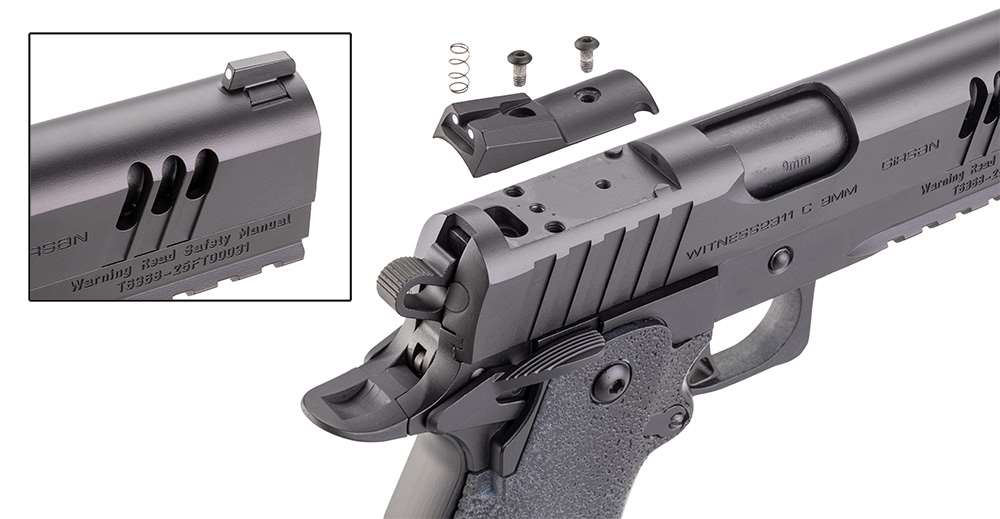
A fixed, low-profile, white-dot rear sight is incorporated into a removable filler plate (r.). The slide’s optic cutout is sized for the direct mounting of Shield-footprint micro red-dots. EAA will also be offering mounting plates to accommodate RMR-footprint optics that will be sold separately. The spring for the firing-pin safety is located directly below the filler plate toward the rear of the slide. (l.) The slide’s forward serrations house three ports on each side that give the pistol a race-gun profile, serve to lighten it and aid in cooling the barrel.
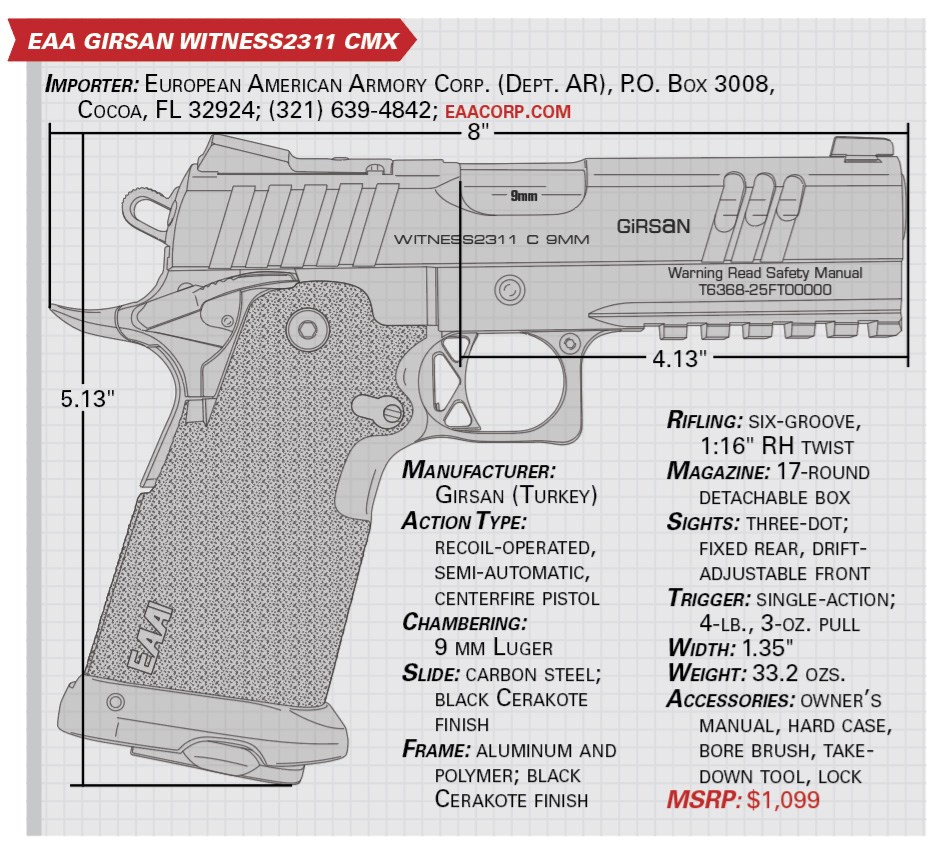
The 4.13″-long linked barrel is made from a carbon-steel alloy and treated with a Cerakote finish that matches the slide. Engraved on the left side of the hood is the same serial number found on the right side of the frame. The bore is button-rifled with six-groove, land-and-groove rifling at a 1:16″ right-hand twist rate. This barrel is belled at the muzzle and fitted to the slide without a barrel bushing.
A full-length steel guide rod supports the barrel, along with a reverse recoil-spring plug and a single round-wire recoil spring. In order to disassemble the pistol for routine cleaning, this recoil-assembly configuration requires the use of a small takedown tool that is provided with the pistol; it is inserted into a port in the guide rod that is exposed when the slide is retracted. The tool secures the rod’s plug and spring so that the assembly can be extracted from the slide as a single unit.
The upper portion of the CMX frame is formed from aircraft-grade aluminum. It, too, is treated with a matte-black Cerakote finish that harmonizes with the appearance of the proprietary polymer grip frame module. The full-length dustcover sports a milled-in 2.65″-long, six-slot M1913 Picatinny accessory rail. A familiar M1911-style slide stop is located on the left side of the frame, and bilateral thumb safeties feature textured extensions. The exposed hammer is of the Commander variety with a serrated loop. And, in the most notable departure from the classic, the grip safety assembly has been replaced with a fixed aluminum insert that provides an extended beavertail to protect the shooting hand from potential hammer bite.
Smooth-faced and vented with no external adjustments, the single-action aluminum trigger exhibited a smooth feel right out of the box, with a hint of take-up before a clean break. The factory pull weight for the CMX is listed at 4 lbs., 8 ozs., but the gun sent for this evaluation exhibited a slightly lighter 4-lb., 3-oz., break according to a Lyman digital trigger gauge.
The polymer grip module for the CMX features an integral trigger guard and a serrated left-side magazine-release button like other members of the Witness2311 series, but the contours and texturing of the grip have been significantly modified. Previous grip modules that I’ve worked with have been molded to emulate, more or less, those of an M1911 frame with traditional removable panels. This includes diamond-pattern grip texturing on either side with a checkered texture along the frontstrap and backstrap.
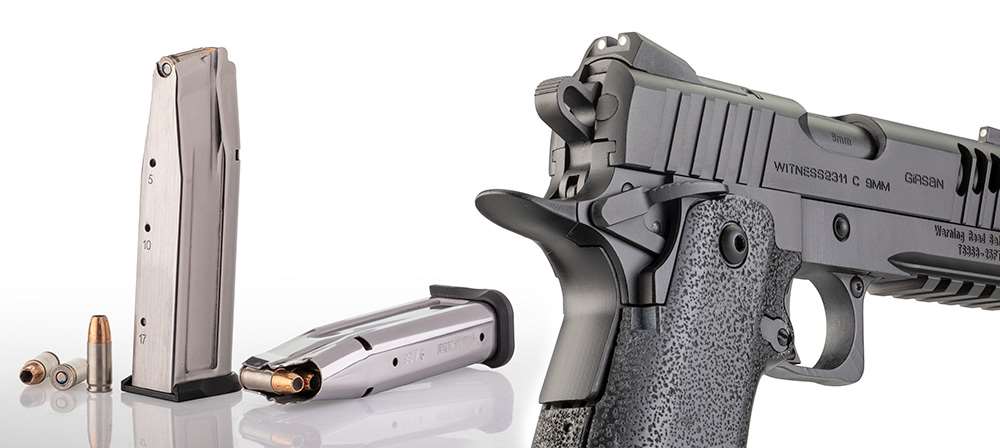
One of the Witness2311 CMX’s most significant departures from the M1911 design is its lack of a grip safety; instead, the gun features a fixed aluminum beavertail (r.). The 17-round Check-Mate magazines feature a stainless-steel body.
EAA’s new CMX frame has been rounded to eliminate the ledges and panels of the previous models. Its contiguous surface is treated with a consistent, wraparound texturing. This texturing is the noticeably more aggressive, tactical type that is comparable to skateboard tape, and it provides plenty of purchase for either gloved or bare hands. The trigger guard is more deeply undercut and beveled where it meets the grip; in fact, if the smooth bevel were any deeper, it could be considered a groove for the shooting hand’s middle finger. At the base of the grip, the magazine well is flared and beveled to speed reloading. The CMX ships with a relatively low-profile polymer magazine-well extension installed. It is held in place by the same steel pin that secures the mainspring housing.
This model ships with one flush-fit, Check-Mate-brand, 17-round, double-stack magazine. Check-Mate is, in fact, the original equipment manufacturer for Staccato’s 2011-pattern magazines; rather than re-invent the wheel, EAA has simply adopted the Check-Mate magazines for its pistols as well. The magazine features a polished, through-hardened, stainless-steel tube, a high-tensile-steel spring along with a polymer follower and baseplate. I’ve worked with more than a dozen of these Check-Mate magazines in different chamberings across multiple Witness2311 models—they have proven to be impressively well-made and reliable—I have yet to experience a single malfunction that could be attributed to them.
Prior to evaluating the CMX, I had the opportunity to work with two other Girsan Witness2311 models chambered in 9 mm Luger. On the heavier side of the lineup was the Match configuration. It has an uncompensated 5″ barrel, an optics-ready slide and an upper frame made of steel instead of aluminum. This gives the pistol an unloaded weight of 41 ozs. with an empty magazine inserted in the grip. Overall, its race-pistol configuration contributed to modest levels of felt recoil with little muzzle rise.
EAA also offers the Girsan Witness2311 BRAT with the same full-size polymer frame as the Match. However, its upper is made of aluminum, the slide has iron sights only and the barrel has been shortened to a subcompact length of 3.4″ for more comfortable concealed carry. Unloaded, the BRAT tips the scales at 29.3 ozs. Despite the peppier levels of recoil this model yields, the 2011-style grip frame makes it impressively controllable for a more compact 9 mm.
With these two previous tests in mind, I was most curious to see how the CMX would handle. With its 4.13″ barrel and aluminum upper, it was well-balanced and exhibited a handy feel and quick target acquisition comparable to that of the BRAT. But with the bit of added forward weight, and a quality optic installed on the slide, its handling was more in line with the Match—which is to say, it provided for an enjoyable extended shooting session. The changes to the grip shape, in particular the skateboard tape-like texturing, provide a high degree of purchase that lend even more control to the pistol’s user. Like other aggressive textures, however, it became abrasive to bare hands after a while; for extended practice sessions, using a pair of shooting gloves would be advisable.
In order to meet certain U.S. importation regulations, the pre-production pistol used for this evaluation was produced here at EAA’s manufacturing facilities in Cocoa, Fla. Once the Turkish-made CMX completes the ATF approval process, customers will be receiving pistols wholly constructed by Girsan. My test gun exhibited a tight, G.I.-wiggle-free, slide-to-frame fit with a smooth action, and the external controls were clean and crisp in their operations. The pistol was test-fired with a total of six Check-Mate magazines, all of which locked into place and dropped free of the grip just as expected.
My 9 mm test ammunition ranged from practice-grade imports to premium American-made, defensive +P hollow points. The pistol experienced a total of three failures to feed with the first magazine used, running the relatively slow Belom ammunition. But after that magazine was emptied, there were no more jams or malfunctions throughout the course of testing, including additional rounds of that load.
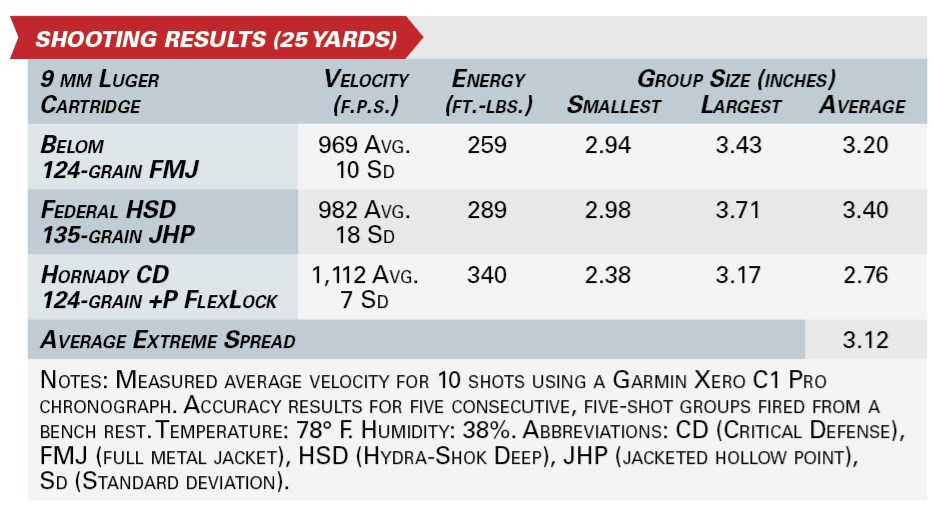
Formal bench-rested accuracy testing was conducted by firing five, five-shot groups with three loads into paper targets set at a distance of 25 yards. Since the CMX is intended to serve as a duty and defensive pistol, I was looking for group size averages of around 3.5″ or less. As the results show, the Belom and Federal loads met this requirement, however, the Hornady load demonstrated that more desirable sub-3″ averages are possible when using the right ammunition.
Today’s duty and defensive pistol market is dominated by polymer-frame, striker-fired 9 mm Luger pistols, many of which are inspired by, or unabashed copies of, the Glock Safe Action design. Although these semi-automatics have earned their place at the top, it’s good to see that there is still room at the table for models such as the Girsan Witness2311 CMX. And this is not just because 2011-pattern pistols are something different to take to the range. They offer a feel and features that striker guns have yet to duplicate, in particular, the classic M1911 single-action trigger pull. And the CMX offers this package of features at a much more wallet-friendly price than some models.
With each new iteration of the 2011-style pistol, the platform takes another step or two away from its M1911 origins into modern defensive-pistol territory. So far, the M1911 purists and modern polymer pistol fans don’t seem to be complaining too much about these developments. This is most likely due to the fact that their preferred platforms are well established and unlikely to go out of production any time soon. But hybrids such as EAA’s 2311 CMX show that we are close to, or may have already achieved, that just-right, best-of-both-worlds blend of features that the developers of the 2011 set out to achieve more than three decades ago.
Read the full article here