

I have a love-hate relationship with Mel Gibson’s film, “The Patriot.” On the one hand, it’s a highly entertaining movie about a topic virtually untouched by Hollywood. On the other, the movie is so replete with historical inaccuracies that one viewing is enough to send even the moderately educated history enthusiast into violent, mouth-frothing convulsions.
But, the simple fact is that “The Patriot” is likely representative of the general view of the American Revolution. Though Americans live, work and play in a nation that directly resulted from the events of 1776 and beyond, 250 years removed, the actual details of who fought, how they fought and the guns with which they armed themselves are generally lost to all but a few die-hard historians. For most Americans, their view of the fighting in North America is largely an abstraction, even a caricature of real events.
American militiamen, from the beginning of the Revolution, were armed with a hodge-podge of firearms. Illustrations courtesy Don Troiani
Like the ideals that underpinned the revolution, the fighting between the British army and the nascent American military was the result of an ongoing evolution. But beyond the ideas about liberty and self- determination, this was an evolution in the kinds of arms being employed on the battlefield, as well as the tactics that governed their use. As we recognize and celebrate the men who fought and died to build this country, it’s important to understand exactly how they fought and the arms they used as they forged a new nation.
The Old World: By Musket and Push of Bayonet
One of the most memorable scenes in “The Patriot” shows Benjamin Martin, the lead character played by Mel Gibson, staring out the window of a plantation house and observing a set-piece battle between the British and Continental armies in an adjoining field. Predictably, the automaton-like mass of British infantry marches in perfect lockstep toward the poor bastards in blue. Finally, they halt at a suicidally close distance and, after absorbing hilariously ineffective scattered fire from the amateurish Americans, proceed to unleash volleys and clumsy bayonet charges to sweep away the upstart colonials. Martin states the obvious: “Going muzzle-to-muzzle with Redcoats in an open field. It’s madness.”
Yeah, it didn’t really happen like that, and if it did, it would be madness. While it is true that linear tactics generally governed 18th-century warfare, the reality of what many engagements looked like is a lot different than you might imagine, and it certainly didn’t look like the scene in “The Patriot.” Recent research indicates that combat in the 18th century occurred at much longer ranges than “muzzle-to-muzzle.” During the Seven Years War, combat usually occurred between 100 to 200 yards, with many firefights breaking out at longer distances, particularly when inexperienced troops were involved. Historian Alex Burns notes that, to military men of the age, the phrase “within musket shot” was generally understood to be a distance of about 300 yards.
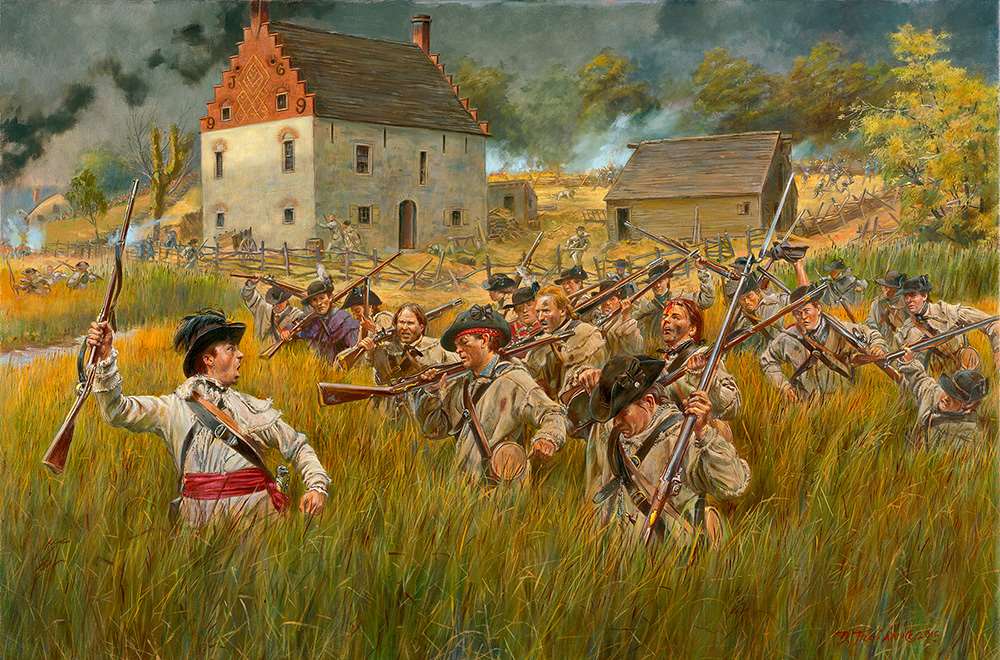
During the Battle of Long Island in 1776, Capt. Samuel Smith led his Maryland riflemen away from disaster as the British overwhelmed American troops.
The typical military firearm used in these conflicts was a smoothbore, flintlock musket with a barrel length roughly 3.5 feet long and a bore size ranging from .69 to .80 caliber. Muzzles were exposed and outfitted with a lug to mount a long, tapered, triangular bayonet that remained a singularly important tool on the 18th-century battlefield, particularly for the British army. Paper-wrapped cartridges containing powder and ball were issued to soldiers, usually with a single round ball of significantly smaller diameter than the bore to accommodate for the variance in bore sizes, as well as the buildup of black-powder fouling that would inevitably arise from repeated firing. This is a phenomenon known to black-powder shooters as “windage,” defined as the space between the outside of the musket ball and the interior of a musket bore. The greater the windage, the more inaccurate the musket shot.
In terms of the practical accuracy of such arms, one could not reasonably expect to hit a man-sized target at distances of more than 80 to 100 yards with any certainty. Given this, you might wonder how 18th-century armies expected their soldiers to hit anyone if they ordered their troops to open fire at distances far greater than the practical accuracy of their military longarms. The answer is that, until the mid-18th century, individual marksmanship in a military context was generally considered superfluous. In a modern analogy, the infantry regiment of the 18th century functioned, essentially, as a large, single-shot shotgun. A musket ball fired by one soldier toward a host of other troops was likely to find its mark somewhere, even if that mark wasn’t the aim of the soldier who fired the ball.
For these sorts of tactics, a certain style of military longarm began to emerge, first standardized in the 1720s. For the British army, this was the King’s Land Pattern musket, more commonly known as the Brown Bess. The earliest of these guns were behemoths, with bore sizes approaching .80 caliber, 46-inch barrels and thick stocks that made them the Mack trucks of 18th-century muskets. But, by the time of the revolution, a new pattern of British military longarm emerged to serve a new kind of infantryman. The Short Land Pattern musket, sometimes referred to as the Pattern 1769, was equipped with a shortened 42-inch, .75-caliber barrel compared with the longer, heavier service muskets that had existed for decades, known henceforth as the Long Land Pattern. These guns were handier while still having enough length to fire in ranks.
The shortened length made them useful for a new class of light infantry, a development of British military doctrine directly influenced by its experience in North American warfare. Instead of fighting and firing in rigid ranks, light infantrymen were more mobile, flexible and expected to operate on their own initiative. Men in light infantry units were chosen specifically for their intelligence and their resourcefulness, and they would fight singly, using cover and concealment while taking carefully aimed shots and maximizing the limited capabilities of their smoothbore infantry muskets. It is these men that American militiamen would encounter on the fields outside Boston as the cold war between Britain and her colonies turned hot in April of 1775, and they would continue to encounter flexible, enterprising infantrymen as the conflict in North America churned into full-scale war.
Arming for the American Cause
While Great Britain standardized its arms in the 1720s, across the English Channel, the French army was similarly situated in the early part of the 18th century and embarked on a similar movement of standardization designed to improve its military readiness. Early patterns of muskets emerged in 1717 and 1728, but, by the end of the Seven Years War, a new design materialized that would become a de facto standard not just for the French military, but also for the nascent American nation.
For the French, it was the fusil d’infanterie modele 1763, later updated in 1766 and now known to collectors as the Model 1763/66. But for American troops who would later be equipped with thousands of such arms, it became simply the “Charleville” musket, so named for the Charleville-Mézières armory in the Ardennes, where many were produced. By 1777, France would begin sending tens of thousands of older-pattern Charleville muskets from its stores to equip the fledgling Continental Army, and by war’s end, the Charleville musket would become the standard longarm for the American military.
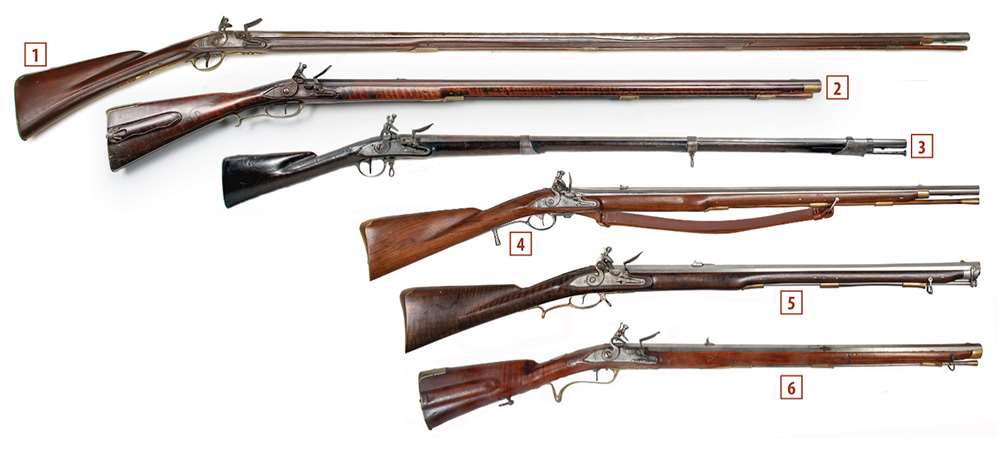
The American Revolution saw the use of a number of unique firearms, ranging from smoothbore flintlock fowlers (1) to the quintessential American longrifle (2). Continental troops would eventually be equipped with Charleville muskets (3), while select British and Hessian troops experimented with designs like the Ferguson breechloader (4), the Pattern 1776 (5) and the German Jäger (6).
But, at the beginning of the conflict, American armament was far from standard. Much of what equipped the militia and the first Continental troops were the disparate civilian smoothbores of the day. One such arm commonly found in New England and the coastal mid-Atlantic colonies was the fowler, a smoothbore, flintlock longarm typified by what was often an extraordinarily long barrel, in some cases exceeding 50 inches, with a bore size ranging from .62 to .80 caliber, or in shotgunning parlance, from about 20 gauge to 10 gauge.
Named for its primary application as a hunting arm, the larger bore size accommodated birdshot, as well as larger buckshot, buck-and-ball and solitary musket ball loads. Its larger bore size and smoothbore construction also meant these guns were capable of accepting the paper cartridges often employed with infantry muskets. A lack of rifling meant fowlers could be loaded with the same rapidity as a military musket, making them suitable for militia use.
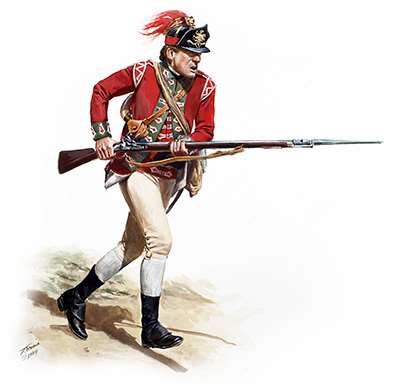
This private of the 5th Foot illustrates the movement and initiative expected of the British light infantry, who fought individually.
However, as versatile as the American fowler was, it wasn’t without drawbacks. Logistically, the need to keep thousands of men supplied with ammunition was greatly complicated by the fact that these guns often had differently sized bores and locks, requiring different sized musket balls, paper cartridges and flints. The need for a somewhat standardized longarm for a prolonged conflict gave rise to a new class of arm that we still struggle to understand: the “Committee of Safety” musket.
In the run-up to the American Revolution, Committees of Safety directed the stockpiling of arms, ammunition and accessories that would become necessary in the event of a shooting war. These groups often directed local gunsmiths to produce military-style longarms, patterned after then-issued British military muskets, that could be used to equip militia units. This was easier said than done.
Many civilian leaders in the American colonies still earnestly hoped that a peaceful resolution could be reached with Great Britain. In this tenuous period, those who produced masses of arms for the ultimate purpose of equipping rebels in a future conflict were, in effect, committing active treason. Given that fact, such activities were so clandestine that little evidence survives detailing who produced such guns and in what quantities.
Today, few verifiable Committee of Safety muskets survive with any sort of rock-solid provenance. However, many longarms exist with the kinds of features that suggest they could have been produced in such circumstances and remain a testament not only to the resolve of American colonists determined to forge their own destinies, but also to the capabilities of domestic gunsmiths across the colonies, thousands of whom would play a role in building and servicing small arms throughout the course of the American Revolution.
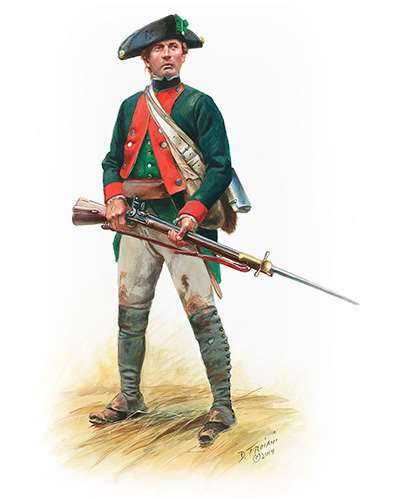
At the outset of the American Revolution, King George III called for 30,000 Hessian troops, and several thousand were equipped with accurate, handy Jäger carbines. Illustrations courtesy Don Troiani
Rifles of the Revolution
Often imbued with downright mythological capabilities, the vaunted American longrifle had several notable features born of the needs of settlers and frontiersmen who lived and worked for long periods away from any supply source. Its distinctive long barrel served two purposes: It provided enough room to maximize the slow burn of black powder, allowing riflemen to make the most of a meager charge of what was likely lower-quality powder, and it offered a lengthened sight radius for longer, more precise shots. Instead of the .60- to .70-caliber bore sizes often seen on the German Jägers that inspired their creation, American rifles generally had bores of .50 caliber or smaller. This allowed riflemen to carry more ammunition for the same given weight. A smaller projectile also required less powder, further maximizing their powder supply.
Despite these advantages, longrifles had one significant drawback compared to smoothbore guns of the era: reloading time. To ensure an accurate, precise shot, longrifles had to be slowly and methodically loaded with a tightly patched ball that would be pressed into the rifling as it traveled down the bore. Consequently, rates of fire for longrifles averaged about one shot per minute, compared with the three shots a minute for a contemporary military musket loaded with paper cartridges. For a frontiersman taking a solitary shot on game, reloading time was not a significant consideration. On the 18th-century battlefield, this drawback would have serious ramifications.
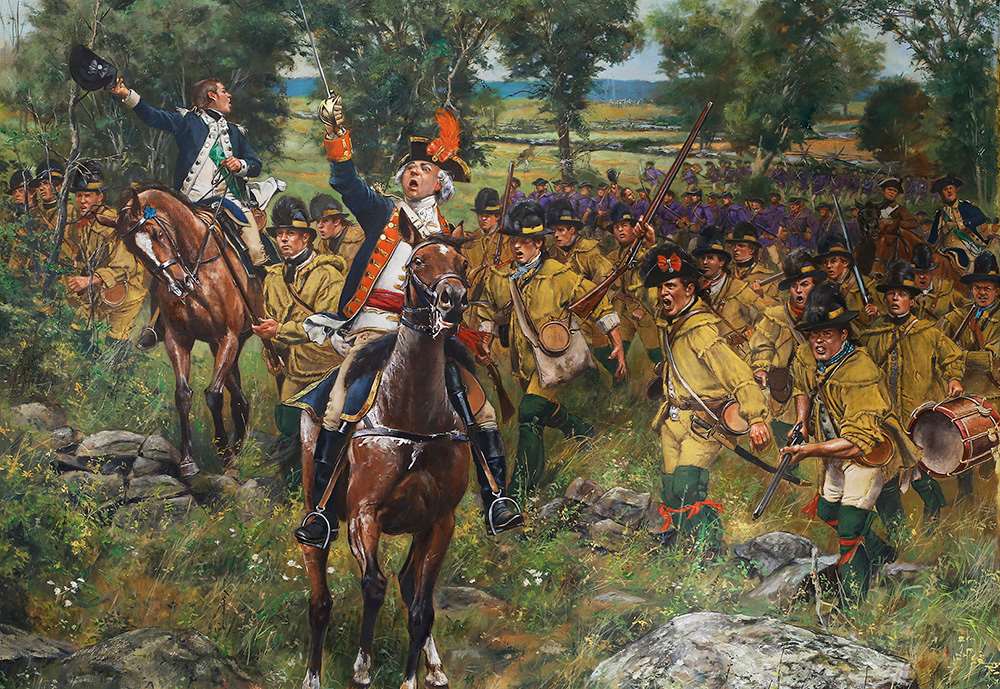
Gen. Israel Putnam led a company of Maryland riflemen into battle at Harlem Heights in 1776, including the famous “Maryland 400” clad in purple hunting shirts.
The American longrifle design was largely derived from the German Jäger rifle, which also appeared in the American Revolution. Barrel rifling as a practice likely emerged in what is now modern Germany in the early 16th century, and by the mid-to-late 17th century, a style of short hunting rifle had materialized that was closely associated with those who employed them, so much so that the German word for “hunter” has been inextricably linked with this particular pattern of longarm.
King George III called for 30,000 Hessian mercenaries to quell the American rebellion, and several thousand of those troops were elite marksmen who employed the Jägerbüchse to great effect. In the disastrous August 1776 battles fought on Long Island, rifle-equipped Hessians swept away American troops from several positions, illustrating the impact that well-aimed fire could have on the battlefield.
In the same year that German Jäger units illustrated their prowess outside New York City, the British military, fearful that longrifle-wielding Americans might have an outsized impact on the course of the conflict, began issuing its first-ever military rifle: the Pattern 1776.
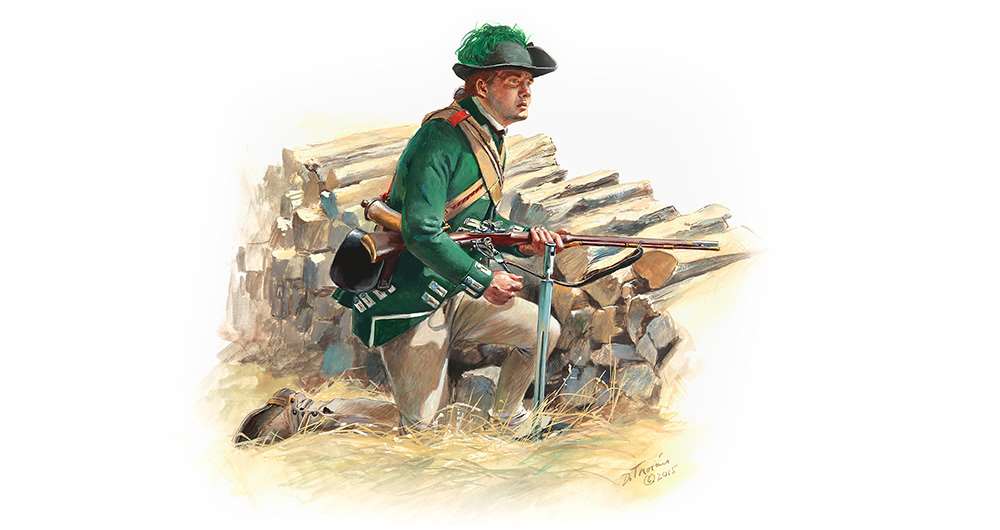
Patrick Ferguson’s company of riflemen employed their novel breechloaders for only a short time.
Ultimately, 1,000 Pattern 1776 rifles, 200 of which were Hanoverian designs produced in Germany, were taken into British service during the American Revolution. Of .62 caliber and having a 28-inch swamped barrel, the Pattern 1776 was an incredibly handy firearm for the era, weighing a relatively svelte 8.5 pounds compared with the 10-pound infantry musket employed by most troops. One of only two rifles in British military history designed for simultaneous use by both infantry and mounted units, the rifle employed a captured ramrod that was affixed to the gun by two opposing swivels, ensuring that cavalrymen couldn’t lose their ramrod when reloading on horseback.
Concurrently, British Army Maj. Patrick Ferguson successfully lobbied for the British military to employ his novel rifle design on a trial basis, following a successful demonstration for senior officers on April 27, 1776, during which he fired “five good shots into a target in the space of a minute.” His rapid, accurate fire was aided by the fact that Ferguson’s rifle did not require muzzleloading.
Instead, the trigger guard formed a handle for a large, vertically oriented screw that served as the breech of the gun, and it could be opened and closed with a single revolution of the trigger guard. When opened, a rifleman simply inserted a projectile and the requisite amount of powder, then turned the breech closed, primed and fired. It offered the rapid fire of a musket with the accuracy of a rifle and was a truly revolutionary design for the British military, albeit inspired by advancements from earlier gunmakers.
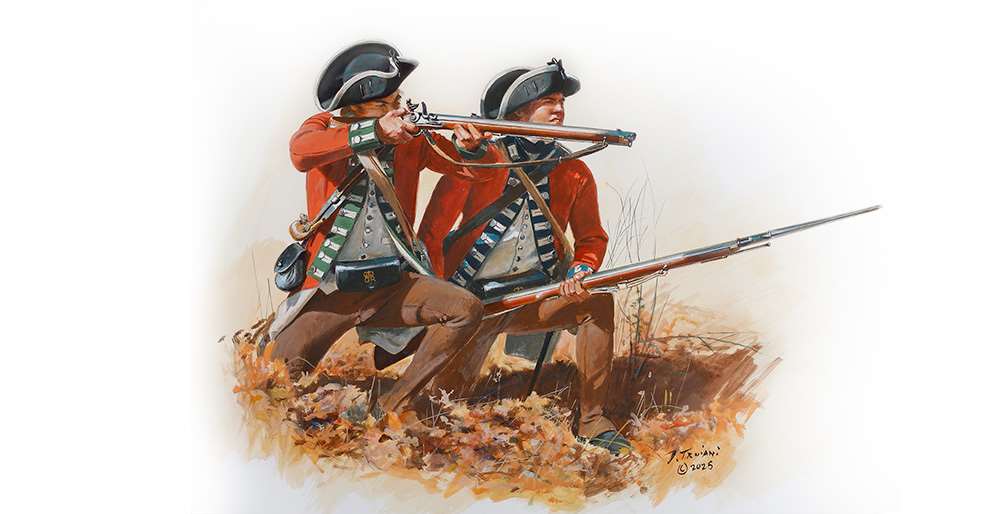
The 4th division of Ferguson’s American Volunteers operated in pairs, one firing a Pattern 1776 rifle and the other using a Brown Bess musket.
Ferguson was given command of a company of riflemen, each equipped with his breechloading rifle, and they set sail for America in March 1777. By June, they were engaged in battle, acting as scouts and skirmishers for Gen. Wilhelm von Knyphausen during the fight for Philadelphia. At the Battle of Brandywine in September 1777, Ferguson was badly wounded in the arm and required a year to recover. During this time, his experimental company was disbanded, with the men returning to their original units.
Ferguson himself returned to combat in 1778, but was soon killed in South Carolina at the Battle of King’s Mountain, ironically by longrifle-wielding Americans. Any hopes of resurrecting a British rifle corps during the American Revolution expired with him. Of the 100 Ferguson rifles that came to North America, only two survive today. But Ferguson’s rifle, along with the Pattern 1776 and the employment of German Jägers, provided a proof of concept that would inspire a new generation of riflemen and military leaders.
While the outcome of the American Revolution was governed more by politics than it was by American feats of arms, the battlefields of North America from 1775 to 1783 nonetheless served as a proving ground for several new styles of military longarms. Over the coming decades, these lessons would coalesce into greater concepts, resulting in the development and employment of rifles on a wider basis. For the field of military small arms, as well as the future of human liberty, the rebellion in the New World was a revolution in more ways than one.
Read the full article here