

This will sound self-contradictory, but it is not: the Traditions Firearms Nitrobolt Rifle is a bolt-action muzzle-loader. The primer and the powder charge cartridge are loaded through the breech via bolt action. The bullet is loaded through the muzzle with a ramrod. This hybrid action offers the powder-charge-consistency and weather-resistance of a breechloading rifle while being legal to use during muzzleloading season in 29 states at the time of this writing.
The Nitrobolt uses Federal Premium FireStick polymer encapsulated powder charges. The FireStick charges use Hodgdon Triple Eight powder. Triple Eight burns more cleanly than black powder or other black powder substitutes. This eliminates the blinding clouds of powder smoke that follow the discharge of most muzzle-loaders.
I found the Nitrobolt to be accurate, reliable, well-machined, and attractive. It is able to propel .50 caliber bullets at velocities that deliver more than enough energy-on-target to humanely harvest all types of medium to large North American game animals.
Because it loads its charge from the breech, the Nitrobolt is considered a modern firearm by the ATF. As such it requires the completion of a Form 4473 when purchased from a dealer.
The Nitrobolt had a manufacturer-suggested retail price of $1,095.95 at the time of this writing. It is made in Spain.
Some who hunt with a muzzle-loader do so in order to experience the technology of a period in history prior to the invention of the breechloading rifle. Those hunters would not enjoy the Nitrobolt. Other hunters would like to use the most effective, state-of-the art muzzle-loader available today. Those hunters should take a serious look at the Nitrobolt.
Background
Acts 17:21 tells us that the people in Athens during the first-century AD “spent their time in nothing else, but either to tell, or to hear some new thing.” I guess that I may resemble the people in Athens in at least one way: I find innovative pieces of equipment especially fascinating. When I heard about a bolt-action muzzle-loader, I was intrigued. I contacted Traditions Firearms and asked if I could borrow a sample of the Nitrobolt for testing and evaluation. They were kind enough to agree. Before long, I received a message from the gun shop that handles my firearms transfers. The Nitrobolt had arrived.
First Impressions
The Nitrobolt box contained a number of items: a packing list, a manual, a plastic bag containing the rifle, a smaller box containing the bolt, a spacer for adjusting the length of pull, an attachment to connect a T-handle to the ramrod, and two Allen wrenches.
The barrel of the Nitrobolt is fluted, 24 inches long, has a Tungsten Cerakote finish, and is threaded to accept a muzzle brake. The one-piece, black, synthetic stock has an adjustable comb, a recoil pad, sling studs, and accommodates the ramrod. An optics rails is preinstalled on the top of the receiver.
In addition to the box containing the rifle, Traditions and Federal Premium sent me two other boxes containing accessories and ammunition for the Nitrobolt.
The first accessory box contained the following: cleaning patches, a muzzle brake, a bronze breech brush, a nylon breech brush, a loading jig, a jar of 100 FireStick pre-saturated cleaning patches, a telescoping cleaning rod, a pack of 15 Smackdown 290 grain MZX bullets, and a pack of 12 Smackdown 340 grain ELD-X Bullets.
The second accessory box contained the following: three packages of 10 each of 100 grain equivalent FireSticks, two packages of 10 each of 120 grain equivalent FireSticks, two packages of 15 each of 350 grain B.O.R. Lock MZ bullets, and two packages of 100 each Federal Premium 209 Muzzleloading primers.
Reading the Manual
The manual is 48 pages long including the front and back covers. It was filled with many tidbits of interesting information:
It appropriately begins with eight pages of safety guidelines.
It recommends allowing the barrel of the Nitrobolt to cool before reloading. During my testing, I found that the reloading process was slow enough that overheating was not an issue.
It recommends keeping FireSticks and primers well away from the firearm while it is being discharged. This recommendation is probably a carry-over from advice based on the volatility of black powder and percussion caps. FireSticks and primers are no more subject to accidental ignition than standard cartridge ammunition.
It is important to clean the Nitrobolt after use to insure future safe operation. Carbon buildup may prevent the proper seating of the FireStick or bullet.
There is also some risk of accidentally loading multiple bullets. Prior to loading, the bolt can be removed to verify that the barrel is clear. Another possibility is to insert the ramrod to assure that a projectile has not yet been loaded.
Marking the ramrod to reflect the depth of a properly seated bullet will help to assure that multiple bullets are not being seated.
The manual recommends a detail cleaning before first use.
The manual also emphasizes that FireSticks should not be reloaded.
The manual recommends loading the bullet first, then the FireStick, then the primer. In my testing I found it difficult to load the primer once the FireStick was inserted into the chamber. Instead, I began inserting the primer into the primer pocket of the FireStick just before loading the FireStick into the chamber.
The manual recommends never dry-firing the Nitrobolt.
They recommend cleaning the bore and chamber after each shot while zeroing the Nitrobolt so that the zero is based on a clean bore. In my testing, this made zeroing a somewhat cumbersome process.
Detail cleaning includes disassembling and cleaning the bolt.
Pre-cleaning
The initial detail cleaning involved the following steps:
1. Moving the safety to the middle position and the cheek rest to the lowest position.
2. Removing the bolt and the ramrod.
3. Decocking the bolt.
4. Unscrewing the bolt cap with a 5mm wrench.
5. Removing the firing pin assembly and bolt handle from the bolt body.
6. Consecutively using solvent on a bore brush, a dry patch and a CLP patch to clean, dry, and lubricate the inside of the bolt body.
7. Using a CLP coated pipe cleaner to clean the firing pin hole.
8. Consecutively using a pre-saturated cleaning patch, dry patch, and CLP patch to clean, dry, and lubricate the outside of the bolt body.
9. Scrubbing the firing pin assembly with a solvent soaked toothbrush. Then drying with a dry patch and lubricating with a CLP patch.
10. Scrubbing the inside of the bolt handle assembly with a solvent soaked toothbrush, drying with a dry patch, and lubricating with a CLP patch.
11. Cleaning the bolt cap with a pre-saturated patch, drying with a dry patch, and lubricating the inside of the cap with a small dot of TW25B grease on a Q-tip. Then a thin film of CLP inside and out.
12. Reassembling the bolt.
13. Attaching a bronze chamber brush to the ramrod, wetting it with solvent, and pushing it from the chamber to the muzzle. The ramrod was not quite long enough to reach all the way from the chamber to the muzzle, so I cleaned from the muzzle toward the chamber as well.
14. Drying the chamber and barrel with dry patches on the end of the ramrod. The barrel was so filthy that it took a couple of pre-saturated patches and a total of 16 dry patches before the patches finally came out clean. This was followed by a CLP patch in the barrel and chamber.
15. Cocking and reinserting the bolt.
16. Applying a thin film of CLP to the external metal surfaces of the rifle.
Mounting a Scope
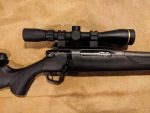 I placed the rifle in a vise and leveled it. I then mounted and leveled a Leupold VX-Freedom 2-9X40mm Huntplex Scope. Next, I raised the cheek rest to its maximum elevation. The eye relief and focus looked good. It would have been nice to raise the cheek rest just a bit higher, but it was close to the ideal position.
At the Range
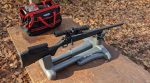 The sun shone half-heartedly on a sodden carpet of leaves. With the Nitrobolt and an overloaded range bag, I made my way to the improvised range behind the pole barn. It was early in the afternoon of the Friday before Thanksgiving. The temperature was 46 degrees Fahrenheit with a variable breeze from the south. I set up a target stand in front of the backstop and a table 25 yards away.
I placed the Nitrobolt on a rifle rest, removed the bolt, and verified that the chamber and barrel were empty. I then loaded a B.O.R. Lock bullet through the muzzle, inserted a 100 grain equivalent FireStick in the chamber, inserted a primer into the FireStick, and closed the bolt.
The recoil from the first shot was significant enough that I put the rifle rest away and got out a lead sled instead.
The sound of the shot was loud enough that I made two decisions: I would not test the muzzle brake, and I would not fire the rifle at an indoor range.
That first shot struck about six inches to the left and about four inches above the point of aim. I decided to wait to swab the barrel and chamber until I was in the general vicinity of the point of aim.
A couple of scope adjustments and a couple of more shots brought me into the general vicinity. Then a couple of more scope adjustments with bore and chamber swabbing in between each shot brought me to a good zero.
Next, I tried a three shot group with field cleaning between each shot. That produced a 1.25 inch group.
I moved the table back to 50 yards and cleaned the Nitrobolt again. I then fired a three shot group utilizing the B.O.R. Lock bullets with 100 grain equivalent FireSticks. I did not clean between each shot. This produced a 2.0 inch group.
I cleaned the Nitrobolt again. I then fired a three shot group utilizing the Smackdown MZX bullets with 100 grain equivalent FireSticks. I did not clean between each shot. This produced a 0.94 inch group.
I cleaned the Nitrobolt again. I then fired a three-shot group utilizing the Smackdown ELD-X bullets with 100 grain equivalent FireSticks. I did not clean between each sot. This produced a 1.13 inch group.
The point of impact for the differing types of bullets varied quite a bit from each other. It will be important to zero the rifle with the exact bullet type that you plan to use.
Final Cleaning
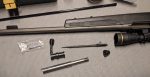 Following the range session, I repeated the detail cleaning that I described above. Since I was more familiar with the process this time, I was able to better admire the excellent fit and finish of the Nitrobolt. It is truly a handsome firearm.
Conclusions
The Traditions Nitrobolt is accurate, powerful, attractive, weather-resistant, and easier to use than the average muzzleloader. It was a lot of fun to shoot, too.
Disclaimer
Traditions Firearms loaned me a sample of their Nitrobolt rifle for testing and evaluation. They also provided me with various accessories and ammo for the rifle. I tried not to allow their kindness to interfere with my objectivity in this review, and I believe that I have succeeded. I did not receive any other financial or other inducement to mention any vendor, product, or service in this article.
Read the full article here