
Active-shooter attacks unfold fast. They are chaotic, violent and unpredictable. In those situations, the first few seconds often decide survival. Law enforcement response times are measured in minutes, but most events are over in less time than that. For armed civilians, readiness isn’t about playing hero. It’s about having the right gear and the skills to decisively use them if violence finds you.
Readiness begins with preparation long before an emergency. The equipment you carry and the way you train can either set you up for decisive action or leave you scrambling. The goal is to strip away fantasy and focus instead on the essentials: a capable and reliable concealed-carry firearm, spare ammunition, medical gear and a high level of shooting skill that matches the stakes of the possible situation.
Gear That Actually Makes a Difference
When preparing for an active-shooter scenario, it’s easy to get distracted by gimmicks. The market is full of flashy accessories that offer little real advantage. What matters is gear that increases your ability to fight effectively, sustain that fight and save lives, both during and after engagement.
Concealed-Carry Firearm: Compact Size, Duty-Level Skill
Many shooters instinctively associate preparedness with full-size handguns. Full-size pistols do offer increased capacity, a longer sight radius and easier handling. However, modern compact pistols and the new hybrids strike an ideal balance between concealment and capability. Models like the SIG Sauer P365 XMacro, Glock G48 and Smith & Wesson M&P Compact provide meaningful magazine capacity, controllability and shootability while remaining practical for everyday concealed carry.
The size of the firearm, however, is only part of the equation. A compact pistol in the hands of someone who has trained to a duty standard is far more effective than a full-size gun carried by someone who only practices occasionally. Compact pistols demand a higher level of user proficiency, especially under stress. Shorter sight radiuses and lighter frames are less forgiving of errors in trigger control and sight picture. To prepare for a high-threat event, train to use the compact pistol with the same level of competence expected of a duty weapon.
Scenario training with inert guns or marking rounds bring skills together, from situational awareness to movement to drawing and shooting accurately—if it comes to that. While you can’t anticipate every scenario, you can learn to think in the midst of chaos and perform under stress. Photos: WOFT
Ammunition management is part of this equation. Compact handguns usually carry between 15 and 17 rounds, depending on the model. That may sound like plenty on paper, but in the chaos of a real engagement, those rounds can disappear quickly. Training should include both speed reloads and tactical reloads until they are second nature. Malfunction clearances should be smooth, instinctive and reliable under pressure. The goal is not just to shoot well, but to keep the gun running when it matters.
Precision and control are equally critical. Head shots or high-thoracic hits may be required to end the fight, particularly if the attacker is wearing body armor or is behind partial cover. These shots demand a refined level of skill. Regular training should incorporate reduced-size targets at realistic distances to build accuracy and accountability. Miniature red-dot sights (MRDS) excel in chaotic environments with smoke, movement or reduced visibility, offering a target-focused, binocular-vision-driven sight picture that allows for rapid, accurate engagement from any position. Their consistent, anytime viewability helps shooters maintain situational awareness while delivering precise fire under stress. To fully realize these advantages, proper mounting and a carefully confirmed zero are essential, ensuring the dot’s point-of-impact matches point-of-aim at practical defensive distances.
In short, carry a compact pistol, but train with it as if it were a duty gun. The firearm’s size does not determine your effectiveness. Your level of skill does.
Spare Magazines
Carrying at least one spare magazine is a simple step that significantly expands your fighting capability. Active-shooter attacks can involve more than one threat, and even if they do not, extended engagements are not uncommon. A spare magazine not only provides additional ammunition, but also ensures you can clear malfunctions that require a fresh magazine. Reloading under pressure is a perishable skill. Regular live and dry practice should make it second nature.
Medical Gear
In many active-shooter events, preventable bleeding is the leading cause of death. Victims often die from extremity wounds that could have been treated with basic trauma care. Carrying a compact trauma kit with a tourniquet, pressure dressing and chest seals can save a life. Knowing how to use that gear is equally important. A good medical-training course gives you the competence to apply lifesaving interventions under stress. Firearms are tools for defense, but medical skills and gear are often what make the difference between life and death in the aftermath. And, these are skills that are important in everyday life as well.
Optional Protective Equipment
For individuals in higher-risk environments, such as security personnel or volunteer protection teams at churches, body armor should prioritize discretion and low visibility. The goal is to blend in during the early stages of an incident, not to stand out or become a more visible target. Soft armor or slim plate carriers designed to be worn under everyday clothing allow protection without broadcasting your capabilities to a potential attacker. Keeping a low profile helps avoid drawing unwanted attention while still providing a layer of defense if violence erupts. Excessive or overt gear can slow movement, signal your presence and potentially make you a priority target, so protection should remain subtle, mobile and focused on enhancing survivability without compromising concealment.
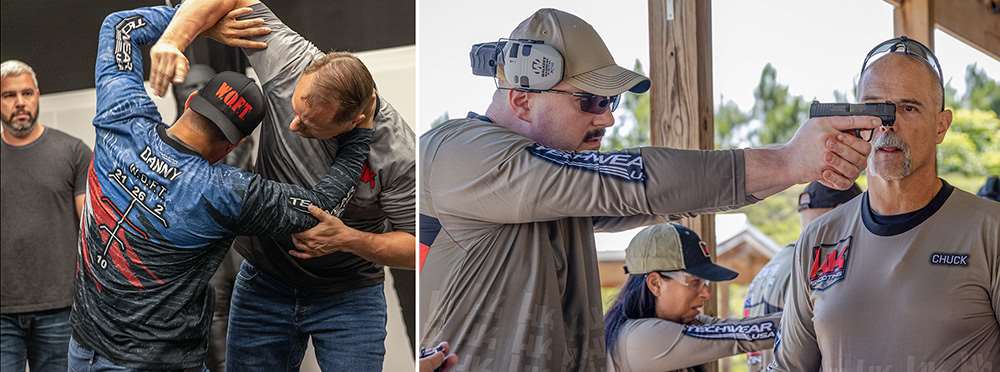
(l.): Keep yourself in decent shape (you’ll shoot better) and master a few martial arts moves in case you find yourself unable to immediately draw or are present in a firearm-prohibiting venue. (r.): Seek expert training and prepare realistically for violent encounters using the tools you expect to have on you.
Training That Translates to Reality
Gear alone is not enough. When violence breaks out, the ability to move, shoot accurately and make quick decisions determines outcomes. Unfortunately, most civilian firearm training focuses on static marksmanship at short distances for self-defense scenarios. While this is important, active-shooter attacks demand more. Surgical shots under stress, shooting while moving and making accurate hits at extended distances are the skills that separate casual practice from meaningful preparation.
Surgical Shots Under Pressure
Some active-shooter situations involve attackers who wear body armor or use cover. Center-mass shots may not be effective. In those cases, precision shots to the head or high-thoracic cavity may be necessary to stop the threat quickly. Routinely making these shots under time pressure requires consistent training on smaller targets placed at realistic distances.
Using reduced-size targets such as 3×5 cards or small steel plates at 7 to 15 yards builds both accuracy and confidence. Drills should be timed to introduce stress and encourage disciplined trigger control. The shooter should be accountable for every round fired. In a crowded environment, misses are not just ineffective; they are dangerous and tied to culpability no matter their intent.
Shooting on the Move
Real-world encounters rarely allow you to stand still. You may need to move toward cover, protect others or close distance to effectively engage the threat. Training must reflect this reality.
Shooting while moving is a skill that must be deliberately developed. Start with controlled forward movement while maintaining a stable sight picture. Progress to lateral and diagonal movement, ensuring that accuracy does not degrade. Drills should emphasize explosive movement off the line of attack, often referred to as “getting off the X,” followed with accurate and effective fire. The ability to move dynamically while maintaining precision can give you a significant ad- vantage in a chaotic environment.
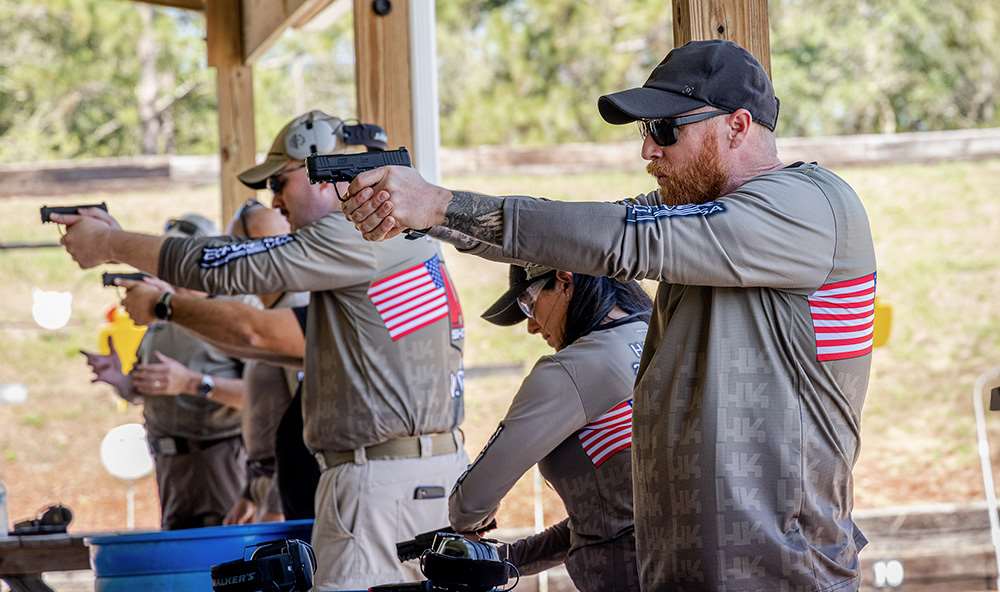
While you may be more accurate with a 5-inch, all-steel Government Model 1911, is that really the gun you are most likely to have on you, day in and day out? Typically, you actually need to master the small, double-stack polymer-frame micro-nine like the H&K CC9 (shown here) to a duty standard. That may seem like a high standard for these subcompact guns, but the stakes are pretty high, too.
Extended-Range Engagements
Many active-shooter incidents occur in large spaces such as places of worship, open areas, malls, parking lots or sporting events. These environments may require engagements well beyond the 7-yard comfort zone where most civilian shooters spend their time. Being able to make accurate hits at 25, 35 or even 50 yards can be decisive.
Regularly incorporating distance shooting into your training plan builds both capability and confidence. Focus on deliberate, stable shooting rather than raw speed. When at extended ranges, sight picture, trigger control and follow-through matter more than cadence. By training to make hits at distance, closer shots become easier under stress, and you expand your ability to engage threats in a wider variety of tactical environments.
Gear and Skill: Nothing More, Nothing Less
Preparing for an active-shooter attack is not about accumulating exotic equipment or imagining yourself in a cinematic gunfight. It is about making smart, disciplined decisions about what to carry and how to train. A reliable compact handgun, spare ammunition, medical gear and the ability to place accurate shots on demand while moving and at distance form the backbone of effective preparedness.
Skill is the great equalizer. The best gear in the world cannot compensate for poor training, but a skilled shooter with solid, minimalist equipment can solve complex problems under pressure. This kind of preparation requires time and commitment. It means moving beyond the comfort-zone shooting espoused in self-defense circles and embracing the reality that violence is dynamic and downright unforgiving.
When chaos erupts, gear gets you into the fight, but skill gets you out alive. If you carry a firearm for defense, take the time to develop duty-level proficiency with your chosen platform, learn to manage your am-munition, master precision under pressure, train to move and push your abilities at distance. Equip yourself smartly, train intentionally and prepare diligently for the moment you hope never comes.
Read the full article here