

The TriStar KR22 rifle has many excellent features. It is well-balanced and feeds smoothly. The synthetic stock is nicely weather resistant. It comes with two magazines. The comb can be adjusted for height, making it easy to get a good cheek weld while using optics. The receiver includes an integrated Picatinny rail. The stock comes with sling studs installed. The barrel is threaded to accept muzzle devices. The magazine-well accepts Ruger BX-series magazines.
For me, the KR22 functioned most effectively with a red dot sight. To be useful for pest control, a rifle should be capable of consistently shooting two-inch groups or better at 25 yards. The KR22 exceeded this level of accuracy in my testing.
The KR22 is made in Turkey. At the time of this writing it cost $289 at www.tristararms.com .
By combining excellent features, acceptable accuracy, and an attractive price point, the KR22 offers a good value for the money. If you are looking for a budget-friendly semi-auto in .22LR, then the KR22 offers a viable choice.
Background
I love firearms chambered in .22LR. They are light, relatively quiet, produce almost no recoil, and are economical to feed. They are great for training, effective for pest control, and are a whole lot of fun to shoot. So when I saw that TriStar had a new rifle chambered in .22LR, I wanted to give it a try. I contacted TriStar, and they were kind enough to agree to loan me a sample for testing and evaluation. Before long, I received a tracking number via email. Not long afterward, I was able to make my way to the gun store that handles my firearms transfers and pick up the rifle.
First Impressions
The box was imprinted with helpful information. It noted that the KR22 is made in Turkey, that it comes with two 10-round magazines, that the web address for TriStar Arms is www.tristararms.com , and that the box should not be used as a shipping carton.
That final bit of information is correct. I don’t know how the box was packaged for shipment to the gun store, but it was damaged en route. In spite of the damage, the box did a good job of protecting the rifle it contained.
The box contained the rifle, a manual, two clones of Ruger BX-10 magazines (the familiar Ruger 10/22 rotary design) made by Kral Arms, a set of Allen wrenches, and the rifle encased in a plastic bag. It is a nice touch to include the tools needed to adjust and disassemble the rifle. It is also a nice touch to include two magazines with the rifle instead of just one. It is even nicer that those magazines are Ruger BX-series compatible. This makes it possible to increase the capacity of the rifle from 10 to 25 just by inserting a Ruger BX-25 magazine.
The synthetic stock is sturdy and highly functional. It features a comb that can be adjusted for height. It also includes pre-installed sling studs. A thin rubber recoil pad on the butt of the stock is more than adequate to absorb the minimal recoil produced by .22LR loads.
The rifle is equipped with fiber-optic fixed sights and an integrated optics rail.
The trigger and its integrated trigger safety are made of polymer. There is also a cross-bolt safety at the front of the trigger guard.
The barrel is threaded to accept muzzle devices. A thread protector prevents damage to the threading when muzzle devices are not installed.
Reading the Manual
The manual is 14 pages long including the front and back covers. Here are some highlights:
The manual begins with the basic rules of gun safety. It is a good idea to cover this foundational information while the reader is still alert.
Some minor spelling errors help to give the manual a human touch. For example, “Identify” is misspelled as “Indetify.” Since I have been known to err more often than I would like, I always feel a kinship with those who make typos, spelling errors, or grammatical blunders. To err is human. To really foul up requires a computer. Just think what humanity will be able to do with AI.
Like many firearms manuals, this one warns against the use of reloaded ammunition. Since relatively few people reload .22LR, this warning is not as inconvenient as it is in the case of firearms chambered for more commonly reloaded cartridges.
The manual sounds in places like it might have been written or translated by a person who does not have English as their mother tongue. For example, in reference to loading the magazine, the manual states, “then keep this process until it reaches to max capacity or less according to your demands.” Elsewhere, the manual states, “put the safety ON and not to forget pointing in a safe direction.” These phrases are unusual but still easy to understand. The TriStar technical writer obviously speaks English much better than I speak Turkish.
The cocking handle can be moved to the left side of the receiver for left-handed use. I did note that the rifle does not have a bolt-hold-open feature.
The photographs in the manual tend to be quite dark. This renders them difficult to decipher at times. Well-executed line drawings or clearer photos would be more helpful.
The center of the manual has a nice exploded diagram of the KR22 and a helpful parts list.
The warranty offers to repair defects in material or workmanship for a period of one year following purchase. TriStar will subsequently provide free replacements for defective parts for a period of up to four years from the date of purchase. These provisions apply only to the original owner, who must register within 30 days of purchasing the firearm in order to receive warranty coverage.
The state specific warning come near the end of the manual. This is a great idea, since those warnings tend to be boring and to discourage further reading.
Mounting a Scope
 I mounted a Leupold VX-Freedom 3-9×40 Hunt-Plex scope on the integral optics rail using Leupold Rifleman Medium Rings. I then adjusted the comb to provide a good cheek weld.
Range Session One
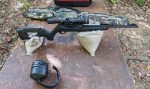 It was a sunny afternoon in early autumn. The temperature was 75 degrees Fahrenheit. A light and variable breeze drifted in from the west.
I set up a target stand in front of the backstop on the improvised range behind my pole barn. I also set up table 25 yards away. A couple of sandbags on the table provided a rest for the rifle.
I loaded a single round of Federal 36-grain copper-plated hollow point and fired. The pleasant scent of burnt gunpowder tickled my nostrils. That first shot hit the ground in front of the target stand, and ricocheted up into the target.
I loaded another round, and aimed at a higher point on the target. The shot hit 16.5 inches below my point of aim. Something was not right.
An examination of the scope revealed that the bell was touching an elevated area at the front of the optics rail. I switched to taller rings, and adjusted the comb accordingly.
The next shot was at approximately the right elevation, but struck 8 inches to the right of the point of aim. Over the course of the next three shots, I gradually walked the shots in toward the center of the target. I then fired a three-shot group that measured 1.41 inches.
I moved the table back to 50 yards from the target. From there, I fired a 1.59 inch three-shot group.
Federal AutoMatch 40 grain LRN produced a 2.03 inch three-shot group. MaxxTech 40 grain LRN produced a 5.53 inch three-shot group that included a failure to feed.
I decided to go back to the Federal ammo. It now produced a 4.47 inch group.
The increasing size of the groups suggested that a screw was loose somewhere: with the scope rings, with the rifle, or with me. I removed the scope and tried a couple of rounds using the fixed sights. Those shots were not on paper. I became frustrated, and decided to call it a day.
Range Session Two
I mounted a UTG SCP-RD40RGW-A red/green dot sight on the KR22 and adjusted the comb accordingly. I already had an identical scope mounted on my Ruger 10/22. I decided to test the two rifles side by side to see if I was just having a bad day during my previous range session or if there was some problem with the KR22.
It was a cloudy afternoon in early autumn. The temperature was 77 degrees Fahrenheit. There was little wind.
I began by firing a single round of Federal 38 grain copper-plated hollow point. Much to my surprise, it struck very close to the point of aim. I then fired two more rounds, producing a 1.16 inch three-shot group.
Next I fired a three-shot group from the 10/22. It was 0.53 inches in size.
I continued this process until I had fired several three-shot groups from each of the rifles. The groups from the KR22 averaged 1.47 inches in size. The groups from the 10/22 averaged 0.51 inches in size. So the 10/22 was more accurate, but the KR22 was accurate enough. There was one failure to feed on the 10/22. The KR22 functioned flawlessly.
The large magazine release lever on the KR22 made mag changes easier and smoother than they were with the 10/22. The integrated adjustable comb was easier to use than the clunky cheek rest that I had crafted for the 10/22.
I then tried a 10 round “mag dump” from the KR22. Everything functioned flawlessly.
Cleaning
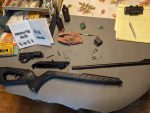 I disassembled the KR22 in accordance with the instructions in the manual. I was surprised by the large amount of polymer that is utilized in the design. Besides the bolt and barrel and the screws that hold it together, almost everything else is made of polymer. I like this in terms of corrosion resistance in comparison with metal and in terms of freedom from swelling in comparison with wood. The jury is still out in terms of durability. I have had my 10/22 for about 50 years now, and it is holding up well. I don’t know how well a KR22 will be holding up 50 years from now.
Conclusions
The TriStar KR22 is a fun little .22LR rifle that offers many attractive features at a budget-friendly price-point. Because of those features, I like it better than any similarly priced option of which I am currently aware. If you are looking for an inexpensive rifle chambered in .22LR for training, pest control, or just for fun, you may want to take a look at the KR22.
Disclaimer
TriStar Arms loaned me a sample of their KR22 rifle for testing and evaluation. I tried not to allow their kindness to interfere with my objectivity in this review, and I believe that I have succeeded. I did not receive any other financial or other inducement to mention any vendor, product, or service in this article.
Read the full article here