
There have been several Pietro Berettas to head the firm, including the 12th generation of the family seen here. He led Beretta from the late 19th century into the 1950s, a period of enormous growth, the devastation of two world wars and the subsequent reconstruction.
Anyone remember American Rifleman’s article from March 1980 hailing Beretta’s big 300th anniversary? (Not a typo.) In part, it featured family member Ugo Gussalli Beretta, who in the years since went from general manager to CEO to chairman of the board. For now, let’s just say the changes that occurred under his watch were astounding (details to come) and the most surprising, the one that rewrote history, happened first. Shortly after that issue was mailed, the State Archive of Venice coughed up a blockbuster: A handwritten brief dated 3 October 1526 recording the payment of 296 ducati to Maestro Bartolomeo Beretta of the Brescian territory of Gardone for delivery of 185 arquebus barrels to the Venetian Republic arsenal. Until that reveal, no one knew exactly how old Beretta was, and in a sense that’s still the case. But, history of this magnitude hinges on hard evidence, and this invoice, as Beretta calls it, is as ironclad as those long-ago barrels. So, we say congratulations again to the Beretta family and their employees, this time for making great guns without interruption for half a millennium.
The Beretta family’s firearm genius was in no small measure destined by birth in Italy’s Val Trompia, a mountain valley rich in iron-ore deposits ideal for making arms and armor. For millennia, resident armorers outfitted Roman legionnaires, medieval knights and crusaders bound for the Holy Land with swords, helmets, shields and more. The coming of gunpowder gave rise to barrelsmithing, a specialized trade that became near-exclusive to Beretta’s hometown, Gardone. For more than five centuries, an unbroken hereditary line of Beretta sons has tended the business. Now retired, Ugo represents the 14th generation; his sons, Pietro Gussalli Beretta, President/CEO of Beretta Holding, and Franco Gussalli Beretta, President/CEO of Italy-based Fabbrica d’Armi Pietro Beretta, are the 15th; Ugo’s grandchildren, Carlo and Marie Teresa, are in line to become the 16th generation. Many historians believe Beretta is not only the world’s oldest gun manufacturer, but also the oldest family business.
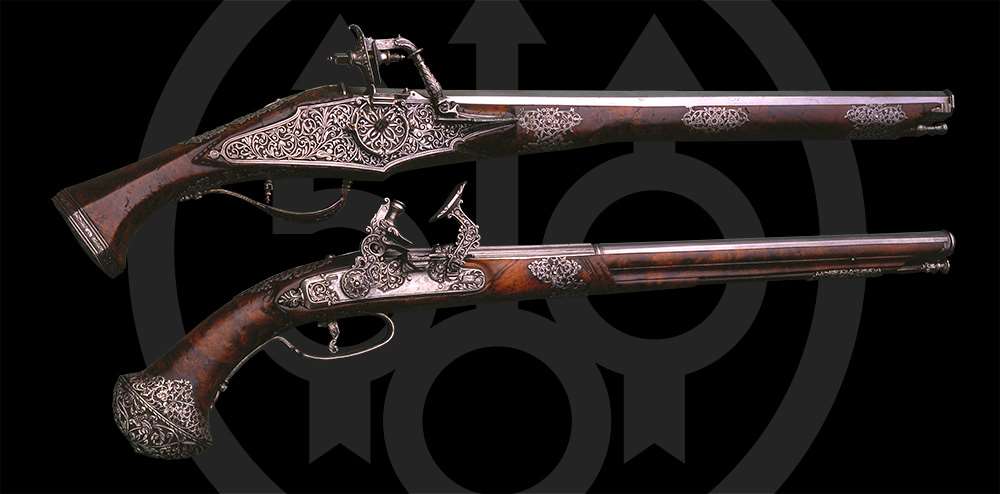
The two oldest known surviving Beretta pistols date from the 17th and 18th centuries, respectively, and are emblematic of the company’s 500-year commitment to building innovative, reliable, beautiful and timeless firearms.
“Our history is not something we simply preserve. It is something we build on and renew every day,” says Franco Gussalli Beretta. “There is a natural tendency to look at a company with five centuries behind it and assume that continuity comes easily.
In fact, the opposite is true. Continuity demands discipline, a strong sense of responsibility and a constant commitment from one generation to the next. However, Beretta is not defined by its past alone. Its identity lies in the balance between deep roots and a clear vision for the future. We are a manufacturing company built on people, quality and responsibility, while continuing to evolve through innovation and technology. To understand this balance is to understand the true essence of Beretta.”
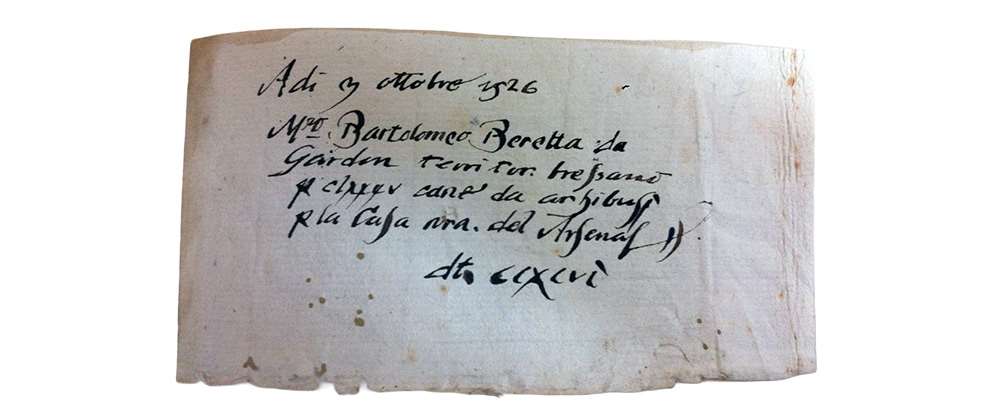
The first evidence of Beretta’s existence is this purchase order from the Serene Republic of Venice dated 1526.
While the early history is sketchy, Beretta highlights are a focal point of the 1980 hardcover, “Beretta: The World’s Oldest Industrial Dynasty,” by military arms scholars Marco Morin and Robert Held. For such as the aforementioned arquebuses, the authors trace some 15 steps from mining and refining the ore, to final bore straightening and polishing to fitting locks and other hardware. “The phase most vital” state Morin and Held, “carried out by the true and proper maestri da canne … was to wrap the red-hot [iron] plates around a cylindrical steel mandrel and to lap-weld the resulting tubes by anvil forging along their entire lengths. This organisation, [the] half-industrial, half-artisan transformation of gritty minerals into gun barrels prized everywhere for their perfection … lasted with but slight modifications until the fall of the Venetian Republic in 1797.”
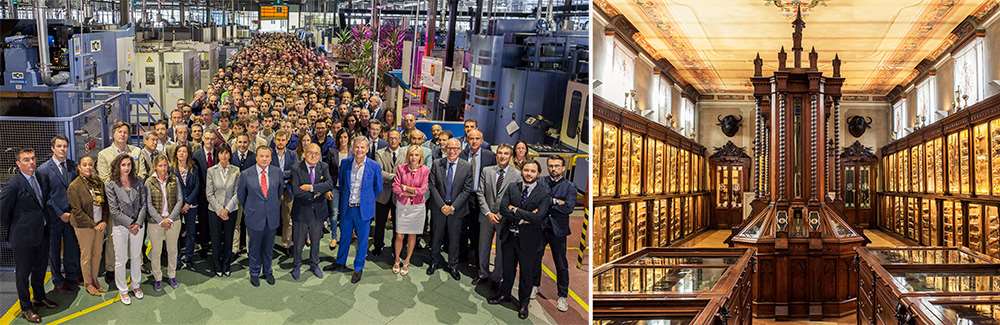
(l.) While still owned by the Beretta family, what was once an artisan shop has grown to a multinational conglomerate with thousands of employees and advanced, modern production facilities. (r.) The ornate gun library at Beretta’s headquarters includes examples of the company’s products spanning centuries.
Forging Ahead
Because of frequent wars, Val Trompian armsmakers were esteemed, but nonetheless governed erratically. Though the ruling senate granted the tradesmen tax breaks and exemptions from compulsory military service, at times it banned the export of unlicensed military barrels and blocked the sale of “all unstocked barrels,” according to firearm guru R.L. Wilson in his “The World of Beretta” (2000). To counter resentment, the authorities brokered contracts with foreign powers, such as a 1544 order from “His Magnificence the ambassador of the most serene King of England” for “1,500 arquebuses and [1,500 suits of] armors.” That monarch was renowned hunter Henry VIII, and so speculation naturally holds that his pursuit of British stags and boar may have included Beretta barrels.
Prosperity spiked in the 1570s, when Venice allied with Spain and the Papal States to defend its island territory of Cyprus from warring Turks. The rectors of Brescia were commanded to arm the Christian forces and expressly required to operate the forges around the clock for nearly three years. At war’s end, a Brescian report to the Senate stated, “[The Gardonese] made as many as [300] arquebuses a day, that is, the barrels with their iron furnishings.”
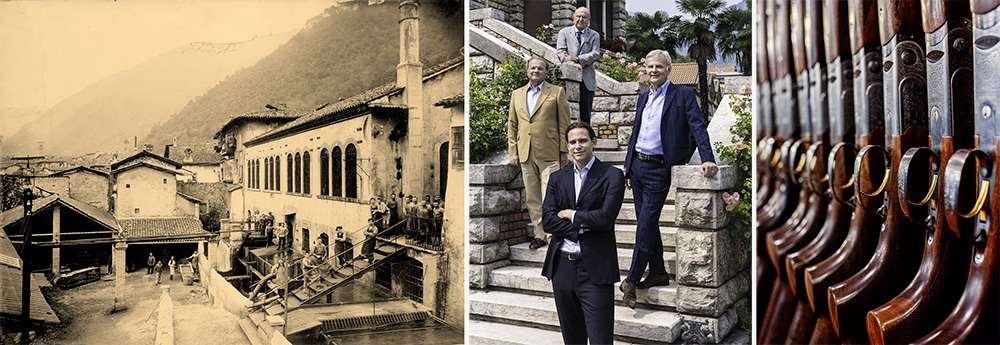
(l.) Gardone Val Trompia has been Beretta’s home for half a millennium. By the 1880s, its factory was fully industrialized, and modernization has never ceased.. (ctr.) Ugo Gussalli Beretta, his sons, Pietro and Franco and grandson Carlo, continue the 500-year legacy of Beretta family ownership (r.) One of Beretta’s more iconic product lines, its shotguns are prized throughout the world for their quality and craftsmanship.
The Beretta workshop was under new management, since Bartolomeo’s death circa 1568 elevated his son Giovannino, aged between 30 and 40 years old, but already a master barrelsmith himself. In fact, an older brother, Lodovico, was likewise accorded master status, but rather than staying in the family business, he moved to Brescia to fabricate locks and other accessories. And so, were barrels from the historic forge finished with parts produced by a brother? Could this herald the very first all-Beretta guns? Perhaps not, though there’s no overlooking an historic dynasty in the making.
The demands faced then, however, are not entirely different than today’s, according to Franco Gussalli Beretta: “Producing those early barrels required more than technical skill alone. From the very beginning, Beretta’s work was founded on craftsmanship, discipline and an exceptional level of manual expertise. It also demanded consistency, precision and reliability—qualities that have
remained at the heart of the company throughout its history. In this respect, although the tools and technologies have changed beyond recognition, the fundamental challenge remains much the same: achieving precision and repeatability with the resources available. Today, advanced technologies and control systems allow us to manage and monitor every stage of that process. In the 16th century, the same result depended almost entirely on the experience, judgment and skill of the individual craftsman.”
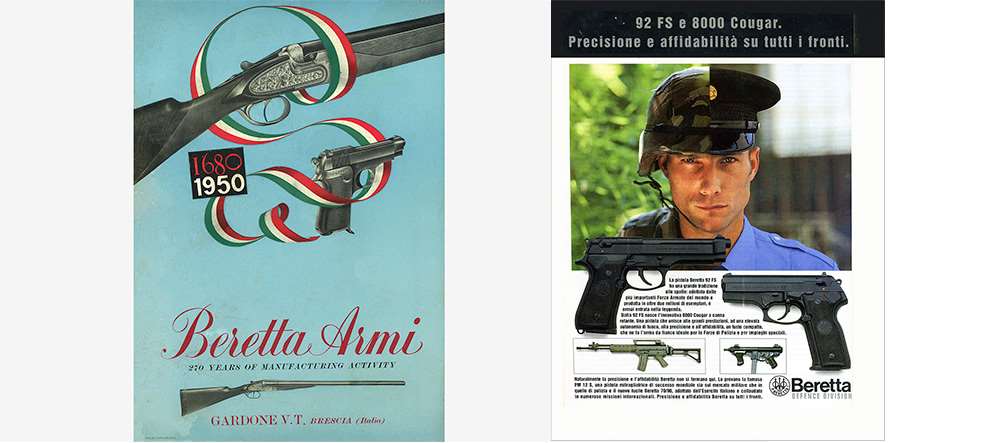
The 20th century saw rapid growth of both Beretta’s commercial business and its military sales, as evidenced by these advertisements.
Renaissance
The 1600s ushered in successors to traditional matchlock arquebuses. Shoulder-fired moschetti (muskets) and heavy-barreled, large-bore arms were built to handle greater muzzle energy generated by increasing projectile weight over larger powder charges to maintain velocity. Though intended for one-man operation, optimally such shoulder cannons required a forked rest to aid firing. A Venetian order specified barrels must have reinforced breech halves before tapering to the muzzle. Much lighter were cavalry muskets or carbines fitted with barrels a bit longer than 20 inches, plus pistols downsized to .55 caliber with barrels measuring about 10 inches. After 1625, wheellocks were commonly used on lightweight arms. From the 1680s onward, small arms were increasingly equipped with flintlocks, which would remain for more than 150 years. An accounting from 1698 showed that Gardone’s 33 chief masters had produced 21,930 long barrels and 1,136 pistol barrels. Beretta’s output of 2,883 made it the second-most prolific on the list, according to Morin/Held.
The ballistic advances were actually surpassed by another aspect of gunmaking. During the height of the Renaissance, firearms ornamentation became an increasingly elaborate art form, and that was certainly the case in Brescia. Rather than the engraving we prize today, lockplates, grips and butt collars were fashioned from so-called iron lace—compositions of hundreds of intricate piercings created by tiny wire saws and needle files for seamless mounting into stock inlets. Among other enhancements were diminutive figures sculpted into hammers, ramrod guides and trigger guards, as well as stocks carved from highly figured Italian walnut root wood.
Masterworks fitted with Beretta-marked barrels can be found in present-day museums, a heritage that allows us to better appreciate Beretta’s zeal for finely adorned firearms. For decades, its engraving studios have been cherished not only for the art they create, but also for training top engravers who go on to work elsewhere. No other major gun manufacturer is in Beretta’s league in this area.

At PB Custom Atelier, Beretta’s in-house custom shop, customers can order handmade stocks and hand-engraved metalwork, all produced by master artisans who spend hundreds of hours working on a single firearm • Gold inlay, intricate hand-engraving and custom designs are all options for the discerning Beretta customer • Beretta shotguns also have an outstanding reputation for performance and reliability in hunting fields and blinds.
Though Beretta had both prospered and survived trying times for more than 300 years, it was about to face a turning point. In 1797, Napoleon Bonaparte marched his army east on a mission of conquest, and when the once-proud Venetian Republic capitulated without a fight, Val Trompia’s armsmakers no longer answered to a senate that for centuries had encouraged their genius, bought their products, regulated their industry and taxed the proceeds. Here was a new ruler who desperately needed what they could supply. That demand continued for years, even after the entire region was sold to the Austrians, according to Wilson.
Industrial Revolution
In the wake of Europe’s Industrial Revolution, the father/son duo of Pietro and Giuseppe Beretta, respectively ninth and 10th in the family line of succession, proved themselves savvy entrepreneurs and forward-thinkers. Correspondence details that both men frequently traveled to meet with exporters, brokers and shopkeepers, clearly determined to grow business to civilian customers. Fittingly, the firm was formally christened Fabbrica d’Armi Pietro Beretta, a name long since stamped into gun metal and printed on catalogs.
Just 13 when his father died in 1853, Giuseppe’s delayed tenure soon bore fruit. Along with his penchant for traveling to buoy the sales network he’d inherited, the mid-century boss greatly modernized manufacturing capabilities to the point where Beretta was producing rifles, pistols, revolvers and shotguns, and it strived to fabricate the necessary components in-house. Production boomed from around 300 guns annually during the 1850s to more than 7,500 by the 1880s. Under Pietro’s watch, the factory had moved from flintlock to caplock ignition, but in just a few decades, it leaped to mass production of breechloading centerfires. In an 1876 letter to the newspaper La Borsa, Giuseppe Beretta bragged, “This firm alone possesses the remarkable capability of total production … and sends out finished guns, which are sold not only in Italy, but also abroad …where they are much sought after for their quality and safety.”
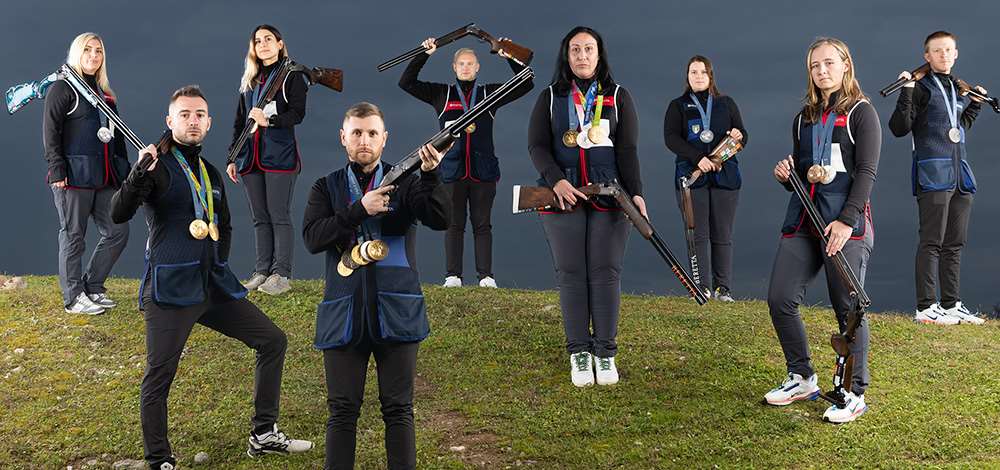
Beretta shotguns have dominated the Olympic Games, including helping its sponsored athletes win 14 of 15 available medals at the 2024 Summer Olympiad in Paris
The next president, Giuseppe’s eldest son, (also) Pietro Beretta, furthered his forefathers’ accomplishments well into the 1950s, capping a three-generational run that spanned nearly a century and a half. Priorities shifted from exposed-hammer models to modern designs like bolt-action Vetterli and Carcano rifles, as well as handguns like the Model 1889 Bodeo revolver. As the machinery needed to drive the rapidly enlarging facilities and workforce often had to be improvised in-house, the 20th-century maestro deftly tackled the design and integration of new tooling. Even so, Pietro Beretta’s foremost engineering feat was the creation of hydroelectric plants, a new way to harness the valley’s Mella River, which for a millennium had powered the forges’ massive bellows.
World Wars
The progress soon slowed, however, as war clouds altered European gun concerns. To keep its factory busy as sporting sales
cratered, Beretta took on contract work to supply barrels and parts for Fiat 1914 and Villar Perosa machine guns, among others. Production resumed on Carcano Model 91 TS carbines for the Italian army, and it remained a Beretta standby through both world wars.
More importantly, unfilled demand for service pistols led to development of the long-lived Model 1915. Sized between existing pocket pistols and duty guns like the American M1911 or German P08, the semi-automatic chambered in 9 mm Glisenti and 7.65 mm/.32 ACP was reliable due in part to its open slide, and for its time, it boasted a fast lock time. By war’s end, production topped 4,200 pistols per month, and for years to come, derivative models possessed Model 1915 characteristics. One was the Model 1934, which in 1935 was adopted as the longtime Italian army standard-issue pistol. As with many of its service sidearms, the Model 1934 was widely used by various armies fighting in Italy, thereby spreading awareness of Italian workmanship.
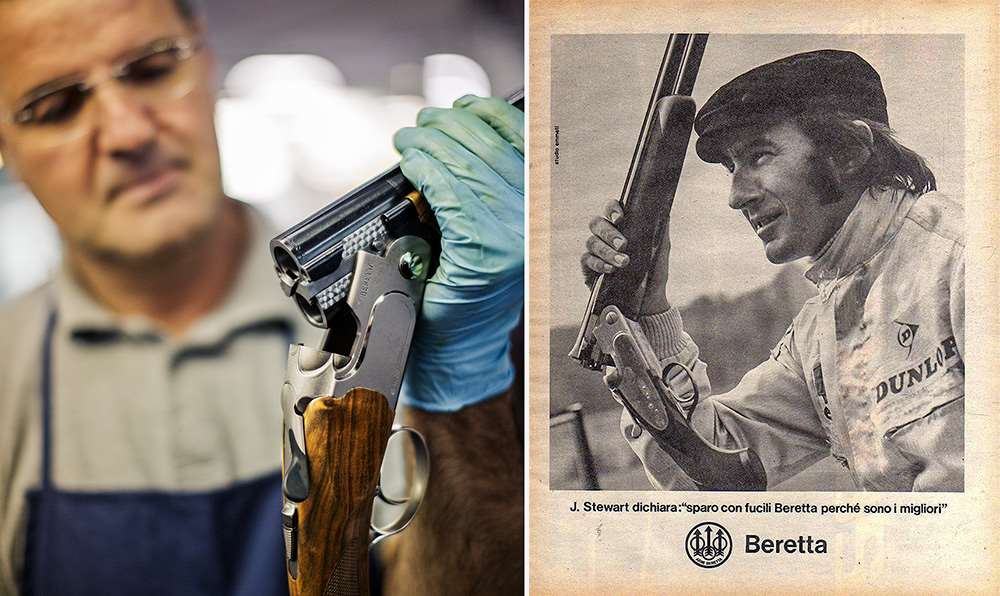
(l.) Part of the reason for that Olympic success comes from the craftsmen who build the guns. The company has a highly skilled labor force and uses the latest technology to build some of the finest shotguns in the world. (r.) Competitive shotgunning has long been a focus for Beretta, both as a statement of the company’s commitment to supporting the shooting sports and to help showcase its products’ performance capabilities.
While wartime production went out to all Axis powers, it’s also true that Beretta lashed back at the Nazi command, which occupied company plants as well as the family home after the fall of the Italian regime in 1943. Reportedly, the Germans suspected Pietro and sons Carlo and Giuseppe of diverting guns to partisan fighters but needed the men present to keep things running. After heavy aerial bombing in Brescia, employees prevailed on Carlo to halt work for a day so they could check on family. For doing so, he was jailed by the SS for two weeks, though he ultimately returned to the plant under constant watch. In late April 1945, as fighting wound down, Pietro Beretta, age 75, was held as a hostage before local partisans fought and took German prisoners to win his release. Though Beretta facilities were heavily damaged, the family and workers rallied to resume production late that year.
Following World War II, Beretta imports started trickling into the U.S. Early examples include military-surplus guns like the Carcano and Model 1934 pistol, which eventually gave way to Cold War arms like the Model 51 duty handgun, the firm’s first firearm chambered in 9 mm, along with the Model 12 submachine gun, which attracted a cult following despite restricted availability to civilians. The 1960s also brought the BM59, in essence the M1 Garand converted to shoot 7.62 NATO ammo. Beretta also made it more compact and gave it a detachable box magazine, creating a package that World War II authority Martin K.A. Morgan said, “… made a bit of a splash on the civilian market here in the U.S.” And then he doubled-down, lauding “… the sheer engineering prowess of [Beretta engineers] who took John Garand’s magnum opus and made it better.”
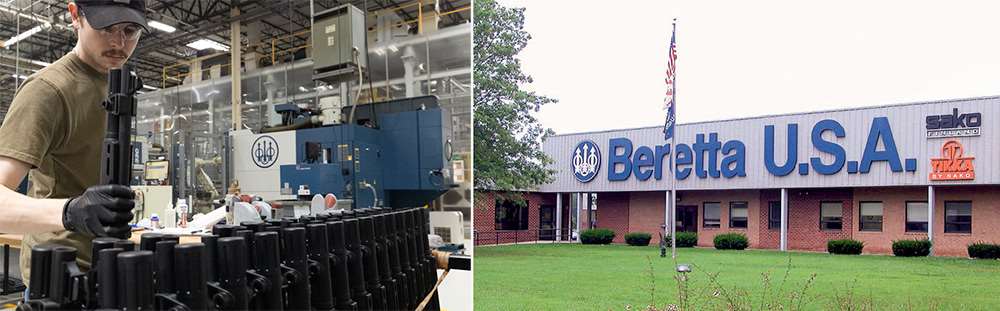
(l.) In 1977, the Italian firm acquired a manufacturing facility in Accokeek, Md., and has since opened a larger factory in Gallatin, Tenn. (r.) Beretta USA builds many of the brand’s iconic guns sold in North America.
Sporting guns likewise grabbed attention, especially in trap and skeet leagues springing up across the U.S. More than any other maker, Beretta capitalized as over-under shotguns surpassed the popularity of the iconic side-by-side. Starting with its S1 model in the early 1930s, the Italians diligently refined a template featuring a low-seated receiver so adept at managing recoil geometry that it eased follow-up shots.
A century later, the upper-crust SO sidelock series remains an aspirational fixture, but it fortuitously spawned the wildly successful boxlock 680 family, which balances brilliant handling and performance with relative affordability. Since its introduction in the 1980s, price points across innumerable 680/682/686/687 iterations have ranged from the high three figures to well over five. Field gunners who prefer a double can—and often do—take advantage. For scale, Morin/Held wrote that “the name Beretta is as synonymous with [over-under] as Colt is with revolver and Winchester is with lever-action.” That was 46 years ago, but it hasn’t changed.
Global Economy
Since 1995, the Beretta Holding superstructure, while remaining true to its small-town, family roots, has assembled an A-list roster. Under now-retired Ugo Gussalli Beretta and CEO sons Pietro and Franco, the diversified holdings connect a constellation of famous shooting brands to namesake couture and retail galleries in key cities. In nearly every popular category, the arms portfolio is competitive, if not dominant.
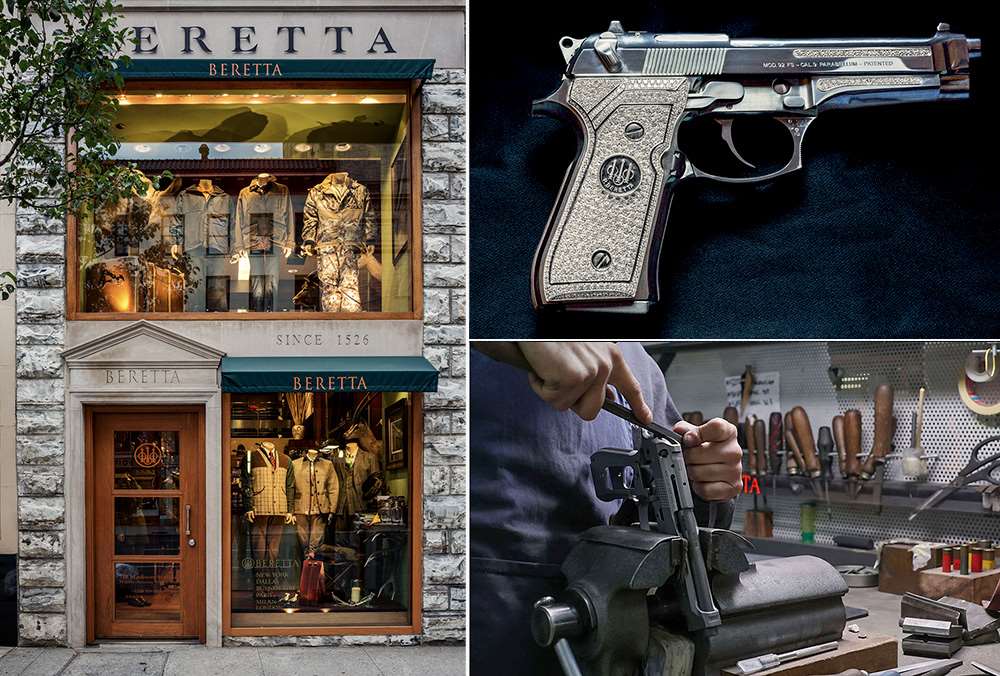
(l.) Beretta Galleries in London, Paris, Dallas and on Madison Avenue in Manhattan offer a refined retail experience reflecting the company’s style and heritage. (top r.) Beretta handguns can also receive the custom treatment, as seen on this Model 92FS (btm. r.) Hand-fitting and finishing are key components of Beretta’s custom guns.
The rise traces back to a 1977 decision to manufacture Berettas in the U.S. Upon acquisition of the former Firearms International Industries gun factory in Accokeek, Md., a new-world “forge” fired up to produce the M950 semi-automatic handgun. Such small-framed “pocket” pistols had been banned from importation by the 1968 Gun Control Act, and though free to market their successful shotguns and other sporting designs, the Italians would not be denied full access to the world’s biggest firearm marketplace. American shooters would soon “discover” the age-old brand stamped “Made in USA.”
But, that was just a warm-up to the “hello, America” message that really drove Ugo Gussalli Beretta. It was not mere coincidence that the Defense Department would soon conduct trials for a new service handgun to replace the revered M1911. In hindsight, it appears preordained that the plum contract would not go to a domestic legacy maker, but for many 1980s gun geeks, such a turn was unthinkable. Backing the practical merits of its proven Model 92SB-F, the hole card was Beretta USA’s growing facility 23 miles from the Pentagon. And we all know the rest of the story behind the M9’s service across all branches of our Armed Forces for an enlistment that stretched 30-some years. Sure, there was griping: “not a 1911, not a .45, not what won us two World Wars!” Eventually soldiers would set the record straight—the M9 was a smooth shooter, trainee-friendly, reliable and after tweaks, increasingly earned its battlefield stripes in Iraq and Afghanistan.
The Sixth Century
Across 30-plus years, U.S. military contracts for the M9 called for delivery of more than a half-million handguns. Just the proof-testing alone was a titanic chore, not to mention everything else—material handling, machining, assembly, finishing, in-spection, packing. And while all that occurred as specified by Fabbrica d’Armi Pietro Beretta in Italy and Beretta USA, the newly established Beretta Holding kicked every other task into a higher gear.
The creation of Beretta Holding marked a new chapter, bringing together the Beretta family’s businesses under a single corporate structure and laying the foundation for one of the industry’s broadest portfolios. From its headquarters in Luxembourg, CEO Pietro Gussalli Beretta and his team have engineered growth whose compound stature exceeds balance-sheet numbers. Beyond “big and bold,” the whole thing defies summation. A giant acquisition, say Europe’s Ammotec, loading around 1 million rounds daily, is balanced by a prestige pickup like the Britain’s Holland & Holland, whose artisans hand-build 50 guns a year.
And now it has put down more roots—a Beretta factory in Gallatin, Tenn. (2016), and a Norma ammunition plant near Savannah, Ga. (2022)—resulting in hundreds of coveted American jobs welcomed by pro-gun, pro-business governors in those states. That comes in contrast to Maryland’s stifling anti-gun climate, where ill-conceived legislation blindsided established practices. Clearly Beretta Holding is here to stay, and it understands where to find the needed stability.
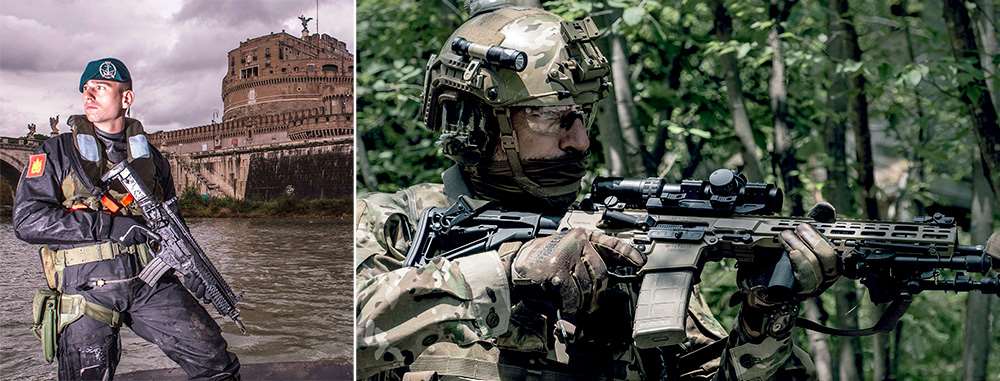
Beretta is a global leader in military small arms manufacture, with guns like the modular ARX160 and the new NARP seeing service with multiple armies.
“We have something that others don’t, and that they’ll never have: a single family owner,” Pietro Gussalli Beretta told Forbes magazine. “When we need to deal with foreign governments, it’s me or my brother meeting the president. That’s not the case with other businesses. We have a long-term vision that isn’t speculative.”
As this was written, huge news broke announcing formal ties between Beretta Holding and Ruger. An AmericanRifleman.org report explained what led to discussions and the subsequent agreement and shared optimistic quotes from leaders at both companies. At this point, no information has been released regarding joint efforts in product design and manufacture, cooperative operations or other corporate synergy. We will keep watch.
Mind-boggling as the pending alliance may be, what we do know at present is that Beretta Holding’s global reach includes manufacturing, administrative and sales operations and employees in 50 countries, generating more than $1.9 billion in annual revenue. Purchases here in the U.S. absorb nearly 40 percent of Beretta Holding’s annual firearms output. The scope is vast, especially when you can track it back to a known craftsman working at a small forge hammering red-hot iron sheets into gun barrels. We don’t dismiss concerns about consolidation, but the number of gun-manufacturer startups remains as strong or stronger than any time in the past 50 years. Again, it bears watching.
Why it’s important and beneficial to American gun owners is that the clout of companies as big as Beretta Holding and Ruger makes them critical allies in NRA’s mission to preserve individual freedoms for now and for tomorrow.
Time for Fireworks: America at 250 Salutes Beretta at 500
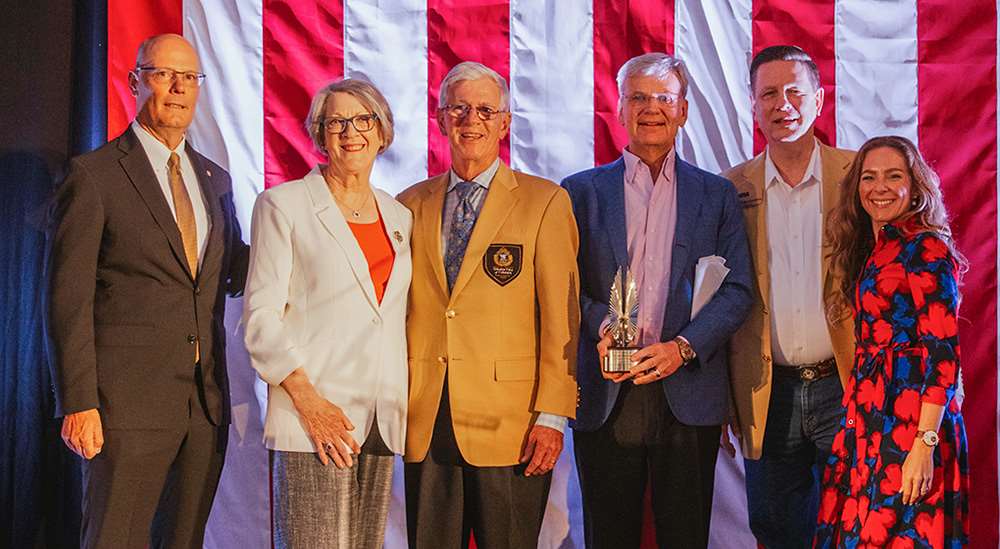
Since launching U.S. operations, Beretta et al. have been industry champions in support of shooting, hunting and conservation and firearm training. NRA has prominently received funding for political action and litigation, as well as youth programs, hunting and conservation activities and the National Firearms Museum. Accordingly, NRA leaders have praised Beretta’s timely and strategic commitments to preserving American rights. At the 2026 NRA Annual Meetings and Exhibits in Houston, Franco Gussalli Beretta, president and CEO of Fabbrica d’Armi Pietro Beretta, was presented with the 2026 NRA Defender of Freedom Award, one of the Association’s highest honors recognizing individuals whose extraordinary efforts help preserve the fundamental freedoms upon which the U.S. was built. That meaningful salute to Beretta’s epic quincentennial came on behalf of all NRA members and like-minded Americans. It is time to celebrate.
Read the full article here