


Carrying a handgun requires careful consideration, as there are several types of threats that you can encounter. While we often spend dozens of hours thinking about the firearm itself, but quite often, little thought is put into the ammunition that we load into that firearm. Most of us chose options that defend against a human threat. While this is certainly prudent, for those of us who are more isolated, or for the times that we find ourselves enjoying the great outdoors, there are options for defending against the rest of the animal kingdom. Venomous snakes rise to the top of the list, as nearly every state in the union is home to some. The best medicine for these serpents has always been a handgun cartridge loaded with a small dose of lead birdshot. Of course, resorting to cartridges like this comes with a few tradeoffs, with the most obvious being their inability to defend against anything much larger.
Seeing this issue, DoubleTap Ammunition introduced a line of revolver loads built for snake defense, but the company also added a prominent lead slug in addition to the shot. This created a product that is suitable for multiple types of threats, just so long as you were OK with carrying a wheelgun or derringer. Surprisingly, nobody ever trademarked the phrase “Snake Shot,” so DoubleTap scooped it up and used it to name its new product. Being that most folks these days prefer to carry a semi-automatic pistol over a revolver, the company quickly worked on making loads designed to work reliably in those platforms. Released earlier this year, SnakeShot Defense promises the same multiple-projectile performance that will reliably cycle semi-automatics, making them the first of their kind.
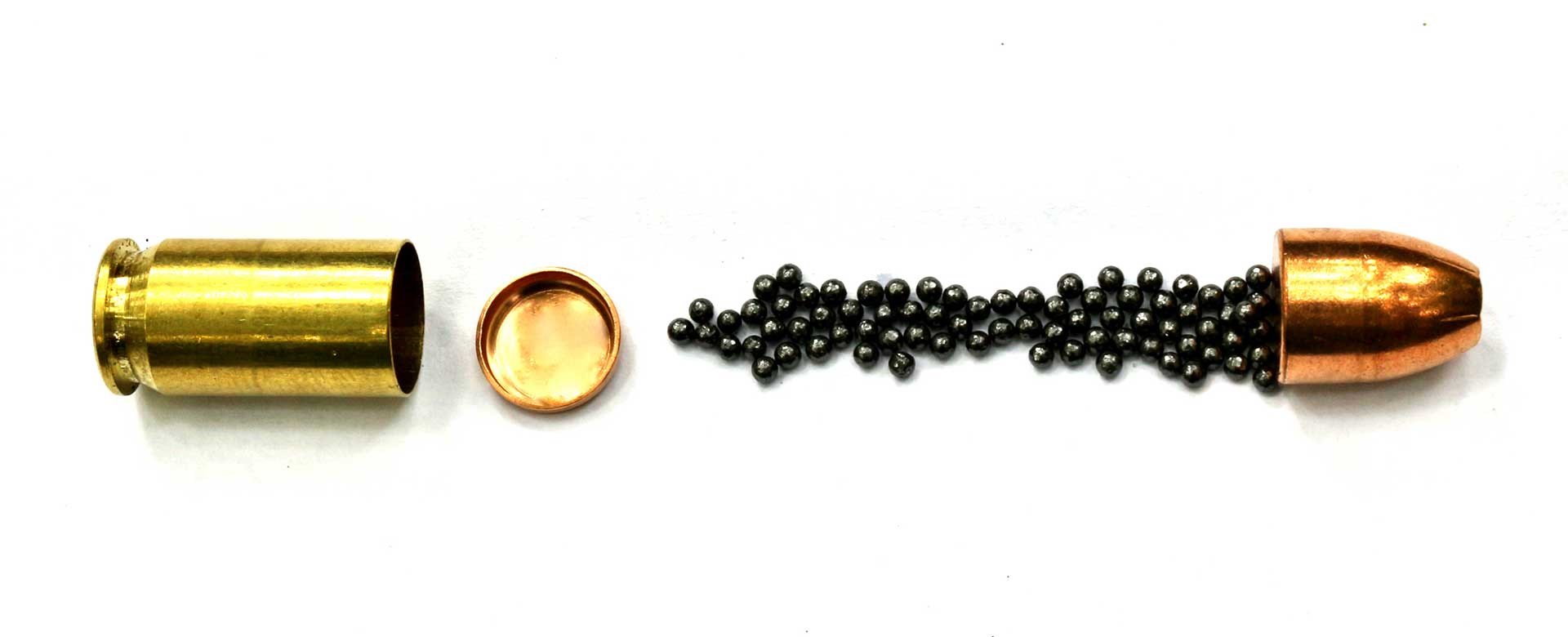
SnakeShot Defense is currently available in 9 mm, 10 mm Auto and .45 ACP +P and carries a price tag of $30 per 20-round box, regardless of chambering. Each load is built with a light-for-caliber hollow-point bullet, which is precisely what generates the pressure needed to cycle semi-automatic actions. Further, being that it is shorter than the usual bullets loaded into these cartridges, it leaves room for as many as 140 pieces of No. 9 shot. Separating the payload from the powder charge is a copper wad, which is essentially a repurposed gas check. This also leaves the muzzle with enough speed to thwart an attacker. As none of these components are built for excessive penetration, this load is an excellent choice for home defense as well, removing yet another layer of give-and-take. With the array of benefits presented in this new ammunition offering, I was eager to get these loads to the firing line. Luckily, samples were waiting for me, and all I needed to do was clear my schedule for a little well-anticipated range time.
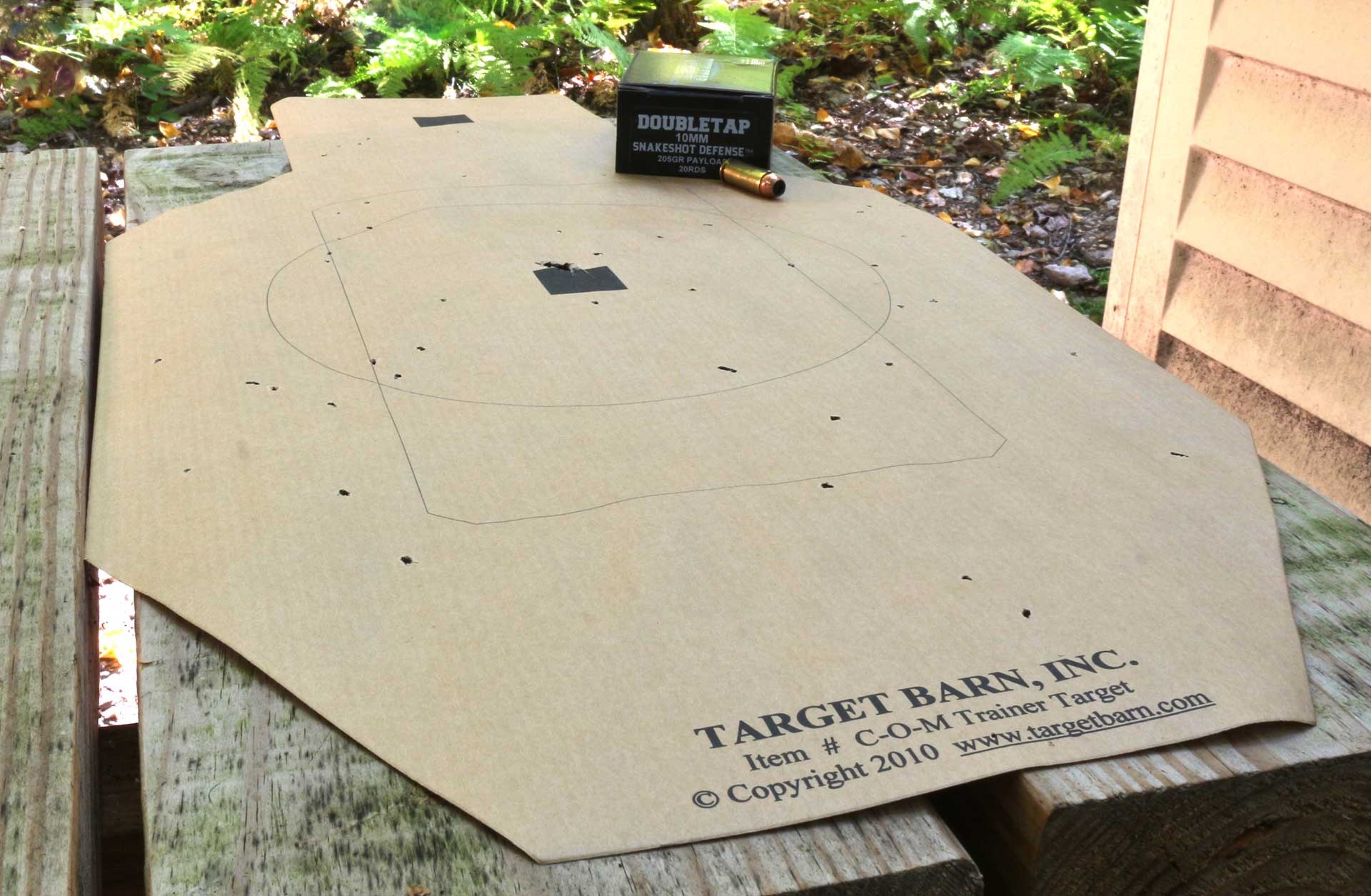
Testing this ammunition was going to be touch different from the standard American Rifleman protocol, as these rounds are anything but standard. In the spirit of self-defense, I chose a 7-yard test distance, which was mainly to see if the bullets would be thrown off course by the birdshot and copper wad pushing them down the barrel. Understanding that snake encounters are often much closer than this, I supplemented it with a 3-yard target to help display a more realistic pattern. The target of choice for this test was Target Barn’s C-O-M Trainer. Intended as a repair center, this 12-inch x 24-inch target provides both the IPSC A-Zone as well as the 8-inch IDPA -0 scoring area. In the center is a 1-inch aiming square, giving me everything I need to test both projectiles simultaneously.
I decided on test guns that fell in between full-size and micro-compact to achieve more balanced test results. For the 9 mm, I went with a 3.9-inch-barreled AMP from Live Free Armory. For the 10 mm, I chose an FK BRNO PSD-C with a 4.25-inch barrel, and to sling the .45 ACP, I chose a Tisas commander-size M1911 with a barrel of the same length. The only other piece of test equipment I needed was a chronograph, to which I turned to a Garmin Xero for its uncanny ability to read multiple-projectile loads.
I began the day by firing the 9 mm at 7 yards. This load contains a 145-grain payload consisting of a 95-grain jacketed hollow point and 100 shot pellets. Registering an average speed of 969 feet per second, that equates to 302 foot-pounds of muzzle energy, proving that this is no gimmick. At this distance, few if any pellets hit the target; however, the bullet faithfully landed within three inches of my point of aim. In most cases, the copper wad landed right beside it. Moving to 3 yards did not change things with these components, but it did dramatically tighten up the pattern. On average, 12 pellets landed within the central circle, and 36 out of the 100 landed somewhere on the target. Given this is the smallest of the cartridges, I found this performance plenty adequate and moved on to the larger offerings.
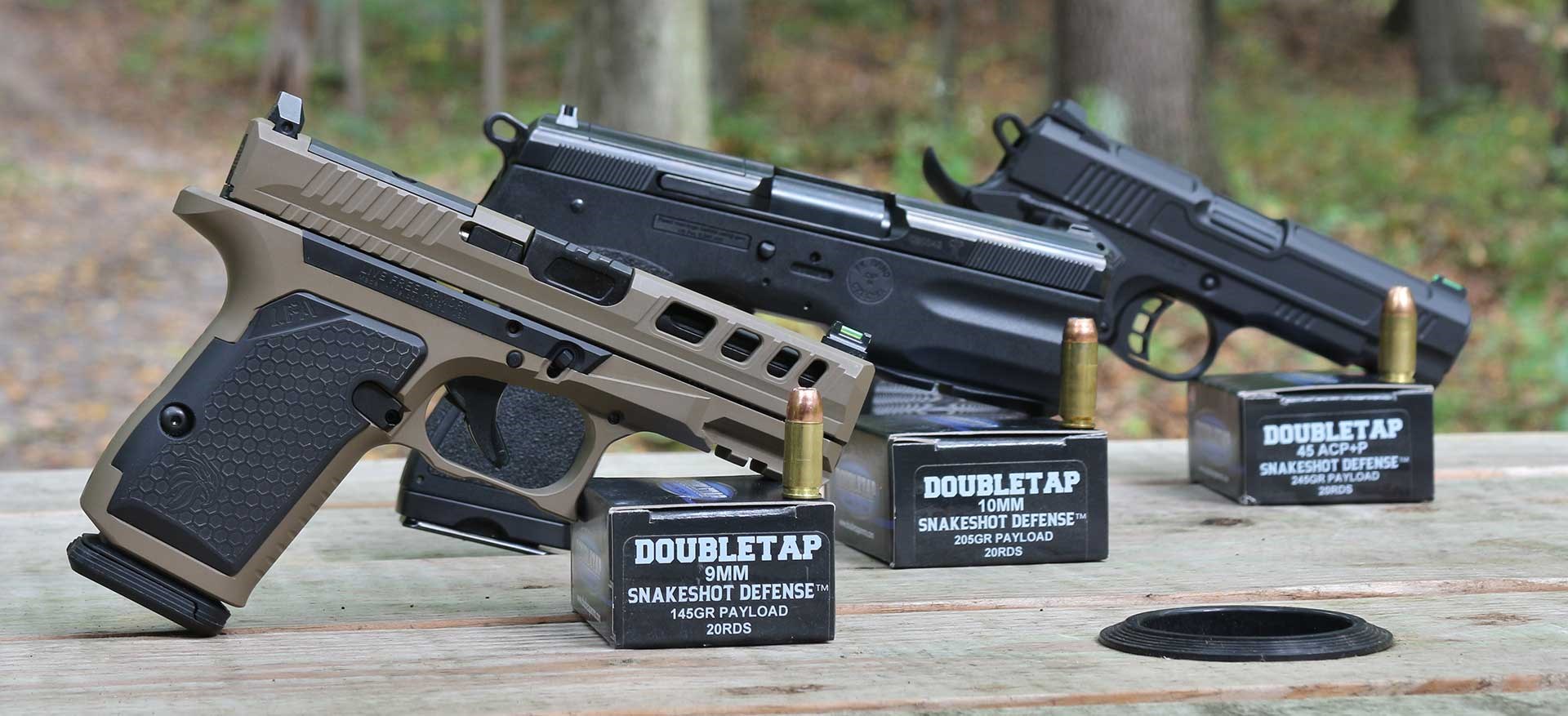
Resetting the target at 7 yards, I proceeded to fire the 10 mm Auto. The 205-grain payload left the muzzle at an average of 991 feet per second and generated 456 foot-pounds of punch. The performance from the 205-grain JHP main projectile was exceptional, cutting the central square nearly every time, with the copper wad landing just an inch or two from it. On average, 6 of the 140 pellets landed within the central circle, with around 13 hitting the target overall. Bringing things into 3 yards was eye-opening, as the bullet and wad landed nearly on top of each other. The average pellet count on target was 55, with a mean of 15 landing inside the circle. This ought to do on targets such as bobcats or raccoons, while likely still putting enough lead on a snake to change its mind.
Last up was the venerable .45 ACP. With its total payload of 245 grains in front of a generous powder charge, it neatly earns the +P classification. This is comprised of a relatively common 185-grain JHP bullet and 120 pieces of shot. Out of my commander-length pistol, it reached an average speed of 797 feet per second, which equates to 345 foot-pounds of kinetic energy. Like the others, the main projectile flew straight and landed where intended, but the wad seemed to wander off the 7-yard target. This is likely due to its larger diameter, which takes it a few steps further from a sphere and makes it more of a tumbling Frisbee. On the bright side, plenty of pellets hit the target, averaging 15 per shot. Of these, an average of 8 landed within the circle, which should do the trick on larger threats. At 3 yards, things were predictable, even better with a total average pellet count of 41, with 11 falling into the center circle. Additionally, at this distance, more wads than not landed somewhere on the target, putting more of the muzzle energy to work.
My final synopsis of DoubleTap SnakeShot Defense can be summed up in two words: Why not? Whenever I’m confronted with unorthodox self-defense loads, my first thought is how they measure up to conventional ammo. In this case, this is conventional ammo, just with a birdshot bonus. If we focus our attention on the performance of the main projectiles, they flew straight and were fast and heavy enough to address a human threat, the same as any other. Most importantly, the loads all cycled with impunity, which was a first for me when it comes to pistol ammo that contains birdshot.
As for the shot itself, yes, I would have liked to see more pellets in the 8-inch circle, but we have to remember even the largest dose of 140 pieces isn’t very many to begin with, so having enough to be adequate shows me that the manufacturer understands how to balance available cartridge space. Remember, to get more shot in each round, they’d have to reduce the powder charge or trim back the main bullet, both of which can negatively affect cycling or penetration.
Overall, I believe this to be a fine product, particularly if you are exploring the woods and want a method of defending against two-legged predators in addition to other members of the animal kingdom. Above all, it eliminates much of the thought process that comes with selecting carry fodder, leaving your mind free to wander a bit as well. For more information, visit DoubleTap Ammunition’s website here.
Read the full article here