


American firearm enthusiasts are pretty lucky. We’re a big enough market that, for most international gun companies, it’s worth the effort to sell their products here. And despite the restrictions we have on our freedoms, those manufacturers can offer a wider variety of their firearms in the U.S. than most anywhere else in the world. One notable exception to this reality is the absence of the Heckler & Koch G36 on the U.S. civilian market, but H&K is doing its best to change this—with a rimfire G36 we can own now and the hopes of a centerfire G36 in the future.
At first glance, the H&K G36 .22 LR is just another black polymer “tactical rimfire” and, unlike the numerous rimfire AR-15s on the market, one whose form most Americans aren’t familiar with. That form is significant, however, and to understand why, you first need to know the history of its centerfire big brother.
When the Bundeswehr adopted the rifle it would designate the Gewehr 36, or “G36,” in 1997, it was not only a vastly different rifle from the Cold War-era G3 it replaced, but also a radical departure from designer H&K’s tried-and-true, roller-delayed-blowback action and stamped-steel firearms. It took many features from H&K’s revolutionary G11 caseless-ammunition rifle, including its extensive use of glass-fiber-reinforced polymer and its integrated optical sight. Polymer was used for G36 parts like the receiver (with a steel trunnion and reinforcing inserts) and components in the fire-control group, resulting in a significant cost and weight savings. Not having iron sights, the G36 had a 3.5X optic with a red-dot sight mounted above it, both integrated into the carry handle.
Firing 5.56 NATO, internally the G36 used a multi-lug, rotating bolt that rode in a square carrier and a short-stroke, gas-piston operating system. It fed from proprietary magazines made of translucent polymer that were released by a paddle behind the mag well.
Visually, the G36 .22 LR is a relatively faithful facsimile of its centerfire inspiration. The first effort to import a G36-pattern rifle was the SL8, which included, among other departures, a gray thumbhole stock to satisfy both export and import restrictions. The G36 was adopted by the German military, but eventually replaced by the HK416. The G36 .22 LR’s stock folds to the right. Beneath the stock, pins can be removed for disassembly, though this is not needed for standard takedown for cleaning. The U.S. Army considered the G36-inspired XM8 to replace the M4 family.
In 2022, the G36 was replaced in German service by the G95K, a variant of the HK416. During its 25 years of service, it also became popular with special-operations groups and law-enforcement agencies around the world. It even nearly became a U.S. service rifle, when its design was used as a component of the XM29 Objective Individual Combat Weapon (OICW), and later as the basis of the standalone XM8 rifle, neither of which ended up being adopted by the U.S. Military.
Despite its popularity, G36-type rifles have been elusive on the U.S. civilian market. All jokes aside, H&K really doesn’t hate its civilian customers. The company is just stuck between a rock and a hard place, a.k.a. the German and U.S. governments. With its home country limiting what it can export and our own government restricting what can be imported, H&K is forced to jump its products through numerous hoops before they can be sold to us.
One year after Germany adopted the G36, H&K introduced the SL8. Using the basic operating system of the G36, but in semi-automatic-only form, the SL8 was modified to be sold in civilian markets around the world so it could be imported into the U.S. as a complete, factory-built rifle.
The original SL8-1 variant was imported into the U.S. from 1998 to 2004 and again from 2006 through 2008. In 2021, the company re-introduced the model as the SL8-6. This version uses black polymer throughout its construction and has a G36-type carry handle rail with no iron sights. It is currently discontinued from HK USA’s catalog.
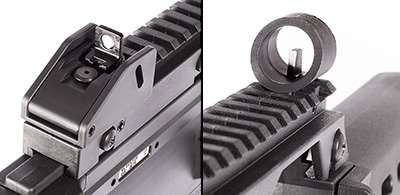
The hooded front post is typical of H&K rifles, but a departure from the original G36. The flippable rear sight consists of an aperture for speed and a notch for greater precision.
Heckler & Koch fans went to great lengths to make the SL8 into a “true” G36. Elaborate conversions involved cutting the original receiver and grafting in portions of a salvaged G36 receiver from a surplus parts kit, modifying the magazine well and even re-dying gray parts black. While the results are impressive, they are out of the price range of the average firearm enthusiast. In 2013, H&K announced the HK243, a significant re-design of the G36 to make a semi-automatic-only rifle for the European market. A model for the American market, called the “HK293,” was announced, but never materialized.
Although absent from shelves, the G36 has nonetheless staked a claim within American culture. Now that H&K is manufacturing firearms in the United States, including rifles, it would be possible to make a civilian version of the G36 in the U.S., and the company has officially acknowledged this possibility. In the meantime, the closest an American citizen can currently get to a factory-produced G36 is this .22 LR-chambered version.
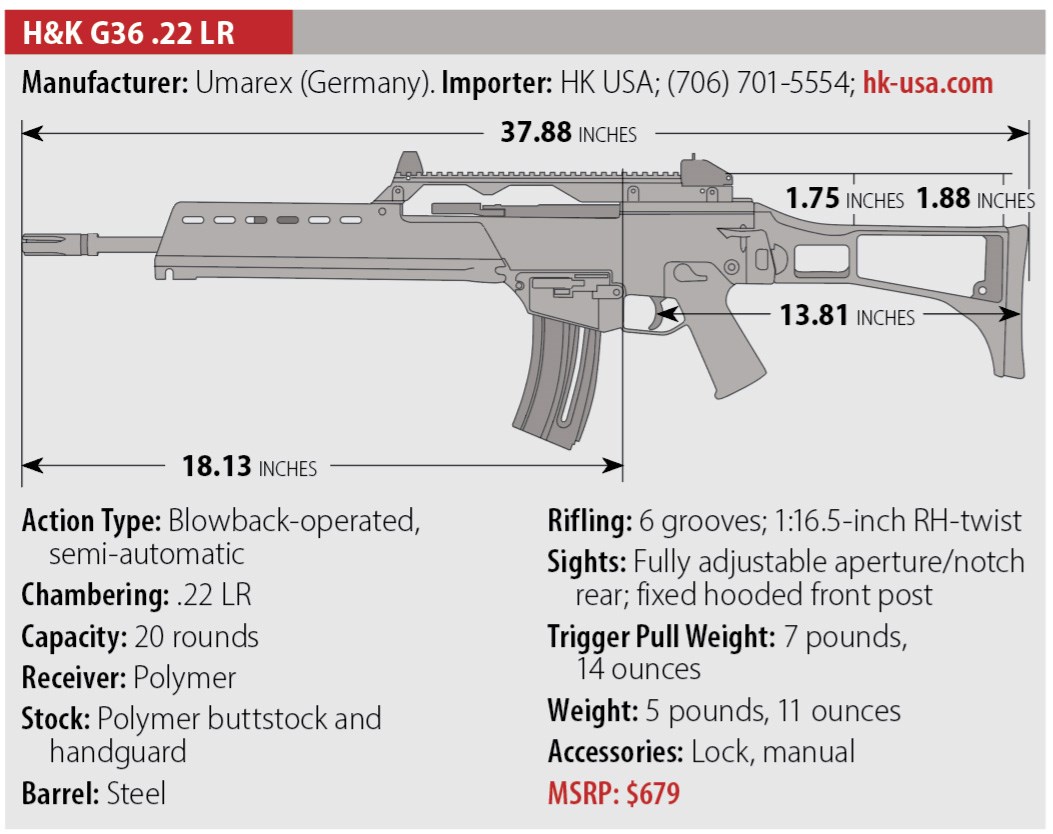
In 2025, HK USA re-introduced the G36 .22 LR (the model had been offered for a few years starting in 2015 under the Walther nameplate). Born of the partnership that the company has with Umarex (of which Walther is a subsidiary), which has also produced semi-automatic .22 rimfire versions of the MP5 and HK416, the G36 .22 LR has the same overall dimensions as the centerfire G36, but weighs about 2 pounds less. Its barrel is 18.13 inches long and has its muzzle capped with an authentic-looking, four-prong flash hider, like what is used on shortened C and K variants of the G36.
Controls are identical to the centerfire version, with an ambidextrous charging handle that folds out to the right or left side and bilateral safety levers that have a 45-degree throw between the safe (“no bullets”) and fire (“bullets”) positions. A bolt-hold-open catch is located in the trigger guard. Like the original centerfire G36, it can be actuated to manually lock the bolt to the rear, but is not designed to release the bolt. Unlike the centerfire G36, the reciprocating charging handle on the .22 model cannot be locked into the bolt carrier for forward-assist capabilities.
The G36 .22 LR uses the same design of carry handle/sight rail with fixed sights as used on the original C and K versions of the G36. Sights consist of a fully adjustable rear that can be flipped between an open notch and an aperture (instead of the dual apertures of the centerfire G36), and a hooded front post. Both are mounted on a carry handle with a section of Picatinny rail. As an additional bonus for H&K fans, many of the G36 .22 LR’s parts are compatible with the centerfire rifle, including the handguard, sight rail and stock.
A single button releases the buttstock (which has the 10.5-inch length of a full-size G36 stock), to fold to the right and lock in place onto the receiver’s case deflector. The rifle will fire with the stock folded, with a cut in the stock’s upper arm directing spent cases downward. The handguard attaches to the receiver, allowing the barrel to float freely within it. There is a faux gas block mounted on the barrel. The slots on the handguard are for ventilation only and are not compatible with M-Lok or any other accessory attachment system.
Instead of the one-piece polymer receiver with molded-in steel inserts, the G36 .22 LR uses a two-piece “clamshell” receiver design that screws together. Underneath its exterior, the rifle uses a simple blowback-operated action. Its magazine well follows the STANAG pattern present on centerfire G36 rifles, with a left-side-only release, and the rifle uses the same magazine as the HK416 .22 LR and the Walther M4 .22. Magazines are available in 10-, 20- and 30-round capacities, and the rifle ships with either a single 10- or 20-round version. The polymer magazines feature an assist tab to make loading easier.
Where the current rifles differ from the original imports from a decade ago are in their markings, which list H&K as the importer and the manufacturer as Umarex—and by the lack of a hand stop and the absence of screw-in attachment points for rail sections on the longer handguard. The threaded-on muzzle brake is not secured by a roll pin, making it easier to remove for installing other muzzle devices or a suppressor. The result is what H&K calls “the most realistic civilian version of the G36 yet,” to which I would add the caveat “on the U.S. market.”
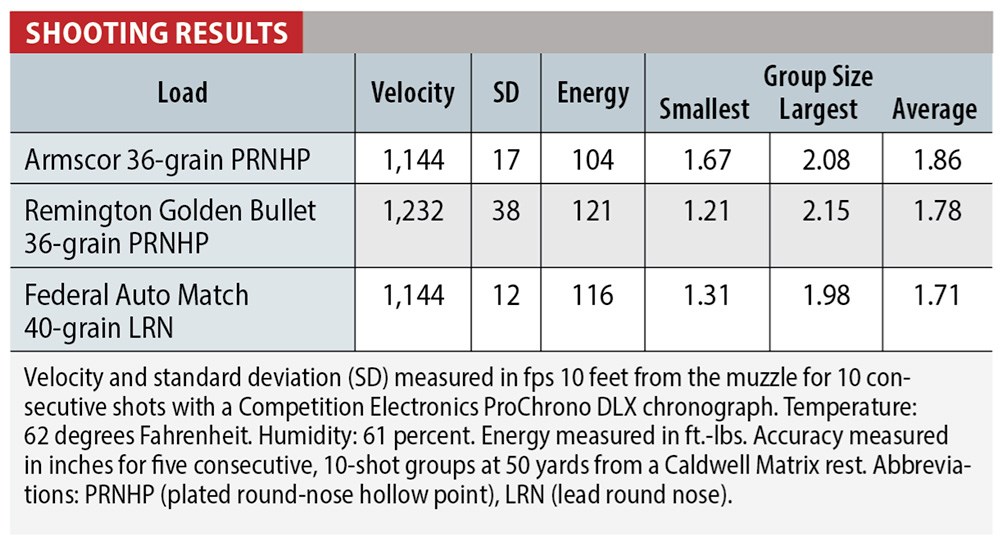
Heckler & Koch recommends using high-velocity .22 LR loads, so I headed to the range with a variety of bulk-pack ammo meeting that criterion. At the end of the day, the G36 .22 LR is a high-volume plinker, and the types of cartridges in those loose-packed boxes are what will likely be its primary diet. The rifle proved up to the task. Reliability was 100 percent from round one; it even fed my gold standard for baseline .22 ammunition—Remington Thunderbolts—without hesitation. This reliability continued through several hundred rounds without requiring cleaning.
The rifle’s single-stage trigger is “mil-spec” in the sense of being similar to the centerfire G36, with a nearly 8-pound pull that is long and must be fully released to reset. An empty magazine locks the bolt open, and then a short pull of the charging handle will release the bolt once a loaded magazine is in place.
On the precision side, the G36 .22 LR is no match rifle, but it is capable of “minute of milk jug” accuracy out to 100 yards. More importantly, it’s just fun. The rimfire G36 gives those of us without any experience with the real thing a chance to fall in love with the innovative design and intuitive controls of the G36. In terms of aftermarket customization, there are telescoping G36 stocks available that should appropriately shorten its length of pull for shooters of smaller stature. With H&K’s promise of parts compatibility, other extant H&K and clone accessories, furniture and part upgrades are also available online.
Basic fieldstripping of the G36 .22 LR matches its bigger brother. The spring-retained push pins for which H&K is famous hold the handguard, mag well and lower housing in place, and conveniently store in holes in the buttstock to keep them from getting lost when the rifle is apart. Folding the buttstock out of the way allows for the bolt, carrier and recoil spring to be removed through the rear of the receiver. Obviously, there is no gas system to disassemble.
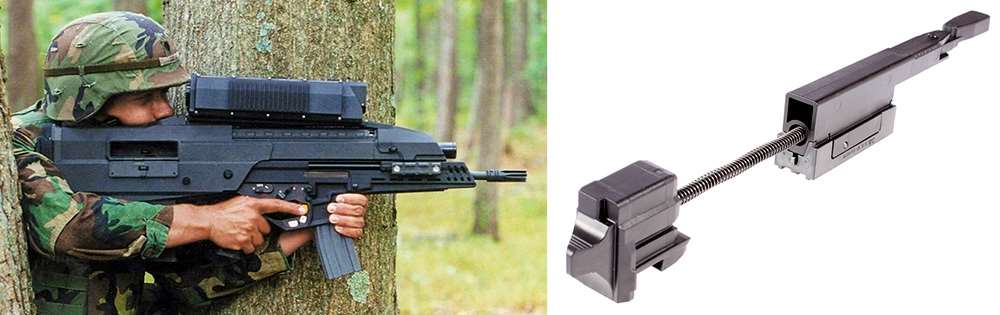
Prior to testing the XM8, the U.S. Military considered the XM29 OICW, which consisted of a G36-pattern rifle beneath an airburst-grenade launcher and an integrated optical fire-control system. As a rimfire rifle, the G36 .22 LR is blowback operated. The “gas system” is just for show to maintain similar looks with its centerfire cousin. (photo U.S.Army)
Umarex works with manufacturers to produce licensed .22 LR replicas of classic military firearms, which has resulted in a resurgence of the “tactical rimfire” market. Its popularity is easily understood once you’ve spent time with the G36 .22 LR. The features that make it “tactical” also make it “practical.” It’s a rugged, compact and modular rifle that is accurate enough to be deployed (see what I did there) for small-game hunting and varmint control.
Its authentic size and controls make the rifle a great trainer for modern sporting rifles and for the centerfire G36 we will hopefully have one day. One word of advice for AR-15 users who transition to the G36: Make sure the push pin that holds the magazine well in place is inserted from right to left to deter your index finger—that is accustomed to finding an AR-15 magazine release in that position—from accidently pushing the pin.
In 2024, HK USA announced it was working with both the ATF and German authorities to find a “path forward” for a civilian centerfire G36 for the U.S. market. Although the program was “in progress,” H&K fans were warned to not expect anything until at least this year, and we’ve seen nothing yet. In the meantime, the G36 .22 LR is a fine stopgap and a great rimfire rifle in its own right.
Read the full article here