


(Continued from Part 4. This concludes the article.)
Where do I start if I’m new?
Okay, this all sounds great but maybe you’re feeling overwhelmed. Where do you start if you are starting from scratch? Or maybe you have a large garden but aren’t sure you want to convert the whole thing over to this approach. I’m going to give you my method for establishing a garden bed on new ground, which I have used successfully in multiple beds on my property including my entire greenhouse.
Establishing a New Garden Bed
- Mark out your bed in a location that gets full sun — a minimum 6 hours of direct sunlight. If the soil is very compact then you may benefit from a one-time tillage to loosen up the soil to water and air.
- If you are building a raised bed, add your sides at this point. If you are using wood I would recommend cedar. Do not use treated lumber.
- Add any mineral amendments on top of the bed (azomite, sea-90, greensand, volcanic rock dust, etc…)
- Add a minimum of 3”-4” of compost on top of the soil. You can add more compost if you have enough or if it is a raised bed. Do not till it in. It serves as slow-feed organic matter and mulch all in one. In the future you will only need to add ¾”-1” of compost per year to maintain the bed.
- If you have multiple beds with aisles, place ink-free cardboard down in the aisles as a weed barrier and then cover with woodchips to the same depth as your compost.
- That’s it. Plant your seeds or transplants directly into the compost.
- Add a thick layer of mulch on top of the compost throughout the season to help retain water and suppress weeds. I prefer grass clippings (from a chemical-free lawn) or leaves. Herbicide-free junk hay or straw are also good options.
- Ensure the bed is thickly mulched at the end of the year so it is protected over the winter. If you are in a warmer growing zone just keep growing with winter-appropriate plants.
Tips for New Gardeners
- Start small with 1 or 2 small beds (3’x8’) so it stays fun and isn’t overwhelming. If you don’t keep it enjoyable, you won’t stick with it.
- Grow a few things you like and already use in your cooking. Each season add another plant or two to your mix, and add beds as it makes sense. Don’t make the garden a burden. Keep the scale small enough to be fun. If TEOTWAWKI hits I’d rather be a highly skilled small scale gardener than a mediocre large scale gardener. You can always scale up later.
- Don’t worry about perfection, just try things out, take notes and get a little better each year. There is no such thing as a “green thumb.” Good gardeners are simply people who pay attention to what they are doing, work to improve each year, and are always learning. It is the same recipe for success you can apply to any skill in life.
- Super short cheat sheet for early success: Don’t till, add compost on top of the soil, mulch your beds.
- Time your plantings and harvest so you can use the same garden space twice per season, that way you can start with a smaller garden.
- Each new plant is a whole set of skills (planting, care, harvesting, storing, cooking) so only add 1 or 2 new crops each year so you aren’t overwhelmed.
- Recommended Starter Crops:
- Tomatoes & peppers (because everybody wants them)
- Sugar snap peas (you can grow these in the early spring and the fall)
- Sweet potatoes (fairly easy to grow if you get slips from a local greenhouse, store all winter long, and you can save a couple to start your own slips the next year)
- Herbs like basil, parsley, thyme, sage, rosemary and oregano won’t take much space and can really boost your cooking by using fresh herbs
Conclusion
Modern agricultural practices run largely in opposition to the biological systems, and in our hubris we employ chemicals and machinery to prop up our failing plants and call it successful farming. When we engage in tillage in conventional agriculture we are breaking up the mycorrhizal network and destroying the nutrient transport system. We reduce the organic matter in the soil as it is exposed to the air and evaporates through oxidation. The flow of water up and down through the soil in old root channels and capillary action is broken up. It’s no wonder the plants we sow in that field need fertilizers and irrigation to stay alive. But those fertilizers don’t give the plants all the micronutrients they need so the plants aren’t strong enough to fight off pests, so now we need pesticides as well. The petrochemical agro complex is happy to keep selling us fertilizer and bug spray so we can grow and eat nutrient-deficient foods. Monsanto will make genetically modified corn and soy that can handle roundup and this whole sick system will work in violation of the created design, until the house of cards collapses without the power grid and efficient transport. If your garden is operating within the conventional agriculture paradigm your production will collapse too.
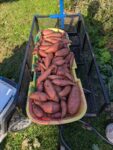 In this article, I’ve presented my approach to gardening in partnership with the biological systems of creation. This approach requires little to no power equipment, can be maintained with no external inputs once established, does not require fertilizer or pesticides, greatly reduces irrigation requirements, and produces healthier, more nutritious crops. While there are some labor savings in this system, there is still a significant amount of work involved. It’s just more fun to be working harvesting 180 garlic bulbs or 150 pounds of potatoes, than it is to be wondering why your tomatoes died before setting very much fruit. If you recognize the need for small-scale food production that is locally sustainable I hope you will consider partnering with creation and trying this approach in a few garden beds this year.
Resources for Additional Learning
I’ve collected a list of books and resources that I have found very helpful throughout my journey growing food for my family. I have no association with any of these authors and businesses other than having been a customer or subscriber and have found all of them to be more than worth my time and money. You will find almost all of the ideas I have presented in this article covered in greater depth within these resources.
- Bionutrient Food Association website and YouTube channel. I highly recommend the High Bionutrient Crop Production seminar recording. This is their 2-day seminar with in-depth teaching on soil life, soil chemistry, and biological growing techniques. It is what started me down the biological systems path and gave me a much deeper understanding of what is going on in the soil. It’s so good I rewatched it while in the process of writing this article.
- Dan Kittridge-TEDx Talk
- Paul Gautschi’s Back to Eden Gardening method
- Charles Dowding’s Website, youtube channel, and books. His youtube videos are like learning gardening from your favorite grandpa. He practices no dig gardening, and uses compost extensively. He has a number of videos to help you learn to make your own compost, along with growing guides on most garden vegetables.
- Elliot Coleman’s books: “The New Organic Grower” and “Four Season Harvest” Eliot Coleman is based in Maine and will be especially relevant for northern readers in colder zones.
- Joel Salatin’s books especially as resources for tending animals and building soil through pasturing livestock. His book “Polyface Micro” is a good starting point.
- Seed sources I use:
- Fedco (based in Maine)-many northern adapted varieties, good selection of heirlooms, fruit trees, natives, and some medicinal plants
- Johnny’s Selected Seed-good selection of northern-adapted seed varieties
- Seed Saver Exchange-Source for rare heirlooms varieties
- Strictly Medicinal Seeds-Top source for medicinal herbal plants and seeds. They have the widest medicinal plant & seed selection I’ve seen anywhere.
- Logan Labs-Soil testing service I have used. I used their standard soil analysis with extras. Here is a look to a Sample Report
Read the full article here