

The last presidential election has started to reverse the damage inflicted upon our Second Amendment rights by the Biden administration, but it would be foolish to think the cultural war against gun ownership has been won and the midterms are coming up which could halt the progress made so far. The mindset that Americans can’t be trusted with firearms or should only be allowed to defend themselves with a limited set of comparatively ineffective arms maybe temporarily contained, but hardly vanquished. The money flowing from Michael Bloomberg and George Soros to politicians who support civilian disarmament will continue unrelentingly while a complicit media brainwashes people into believing guns—not their criminal use—are responsible for crime.
As a concerned gun owner, you can counter the well-funded anti-gun disinformation at the grass roots level by taking an interested newcomer with an open mind to the range for some quality trigger time. If done correctly, that educational experience could grow the ranks of Second Amendment advocates, but with the wrong approach, the opportunity may be lost.
From my experience as an instructor, here’s five suggestions to help make trigger time a success.
Safety Matters Most
Start off with safety instruction specific to the firearms and range you will use. As an experienced shooter, safe gun handling and proper range conduct should be automatic to you, but that does not mean you can teach the procedures from memory. Write them down beforehand so you don’t miss any and be sure to explain the “why” behind them if it’s not obvious. Give safety instruction while the firing line is cold or, preferably, in a separate area so you don’t need to shout to be heard or answer questions.
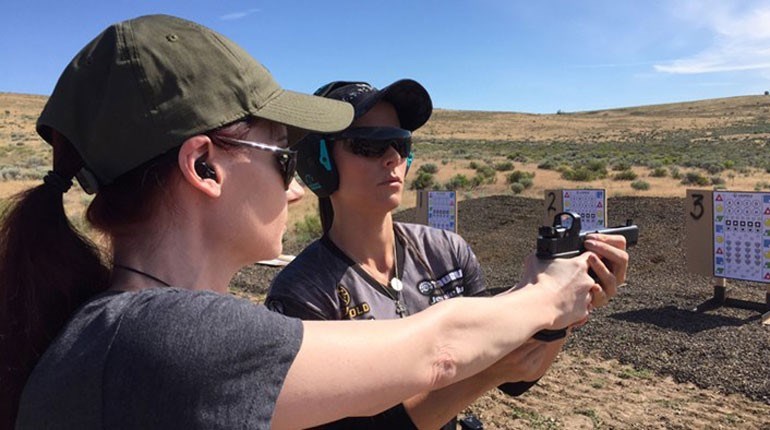
Wearing eye and ear protection seems obvious, but other attire is also important to mitigate hazards. Be sure your friends or family comes dressed for safety wearing a hat with a brim to keep ejecting brass out of their face from an adjoining shooter and a shirt with a high neckline that won’t channel hot brass onto the neck, back or chest. Avoid sandals and shorts for the same reason.
Indoor or Outdoor Range?
An outdoor range is a far better venue for a first-time shooting experience. The environment is familiar and natural lighting, open air and spaciousness are major benefits. Periodic cease-fires to change targets are also a welcome respite and provide a chance to coach using a normal voice. Outdoor ranges usually allow a wider range of targets than indoors where paper is often the only type allowed.
In contrast, even the best-designed indoor ranges can be an unfamiliar and foreboding environment with seemingly cramped spaces, more apparent noise and smoke, and sometimes dim lighting that may make an unaccustomed person apprehensive. If you can’t access an outdoor range, try to use a modern indoor range that is brightly lit, has effective sound deadening material, spacious booths and good ventilation. Also go at a time when fewer people are shooting.
Handgun, Rifle or Shotgun?
I prefer a .22LR handgun for new adult shooters because it is mildly recoiling, easier to hold, more intuitive to aim and lighter weight than a rifle or shotgun. Long guns also require more precise techniques to shoot correctly because arm and body position are far more important than shooting with a handgun.
Moreover, first-time shooters find that positioning their body into a correct rifle stance can be awkward. It’s certainly more instruction-intensive than setting up to shoot a pistol, and you may need to contend with gun-mount problems caused by cross-eye dominance where a right-handed shooter has a dominant left eye. Also, some people are uncomfortable placing their cheek onto a rifle or shotgun stock.
Type of Handgun
I’ve found that a semi-automatic pistol with a large enough frame to grip with all fingers of the firing hand and at least a 4-inch barrel that provides a sufficient sight radius works best for novices. Because proper sight alignment and sight picture are difficult concepts to put into practice for many first-time shooters, the ideal sight configuration is a front sight with an embedded green fiber-optic to draw the shooter’s focus paired with a black square notch rear sight. Rear sights with white dots, white brackets and the like distract the shooter from a front sight focus, but can be “cured” with a black sharpie marker. Red dot optical sights also work well but make a shooter’s involuntary movement or inability to hold on target obvious.
Revolvers with 4-inch or longer barrels can also be used, but gas escaping from the barrel-cylinder gap needs to be explained, and the superior balance and pointing characteristics of a pistol usually carry the day for those taking their first shots.
Though it may be tempting to start off with a 9 mm semi-automatic—and some gunmakers push the idea for new women shooters interested in self-defense—that’s a mistake for a first-time experience, because the recoil and noise is unexpected and unpleasant for most newcomers. At least, that’s the reason I hear most often from people who tried shooting for the first time and avoided it thereafter. It can also induce flinching and cause frustration when they can’t hit the target where intended.
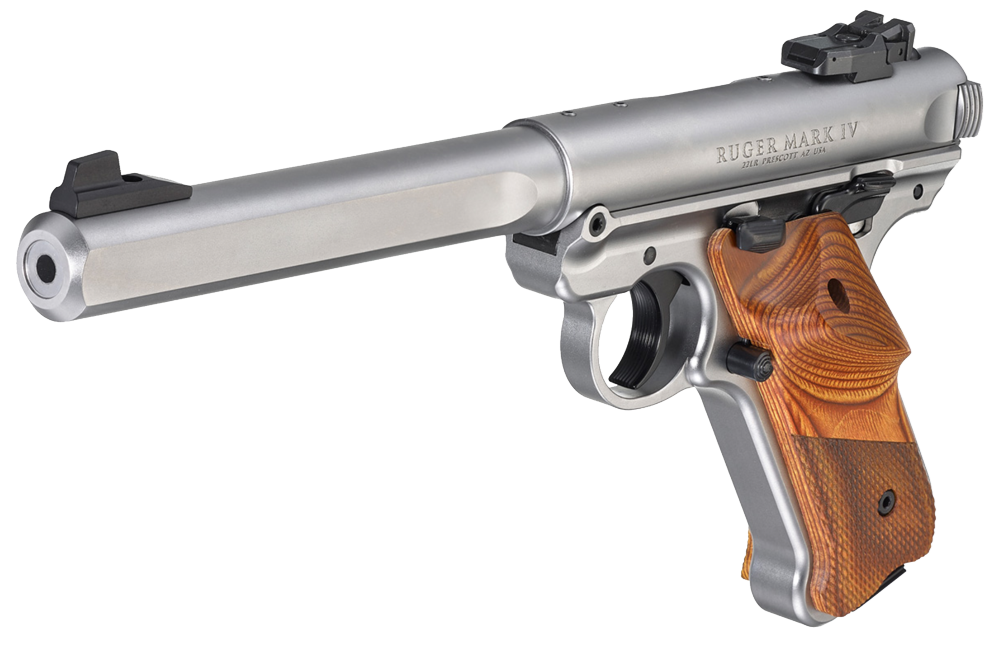
Though there are many other suitable handguns for a first-time experience, I prefer pistols made for informal target shooting, like the Browning Buckmark, Ruger MK IV and Smith & Wesson Victory because of their ergonomics, sights and triggers. They’re also durable and will last a long time. For those with weaker arms who need a lighter weight pistol, I like the full-size SIG P322, Taurus TX22 and Smith & Wesson M&P22. For revolvers, I prefer the Ruger Single Six because of its 6-inch barrel, single-action trigger and non-muzzle-heavy feel. If you don’t have any .22 LR handguns, consider a rimfire conversion kit for your centerfire pistol, which can make training and stepping up to a centerfire pistol far easier.
One drawback of using a handgun can’t be stressed enough: They are easier to mis-point than long guns, which is one reason rifles are typically used to teach children and teenagers. Be sure to mention in your safety briefing that constant muzzle awareness and control are critical, and all it takes to endanger someone with a handgun is a mere flip of the wrist.
Targets
Targets provide performance feedback, but they also need to be fun and engaging. Start by setting paper targets close to verify your student knows the rudiments of how to aim and hold on target. Then, because the objective with a first-time experience isn’t to make Olympians or Navy SEALS, transition to more engaging reactive targets once your student consistently hits paper reasonably near the aiming point. If they can’t hit reasonably well standing up or have difficulty holding on target or aiming, have them fire off a bench rest or sandbags to start.
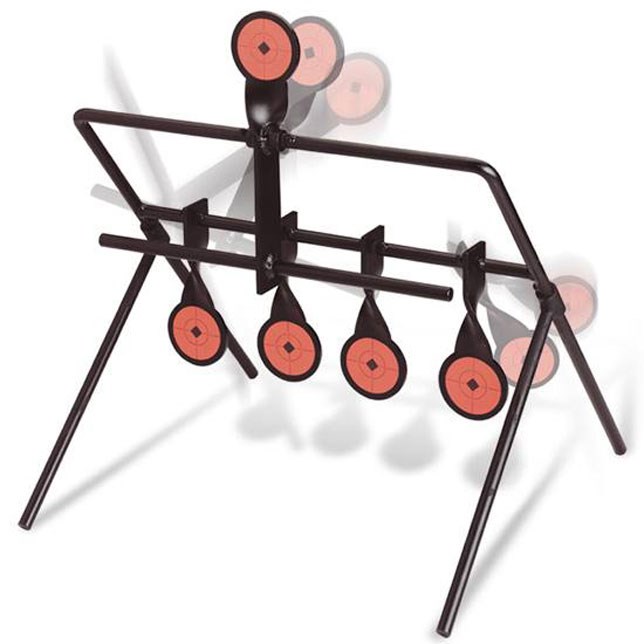
Steel plates that spin or fall are fun, but they need to be set at a certain distance to avoid backsplatter, which may be too far downrange for your shooter to hit. Paint one side white so you can easily see the bullet strikes and the other side a different color. When it gets struck and starts to spin, challenge your students to time their next shot to hit one color and not the other.
Also try suspended wood blocks, tin cans and tennis balls, all of which can be set closer. I also like to use poker playing cards stapled to wood blocks, which are fun targets and are a take home souvenir to remind your friends of the wonderful experience you gave them.
Summary
A positive first-time shooting experience can create allies in our struggle to preserve the Second Amendment but requires careful planning and an approach that reduces stress and makes success easy in a safe and attractive environment. Don’t make the experience a one-time event by pointing your friends to the NRA website where they can find formal classes and much more. If you enjoy introducing new shooters to a lifetime of gun ownership, become an NRA-certified instructor. It’s one of the most rewarding experiences you can find. It certainly has been for me.
Read the full article here