


The cool part about shooting with mounted red-dot sights on handguns is that, once shooters get used to them, they turn into major performance boosters. It boils down to the fact that using a single “aiming reference” (the dot itself versus a front and rear sight), to shoot aids both with speed and precision in pistol shooting. And to properly leverage the power of the dot, shooters must use target-focus.
Unfortunately, both new and experienced shooters alike are oftentimes prone to getting “lost looking through their dots” instead of focusing on their targets. This common phenomenon basically amounts to a mild form of tunnel vision. Though it’s a subtle mental mistake, when shooting against the clock, it can cost shooters precious time and the degradation of higher performance. This needless tunnel vision can also cause shooters to miss, especially in the case of having to transition between targets. The easy fix for this is to simply remember to always focus very strongly on the target. However, that’s easier said than done–even for experienced shooters.
The manner in which our minds work makes it somewhat challenging to stay keenly focused on every aspect of shooting a handgun. But yes, shooters can get there with dedicated training and practice.
Introducing Red-Dot Occlusion
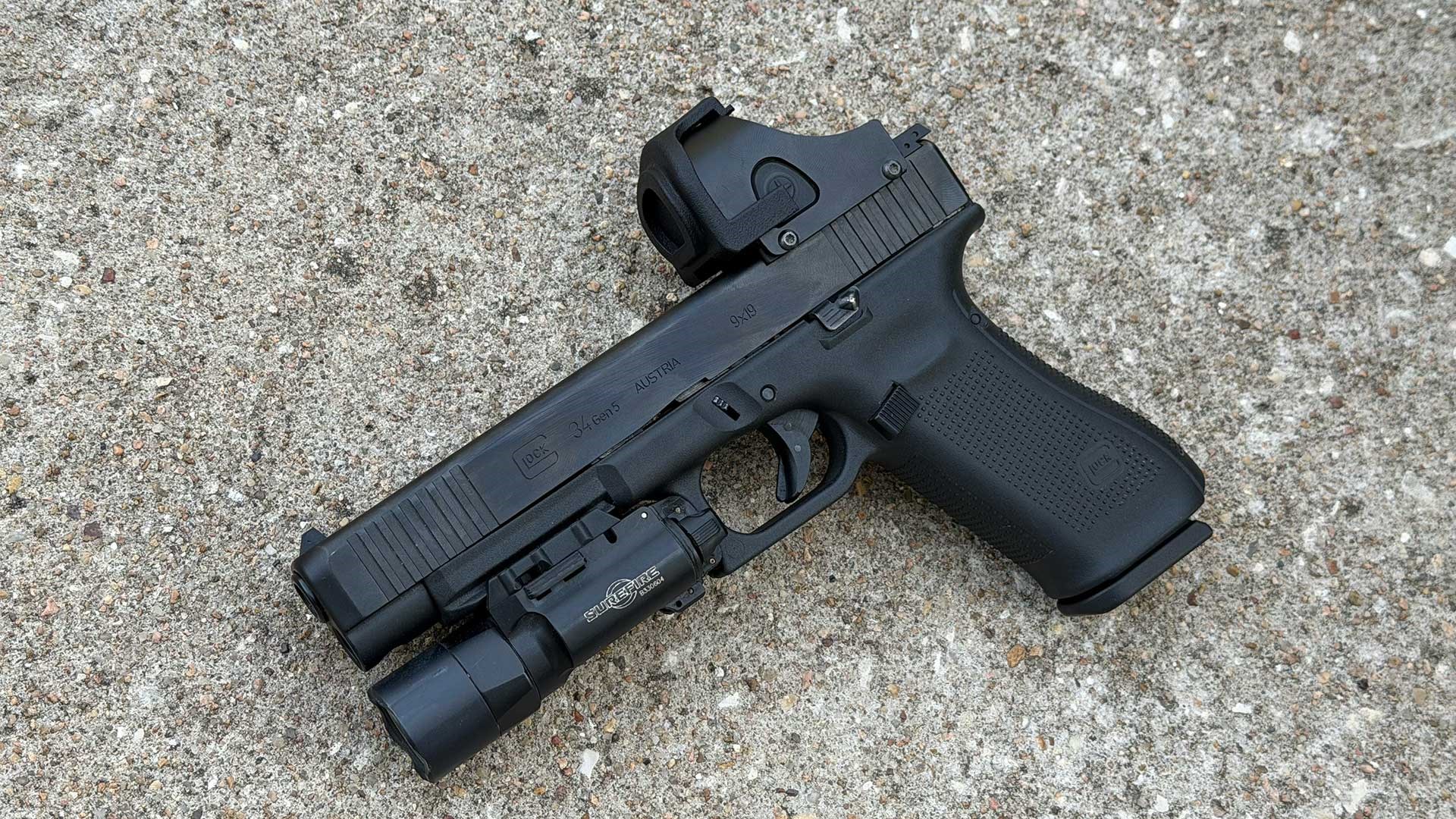
Red-dot occlusion is a passive technique that shooters can work with to train themselves to remain target-focused. It is a very easy fix that takes all the pressure off your mental faculties by physically blocking or occluding the sight’s window. Even using something as basic as masking tape works in a pinch. At this point, there are several companies that offer molded Kydex or polymer covers that snap on over the front of major red-dot sights. No doubt these work more cleanly than using tape. I have some experience with Arise Mfg.’s Occluder for its Aegis optics shroud, and that’s shown on my Glock 34.
An occluded sight’s red-dot is still visible; the emitter beams the dot onto the lens and reflects it back to the shooter. Though the front of the sight is blocked-off, when aiming with an occluded sight with both eyes open (and a hard target focus), the human brain will automatically ignore the occlusion.
To be more specific, it works like this: thanks to the fact that human vision is binocular, the brain automatically combines what both eyes are seeing. The end result is a superimposed sight picture over the actual target. When done correctly, the rear of the sight and its dot look like a phantom image. As long as both eyes are keenly focused ahead at the actual target, the sight remains a phantom image. It doesn’t matter whether the front of the sight has a clear opening.
Occluded shooting works both with pistols and long guns with red-dot sights. However, it is especially useful when adapting to shooting pistols with red-dot sights specifically.
The Singlepoint OEG: Proving The Occlusion Concept Since The Vietnam War
I’d be remiss if I failed to mention the old Singlepoint OEG (Occluded Eye Gunsight) in an article about red-dot occlusion. The Singlepoint OEG was one of the first ever red-dot sights and it was famously used by U.S. Army Special Forces on their GAU-5 carbines during the daring Son Tay prison raid. As a forerunner to modern red-dot reflex sights, the Singlepoint OEG consisted of a tube with a thick fiber-optic filament.
The front of the Singlepoint had a clear nose-like dome that was shaped like the nose-cone of a World War II bomber that allowed the fiber-optic rod to gather light and shine. Their entire body also looks like a submarine, with the front being completely closed off. Singlepoint OEGs had no objective lens. Besides being a notable forerunner in tactical optics, shooting with it entailed keeping both eyes open and relying on the brain’s automatic occlusion mechanism.
More sophisticated red-dot optics wouldn’t show up on scene until later, and the technology of the day limited the Singlepoint OEG to its fiber-optic filament and its “closed-off” front. That’s why there was no choice but to use these aiming aids with occluded shooting techniques.
An Expert Opinion From Christopher Bean
Christopher Bean is one of the greatest shooting coaches and instructors you’ve probably never heard of [yet]. Besides his skill, Bean is quite articulate and does a good job at breaking down the “hows” and “whys” behind techniques.
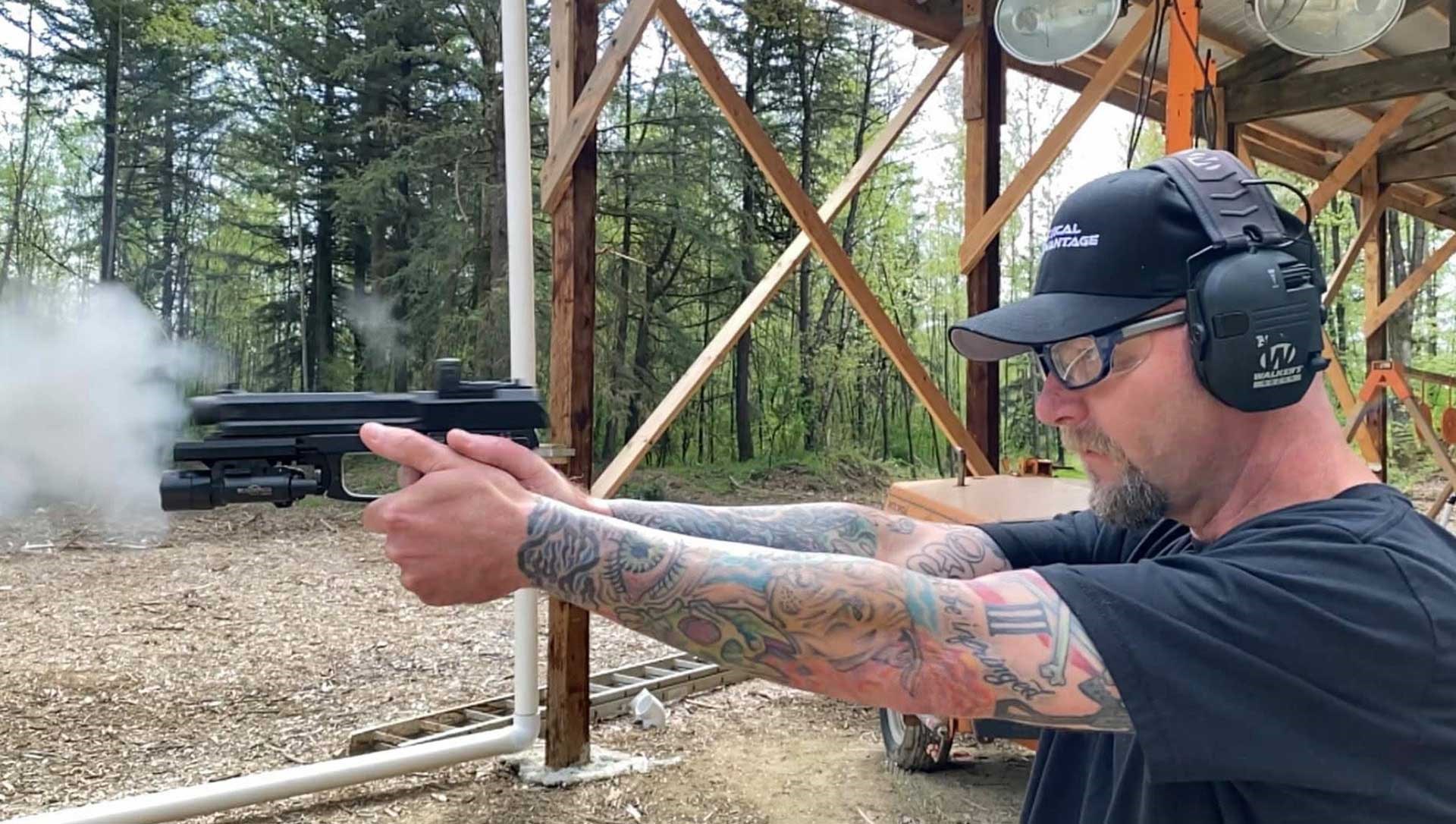
Prior to writing this article, we had a conversation about pistol shooting with red-dot sights and why sight occlusion can be an important training consideration. In his own words, this is his articulation on the technique:
BEAN: Keep in mind that shooting is nearly 100 percent based on visual interpretation.
Most shooters learn to shoot by closing their non-dominant eye and keeping a strong focus on the front sight. With the other eye closed and out of the picture, the lion’s share of visual processing falls back to the dominant eye. Adapting to mounted red-dots, which require focusing on the target ahead of the pistol with both eyes open, tends to induce a challenge. This is because shooters are so accustomed to doing the heavy lifting with a single eye and focusing on the front sight, not the target. What happens is that shooters end up hyper-focusing on the dot itself [thus creating that tunnel vision referenced above] (emphasis mine).
Hyper-focusing on the dot manifests in slower and less reliable transitions. It also causes shooters to spend more time “looking” or “fishing” for the dot. The fact of the matter is that red-dot shooting goes more smoothly when used in-line with natural human binocular fusion vision.
Where The Dot Is, The Bullet Goes
Red-dot occlusion becomes a factor in this shooting equation because the physical blocking of the sight’s “viewport” forces the brain to subconsciously switch and combine what both eyes are seeing thanks to binocular vision.
BEAN: By occluding the objective lens of a red-dot sight, if one is hyper-focused on the dot or allowed visual convergence, the view would naturally be blocked. But the occlusion forces the brain to utilize its binocular visual function to see both the target and the dot while combining both. This allows the dot to appear in the shooter’s vision while being able to move and rest as intended.
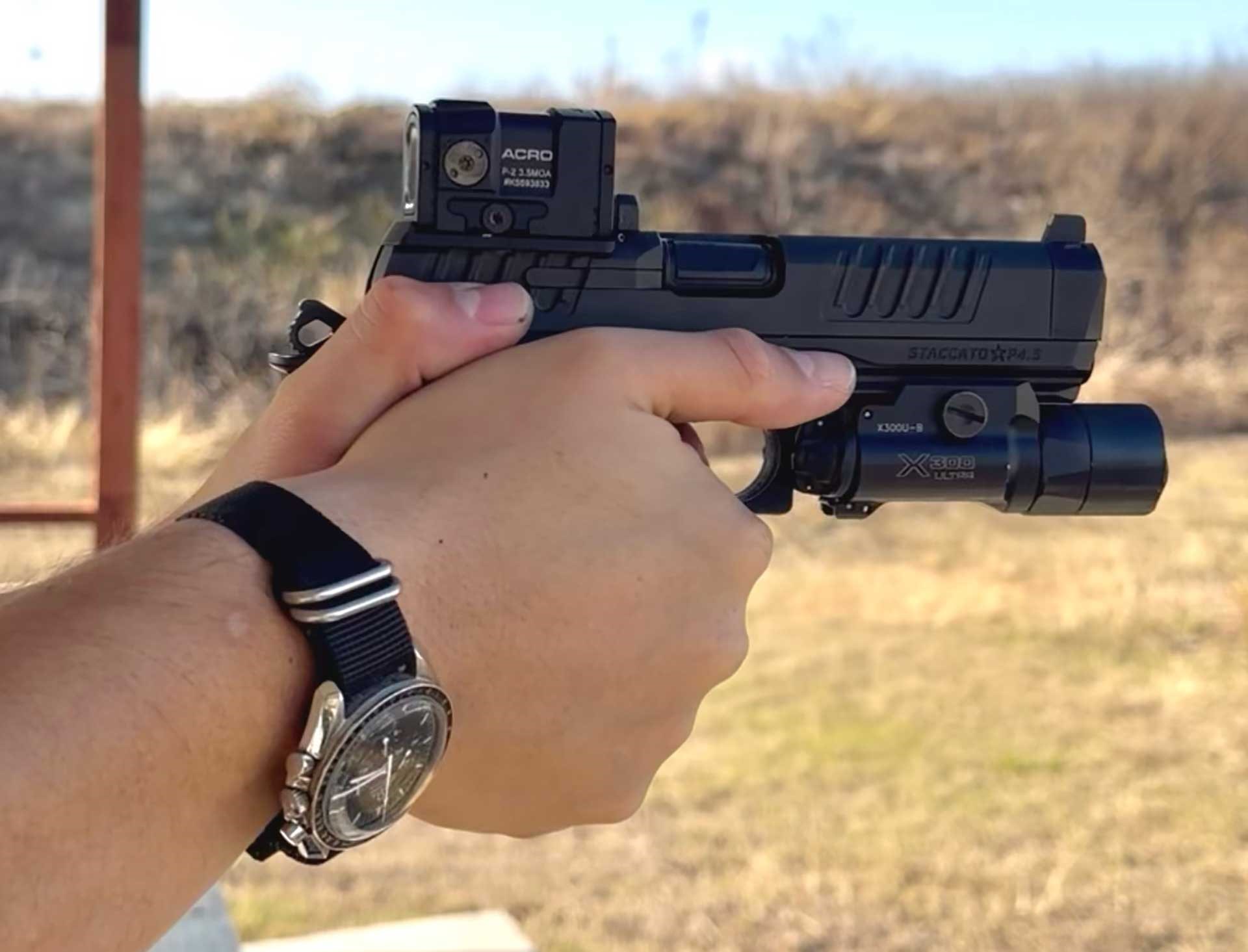
This visual phenomenon about how the eye tracks a red-dot’s sight picture further ties into why most red-dot sights are shooting performance boosters and why also virtually (or just about) parallax free.
It boils down to that simple adage of “where the dot is, the bullet goes.”
BEAN: Red-dot occlusion is a helpful tool. Especially for those looking to truly begin understanding target focus, shot calling and efficient use of red-dots.
Tying Red-Dot Occlusion Into The Bigger Picture
I’ve previously shared my thoughts about shooting with red-dots across various shooting-related publications. The bottom line is that red-dot-aided shooting does promote a higher degree of accuracy and makes it easier to shoot quickly since the single aiming point is easier to track as the slide reciprocates. I also happen to think that both the learning curve, added hassle and cost associated with them is worthwhile for the serious handgunner.
Aside from cost or correct red-dot mounting hygiene, the learning curve can take some time to master. However, I don’t think that conquering it is a herculean or byzantine task. The good news is that most of it can be done with dry-fire and getting used to the gun’s proper target-focused sight picture.
As for relying on red-dot occlusion as an additional shooting aid, it’s simply a passive technique that makes the red-dot learning curve flatter rather than steeper.
One critically important piece of advice I’d like to metion is that you should never use a target paster directly over a red-dot’s viewport to occlude. I found that out the hard way! Even though tape is quick and easy, the wrong kind will also smudge the lens.
Read the full article here