


Some folks sneer at line extensions from firearm companies, and I’ve never understood that. Why on earth would you not want more options? Sure, sometimes it’s just a new frame in flat dark earth, but even then, why is having more choices a bad thing? The gun we’ve got here is another new chambering for Smith & Wesson’s M&P FPC line of folding carbines, and it’s a great one: 5.7×28 mm.
It joins a growing line, from the original 9 mm to .22 LR, .40 S&W and 10 mm, each using the same magazine as their M&P handgun counterpart. The carbine gives more oomph as well as more options for optics and accessories. The “F” in the FPC (unconfirmed by Smith & Wesson, but if it isn’t true, it should be)—“folding”—turns what might otherwise be a fun range toy (and there’s nothing wrong with that) into a PDW that can be added to a bug-out bag or included as a “better than a handgun” option in your preparedness plan.
Without going too deep in the weeds on the 5.7 mm cartridge, it started life as a PDW-specific round for one specific PDW: the FN P90. Over the years, more and more companies have added both handguns and carbines to the 5.7 family, to the point where the round risks becoming—dare I say it—mainstream. I mean, Federal manufactures its American Eagle FMJs in 5.7×28 mm now. What could be more mainstream?
The 5.7 round is one of those cartridges that really gains a lot from the longer barrel of a carbine. Sure, most rounds benefit from longer barrels and the extra velocity; the 5.7 is on the more extreme end of rounds that benefit from rifle-length barrels. It is elevated to fundamentally the same muzzle energy as 9 mm out of a carbine-length barrel—and maintains superior characteristics should you require longer-range application. Obviously, neither is going to rival a centerfire rifle for power, but life is about tradeoffs; with the FPC, you can share magazines with your favorite handgun and then fold it up and put it in a messenger bag for easy transport.
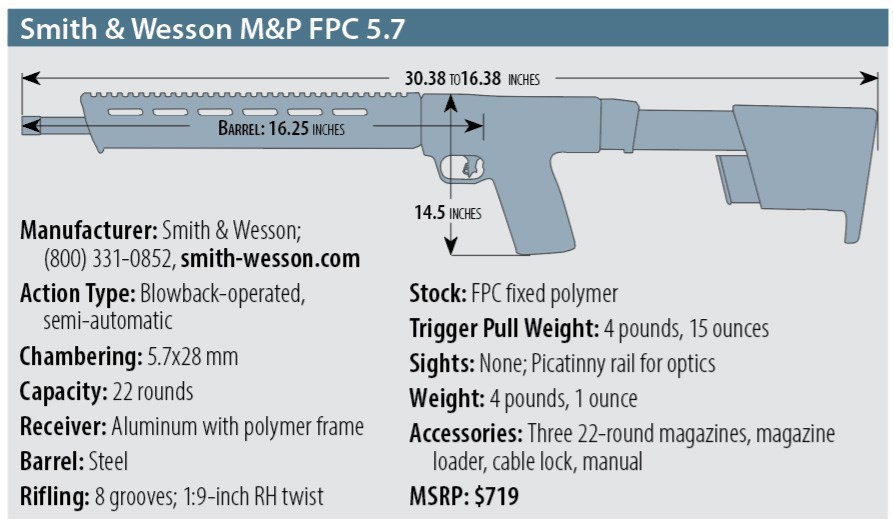
Unfolded, the carbine has an interesting profile, with a significant amount of rail space for optics and/or iron sights—which are not affected when the carbine is folded for transport • Two magazines fit in the fixed polymer buttstock for impressive on-board capacity • With the muzzle threaded 1/2×28 tpi, a sound suppressor or muzzle device can easily be added, and there are even suppressors specifically engineered to work best with the 5.7×28 mm round • Pushing forward on the polymer release allows the FPC to be folded for transport or storage • When folded, the carbine takes up a mere 16.38 inches and fits into a variety of cases, allowing more discreet transport • Three 22-round magazines are included with the FPC • Ample M-Lok attachment slots on the polymer handguard allow lights, lasers and other accessories to be added • Ahead of the trigger guard is the crossbolt safety that is easy to reach with the trigger finger • Using the same trigger as the M&P line of handguns, the FPC has an extremely familiar feel for fans of the M&P • A generous ejection port allows cases to be ejected cleanly, leading to superlative operation.
Having the ability to easily fold the carbine, especially with an optic attached, is certainly a big part of the FPC’s appeal. Accomplishing this is simple: ensure the FPC is unloaded, then push the lever on the opposite side of the hinge forward. The charging handle that surrounds the stock extension fits into an M-Lok slot on the handguard to keep it folded, and you simply pull the carbine open to get it ready to use. Insert a magazine, pull the charging handle to the rear and it’s ready for range time. It’s a simple, intuitive procedure that allows the FPC to take up less space than the upper-receiver portion of an AR-15.
Other than that, the operation is specifically engineered to be similar to Smith & Wesson’s decades-old M&P handgun line. There is a traditional, ambidextrous slide-release lever at the top of the pistol grip to release the bolt; I found it simpler to use the charging handle, but others may prefer the release. There’s a bladed-safety trigger to protect against inadvertent discharge should the firearm be dropped, the grip has the same mildly aggressive texture to anchor it in the hand and the 22-round magazines insert in the grip just like the handgun.
Two extra magazines can be carried in the fixed buttstock of the FPC, allowing for an impressive 66 rounds of ammunition carried on the rifle itself, and the generous Picatinny rail gives options for optics. M-Lok slots along the fore-end allow a light, laser or other accessory to be added, and there are QD sling mounts throughout. The light weight and short size of the FPC make it a decent candidate for a single-point sling, for those who prefer that method of carry.
In operation, the FPC was, for lack of a better word, boring. It just plain worked. I was fortunate to have a wide variety of 5.7×28 mm ammo on hand and was thus able to run everything from light 30-grain JHPs to suppressor-friendly (of course the FPC has a 1/2×28 tpi-threaded barrel for a sound suppressor) 62-grain ammo. It all worked; no muss, no fuss. Over the course of testing, 350 rounds were expended with precisely zero malfunctions of any type—the FPC is like the Energizer Bunny (kids, ask your parents): It just keeps going and going and … .Magazines inserted cleanly, rounds fed smoothly, spent cases ejected as expected (some as far as nearly 20 feet away). The trigger broke cleanly, with more of a handgun feel than a carbine feel—which of course makes sense considering the design of the FPC line. Overall, there were no surprises, which is a good thing indeed.
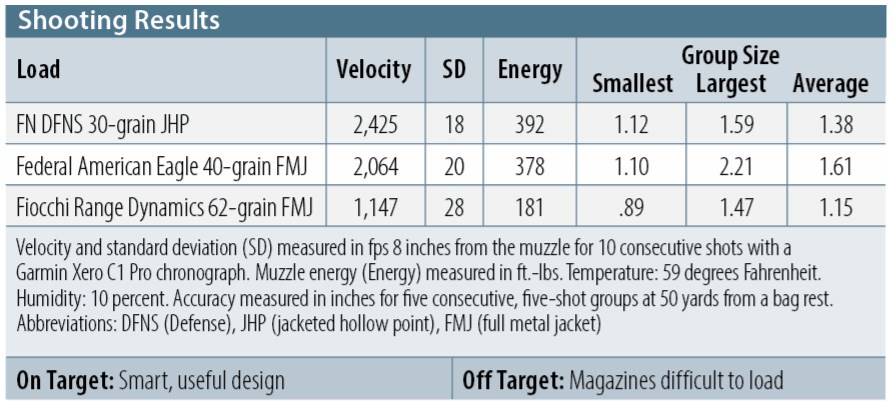
What’s the bottom line on the M&P FPC 5.7? I think it’s a slam-dunk. It’s positioned well, price-wise, in the market—it’s roughly in the middle of the pack of 5.7 mm firearms—and the ability to fold as well as share magazines with the companion handgun are huge bonuses. If you appreciate the oddball cartridge (that’s getting to be less and less oddball) and are looking for a useful carbine in which to shoot it, the FPC is an excellent choice. In fact, I liked it so much, I’ve put it on my “wish list.”
Read the full article here