


To fully trace the origin story of the Daniel Defense H9 Compact, you’d have to go back to the late 1990s, as online firearm forums were gradually supplanting the old rec.guns newsgroup on Usenet.
Step into the General Firearms Discussion section of any forum not dedicated to a specific brand and you were stepping into a war zone dominated by two feuding camps: the Glock Fanboys and the 1911 Acolytes were the Jets and the Sharks of these online war zones.
The 1911 Sharks liked the short, light trigger that slid horizontally in its track rather than pivoting, and they also preferred the metal frame. The Glock Jets touted the simple striker-fired lockwork, reliability and ease of disassembly. They both agreed that the low-bore axis of the designs made them paragons of shootability.
In the mid-1990s, a company by the name of Alchemy Arms—a manufacturer of small parts provided to both the Glock and 1911 ecosystems—went to work trying to combine the best features of both platforms. They made a splash at SHOT Show in 2000 with the Alchemy Arms Spectre.
It had a metal frame, grip and manual safeties and a lightweight, sliding trigger like a 1911. It also used a simple striker-firing mechanism and a double-column magazine like the Glock. Ambitious plans were announced for versions in 9 mm, .40 S&W and .45 ACP but, in the end, it never really got off the ground. Only 100 or 200 pistols ever shipped, all in .45 ACP, before the manufacturer ceased to exist in 2006.
Fast-forward to 2017, and SHOT Show talk was again about a funky hybrid of Glock and 1911 features, this time with an added twist.
Perhaps the most tangible difference between the H9 and its competitors is that the blade of the trigger safety hinges at the bottom, rather than at the top or in the center of the trigger as with most other designs • Disassembly is reassuringly simple. A few manipulations familiar to owners of most striker-fired pistols, and the H9 quickly and easily breaks down into its large-component groups • A three-slot Picatinny rail means the H9 can accommodate full-size weapon lights • The innards of the new H9 are less complicated than previous iterations of the pistol. There is both simplicity and sturdiness to the parts. This most-recent gun is elegant without being fragile.
The Hudson H9, as the name might suggest, was designed as a 9 mm pistol from the ground up. Like the Spectre, it combined a metal frame (though steel rather than aluminum) and a sliding 1911-style trigger with a striker-fired action and a Glock-esque slide.
Unlike the Spectre, it utilized a chassis-style construction, with the lockwork and rails forming a separate subassembly that nestled in the grip module, and separate grip panels so you could theoretically bling it up to suit your taste. Most notably, it had a bizarrely deep dust cover that positioned the recoil spring assembly well below the bore axis, further taming muzzle flip.
The odd new pistol generated outsized interest, but took time to get to production. Alas, starting a gun company from scratch is not an easy task (or else everybody would be doing it) and the Hudson H9 just never really got enough runway to achieve flying speed. The company announced a second model, the aluminum H9A, but shut its doors for good shortly after.
This time, however, the idea of the Glock/1911 hybrid did not vanish from the world entirely. The rights to the Hudson design were acquired by Daniel Defense, a company with a solid manufacturing base and long experience producing precision firearms. Rather than just restarting production, its engineers dove into the guts of the design and—well, it wouldn’t be entirely fair to say they jacked up the H9 name and slid a whole new pistol under it. However, the pistol in today’s test would be better described as “inspired by the Hudson H9” than as a “continuation of the Hudson H9.”
Pop the bright yellow latches on the black, injection-molded pistol case with the raised Daniel Defense logo and you’re greeted with a gray foam lining that’s precision-cut to cradle the H9 Compact pistol as well as two spare 15-round magazines, for a total of three mags.
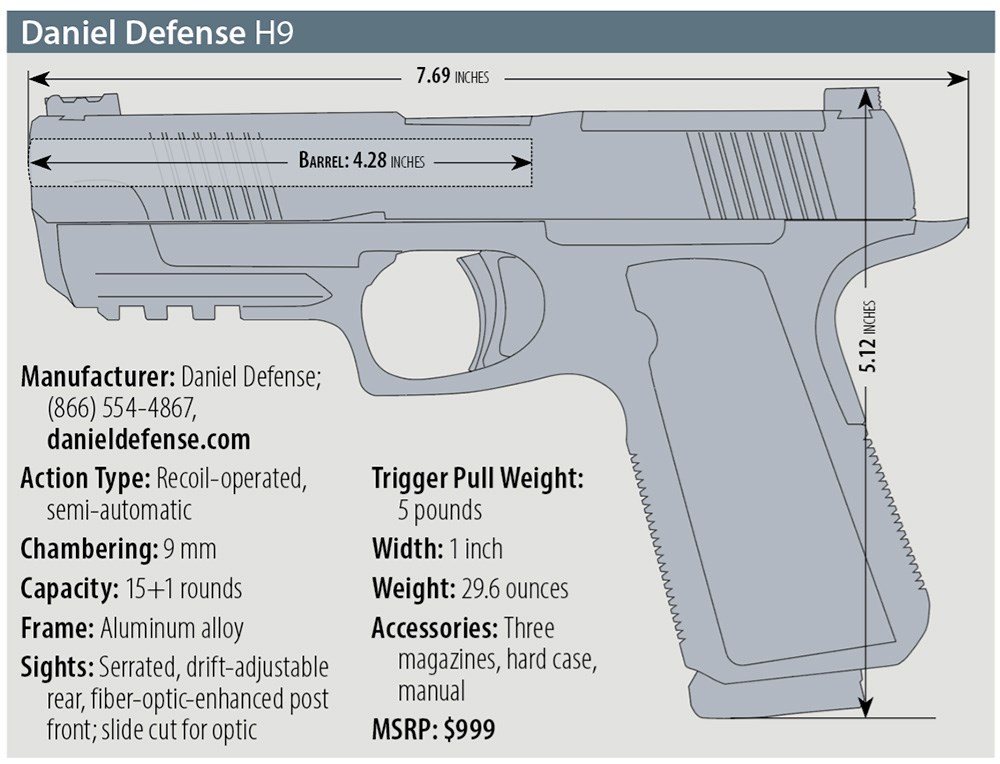
The H9 Compact itself is dimensionally similar to a Hi-Power or perhaps a Glock G17 with the grip chopped to G19 length, al- though the Glock comparisons are unfair as the H9 is unusually svelte for a metal-frame, double-stack pistol. It feels way more Browning-like in the hand; by comparison, a G19 feels like the box a pistol came in.
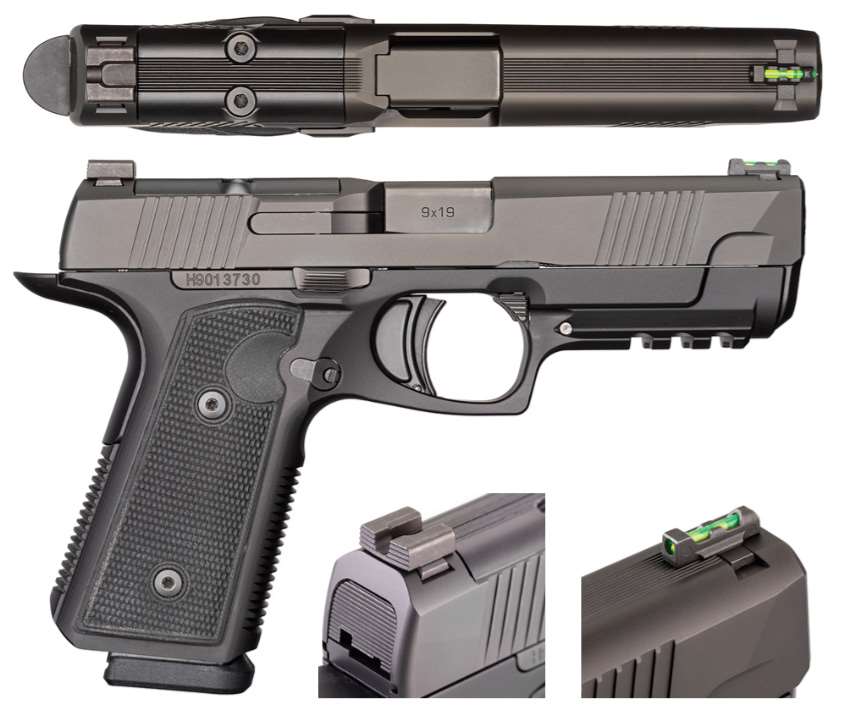
Narrow and clean when viewed from above, the H9 doesn’t have a lot of protrusions that might snag on the draw • The profile isn’t as radical as that of the Hudson pistol, yet it still evokes that earlier gun • The notched rear sight is dovetailed into the slide, as is the front. However, the rear is plain black, whereas the front post is enhanced with a green fiber-optic.
Starting at the top of the handgun, the top of the slide is machined flat and features longitudinal serrations to minimize glare in the sighting plane. The sights are mounted via now-practically-industry-standard SIG Sauer dovetails. The sights on the test pistol consisted of fixed irons with a green fiber optic insert up front. The rear has a U-notch with ample light bars on either side of the front blade and glare-reducing serrations on the rear of the sight body.
One big departure from the previous design is immediately noticeable atop the slide, where there are a pair of countersunk screws securing a cover plate over a cutout for a miniature red-dot optic. In the case, along with the manual, the buyer will find a coupon with a code to scan to allow them to get a free MRDS adaptor plate shipped from Daniel Defense. Plates are available for the Shield, RMR, C-More and Docter/Noblex optic footprints.
On the sides of the slide are angled grasping grooves, eight pairs in the rear and seven up front. The extractor claw is a pivoting external affair that also doubles as a visual and tactile loaded-chamber indicator. The tilting barrel uses the common modified Browning system, locking into the ejection port with a square shoulder atop the chamber. Barrel lockup was impressively snug.
Moving down into the frame, we get to some of the larger differences between the Daniel Defense pistol and its forebear. For starters, the frame is machined aluminum rather than steel, making for a lighter pistol.
The dustcover is not as deep. While still chunkier than most, it no longer extends all the way to the bottom corner of the trigger guard. The widely offset recoil-spring assembly apparently induced more problems than it solved. The Picatinny rail on the bottom of the cover now boasts three slots instead of one and is long enough to accommodate full-size weaponlights like the X300U from SureFire or Streamlight’s TLR-1 series, as well as more compact units.
There are ambidextrous slide releases above and behind the trigger on either side. Smoothly contoured and snag-free, they fall readily under the shooter’s thumb and are lightly serrated for ease of operation. The magazine catch is where you’d expect it and, while not ambidextrous, it is reversible in case you’re one of those poor souls who must shop for left-handed holsters.
The frontstrap and backstrap are serrated rather than checkered, and I have to give Daniel Defense props for selecting a texture that affords good purchase without tearing up your hand or your clothes.
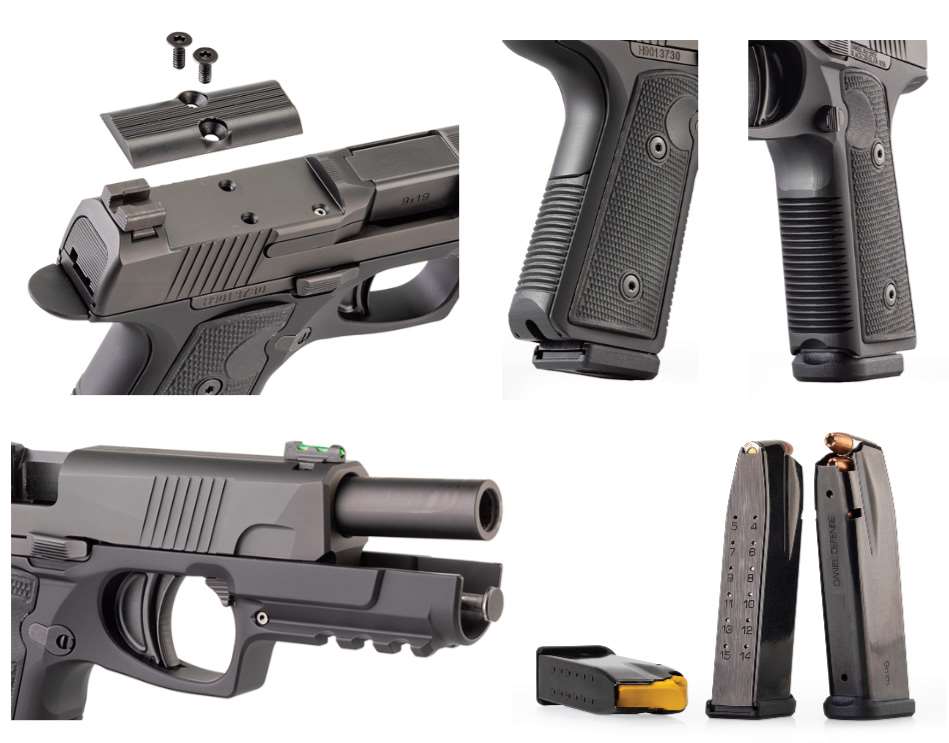
Unlike its predecessors, the H9 is pre- cut for an optical sight, with various optic-footprint plates available from Daniel Defense for the majority of MRDS offerings on the market • Both the back- strap and frontstrap are serrated for good purchase without abrasiveness • Detachable grip panels give H9 owners the ability to customize their pistols, something not possible with most polymer-frame pistols • Value is added to the H9 by the inclusion of three double-stack magazines, all of which functioned perfectly in testing • The steel slide is CNC machined and given a DLC coating, while the barrel is cold-hammer-forged stainless steel.
Another improvement over the original is the takedown system. While the Hudson’s was somewhat baroque, that on the new Daniel Defense H9 Compact is basically straight-up Glock. There are a pair of levers ahead of and above the trigger. After you’ve dropped the magazine and cleared the chamber—triple-checking to make sure it’s really and truly clear—point the firearm in a safe direction and dry fire. Retract the slide slightly and pull down on the levers before easing the slide assembly forward off the frame. Inset into the frame, you’ll notice the chassis that contains the lockwork and forms the frame rails, but this does not need to be removed for normal cleaning.
Inside the trigger guard is a sliding trigger like that of a 1911, although it has a pivoting safety tab to prevent inertial discharges if dropped. The safety tab pivots at the bottom rather than at the top, which can take some getting used to.
The fact that it’s a striker-fired design means that, although the trigger may slide straight in its track like that of a 1911, there’s a lot more travel and a spongier feel to the trigger break than John Moses Browning’s classic design. Still, it’s quite manageable and the trigger consistently broke right at 5 pounds on the nose according to my RCBS scale.
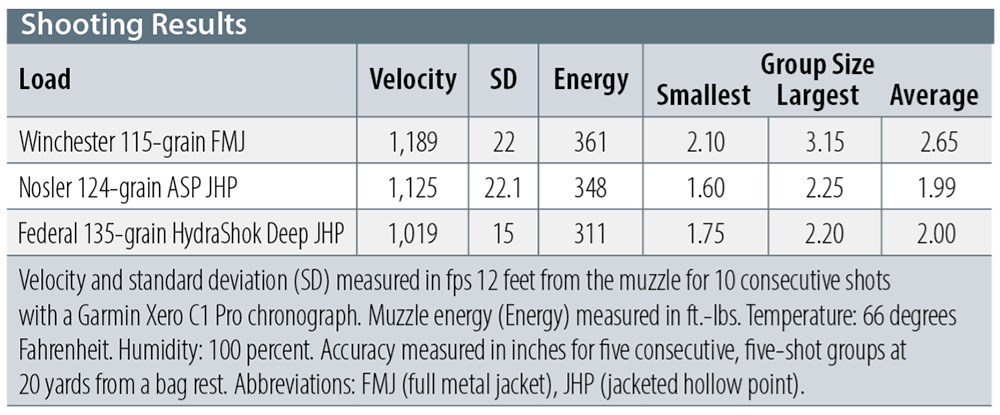
Any accuracy bugs from the initial Daniel Defense H9 launch seem to have been ironed out of this newly unveiled H9 Compact test gun. It functioned well with 300 rounds of ball ammunition and 150 rounds of three different brands of hollow points. It was also satisfyingly accurate, especially with the Federal Hydra-Shok Deep. There were no malfunctions of any kind to report over the course of the testing, although the slide-to-frame fit suggests that this pistol is going to get its preference for lubrication more from the 1911 side of its ancestry rather than from its Glock genes.
Where does the Daniel Defense H9 Compact fit in the general handgun ecosystem? Well, this would make a quality carry piece for someone with a taste for something a little off the beaten path, but who appreciates quality construction and a pedigree with real hybrid vigor. Pairing the rigidity of an aluminum frame with a striker-firing action alone merits some attention as that combination seems to be gaining some interest now. But the H9 Compact is also a working, mass-produced example of a design that has captured the gun community’s interest almost as much for being vaporware as for its many merits. Well, it’s vaporware no more, so you finally have a chance to own one.
Read the full article here