


I had two major surprises as I reviewed the Columbia River Knife and Tool (CRKT) Drifter Liner Lock Folding Knife: one positive and one negative.
The positive surprise was the durability of the gray titanium nitride finish on the blade. It showed absolutely no signs of wear after more than a month of regular use. I was very impressed.
The negative surprise was the country of origin. I ordered the knife because a knife-seller’s website indicated that it was “made in Taiwan”. When the knife arrived, the words “Made in China” were clearly printed on the box. The actual CRKT website is silent about the country of origin of the knife. I would appreciate greater transparency from CRKT about where their various products are made.
At the time of this writing, the Drifter Liner Lock in 8Cr14MoV steel cost $34.99 at crkt.com.
Description
The CRKT Drifter is a good, basic everyday carry (EDC) knife. It has a 2.75 inch, drop-point, hollow-ground blade that is shaving sharp right out of the box. It has an overall length of 3.5 inches when closed and 6.5 inches when opened. The base of the spine is 0.09 inches thick and has jimping to provide better control during delicate cuts.
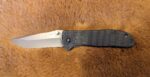
 The blade deploys smoothly and ambidextrously using dual thumb studs. It is held open by a liner lock. It is made of 8Cr14MoV steel. The use of that Chinese steel tends to be an indicator of Chinese manufacture. If I had paid closer attention to the fine print when I ordered it, I could have avoided inadvertently ordering yet another Chinese-made product. There is also a version of the knife with a D2 blade, which is what I thought I was ordering.
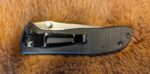
 The black G10 scales of the handle have a faux-canvas-Micarta-like texture that provide excellent grip. They are mounted to a steel liner. A lanyard hole near the butt of the handle looks just a little too small to accommodate paracord. A sturdy pocket clip on the front right of the handle held the knife effectively in my pocket throughout the testing period.
The knife is light and easy to carry at only 2.4 ounces.
As I mentioned above, the gray titanium nitride finish is attractive and unusually durable. I am very impressed with it.
The knife arrived in a 4.63 x 1.5 x 1.13 inch product box. The box contained the knife in a plastic bag and a highly amusing brochure. In addition to do’s and don’ts of knife care and warranty information, the brochure included a section on “How to avoid being asked to work the weekend by your boss.” The three possible suggestions for the latter were to tell your boss that you have a family emergency, to fake an illness, or to “Cut a hole in the ceiling with a K.I.S.S. knife and climb out.” The last suggestion was illustrated with a drawing. The reference to a K.I.S.S. knife refers to CRKT’s iconic and minimalist “Keep It Super Simple” knife. That knife really established CRKT as a serious contender in the knife manufacturing market. It sold like hotcakes after its introduction at the 1997 Shot Show. Unfortunately, most K.I.S.S. models are made in China.
The do’s and don’t’s of knife care were illuminating. Among the don’ts were, don’t “Use the blade to pry, turn screws, dig, or scrape.” They also recommended not using the blade as a hammer.
In that connection, I must confess that during the testing process I used the blade to scrape some crud out of the switch on my wife, “Kari’s” personal blender. At another point during the testing process, I hammered small nails into a toy pirate ship that my grandson and I were building together. I probably used it to pry something as well, but I do that so often that I don’t even notice.
It is possible that I have a genetic predisposition to knife abuse. The tips of almost every table knife in the silverware drawer at my home while I was growing up were deformed. That is because my mother habitually used the tip of a table knife whenever she needed a flat head screwdriver.
Ironically, the lifetime warranty for the Drifter explicitly excludes blade tip breakage, since it is almost always due to abuse. The warranty only covers defective materials and workmanship for the original owner.
Testing
Over the course of more than a month of daily carry, the knife proved useful for a multitude of mostly boring, mundane tasks:
–Opening mail.
–Opening a box of Unlocked devotional booklets for teens, to be distributed in the church foyer.
–Cutting a piece of burrito casserole to warm up for lunch. (I washed the knife first). I then used the knife as a table knife while I ate the burrito casserole.
–Opening a package of Bear Knuckles gloves that I bought to give to some of our missionaries as birthday presents throughout the year.
–Opening a box with a large food order from a warehouse club of which we are members.
–Cutting some chunks off of a giant Hershey Kiss that I had received for Christmas so that I could eat some of it.
–Opening a package of mac & cheese so that I could prepare it.
–Opening a package containing a copy of J.I. Packer’s book Knowing God. I purchased the book so that I could loan it to a congregant at our church. (I had already loaned out another copy to a different congregant).
–Opening a package of Kingstone Comics dealing with the resurrection of Jesus.
–Opening a package of electric crimp terminals so that I could use them to repair my car.
–Opening a box of minibooks from New Growth Press for distribution in the church foyer.
–Opening multiple packages of gospel tracts for distribution in the church foyer.
–Opening a box containing Our Daily Bread booklets for distribution in the church foyer.
–Opening suet for Kari’s bird feeders.
–Opening bags of salt for the water softener.
–Opening a bag of dog food.
–Opening a package of .22 caliber pellets for an air gun.
–Opening boxes of toner cartridges for the two copy-machine/printers at the church office.
–Cutting a page out of a coloring book for my grandson.
–Scraping creosote off the surface of a wet jacket that I was pre-washing in a wash tub prior to putting it in the laundry.
–Prying open a key fob so that the battery could be replaced.
–Opening a package with a new battery for a key fob.
–Removing the staple holding a receipt to an incorrect purchase order.
–Opening a shipment of ammo for a rifle that I will be testing.
–Opening the dog’s monthly dose of flea and tick treatment.
–Opening a shipment of communion bread from Christian Book Distributors.
–Stripping wires so that I could put a new plug on a vacuum cleaner.
The Drifter did an excellent job on all of these tasks.
About CRKT
Columbia River Knife and Tool (CRKT) was founded in 1994 by two former employees of Kershaw Knives: Paul Gillespi and Rod Bremer.
Among of the company’s more well-known products are the K.I.S.S. knife mentioned above and the many varieties of the M16 folding knife. M16 folding knives were widely carried by American forces in Iraq and Afghanistan.
CRKT is located in Tualatin, Oregon.
8Cr14MoV Steel
8Cr14MoV is a Chinese version of Japanese AUS-8 steel. It consists of X% iron, 13.8% chromium, 0.78% carbon, 0.2% molybdenum, and 0.15% vanadium.
Since it contains more than 10.5% chromium, 8Cr14MoV is considered a stainless steel.
8Cr14MoV is considered a budget knife steel. In my testing, I have developed a definite preference for budget knife steels. This is because they tend to sharpen more easily than the more expensive steels. This, in turn, makes it more practical to maintain a useful edge during use in the field.
I am not a metallurgist. If you are interested in a metallurgist’s perspective on 8Cr14MoV, I recommend visiting this web page.
Conclusions
The CRKT Drifter Liner Lock folding knife is a good basic EDC knife. It is light, easy to carry, easy to open, easy to grip, and has a durable titanium nitride finish on the blade. It is one of the better EDC knives at this price point that I have used.
The only drawback of the Drifter is its country of manufacture. Buying this knife strengthens the hand of a geopolitical adversary.
If you are considering the purchase of a CRKT knife, I recommend using AI to inquire about where the particular model that you are considering was manufactured. I generally avoid AI for most purposes whenever possible. A place-of-manufacture-search is the one task at which I have found AI to be somewhat helpful. I have had occasions when AI has assured me that items were made in American when they were in fact made in China. But so far, AI has been 100% accurate when it told me that an item was made in China.
Based on their lack of transparency about the place of manufacture of their various knives, I will probably avoid reviewing CRKT knives in the future.
Disclaimer
Bear Knuckles provided me with samples of several of their gloves for previous reviews. I believe that it was the quality of their gloves rather than their kindness that motivated me to order some of their gloves as birthday presents for our church’s missionaries as mentioned in this article. I did not receive any other financial or other inducement to mention any vendor, product, or service in this article.
Read the full article here