
The internet is one of the greatest inventions in the history of mankind. It lets us share the knowledge of the universe and instantly communicate throughout the world. It’s allowed lifesaving surgery to be performed in remote locations and has brought the truth of freedom to repressed countries. So, then, why do so many of us use it to argue endlessly with people we don’t know and to post photos of our food?
After years of surfing, I am a bit skeptical of anything online. I saw that Elvis is living in Nebraska and that Bigfoot is real. I don’t doubt those things, but I am never sure of anything else.
My point is, don’t believe everything you read on social media. Take shooting, for example. In the last few years, it seems like everybody (but me) has a rifle that will shoot half-inch groups at 1,000 yards on demand. FYI: The world record for a five-shot group at 1,000 yards is 1.068 inches … yet a whole bunch of folks on Facebook claim to have an out-of-the-box rifle that betters the world record by half. They post photos of the targets as proof. Often, those targets have scorch marks on them.
Accuracy is a complicated and complex issue. In today’s world, expectations are much higher than they were in my grandfather’s times. Back then, the goal was a gun that would shoot all its bullets into one minute of angle (MOA). It wasn’t always achievable, but it was a solid goal. Few guns came out of the shipping box capable of that level of accuracy with factory-loaded ammo. But, with tweaks to the rifle and handloaded ammunition, it was—about as often as not—achievable.
The quest for greater accuracy extends to cartridge design and ammunition manufacturing processes. While all new cartridges promise some kind of performance improvement, their staying power in the marketplace varies greatly. Some, like 6.5 Creedmoor, take years to build a significant following, but then explode in popularity, while others, like some of the short-magnum offerings, start hot, then fade to near oblivion.
Fast-forward a couple of generations to mine, the Boomers. We watched a huge transformation in the accuracy of factory rifles throughout our lives. When I was starting out on this gun-guy journey in the early 1970s, the new rifles were not unlike my grandfather’s. They were still made pretty much the same way, so we had about the same results. We had a lot more to pick from, sure, but few showed any huge advancements in accuracy as they arrived from the factory.
My first centerfire rifle was a Remington Model 788 in .243 Win. I bought it on Halloween eve, 1968. I was rather proud that, for years, the barrel was never polluted by a factory round. That demonstrates the gun-guy attitudes at the time, which no doubt trickled down to my young mind full of mush. Records are very incomplete, but those I do have with that gun are all with handloads. I settled on two: 105-grain Speer roundnose bullets for deer and 85-grain Sierra BTHP for woodchucks. Both grouped 1 inch or slightly larger. As I recall, it took a while to get to that point, even with the 788, which was noted for its accuracy.
My next bolt-action was a Remington 700 in 7 mm Rem. Mag. While I was broke and had few prospects for changing that, I needed an elk rifle. No matter that elk lived on the other side of the continent—I knew in my mind I would hunt them one day, so I had to be ready. (Oddly enough, over the years I have hunted elk multiple times, but never with that rifle. Deer, bear and caribou, yes, but no elk.)
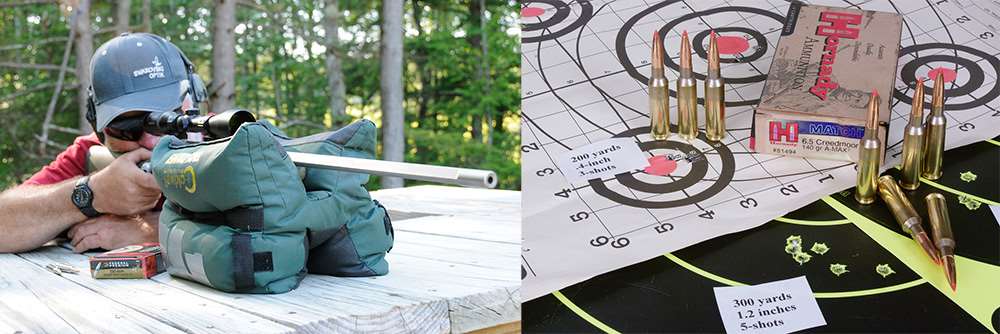
The author conducted all analyzed testing at 100 yards from a solid bench with the rifle supported at the front and the back • What used to be considered medium- or even long-range shooting decades ago has been rendered almost easy thanks to advancements in firearm and ammunition manufacturing.
Again, records are a bit sketchy, but those I can find show that Remington 150-grain factory loads produced 1.5-inch groups. The 175-grain Remington factory ammo produced an amazing 1.25-inch, five-shot group —at least one, anyway. I clearly struggled with handloads but ended up with a load using 160-grain Speer bullets that shot .75-inch group(s) (the record does not say how many groups; it may be one or an average of a hundred. I am assuming it was a novel event).
Another example from that era I’ll mention because of recent events is my Ruger M77 7×57 mm rifle made in 1981. I bought it used some 30-odd years ago. It’s a cool rifle in an intriguing cartridge, but it never shot all that well with the ammo available at the time. It’s been sitting neglected in my gun vault for a long time, but I’m on a kick of getting out some of my neglected guns and using them again. So, I decided to see if this gun would shoot better with today’s ammo. I shot most of the 7×57 mm ammo on the market today, which isn’t a lot, and the results were mostly disappointing.
Hoping for better, I took the gun to my shop, where I re-crowned the barrel and removed the fore-end tip pressure to freefloat the barrel. Then I did a deep clean on the bore. It had already been glass-bedded. This is the stuff that has been done since my grandfather’s time to enhance accuracy.
Back at the range, I shot all the new factory ammo stuff again as well as a dozen different handloads. I tossed the results from a few that simply sucked. The rest averaged 1.8 inches. The best was the Hornady International factory load (which is not even sold in the United States) at 1.2 inches. My best handload was 1.4 inches.
This is surprisingly better than the gun shot when I bought it. Back then, it averaged about 2.5 inches. Still, by today’s standards, it’s not great. The truth is, guns from that era often were just not that accurate. I have dozens of examples, but not the word count to go into them. Besides, it would just be a repeat of the same story until we get to more recent years.
So, what changed? A couple of things. The one most talked about is that gunmakers switched to computer-controlled machinery to make their guns. We gun guys like to talk about old craftsmen, but those were the elite of the business. Most of the guns were made by bored, disconnected factory workers. I have worked in factories and I understand. I didn’t make guns—we made feminine hygiene products and plastic bags—but I have toured innumerable gun and ammo factories and the look on the workers’ faces is the same as the folks I worked with.
Computers don’t get bored. They don’t worry about mortgages or if their spouse is cheating, and they don’t need a good night’s sleep. So, the guns being turned out by CNC machines have a much higher level of quality and consistency. It is also important to note that the tolerances are much tighter with computers, which is a big factor in performance. My engineer son works making precision parts for the medical and aerospace industries, and he works at times with a tolerance of .00005 inch. So, the possibilities are mind-boggling. Guns are not that precise (few things are), but the tolerances used in firearms are much smaller now than when imperfect humans used manual machines.
The second reason is good old capitalism. When my grandfather was looking for a new rifle, his factory-made options to pick from were basically Winchester, Remington and Savage. Today when we want a new rifle, we have a multitude of brands to choose from. Gunmakers must have a clear focus on accuracy demands from their customers, or risk failure.
A lot of the same factors apply to factory ammo as well: better manufacturing, better components and fierce market competition.
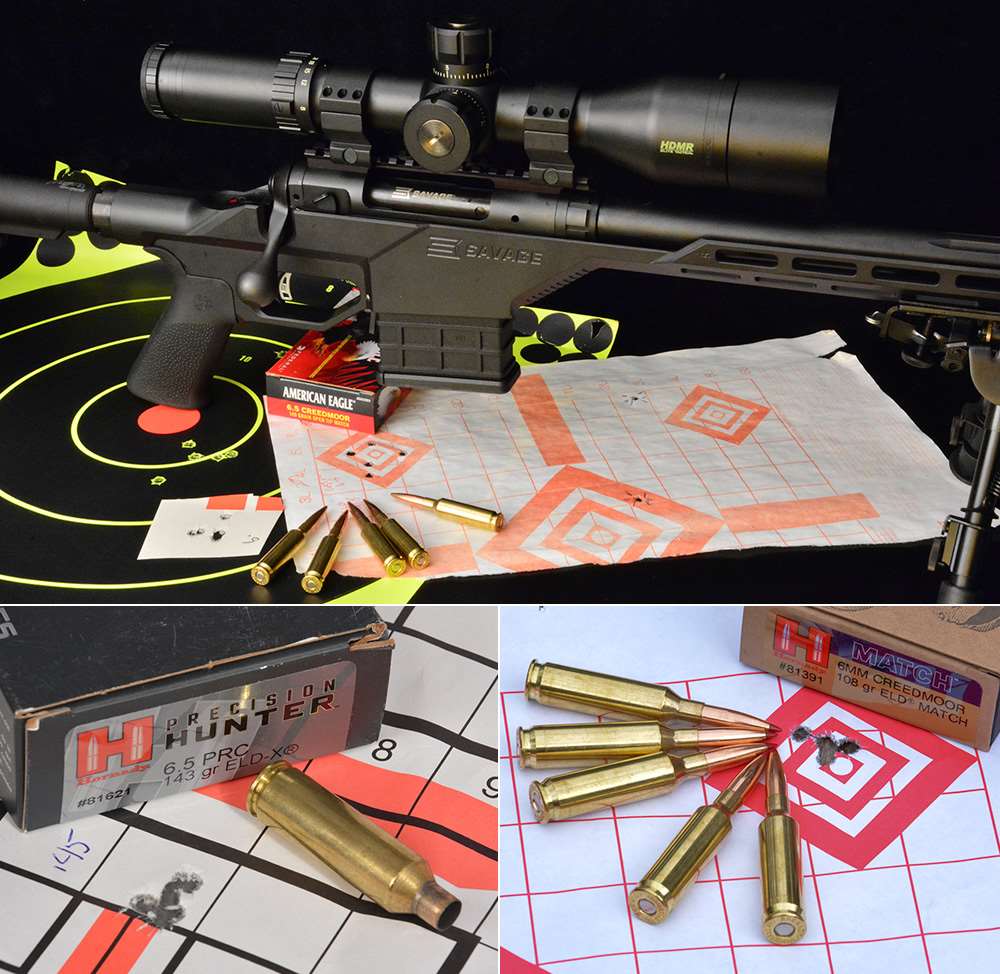
One-large-hole groups at 100 yards are now relatively common, where they used to be fantasy • Cartridge design now incorporates Doppler radar testing and other technologies that were unavailable until quite recently • Today’s rifles, optics and ammunition can achieve accuracy that only existed in highly customized guns in the past. Where 25 years ago a 1-inch group at 100 yards would have been thought excellent, it is now a baseline standard.
I have been writing about guns for more than 45 years. Much of my work has been testing new rifles. Any article I wrote about a new rifle included a formal range test where I shot several groups from a bench at a measured 100 yards. For almost 30 years, I have entered most of the information into a database, so I have a pretty good idea of what to expect from a new rifle in terms of accuracy.
Let’s look at what’s changed. For another article some years ago, I went into the database and found six rifles I tested in 2001. I simply picked them as they came up while I scrolled through the database with no effort to pick and choose. These were all tested to the American Rifleman protocol of five, five-shot groups with at least three different ammo products. The average of ninety, five-shot groups at 100 yards was 1.9 inches.
Out of those six rifles and 18 different ammo products, one produced a sub-inch average group size at .96-inch—a Browning A-Bolt in .300 WSM. The ammunition was Winchester’s 180-grain Fail Safe, a load that is no longer produced.
I also picked eight factory-made, bolt-action rifles tested in what was then the most recent years (this was in 2019). Again, no attempt to cherry-pick; I just chose them at random. The average for 120, five-shot groups at 100 yards is .9 inch, or, if I am doing my math correctly, .86 MOA. That’s a huge improvement in rifle and ammo accuracy in just the past two decades.
I decided to look a bit further at that database. (Well, two databases. Bill Gates forced me to change what I used by not supporting the software that had almost 30 years of data for guns and photography.) Rather than calculate thousands of individual groups, I took the average of the test groups for each rifle and ammo and then averaged those numbers. It’s statistically the same result, but a lot less math for me.
I started with nearly 3,000 data points of guns and ammo tested since late 1999. If I had been more diligent in my record-keeping, that number would no doubt be a lot bigger. Everything is written down someplace, but Methuselah wouldn’t live long enough to find and analyze it all in this landfill of shooting stuff. So, I am going with what is loaded on the computer, which includes all tests done for NRA Media.
I went through the data and removed any custom guns or any that have had improvements made for accuracy other than a better trigger. I also eliminated any handloads, using only factory rifles and factory ammo. Any gun that was not a new, factory-made firearm was also eliminated.
The data reflects the guns I was testing at the time. So, most from the early years are hunting rifles. Later, it includes modern sporting rifles and precision rifles as they became popular. I can’t say for sure how that skewed the data, but, considering how it compares with the earlier (2019) rifle average, it didn’t—the difference between them is only .157 inch.
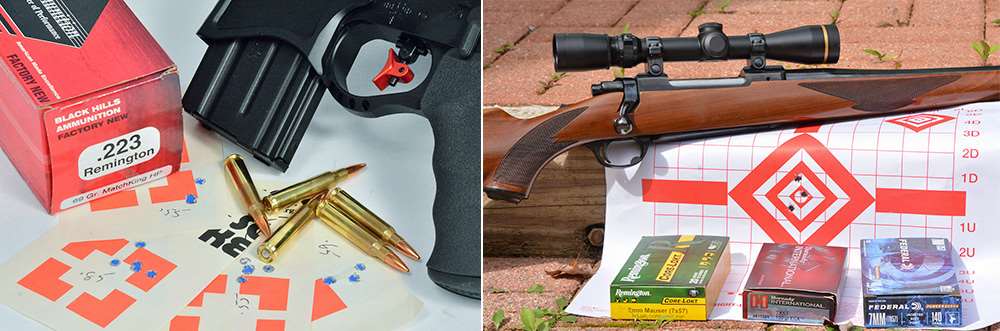
AR-platform rifles used to be considered relatively inaccurate, but enormous advancements have made them capable of greater precision than many older bolt guns • This rifle from 1981 has been substantially modified, but still can’t shoot as accurately as most of today’s factory rifles.
After a heavy cull, I ended up with 260 data points from guns tested between 1999 and 2011. It includes all kinds of rifles and multiple cartridges. Many, perhaps most, were five-shot groups, but since American Hunter has a different protocol and many of the tests were for that publication, I sometimes used three-shot groups.
The average for all the 260 data points is 2.057 inches, center to center, at 100 yards.
There are 33 smaller than the magic 1 inch, but only one that was a half-inch. Nothing was smaller. That group average was from the very short-lived Mossberg SSi One single-shot rifle, and I suspect it was a bit of an outlier.
Data from 2021 to 2024 on the older database has 28 usable entries and a group average of 1.44 inches. That was skewed pretty badly by two rotten rifles. If I eliminate them, the average is .99 inch.
This newest database, for 2024 and 2025, has 19 usable entries with a group average of .75-inch. All but two are sub-inch, and those barely missed at 1.02 and 1.14. If I take all the entries from the two databases, 2021 through 2025, including those rotten guns, the average is 1.09-inch for 47 data points. If I tossed the misfits, it would be .87-inch. That is a 58-percent improvement over the pre-2011 guns. Remember, this is for out-of-the-box rifles with factory ammo.
The best result came from a Savage 110 Magpul Hunter rifle in 6.5 Creedmoor using Hornady ELD-X 143-grain ammo with a group average of .47 inch. Second is .48 inch from the same rifle with Hornady ELD-M 147-grain ammo. That level of accuracy today would astound our grandfathers. If you had told the great gun guys of the early 20th century that factory ammo and rifles would be this good, they would have laughed at you. We truly have come a long way.
But half-inch, 1,000-yard groups? That is still an internet fantasy … for now.
Read the full article here