


As we celebrate our nation’s 250th birthday, what better way to showcase it than with an example of America’s Rifle, the AR-15? While, certainly, semi-automatic rifles are available worldwide, the United States was the first nation to mass-issue semi-automatic rifles in wartime, namely the esteemed M1 Garand. Post World War II development brought us the M16, which has been in service since Vietnam, and has always been available in semi-automatic guise as the AR-15. The rifle we have today is an homage to specialized versions of the M16 used in Vietnam, like the Colt 607 or Commando XM177.
I opted for the A1 Carbine SBR from Rock River Arms for several reasons. First, it’s just plain cool, and there’s little justification needed beyond that for picking up a new gun. It’s a mixture of throwback, retro and nostalgia with a bayonet lug, and you just can’t go wrong there, in my opinion. Rock River Arms is one of the few AR-15 manufacturers still churning out semi-automatic rifles like it did in the early days, under the same management, through boom-and-bust times—a definite American success story. Heck, I had the pleasure of shaking Rock River founder and CEO Chuck Larson’s hand at NRA’s 155th Annual Meeting in Houston, Texas, just a few months ago.
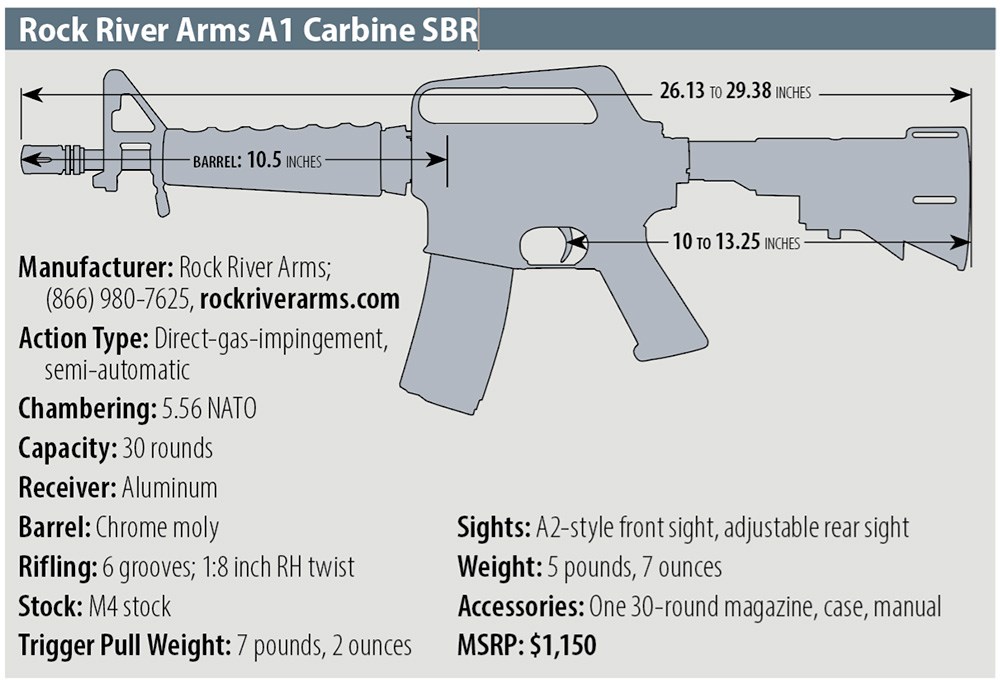
While the profile looks familiar, it’s smaller than expected, with the 10.5-inch barrel barely extending past the A2 front sight block, in addition to the slickside receiver with no brass deflector or forward assist • Should a suppressor be desired, the A2 birdcage flash hider can be removed to access the standard 1/2×28 tpi threaded barrel • Two apertures allow the rear sight to offer close and far sight pictures, while the front post can be adjusted for elevation.
But, back to the carbine. With the 10.5-inch barrel, carry-handle upper receiver and triangular handguard, the retro vibe of Rock River Arms’ A1 Carbine SBR is unmistakable. This is a rifle you get because you want something nostalgic, like buying a record player when streaming music services are widely available. Yes, a flat-top upper receiver gives more options for optics. Yes, a freefloat handguard provides greater accuracy potential as well as options for attachments. That’s not what the A1 Carbine SBR is about. It’s a throwback to the ’60s and ’70s, the start of the AR-15’s ascendency to becoming “America’s Rifle” and the beginning of the modern era of semi-automatic rifles.
Buying a rifle “because I think it’s cool” is quite possibly one of the most American things one can do—there aren’t a lot of places where that freedom exists. Now that the tax on short-barreled rifles has been reduced to $0 thanks to the work of your NRA, the added cost of an SBR isn’t a factor: the A1 Carbine SBR is pretty close in price to a comparable, non-NFA rifle with a 16-inch barrel. Yes, there’s a bit more paperwork involved, but at least there is no longer an extra $200 on top of the rifle’s initial cost of acquisition.
What’s this firearm’s place in the world? That’s the beauty of it—it can fill a wide variety of roles. Home defense? That short barrel will definitely make it easier to maneuver inside a dwelling. Feel like changing things up? That’s the beauty of the modular nature of the AR-15 line. For me, though? This is exactly the kind of rifle I’d want to bring out to the range when I felt like shooting something that’s just a little out of the ordinary. It’s not a cookie-cutter 16-inch carbine with a flat-top receiver sporting the latest LPVO or red dot; it’s something else. I—and most of my firearm-enthusiast friends—have several 16-inch carbines; very few of us have anything like the A1 Carbine SBR.
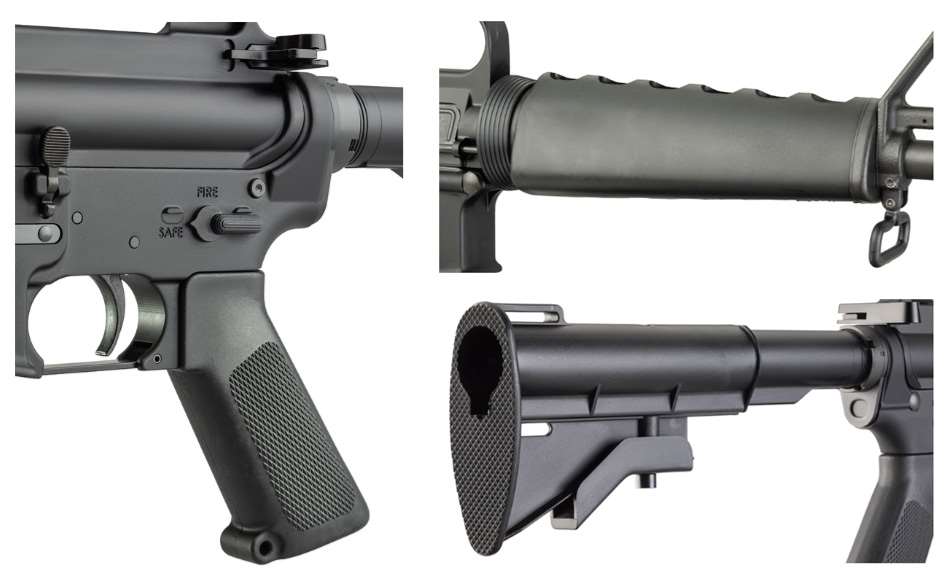
The A1 pistol grip sets the tone for the retro styling, as even the barest-bones modern AR has an A2 pistol grip • No freefloat barrel here, the delta-ring arrange- ment has triangular polymer handguards that are surprisingly comfortable and also allow for quick cooling • What Rock River calls the M4 stock isn’t what we typically think of, but continues the throwback styling of the early M4 carbine era.
Let’s look at this using an analogy from the automotive world: A modern Honda Accord is, by just about any metric, a superior automobile to a late-’70s Chevrolet Corvette. It’s faster, safer and has orders of magnitude more creature comforts and gadgets. You want the Accord to drive every day, but when it comes to taking a leisurely tour on a bright summer afternoon, that loud, inefficient V8 rumble provides a more satisfying soundtrack, and those ubiquitous T-tops add way more “cool factor” than a sunroof. To each his or her own, your mileage may vary; it’s a long-winded way of saying that not everyone is the same with the same tastes, and that’s great.
Let’s take a moment to actually look at the A1 Carbine SBR: Four-position stock, not six—but ask yourself, have you ever used all six positions in a modern carbine? I use fully extended when I’m shooting and fully closed when transporting and storing. I could realistically get by with a two-position stock in 99 percent of my applications. Okay, maybe add a third position somewhere in the middle for when I’m shooting in the middle of winter with a parka on, or if I’m letting someone much smaller than myself shoot it. Beyond that, though? Eh.
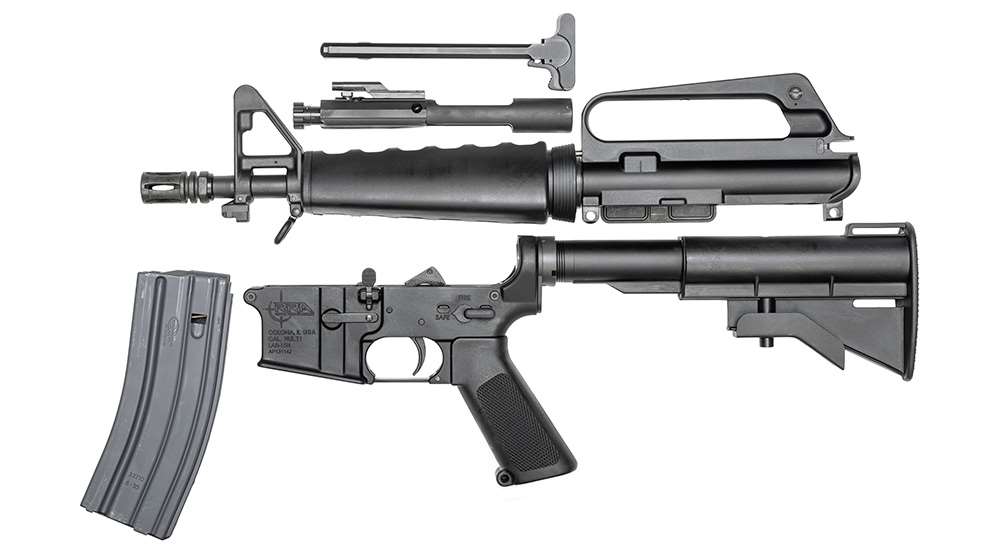
One thing that does not change with either the old-school styling or the shorter barrel is the takedown procedure, which is bone-standard AR-15: After ensuring the firearm is unloaded, press the two takedown pins out and separate the receivers, then remove the bolt-carrier group for basic maintenance.
The sights are adjustable, but not particularly easy to change. Honestly? I kind of like the idea of having at least one rifle with straight-up iron sights. The handguard doesn’t allow for lights, lasers or other accessories, but again, this rifle is an homage to the days before those things became commonplace. The astute reader will also note the absence of both the forward assist and the brass deflector. The lack of a forward assist might be a detriment to some, as it makes dealing with out-of-battery malfunctions more difficult; however others feel it is unnecessary in a modern, well engineered firearm, which the A1 Carbine SBR certainly is.
Returning to our automotive analogy, the A1 Carbine SBR is a ’68 Chevelle in a world of Teslas. (I know, I know, I changed my automotive metaphors mid-stream. Call it “writer’s prerogative” …). Aside from the retro cues, it’s a straight-up AR-15-style rifle. A1 pistol grip, right-hand-only controls, standard birdcage flash hider. Internally, it’s a Rock River Arms—it’s going to work, period. And, it disassembles like any other AR-15 for cleaning and lubrication; there’s nothing different about the operation and function other than a slightly shorter barrel.
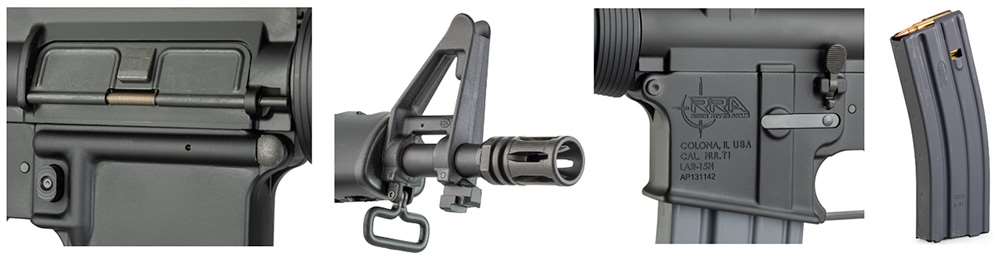
The A1 Carbine SBR has a dustcover to keep the ejection port clear of debris • While it does have a bayonet lug, the short barrel means it will be nigh-on impossible to mount a bayonet in the space between the lug and the end of the muzzle device • A lone metal magazine ships with the A1, but spares are plentiful and inexpensive • Controls are mil-spec, functional and familiar to anyone who knows the AR-15.
Here’s the best part: Rock River has already done the heavy lifting to make sure the rifle functions with that short barrel. I built an AR-15 pistol in .223 Rem. many years ago that literally went through four different buffer weights and two buffer-tube extensions before I found the configuration that would reliably cycle 55-grain ammo. That work’s been done here; you just load magazines and have fun.
Here’s another plug for the popularity of the AR-15-style rifle. Let’s say you decided to pick up the A1 Carbine SBR because you just love the retro styling and wanted it to fill a hole in your armory. With nothing more than the push of two pins, the turn of a screw and the prying of a lever, you could put a 10-inch, .338 ARC upper receiver with a red-dot sight and magnifier on top and swap out the grip and stock for the latest Magpul accessories. Use it in that configuration (suppressed hog-hunting rifle, anyone?) as long as you want, and with minimal effort, it goes right back to the retro configuration. Easy-peasy. Or, again, you could just enjoy it for what it is and be done, but the ability to change it into something completely different—and change it back without much effort—is part of what makes this platform so amazing. And uniquely American. The Swiss may have their multi-function pocketknives. We Americans have multi-function rifles …
Of course, all the retro styling in the world doesn’t mean much if it doesn’t work, so range testing is of paramount importance. American Rifleman testing protocol calls for three different brands of ammunition with different bullet weights to be fired through the firearm in question; obviously we want to run the gamut with available 5.56 NATO ammunition and opted for the standard 55- and 62-grain FMJ options in addition to one heavier-weight, match-grade option. Because I am a curious sort, I compared velocities of ammo used in our Ruger Harrier review a few months back just to see what kind of drop we’d see going from a 16-inch barrel to the 10.5-inch version in the Rock River. Results were not surprising; the 55-, 62- and 77-grain all showed between 185 and 520 fps drop in velocity because of the shorter barrel.
Reliability-wise, the A1 Carbine SBR ran just as you’d expect. Rock River has done its job tuning it, and whether it was fed 55-grain FMJs or 75-grain BTHP match ammo, no malfunctions were experienced over 260 total rounds fired. Everything from slow-fire accuracy testing to drum-magazine-fueled rapid fire performed without incident, although that short barrel does get uncomfortably hot relatively quickly. Certainly not a knock on the gun or Rock River—I don’t expect the company to be able to bend the laws of physics—but it is something about which to be aware if you want to run a lot of ammo through the carbine quickly. Wear gloves.
Other items of note: All levers worked as expected; the safety selector was easy to manipulate and could be moved easily between “Fire” and “Safe” without undue stiffness. The bone-stock charging handle works like millions of other standard charging handles (and, again, is super easy to swap out if you want something ambidextrous or larger). The paddle-style bolt release and pushbutton magazine release worked like every other mil-spec bolt- and magazine-release. The trigger performed better than its deceptively mil-spec pull weight would indicate—while it certainly is a little on the heavier side, it’s quite smooth and can be managed well. The sights are AR-15-style iron sights from several decades ago; I happen to have a carry-handle rail from my first AR-15 purchased sometime in the George W. Bush administration, so I put it on for accuracy testing (it’s not fair to penalize the rifle for my aging eyesight … ). In an nutshell, everything works as it should.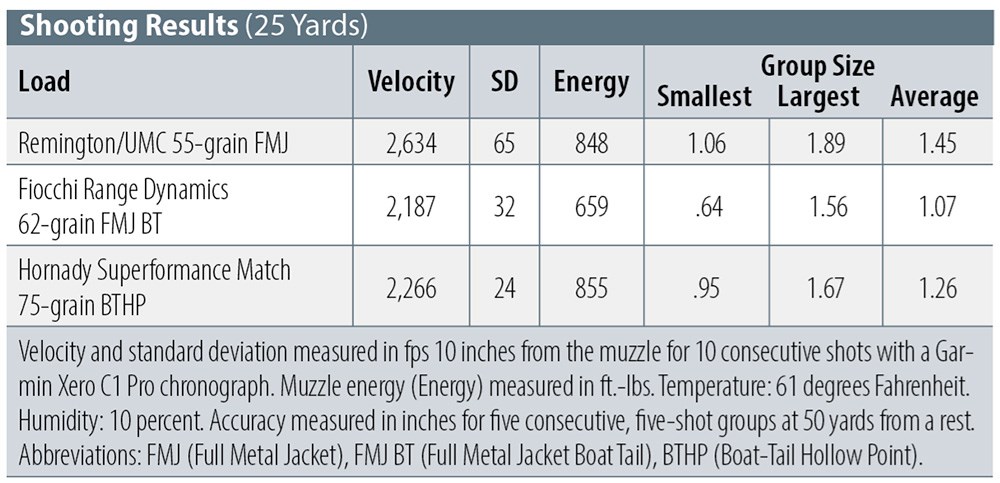
Overall, this is a fun, retro-inspired carbine that’s reasonably priced and works exactly as expected. I’ll repeat: “Because it’s cool and I want one” is a perfect reason to buy a new gun—and the A1 Carbine SBR might just be the epitome of this idea. Here’s another reason, one I touched on earlier: most everyone who has a semi-automatic rifle has some version of the 16-inch carbine. The A1 Carbine SBR is definitely something different, and let’s be honest, you want to bring an interesting gun to the range.
Yes, there are more functional carbines out there. Yes, the short barrel does mean you need to do slightly more paperwork, and there are some extra steps needed in certain instances. However, there has never been a time (at least in the past 92 years) when it has been easier or more affordable to buy a reliable SBR than right now, so why not treat yourself? Why not get yourself a cool present for America’s 250th birthday?
Read the full article here