

When it all hits the fan and the grid is gone for whatever reason, be it EMP, all out nuclear exchange, a hurricane, or possibly a tornado, snow knocking down trees, or as we say up here in the interior of Alaska the four reasons power goes out: it’s either too hot, too cold, too wet, or the dawgs pee on the phone pole, and when that happens, we are now all equally being given a ride back in time … a time of no lights to just switch on, no medical life sustaining devices, and now it’s “game-on”, folks.
Over the years,I have accumulated several solar panels ranging from a military surplus fold-up panel, to ones that I bought with various types of radio gear along with their included battery packs, and most recently one that I purchased with a Dakota Lithium 2400 Power bank System that I recently reviewed in a SurvivalBlog article (see Part 1 and Part 2.)I decided to try out the panel that came with the system this last weekend to see how well it really performs up here in the northern latitudes. (64°.xx.xx” North / 147°.xx’.xx” West) where our sunlight is getting shorter every day.
It is not yet winter. You may wonder when is the first day of winter In 2025? The winter solstice date is Sunday, December 21st. For us, it doesn’t really matter what the almanac says, as we define winter as being zero or subzero temperatures and snow that doesn’t melt off until late May. We had three heavy snowfall events in early September, but they were followed by rain and washed off so that doesn’t count in my book as winter …. I’d be inclined to call it pre-winter.
The sun at this latitude gets closer to the horizon as the months go by. In February it may only rise one or two finger widths above the horizon around 10:30 AM and then travel across that azimuth from east to west and fall below the horizon again around 2:30 PM. If the sky is obscured by clouds and heavy overcast, then it will be a dark day like at late dusk in the Lower 48 area of the country. My concern has been, and continues to be: Will Photovoltaic (PV) power panels be worth the investment for a grid-down situation for long-term use? By long-term I consider using the panels as a power source for three weeks or longer.
I’ve lived here now for 16 years and watched as more homes and businesses have installed solar arrays on their buildings, rooftops, and in some cases mounted on poles in the yard. I was surprised to see how many “solar farms” have also been installed in our area. By solar farms I mean obviously commercial large solar panels amounting to as many as 200 or more panels aligned to the southern horizon. Seeing this growth of solar generation over the years it finally dawned on me that maybe I should consider investing in this technology.
My first thought was the Tesla Battery Wall installation where a Tesla Battery Bank that includes all the charge controller, inverter, and wiring into the home grid system along with a grid switch to cut off any link to the grid should it go out for whatever reason, so that the bank providing home power doesn’t send that power into the grid and present a possible electrocution danger to power line employees working to restore the grid. The Tesla wall power bank, with the roof-mounted solar array, wiring, and installation cost was quoted at $65,000 and would have provided power for the full house needs. But that was a cost that I simply could not afford. Regardless of the tax savings and such it just wasn’t in my budget plans to have another mortgage. So, I decided to research solar energy and my basic TEOTWAWKI power requirements and adjust my decisions accordingly.
To determine the solution that I felt would be a long-term quality investment I took stock of our situation regarding our real power needs as opposed to our desired power needs. What do we really need as opposed to what do we think we need? I felt this would determine the best solution for what we can afford in a long-term situation. Being a disabled vet and cancer survivor at 76 years old my definition of long-term may be a tad bit different from your reasoning, so please take that into consideration.
For our long-term power needs I felt that potable water was # 1 on the list. We have a shallow well since this area has a high-water table. The problem is our water has a lot of minerals in it and needs filtering to make it potable. To this end, we have a very heavy-duty salt-based water softener that runs off 120 volts AC which is down-converted to 12 VDC inside the unit. This is the first stage of filtering into 5 micron filter system. From there it is sent to the hot and cold water lines via two more filters. The cold water line at the kitchen faucet is then run through a reverse osmosis filter system that has 6 different filters in it along with an ultraviolet light system. This filter system will still operate even if there is no power to the UV part of it. In a final bid for potable water we have a countertop Zero Water type unit for drinking water fresh from the tap, and this may be replaced with a Big Berkey type soon.
Four years ago, I replaced the water pump located under our house with one that can run on 120 VAC and does not draw much amperage during its normal run time. I ran a line from that area up to the access opening inside my house to be able to plug it into my Honda 2000i generator set so we could still have cold water available during our usual power outages that have lasted for a few weeks on various occasions.
The second item on our list for power that we felt was necessary was the refrigerator if we lose power in the summer or for long-term situations. Wintertime gives us at least 8 to 9 months of respite from that issue, but summer can be a game-changer. We also have a larger freezer in the pantry room/ However, that will be replaced by a propane type in the future, as funding permits.
The rest of our list are what I consider important but not life-sustaining type needs; the ability to recharge batteries, or maybe keep a lamp going, or something that would be nice to have but won’t be life-threatening to us. All my ham radio gear and comms gear run off 12 VDC and I have already provided battery power for that gear, along with the ability to recharge all that gear from solar and grid sources. The first items were our immediate power source needs that I felt necessary to keep going. The rest of our needs are now fulfilled using Aladdin oil lamps and a few other oil lamps, some very nice LED type lamps that can easily be recharged when needed, a very efficient Blaze King catalytic wood stove that has far more capacity and efficiency than what we really needed that I purchased 15 years ago when I wasn’t as educated to our wood stove needs back then. We can cook on it as well as use it for drying wet clothing items, too.
So, we have light as needed both electric, and non-electric. We can heat and cook, and now we can have water. And, if needed, the seasonal refrigeration of our frozen and non-frozen foods. Of course, we also have long-term food storage with dehydrated as well as canned foods.
Now to the issue at hand: Solar power panel report from the Arctic zone. I have three main solar panels that I bought. The latest is the 180 Watt array from Dakota Lithium Battery Company, one was from a DRMO military surplus unit (60 watts) when I was still active in the Reserves and able to purchase items from DRMO, and one from a previous ham radio system that I was building that I bought off eBay. I also have a couple of smaller panels that were included with the purchase of ham radio gear. I will include those panels in this report as well. And finally, one that was sent to me as a gift a few years ago and seems to be an ok unit for small item use such as a cell phone charger, et cetera. Though I haven’t really used that one much since I have been playing around with larger, more capable panels. That one I keep in the glove box of my truck.
THE TEST EQUIPMENT USED FOR THIS REPORT
I am a professional electronics engineer by trade and all my test equipment for work, as well as most of my test gear at home, has been calibrated to NIST standards due to the need for this requirement in my professional life. It costs more for test gear that meets the NIST standards, but if it is necessary, it is worth the extra cost. I have two oscilloscopes, one is a PicoScope 3203D (calibrated to NIST) and the other is my Hantek scope (Self-Calibrated).
Solar panel testing is crucial in ensuring a module’s quality and safety. Solar panels have a long lifespan if properly built and installed. Quality equipment should generate usable electricity for over 25 years. Given the longevity of your investment, you want to ensure that any equipment on your installation such as what you may have on your roof will perform well and operate safely. See the safety standards that apply to solar panels used in home and commercial use. The portable panels I have may or may not meet these standards but do serve my purpose quite well.
I have also ordered a test unit built and calibrated specifically for testing solar panels under a test load. Evaluate all solar panels as you would test any battery or power source, that is, under load and with enough precision to give you a true look at the performance of the DUT (Device Under Test).
Here is a useful meter: 1800W Solar Panel Tester MPPT Photovoltaic Multimeter & Watt Meter Smart Portable Tool for Solar PV Panel Data & Troubleshoot Measures Power Output, Performance, and Open Circuit Voltage. (NOTE: My assessment of this unit is made at the end of this article.)
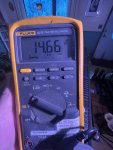 The Fluke Digital Multi-Meter (DMM) tells me if the panel is producing any voltage at all, the Pico Scope can tell me if there is any induced noise on the panel line such as an unusually high RF signal from a nearby power source or transmitter. Any type of induced noise on the output of the solar panel line out can be induced onto the load bank. Yes, the battery will “tune” that out, so it really is not a critical factor, unless it is sufficient to be induced into your other electronic equipment. This is particularly true of any AC voltage that is being either generated or applied to an electronic circuit such as a radio, computer, or such. There are a few systems on the market that will produce an AC voltage from a DC source but have lots of noise induced into the load. A “pure sine wave “ type of AC voltage being produced from a DC source it what we are looking for in an emergency power use situation.
My tests show that the AC voltage out of load and under load in the power bank is so clean that even my oscilloscope (Pico Scope) could not adequately do any mathematical function capture of the errant waveform. My grid-supplied power on the other hand is as filthy as anything that comes out of any politician’s mouth. So, if you are using grid power in sensitive electronic equipment you might want to get some form of power filtering. We have an EMPShield filter system that has really helped with our grid-tied “noise”. There is only one power company up here and complaining about their dirty power isn’t going to fix the problem. I recommend the EMP Shield Whole Home Generator EMP Shielding & Lightning Protection (SP-120-240-G) device. It’s a good investment for conditioning your power, even if you never actually need it for EMP protection.
As for the meter that I bought for this article: It may work, but in reading the input requirements for the test to function there needs to be a minimum of 20 to 120 volts from the solar panels. And for the last month, our sunlight has been moving lower and lower on the horizon compounded by day after day of overcast and snowstorms. This is typical for our area this time of the year so unless God deems to grant me a nice sunny day and some treeless area to run the test unit my only conclusions can be that the 180 watt panel I bought with my power bank has been able to produce enough power to apply some charge into the bank, but not enough in one day of daylight spectrum to fully charge the system in one setting.
At the rate I am currently getting, approximately 1% charge per 2-½ to 3-hour daylight cycle. So it will take at least two months of this type of input to fully charge up the bank to full capacity. On the other hand, if we could get a clear day with full sunlight even just above the horizon, I know that in a few hours I could gain a 100% capacity charge.
My conclusion is that solar power with modern type solar panels will provide sufficient power to substantially reduce the current electrical needs for a few emergency items we deem necessary in any long-term emergency or not.
If I wanted to power my entire house this could prove problematic in my current location due to our latitude and the lack of consistent sunlight, and all the tall spruce and birch trees surrounding my home blocking direct access to the horizon to harvest low-angle winter sunshine. On the other hand, it would significantly reduce my power bill that is normally $250 to $350 per month. And in a TEOTWAWKI it would provide long-term reduced power capability. If you count on PV solar power in the Arctic, then count on taking a severe power diet plan for six months of the year.
The smaller 60-watt or less panels were much better for charging up the smaller portable power banks commonly used for charging cell phones, computers and such did much better for those items, but those units produce a voltage small enough that again, my hand-held test unit did not perform well enough to affect this report.
So, my plan to have a secondary source of off-grid power is a good plan. It will need tweaking, such as adding a second power bank and a second 180-watt panel for a larger capacity. This would give us a significant increase in use for our needs by linking those power banks. In the summer it would be a very highly efficient power source of off-grid power. Up here, we have no need for air conditioning in the summer.
Read the full article here