
Without a doubt, the Smith & Wesson Model 29 is one of the 20th century’s most shootable, collectible “superstar” revolvers. But there is much about this universally-admired .44 magnum that is not known. For example, the serial numbers of the first guns, which officially started at S131700, were not assembled in numerical order, with some of the first Model 29s having serial numbers as high as S167124.
The reason for this, according to Smith & Wesson historian Roy Jinks, “…was that the factory was using frames that had already been built, but were for the .45 Target model of 1955. That frame was already set up for the heavy barrel that was going on the .44 Magnums.”
In addition, contrary to popular belief, Elmer Keith did not receive the first Model 29. He and Julian S. Hatcher, who was technical editor for The American Rifleman, both received 6½-inch-barreled guns from the first five-gun production run in January 1956. Hatcher’s gun was Serial No. S130942; Keith’s was serial number S147220. Here are a few more little-known facts about one of the most popular revolvers ever made.
1. The Smith & Wesson Model 29 was the result of a 1908 revolver and a 19th-century black-powder cartridge.
During the 1930s, there was an informal group of seriously devoted handgunners who were enamored with the .44-caliber revolver. They called themselves “The .44 Associates,” and their erudite membership included such notables as Elmer Keith, Townsend Whelen, Phil Sharpe and P.O. Ackley. At that time, the only cartridge that they deemed suitable for their .44-caliber handloading exploits was the .44 Special, a cartridge developed by Smith & Wesson in 1907 as an updated version of the .44 Russian black powder round.
In fact, when the .44 Special cartridge was first introduced during the transition years between black powder and smokeless propellant, the cartridge was initially loaded with a modest charge of 26 grains of black powder. It didn’t take long, however, for the factory to transition to smokeless powder, albeit with an equally modest reduced charge, leaving plenty of space in the large .44 Special case to give the members of The .44 Associates plenty of room to experiment with increased smokeless powder loads.
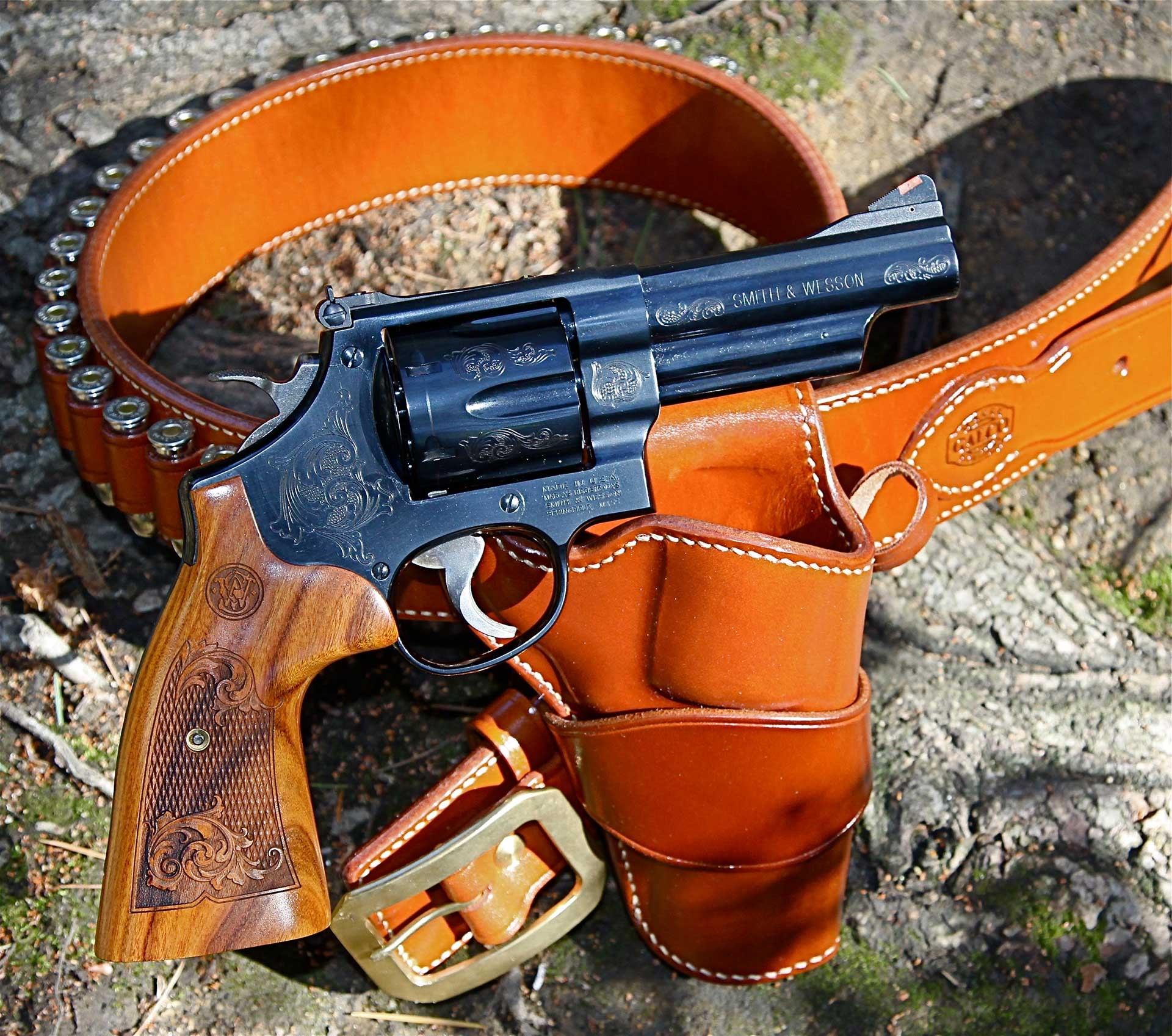
However, at the time, the only commercially available revolver that most of them thought strong enough to handle many of their hotter .44 Special handloads was the Smith & Wesson First Model Hand Ejector of 1908, better known as the Triple Lock, which had been developed especially for the then-new .44 Special cartridge.
In fact, early on, when what would become the .44 Remington Magnum was being developed by Keith and others, Keith suggested that it be chambered in the Triple Lock, which by 1950 had evolved into the N-frame Smith & Wesson .44 Hand Ejector 4th Model Target of 1950. But even this gun had to be beefed up slightly to handle the new .44 Magnum. As a result, the Model 29 was born.
2. Elmer Keith wanted to call the .44 Remington Magnum cartridge by a different name.
Because he had helped develop the .44 Magnum using the .44 Special cartridge as a starting point, Keith originally wanted to call the final result the .44 Special Magnum. However, R.H. Coleman, president of Remington Arms, the company that finally decided to produce a factory version of Keith’s souped-up cartridge, had different ideas. Thus the new cartridge was christened the .44 Remington Magnum.
3. The first “no-dash” Model 29s had a habit of jamming.
Today, everyone wants to collect first production “no-dash” Model 29s, but they had a drawback, which you wouldn’t know unless you owned and fired a no-dash Model 29 for any length of time, as I have: The earliest guns had right-hand ejector rod screw threads.
Because of this, the excessive recoil after many full-house rounds would cause the ejector rod to eventually back out and jam the gun’s action. In 1962, Smith & Wesson corrected this deficiency by switching to left-handed ejector rod threads, thus implementing the first Model 29 change, denoted by the 29-1 stamped on the cylinder yoke. Consequently, this problem no longer exists on Model 29-1 guns and later.
4. The NRA National Pistol Championships at Camp Perry, Ohio, were the reason an 8 3/8-inch barrel length was added to the Model 29 almost a century later.
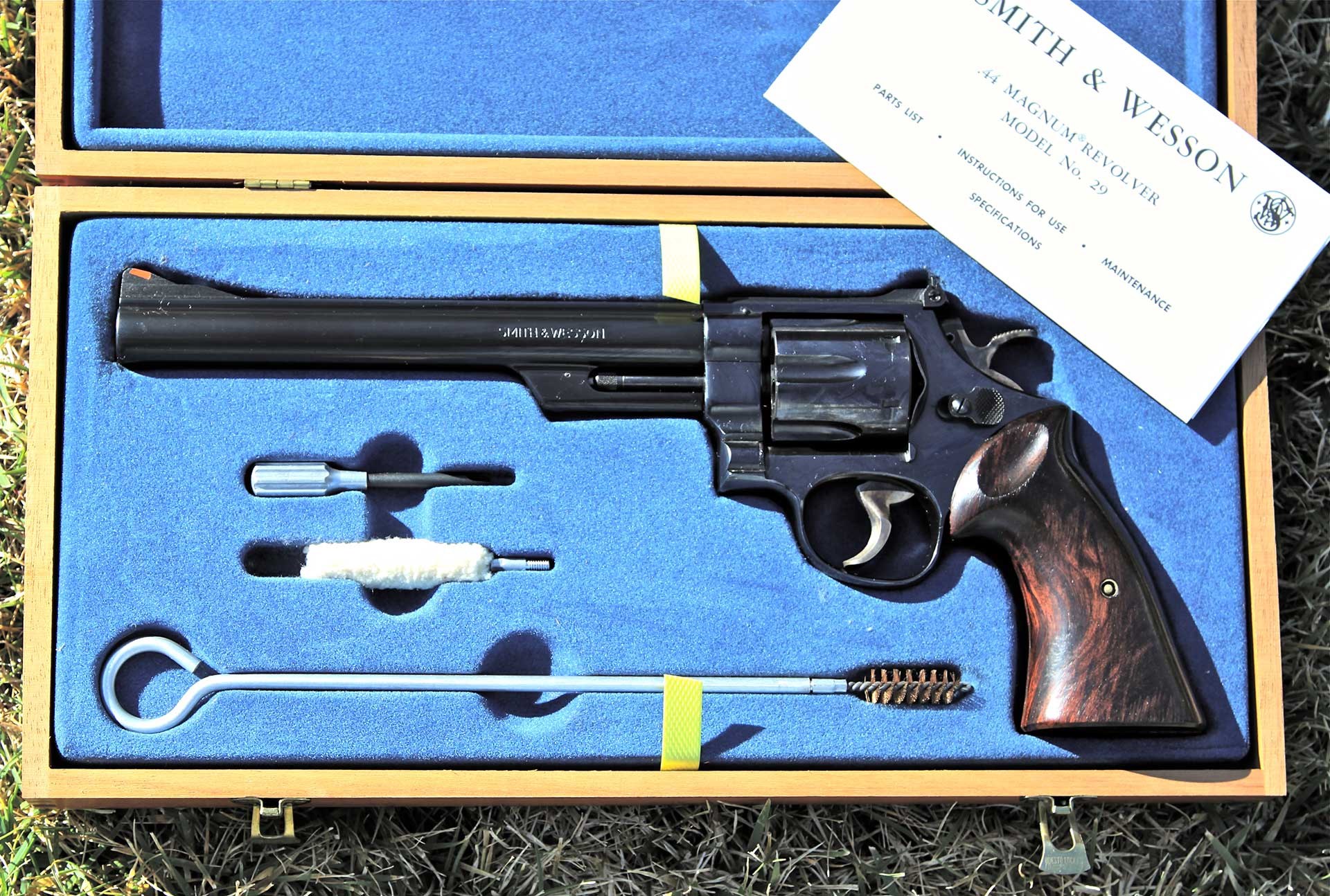
In addition to the Model 29’s original 4-inch and 6½-inch barrels, in 1958, Smith & Wesson added an 8 3/8-inch barrel length. The reason for this fractional elongated barrel measurement stems from the fact that, back in 1907, the NRA National Pistol Championship, which had recently been moved to Camp Perry, Ohio, had a rule specifying a maximum allowable distance between the front and rear sights of competition pistols, as well as their overall length.
Smith & Wesson’s large- and medium-frame target revolvers were very popular at the time, so in order to have their guns qualify, a barrel length of 8 3/8 inches (allowing for a slight margin of error) was decided upon by S&W as the longest legal length that would provide the greatest front to rear sight radius. Nonetheless, that barrel length did not appear on many, if any, S&W factory guns until 1935, with the advent of the Registered Magnum, in which any barrel length up to 8 ¾ inches—later shortened to the aforementioned 8 3/8 inches—could be ordered.
This factory barrel length reappeared 23 years later with the advent of the Model 29. Today, it is highly sought-after (often at a premium price) by handgun hunters and reloaders desiring to get the maximum accuracy and ballistic efficiency from their Model 29s.
5. When the first Dirty Harry movie was released in 1971, the Model 29 was no longer in production.
Although introduced to great fanfare in 1955, by the late 1960s, sales of the Model 29 had dropped off dramatically. One of the reasons, of course, was the excessive recoil from firing full-house factory loads. As Julian Hatcher wrote in his March 1956 American Rifleman review of the then-new Model 29, “In shooting the .44 Magnum, we found it advisable to use gloves, as the recoil can only be described as severe.…” To be sure, once the initial thrill of unleashing a few cylinderfuls of wrist-bending .44 Magnums was over, most shooters turned to shucking comparatively milder .44 Specials into their Model 29 cylinders.
In addition, there were now a few other .44 Magnum revolvers on the market that were priced less than the Model 29, most notably the Ruger Blackhawk, not to mention lesser-priced .44 Special revolvers from Colt, Smith & Wesson and Charter Arms. Finally, by the late 1960s, the constantly diminishing sales of the Model 29 prompted Smith & Wesson to take it out of production completely, even though it continued to be catalogued.
However, all that was about to be dramatically changed with the 1971 release of the movie “Dirty Harry,” which co-starred a Smith & Wesson Model 29 as “…The most powerful handgun in the world….” and instantly catapulted this sleeping giant into the spotlight, resulting in overwhelming demand for the big gun and catching Smith & Wesson completely off-guard.
It took the company years to catch up with sales, and in the meantime, prices for existing Model 29s—when they could be found—soared to as much as three times more than the contemporary suggested retail price of $194.
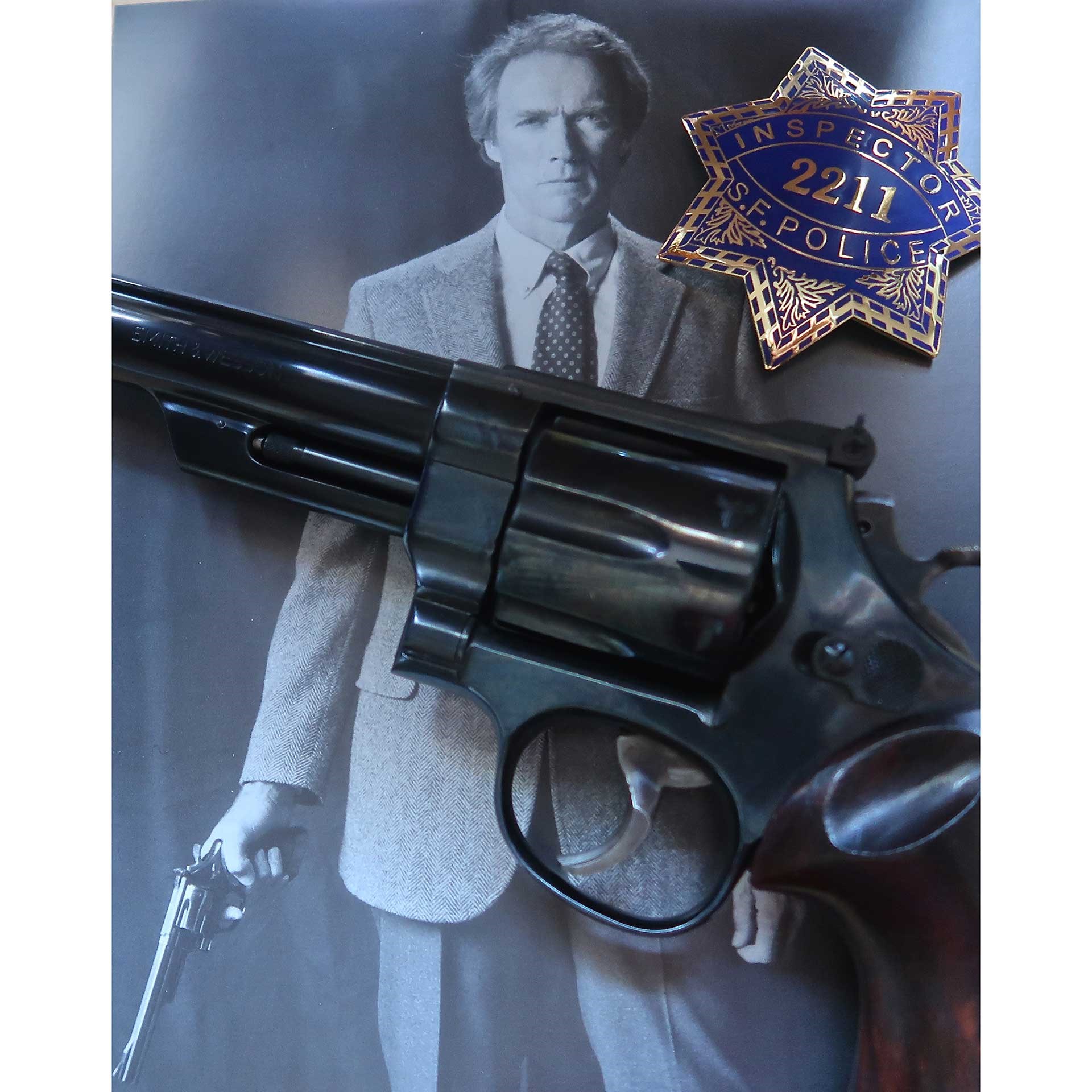
6. The Model 29 used in the “Dirty Harry” movies was not the gun that was supposed to be featured.
The initial Sept. 23, 1970, draft of the “Dirty Harry” motion picture script that John Milius showed me called for “Dirty Harry” Callahan to carry a 4-inch-barreled, nickel-plated Model 29 with ivory grips. But when filming began, as noted above, the Model 29 was no longer being produced. Nonetheless, Milius and the movie’s director, Don Siegel, insisted that the Model 29 be retained as part of the movie’s plot and Dirty Harry’s persona.
Finally, the only Model 29 that could be readily located was a 6½-inch blued Model 29 back at the factory that had been assembled a few years before from parts by Archie Dubia, foreman of S&Ws hand-fitting department. At the request of Warner Bros., Kelly Lookabaugh, S&W’s West Coast representative, arranged for that gun to be sent to the studios for the Dirty Harry movie.
However, Hollywood studios like to have at least one—preferably two—identical guns on hand for backup. To meet this criteria, S&W factory superintendent Fred Miller, who helped develop the Model 29 16 years earlier, was able to locate enough parts to assemble two more Model 29 revolvers – one with a 6½-inch barrel as a stand-in for the original gun, and another with an 8 3/8-inch barrel, which can also be seen in the 1988 movie poster for “Deadpool.” As a side note, Stembridge Gun Rentals had to custom-make .44 Magnum blanks for the Dirty Harry movies, as standard movie 5-in-1 blanks would not chamber in the Model 29’s cylinder.
7. The weight of the 6½-inch Model 29 caused Frank Sinatra to turn down the Dirty Harry role.
Frank Sinatra was the first actor to be offered the part of Dirty Harry, which was originally written for a 50-something rogue detective, but he had to bow out after accidentally breaking his wrist and realizing that the hefty Model 29 would be too much gun for him to effectively handle in an action movie.
John Wayne was then offered the part of Harry Callahan, but he emphatically turned it down (and later said he regretted it), stating that he would never accept any role that had been offered to another actor first. Other actors, including Paul Newman and Steve McQueen, were then offered the Dirty Harry part, and all of them passed on it for various reasons.
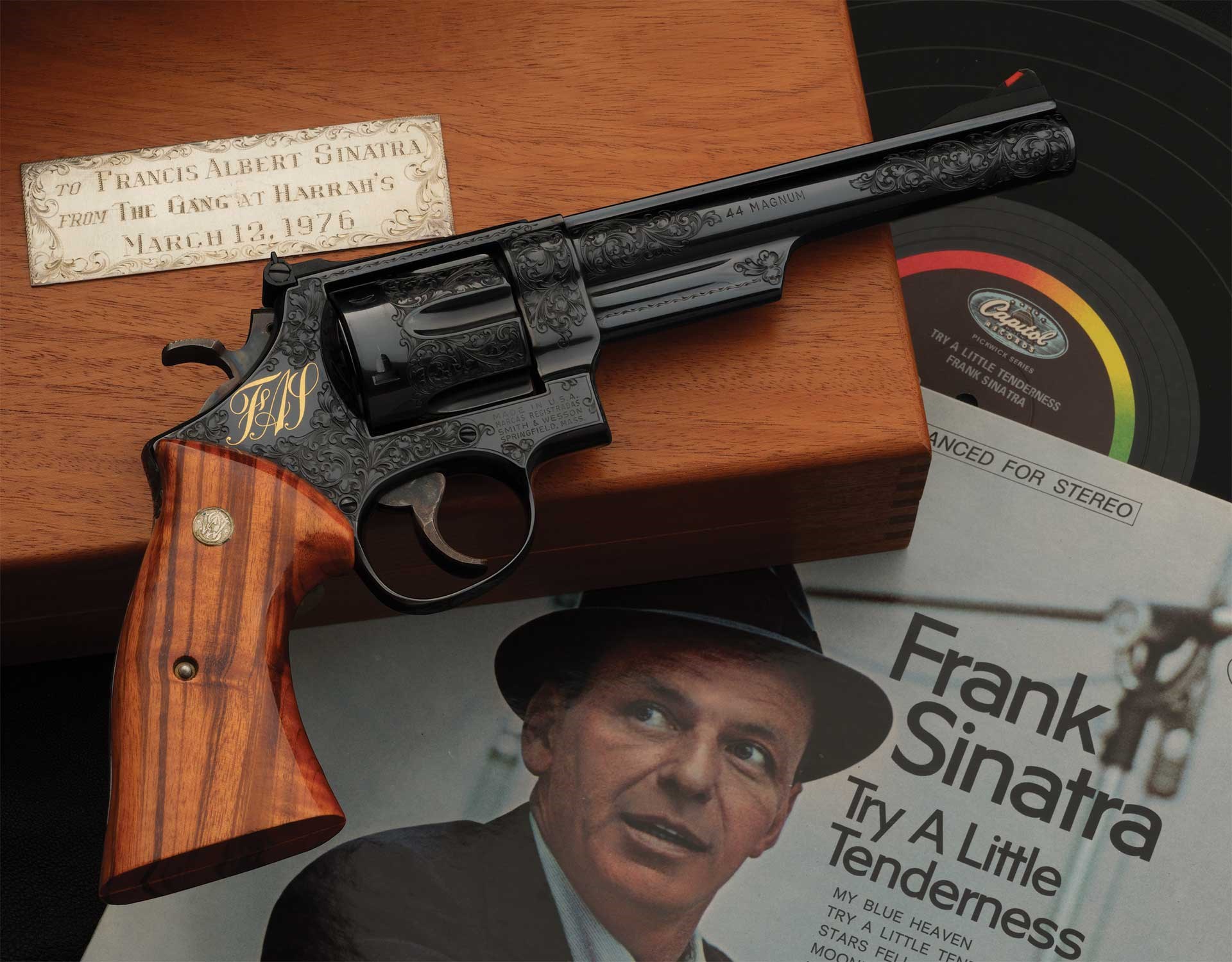
Finally, Newman suggested to Warner Bros. that Clint Eastwood would make a good Dirty Harry, and the rest is history. But don’t feel too bad for Sinatra. Two years later, he got his own Model 29, an elaborately engraved 6½-inch-barreled version presented to him by Harrah’s Casino in Las Vegas. (Sinatra later gave this gun to his musical arranger, Henry “Hank” Cattaneo. In December 2025, that gun was sold by Rock Island Auction for $82,250.)
8 Clint Eastwood was not the first movie star to use a Model 29 in a major motion picture.
The honor of debuting the Model 29 on the big screen belongs to Lee Marvin, who was the first major movie star to wield a Model 29 on film. Specifically, it was a 4-inch blued version that the Academy Award winning actor used throughout the 1967 action-packed crime thriller “Point Blank.”
9. The recessed cylinder chambers of pre-1982 Model 29s originated with the .22 rimfire cartridge.
When Horace Smith and Daniel Wesson introduced the .22 Short rimfire cartridge for their No. 1 revolver in 1857, the cases were made of soft copper and had a habit of occasionally rupturing when fired. To help protect the shooter and bystanders from pieces of flying metal, it was decided to recess the chambers.
Even when cartridge cases began being made of brass, the rimmed cylinder feature was retained by Smith & Wesson as an added safety precaution, especially when their .357 Magnum was introduced in 1935 and, of course, with the much more powerful .44 Magnum in 1955.
However, thanks to improved metallurgy, combined with an obvious cost-savings benefit, in 1981, the recessed cylinder was discontinued, as noted by the 29-3 designation on all subsequent Model 29s, which also did away with the pinned barrel that same year, as both features were no longer considered necessary. However, pre-1982 Model 29s with pinned barrels and recessed cylinders (known as P&R guns by collectors) carry a premium on today’s secondary market.
10. The Model 29 was outvoted by a Jedi’s lightsaber…but just barely.
In 2008, 20th Century Fox studios conducted a survey of 2,000 dedicated film fans to ascertain the most popular movie weapons. The Star Wars lightsaber came in first, but right behind it, in second place, was Dirty Harry’s Smith & Wesson Model 29. However, in my opinion, the Model 29 was the true winner, as the lightsaber is only a fictionalized movie prop, while the Model 29 is an actual bona-fide handgun.
Read the full article here