


Aaron Voigt is a gun designer who began making waves in the shooting-sports marketplace in 2017 with the release of the cellphone-size series of Trailblazer Lifecard folding single-shot rimfire pistols. Later, in 2024, Trailblazer would take home a coveted Golden Bullseye Award for his uncommon and innovative Pivot pistol-caliber carbine. By 2025, his latest manufacturing venture, Dark Mountain Arms, was in full swing producing yet another proprietary platform called the Stowaway, which is available in several chamberings, including the 5.7×28 mm version I tested.
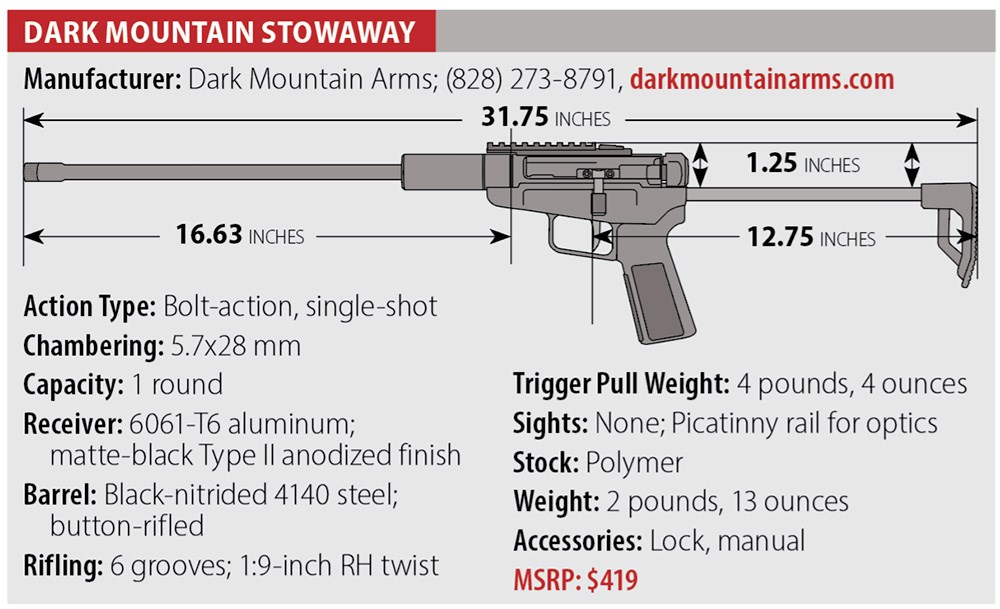
The Stowaway is a single-shot, takedown, bolt-action carbine designed to be as lightweight as possible while maintaining a high standard of quality. As configured from the factory, the 5.7 mm version weighs in at a small fraction lighter than 3 pounds unloaded; making the Stowaway one of the lightest—if not the lightest—rifles currently available in this chambering. Intended for use as a backpacking or survival rifle, the tubular receiver is milled from 6061-T6 aluminum and treated with a matte-black Type II anodized finish. The front of its receiver is threaded for a 4.7-inch-long aluminum barrel sleeve that serves double-duty as a barrel nut, securing the barrel to the receiver, and also as the rifle’s fore-end.
The thin-profile barrel is made from 4140 steel treated with a corrosion-resistant black-nitride finish; its bore is button-rifled with a 1:9-inch, right-hand twist, while the muzzle is threaded 1/2×28 tpi for popular muzzle devices, including compensators, flash hiders and sound suppressors. A knurled, anodized-aluminum thread protector is provided.
Should a sound suppressor be desired, the barrel comes threaded in the standard 1/2×28 tpi pitch. A thread protector is included if no muzzle device is to be attached. While the bolt appears to be set up for a left-handed shooter, it allows a right-handed shooter to work the bolt and insert rounds with the weak hand while maintaining a firing grip. Removing the bolt from the receiver requires pushing down on a lever on top of the receiver, after which the bolt can be removed for cleaning or lubrication. Minimalist in nature, the buttstock doesn’t add much bulk, but anchors the rifle well against the shoulder. Unscrewing the metal collet allows the barrel to be taken out of the receiver and breaks the Stowaway down for easy transport and storage. Closing the bolt does not cock the firing pin; that must be done manually for every shot using the glass-reinforced nylon cocking knob. If the end-user wants to swap out the grip for any reason, the Stowaway accommodates most standard AR-15-style pistol grips.
The barrel is listed with a nominal length of 16 inches, but I measured an actual length of 16.63 inches on my sample gun—this is due to a reduced-scale AR-15-style barrel extension installed to engage the three lugs of the bolt assembly. At the top of this extension is a small post that aligns with a notch cut into the threaded portion of the aluminum receiver to ensure barrel alignment.
A nine-slot, aluminum Picatinny rail is fitted atop the receiver assembly. At the rear of the rail is a takedown lever used to remove the bolt assembly from the rifle for routine cleaning. The simplified bolt assembly consists mostly of black-oxide-coated 4140 steel components. Where needed, these parts have been heat-treated for durability.
Located on the left side of the rifle, the knurled charging handle is made from aluminum, while the cocking knob is molded from glass-reinforced nylon. Between shots, the knob rests away from the firing pin in a half-cocked position to prevent an unintentional discharge if bumped or dropped while the chamber is loaded. This rifle does not have any other external safeties.
The receiver is mounted to a glass-filled nylon frame that also supports the trigger group, a monolithic aluminum trigger guard that also serves as the mounting point for the B5 Systems AR-15 pistol grip and the aluminum rod with a textured polymer buttplate that serves as the buttstock. Breaking on average at 4 pounds, 4 ounces of pressure, the vertical, flat-face steel trigger is listed as a single-stage, but in testing, I found it to behave more like that of a double-action revolver.
Disassembling the Stowaway is a simple process accomplished without the need for tools. First, verify that the rifle is completely unloaded. With the bolt assembly in the open position, twist off and remove the barrel sleeve and then pull the barrel out of the receiver. Lastly, close the bolt and the rifle’s major components are ready to be stored or packed.
On the range, the Stowaway proved to be easy to use and utterly reliable with all the 5.7×28 mm ammunition tested. Although a few of the spent cartridge cases for the hotter rounds exhibited some resistance when extracted from the chamber, there were no failures to eject the cases properly. Rimfire options like .22 LR and .22 WMR are popular for takedown survival rifles in the same class as the Stowaway, but the 5.7 mm centerfire round offers a notable boost in kinetic energy without the need to reinforce the receiver or barrel as may be needed with other centerfire options.
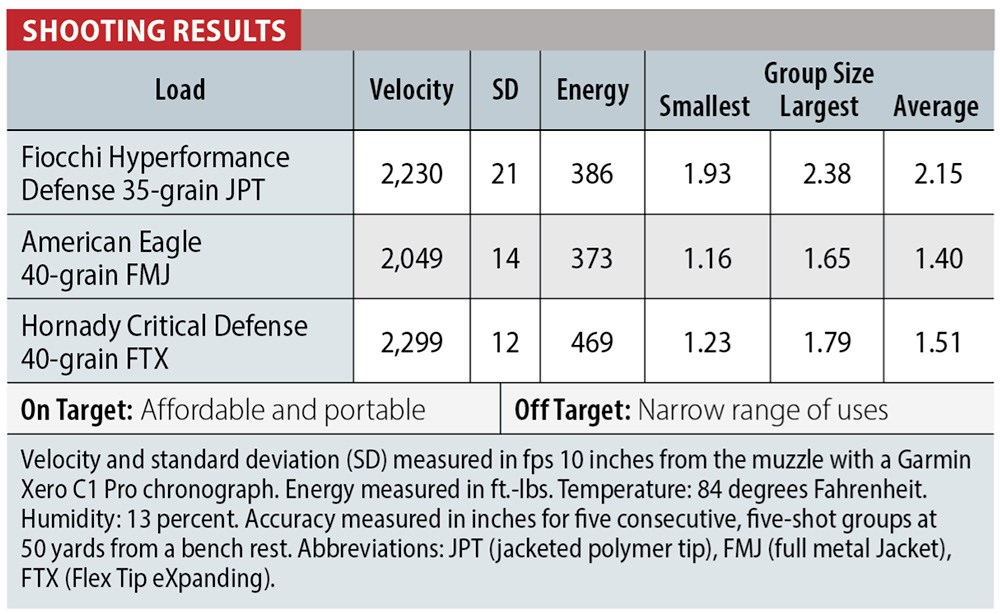
The Dark Mountain Arms Stowaway provides a useful blend of reduced weight, reliability and durability for a suggested retail price of $419. It is also available chambered in the ubiquitous 9 mm cartridge, and cartridge-conversion kits consisting of a barrel and a complete bolt assembly are available for $199. The company also offers its Stowaway platform in large-format-pistol configurations with or without braces, with prices starting at $389. And for those who are interested in a rimfire option, .22 LR and .22 WMR offerings were nearing completion at the time of this writing.
Read the full article here