

This year, we are celebrating the 250th anniversary of our country, not only as a world bastion of freedom, but as a nation of riflemen. But unlike the flintlock, percussion rifle and many other firearm actions we inherited and then improved upon, the lever-action is a distinctly American innovation. The motivating force behind its creation was the need for more firepower, or more specifically, the need for more reliable firepower, superseding earlier multiple-barrel and swivel-breech attempts.
An inkling of what was to come began in 1848, when New York innovator Walter Hunt (who also created the fountain pen and the safety pin, among many other inventions) patented his “Volition Repeater” and its Rocket Ball round. This design could not technically be called a cartridge, because there was no separate case involved—just primer, powder and projectile. Basically, Hunt’s design was a hollow lead bullet containing what little powder could fill the bullet’s cavity; ignition was from a priming charge inserted into the bullet’s base. Approximately 12 Rocket Balls were loaded into a hollow tube underneath the barrel. A finger lever cycled each round into the chamber, while a second finger ring brought up and inserted the primer. There was no ejector, because there was nothing to eject (other than an unfired Rocket Ball, which occurred all too frequently).
Due to its complex mechanism, Hunt’s Volition Repeater never went into production. The only known example (most likely Hunt’s prototype) is in the Cody Firearms Museum in Wyoming. But, as crude and unreliable as it was, the Volition Repeater inspired another inventor, Lewis Jennings, to partner with Hunt and simplify the cycling system via a single finger lever and an external cocking hammer. Unfortunately, the Hunt-Jennings rifle failed to garner interest from either the public or the military, as it was still too complicated. As a result, fewer than a thousand Hunt-Jennings rifles were produced, with some converted to muzzleloaders—the ultimate affront for a rifle conceived of as a repeater.
Trappers—originally called “Baby Carbines” —were shorter-barreled versions of carbines and are rare, as they were special-order guns and relatively few were made. Shown here is a 14-inch Marlin 1894 and 16-inch Winchester 1894. Photo: Rick Hacker
The Hunt-Jennings rifle eventually ended up in the hands of another New England gunsmith, Horace Smith, who greatly simplified the rack-and-pinion action and magazine-loading operation to become the Smith-Jennings Rifle. Buoyed by the potential of his improvements, in 1852, Smith formed an alliance with Daniel Wesson, whom he knew from the gunmaking firm of Robbins & Lawrence, where both had worked alongside a shop foreman named Benjamin Tyler Henry.
It was at the newly formed Smith & Wesson company that the Smith-Jennings design evolved into a gun given the rather fanciful name of the Volcanic—a reference to the multiple flashes of fire and smoke emitting from the muzzle of the “repeater.” Both rifles and pistols were produced, featuring an iron frame, a front-loading magazine tube, a toggle-link action and an operating lever (or ring, in the case of the pistol) that cocked the hammer and cycled the action.
With high hopes for success, in 1855, Smith & Wesson named their new entity The Volcanic Repeating Arms Company, with financing from a group of investors that included a New England shirtmaker named Oliver Fisher Winchester. Benjamin Tyler Henry was hired to supervise manufacturing. Unfortunately, the Volcanic pistols and rifles (which were listed as 16-, 21- and 25-inch barreled “carbines”) still fired the underpowered Hunt Rocket Ball, with a miniscule black powder charge of 6.5 grains, which had the bullet moseying out of the barrel at a leisurely 260 fps. In addition, feeding and ignition problems continued to plague the Volcanics. Consequently, in 1856, Smith & Wesson declared the Volcanic Repeating Arms Company insolvent, with fewer than 3,400 total guns sold. Smith & Wesson went on to form the iconic firearm firm bearing their names today.
Meanwhile, another firearm legend was taking shape. Having been successful in devising a way to mass-produce men’s dress shirts, Winchester had an eye for machinery and innovation. He acquired Volcanic’s assets to try and salvage at least some of his investment. In 1857, he relocated his newly obtained holdings to Connecticut and established the New Haven Arms Company. He then changed the Volcanic’s iron frame to less-expensive brass and visually enhanced many of the guns with nickel-plating and engraving.
Winchester used the Volcanic name extensively in advertising, but it was never stamped on the guns. Unfortunately, although it held the lure of being able to cycle and fire bullets via a finger lever, the Volcanic was still hampered by unreliable ammunition, and sales remained dismal. Seeking a solution, Winchester hired Henry, who was familiar with the Smith-Jennings and Volcanic toggle-link actions, and appointed him plant superintendent with the admonition to, “See if you can make this fool gun work.”
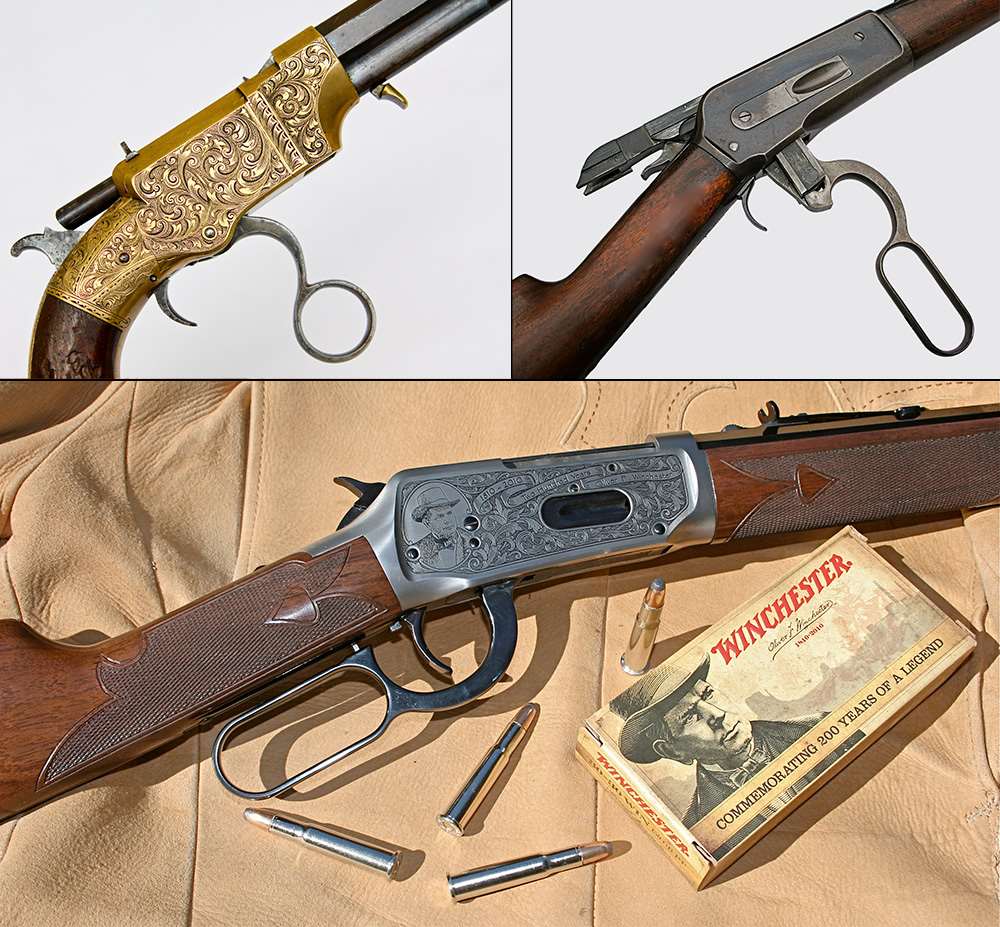
Both the Volcanic pistol and rifle used the same action and were the forerunners of the Henry Rifle • The Browning-designed Winchester Model 1886 weaned Winchester away from the toggle-link system and replaced it with the sturdy, smooth-operating twin locking bolt system of the Model 1886 • Many 19th-century lever-actions are still made today, albeit with some “modern” improvements, as shown here with this Oliver Winchester Commemorative Model 94 and ammunition. Photos: Rick Hacker
Henry realized the problem wasn’t primarily with the rifle’s action, but with the ammunition it fired. As Smith & Wesson was now having success with rimfire .22-caliber revolvers, Henry seized upon this more reliable ignition method to develop a .44-caliber, 216-grain lead bullet in a copper case containing 13 grains of powder— double that of the Volcanic round.
To handle this larger cartridge, the Volcanic’s receiver and toggle-link action were strengthened so thoroughly that they would be-come the basis for the future Winchester Models 1866, 1873 and 1876. Henry also incorporated twin firing pins to help alleviate rimfire misfires. He then deepened the rifling and gave it a gain twist to eliminate the Volcanic’s propensity to keyhole bullets.
Loading was accomplished by raising a spring-powered brass plunger up a lengthwise slit in the magazine tube, then rotating the top of the tube to expose an opening in the end. Cartridges were inserted, base first, down the tube. The top was then rotated back into place and the plunger lowered onto the topmost cartridge. In 1860, the gun that finally emerged was a brass-frame, 24-inch-barreled, 15-shot, lever-action rifle.
Obviously pleased with his shop foreman’s revamped lever-action, Winchester christened it “The Henry Rifle,” and the cartridge it fired became the .44 Henry Flat. Although not overly powerful compared to the harder-hitting muzzleloaders of the day, the Henry offered one thing they did not: unprecedented firepower.
With an inevitable Civil War smoldering on the horizon, one would assume the Henry rifle’s success was immediate. Unfortunately, production problems and distribution difficulties prevented Henry rifles from entering the mainstream until 1862. Winchester also had high hopes for the military adopting his new lever-action (hence the inclusion of sling swivels on many of the rifles), but the Army was not enamored of the Henry, especially when compared with the relative simplicity of the issued 1861 Springfield muskets. And then there was the price. With most military muzzleloaders selling for around $16 apiece, the Henry’s lofty price of $47 put it out of reach for many, as the average wage at that time was $18 a month.
But, with the Civil War raging and regular production finally underway, the fate of the Henry rifle began to improve. Both Union and Confederate soldiers eagerly purchased the rifles privately, and a few military units on both sides of the Civil War, including the 1st District of Columbia Cavalry regiment and the 7th Virginia Cavalry, issued community-funded Henry rifles to their troopers.
“Sixty Shots Per Minute” an 1862 broadside boasted, obviously not taking into account the time for reloading. The broadside further proclaimed, “A resolute man, armed with one of these Rifles, particularly if on horseback, CANNOT BE CAPTURED.”
That was not entirely true. In 1867, a Union Pacific Railroad surveyor named Lathrop Hills, on horseback and armed with his UPRR-stamped Henry rifle while scouting a route for the future Transcontinental Railroad, was overtaken and killed by a warring band of Indians near what is now Cheyenne, Wyo. Many years later, the remnants of Hill’s rifle were found with five rounds still in the rusted magazine tube.
Indeed, one of the flaws of the Henry was that, when rapidly working the action, the exposed brass tab of the loading spring would gradually inch down with each ejection of another spent case until the tab rested against the supporting hand, preventing the next round from advancing. This quirk may very well have cost Hill his life. Additionally, the need to raise the muzzle—and one’s profile—for loading could prove disastrous in certain defensive situations.
To overcome these flaws, Nelson King, Winchester’s new superintendent (Henry had departed over royalty disputes), developed a spring-mounted gate that permitted loading from the side of the receiver. A wooden forearm was added to protect the shooter’s supporting hand from a barrel heated by rapid firing. Introduced in 1866 and reflecting the old New Haven Arms Company’s reorganization as the Winchester Repeating Arms Company, this suitably dubbed “Improved Henry Rifle” became the first stamped with Winchester’s name. Seven years later, it was renamed the Model 1866.
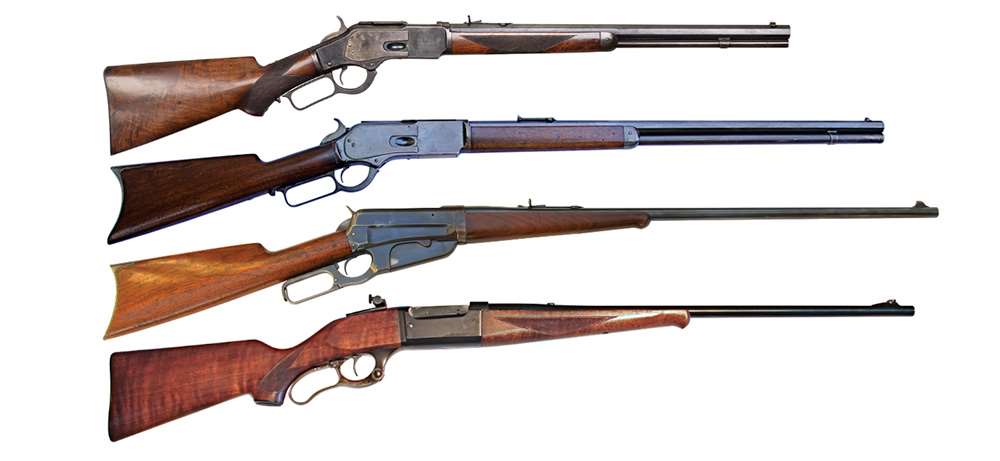
Top to Bottom: Winchester Model 1873, Winchester Model 1876, Winchester Model 1895 and Savage Model 99. Together, these four rifles remain some of the most prominent lever-action designs ever made. The ‘73 Winchester gained fame as the “Gun That Won The West,” a marketing slogan coined in the early 20th century by the company, long after the frontier had closed. Winchester’s later designs, the 1876 and 1895, introduced their own innovations, namely a stronger, more capable action in the 1876 and the box magazine in the 1895. Savage’s Model 99 also had its own unique magazine design, a rotary arrangement that allowed the rifle to be chambered for a number of modern cartridges with spitzer-style bullets. Photos: Rick Hacker
The Model 1866 was soon overshadowed by the Winchester 1873 and a cartridge that was literally made for it: the .44-40 Win. centerfire. The .44-40’s bottlenecked brass case could be reloaded; moreover, with 40 grains of powder, its 200-grain bullet got boosted to 1,340 fps and proved itself a potent mid-range round. Although the Winchester ’73 still used the same toggle-link action as the Henry and Model 1866, the receiver was now made of iron (changed to steel in 1884) and featured removable sideplates, as well as a protective sliding dustcover. Four different models were offered: a 24-inch-barreled sporting rifle, a pistol-gripped, checkered-walnut sporting rifle, a 20-inch-barreled saddle-ring carbine and a full-stocked 30-inch barreled military musket, a number of which were purchased by various foreign governments, though not by the U.S.
Like the Henry, the Winchester ‘73 got off to a slow start; it wasn’t cataloged or even advertised until 1875, no doubt due to the same production problems suffered by the Henry. However, once the ’73 made its way West, its fame spread quickly. Sales were enhanced further when Winchester introduced a .38-40 Win. chambering for the ’73 in 1880 and added a .32-20 Win. chambering in 1882, further increasing its pairing options with the Colt Single Action Army and other revolvers of the period, capitalizing on the rifle-revolver compatibility trend started by the Winchester ’66. And, in 1884, the Winchester ’73 became the first .22-caliber repeating rifle in America chambered for .22 Short and .22 Long rimfire ammunition.
Despite its widespread popularity, the Winchester 1873’s action was too short to digest the longer, stronger big-game cartridges of the day. One quick fix to this dilemma was achieved by noticeably beefing up the 1873—literally lock, stock and barrel. The new rifle, dubbed the Winchester Model 1876, was officially unveiled at the 1876 Philadelphia Centennial Exhibition, where it became known as “The Centennial Rifle.”
Available as a sporting rifle, half-magazine express rifle and a full-stocked carbine and musket, Winchester’s big-game rifle was enthusiastically accepted by America’s hunters, even though its action still wasn’t long enough to cycle the popular and much-in-demand .45-70 Gov’t cartridge. Instead, Winchester came out with a .45-75 round that, thanks to a squat, 350-grain bullet, packed a bit more punch due to a slightly larger powder charge. Later chamberings were .45-60, .50-95 Express and .40-60.

Top to bottom: Smith & Wesson Model 1854, Marlin Model 1895 Dark, Fightlite Industries Herring Model 2024 and POF-USA Tombstone. Together, these four rifles are indicative of the modern trend of lever-action rifles, showcasing how this quintessentially American action still has a place in the modern shooting world. Recent developments have focused on incorporating user-friendly features, like M-Lok accessory attachment points and Picatinny rails for mounting optics, but another major trend has been the incorporation of detachable box magazines that increase the capacity of lever-action designs that have long been limited by the length of their under-barrel tubular magazine. Photos: Rick Hacker
In 1881, much to Winchester’s chagrin, Marlin introduced its first lever-action, the Marlin Repeating Rifle (it was not listed as the Model 1881 until the appearance of Marlin’s second lever-action in 1888), which was not only chambered for the company’s proprietary .40-60 Marlin but also for the .45-70 Gov’t, with other chamberings soon to follow. A sliding loading gate, elongated lever profile and scalloped steel fore-end cap helped distinguish the Marlin 1881 from the Winchester ’76. Plus, with Marlin’s Ballard rifling, accuracy was excellent. Unfortunately, it was also prone to jamming. Undeterred, and perhaps to goad Winchester, John Marlin entered his lever-action in the U.S. Army trials of 1881-1882, but a broken buttstock and a detonated cartridge in the magazine tube quashed hopes for any government contract.
Realizing he was being challenged by his New Haven neighbor, Winchester enlisted the genius of John Moses Browning for his next lever-action, a design that weaned Winchester from the toggle-link with a sliding, twin-bolt locking system that became the Winchester 1886, a sturdy, smooth-operating, big-bore lever-action that eventually was chambered for everything from .33 WCF to .50-110 Express—including, of course, the .45-70 Gov’t.
Meanwhile, Marlin went on to perfect its lever-actions with the smaller-framed Model 1888, which was immediately replaced by the company’s first side-ejecting lever-action, the Model 1889, both chambered for the same three calibers as Winchester’s 1873.
Although the Winchester ’73 in .22 rimfire was not a big seller, Marlin introduced its Models 1891 and 1892 in .22- and .32 rimfire calibers, respectively, then went on to greater success with its .22 rimfire Model 1897. But it was the big-bore Marlin Models of 1893 and 1895 that attracted America’s hunters. However, few lever-actions could match the small-to-medium game popularity of the Winchester 1892, which was basically a scaled-down Model 1886, though the Marlin 1894 gave it some competition, as both guns were chambered in .25-20 Win., .32-20 Win., .38-40 Win. and .44-40 Win.
The now-legendary Winchester Model 1894 officially became the first lever-action rifle specifically created for smokeless powder, although its .30-30 Win. and .25-35 Win. chamberings were delayed a year due to problems with the new nickel-steel barrels, so, ironically, the first two calibers were the older .32-40 and .38-55 black-powder cartridges. John Browning’s subsequent lever-action, the Winchester 1895, dramatically departed from the tubular magazine concept with its internal box magazine, which made it adaptable to spitzer as well as round-nosed bullets.

The modern Henry Repeating Arms, inspired by the innovative legacy of Benjamin Tyler Henry, continues to innovate on the lever-action concept, and the company’s Lever Action Supreme Rifle (LASR) is one of its most recent developments. Concessions to modernity include a threaded muzzle and the ability to use STANAG magazines.
Also, in 1895, Arthur Savage revolutionized the lever-action world with a hammerless lever-action that featured a unique five-shot rotary magazine specifically designed for spitzer bullets. This was followed four years later with an updated Model 99, which remained in the company’s product line for nearly 100 years.
Many of the original Winchester and Marlin lever-actions proved readily adaptable to the 20th and 21st centuries with a few mechanical upgrades and occasionally revised model designations. Except for the Savage 99, all remain available today, either as updated versions, reissues by the original companies or as replicas from importers such as Cimarron Firearms.
Even the 1860 Henry is once again being made in America by the similarly named Henry Repeating Arms, albeit in the more shootable .44-40 Win. and .45 Colt chamberings. However, the current Henry Repeating Arms company has no relationship to the original, and its founder and CEO, Anthony Imperato, has taken today’s Henry rifle well into the 21st century, most recently with the company’s Lever Action Supreme Rifle (LASR), which is chambered in 5.56 NATO and boasts a detachable AR-15-style magazine.
Likewise, Ruger, having re-introduced the classic Marlin 336 rifle two years ago, has since dramatically updated versions of that venerable lever-action with its SBL Series, which features, among other modernizations, stainless-steel furniture, Picatinny rails and ghost-ring-style sights, while Marlin’s Dark Series models look like they might be more at home in a “Star Wars” sequel, with their skeletonized buttstocks, full-length aluminum handguards and, of course, the combination of Graphite Black Cerakote and nitride finishes that give the design its name.
Even Smith & Wesson, up until recently known for handguns, has brought its historic past into today’s world with the company’s Model 1854 series of lever-actions, which feature M-Lok-compatible synthetic stocks, removable magazine tubes for convenient reloading and chamberings ranging from .30-30 Win. to 360 Buckhammer. Other manufacturers, including Chiappa with its 86 Wildlands lever-action and Rossi with its R95 45-70 Triple Black, continue to prove the versatility of the fast-firing, multi-shot, lever-action rifle.
Indeed, the lever-action, whether in its 19th-century guise or in its updated 21st-century versions, lives on today as testimony to the ingenuity of our great nation.
Read the full article here